Last updated: June 2026 · Features and pricing verified from live Shopify App Store listings on June 24, 2026.
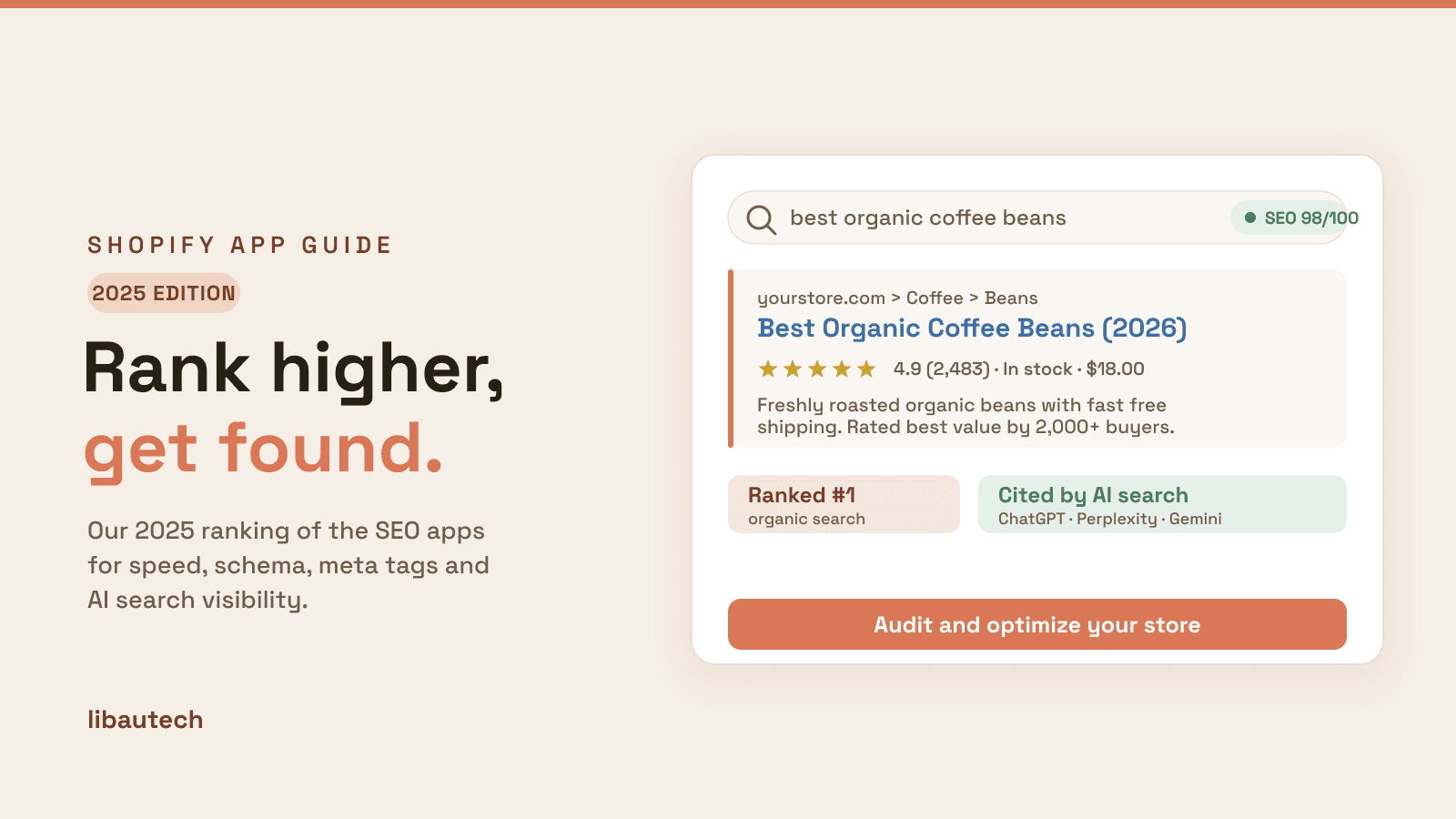
Most Shopify SEO roundups list 15 apps that all claim to do everything — audits, schema, speed, meta tags, keyword research — and rank them by star rating. That framing hides the real decision. SEO apps actually solve four distinct jobs, and the best app for your store depends on which ones matter most for your catalog and your traffic.
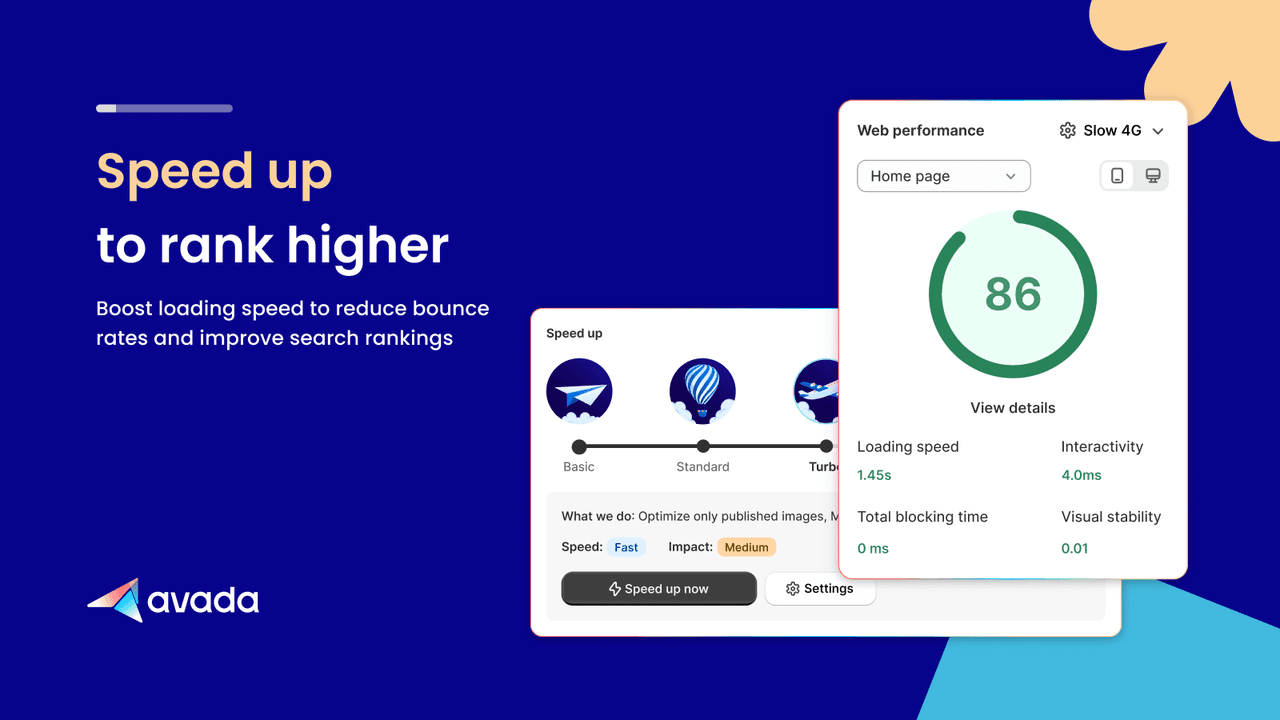
The first job is page speed and image optimization. Images are usually the single largest drag on Shopify page speed, and unoptimized images mean slower crawls and worse Core Web Vitals. Google's Core Web Vitals — LCP (Largest Contentful Paint), INP (Interaction to Next Paint), and CLS (Cumulative Layout Shift) — are a confirmed ranking factor, and on most product pages the LCP element is the hero product image. Lossless image compression, lazy loading, and JS/CSS minification are the highest-leverage technical fixes because they show measurable results in days rather than months.
The second job is structured data and JSON-LD schema. Structured data in 2026 is not optional — rich results (star ratings, price, availability) lift click-through rates in both traditional and AI-powered search. Search engines no longer just match keywords, they understand entities and the relationships between products, brands, and categories. Robust JSON-LD is what lets ChatGPT, Claude, Perplexity, and Google's AI Overviews cite your products with confidence, which is why an LLMs.txt file has joined schema as a baseline AI-search requirement.
The third job is technical auditing. A good audit app crawls your store, surfaces broken internal and external links, flags missing meta tags and alt text, detects duplicate content, and manages 404 pages and 301 redirects so you do not leak link equity. Shopify's default architecture creates specific challenges — duplicate content from multiple product URLs, limited URL control, and app script bloat — so a recurring audit that prioritizes fixes by impact is worth more than a raw list of every error.
The fourth job is meta tag automation. Shopify lets you edit meta titles and descriptions one page at a time. That is fine for 50 products and painful for 500. Bulk metadata editing and AI-assisted title and description generation are where a $14/month app pays for itself in the first day once a catalog crosses a few hundred SKUs, and multilingual stores need schema and meta that translate per locale, which Shopify does not provide natively.
This post ranks 6 options across five jobs with verified June 2026 features and pricing, and explains which app profile fits which store.
SEO stacks with the rest of your growth tooling. See our guides on best Shopify shipping apps for the fulfillment layer, best Shopify digital product apps for digital catalogs, and best Shopify dropshipping apps for the dropshipping tool stack.
| App | Rating | Free Plan | Paid From | Best For |
|---|---|---|---|---|
| Tiny SEO Speed Image Optimizer | ⭐ 5.0 | Yes (50 images/mo) | $14/mo | Speed, schema and meta automation in one app |
| Avada AI SEO Image Optimizer | ⭐ 4.8 | Yes | Free + paid tiers | Hands-off AI audit agent and one-click fixes |
| Sherpas: Smart SEO | ⭐ 4.9 | Yes | $14.99/mo | JSON-LD schema and multi-language SEO |
| Tapita SEO & Speed Optimizer | ⭐ 5.0 | Yes (generous) | $12.99/mo | Budget and multilingual stores |
| Plug In SEO | ⭐ 4.6 | 14-day trial | $29.99/mo | Deep page audits and reporting |
| Shoptank | New | No (7-day trial) | $14.99/mo | AI search visibility on ChatGPT, Claude and Perplexity |
Best for: Shopify stores that want the most complete technical SEO foundation — image compression, JSON-LD schema, broken link fixing, meta automation, and LLMs.txt — in a single app, especially image-heavy catalogs in fashion, jewelry, furniture, and print-on-demand.
Tiny SEO Speed Image Optimizer (listed under TinyIMG) is the app most agencies reach for first, and it earns the top spot by covering all four SEO jobs without forcing you to stack multiple tools. It holds a 5.0-star rating on the App Store and carries the Built for Shopify badge for meeting Shopify's highest performance and integration standards.
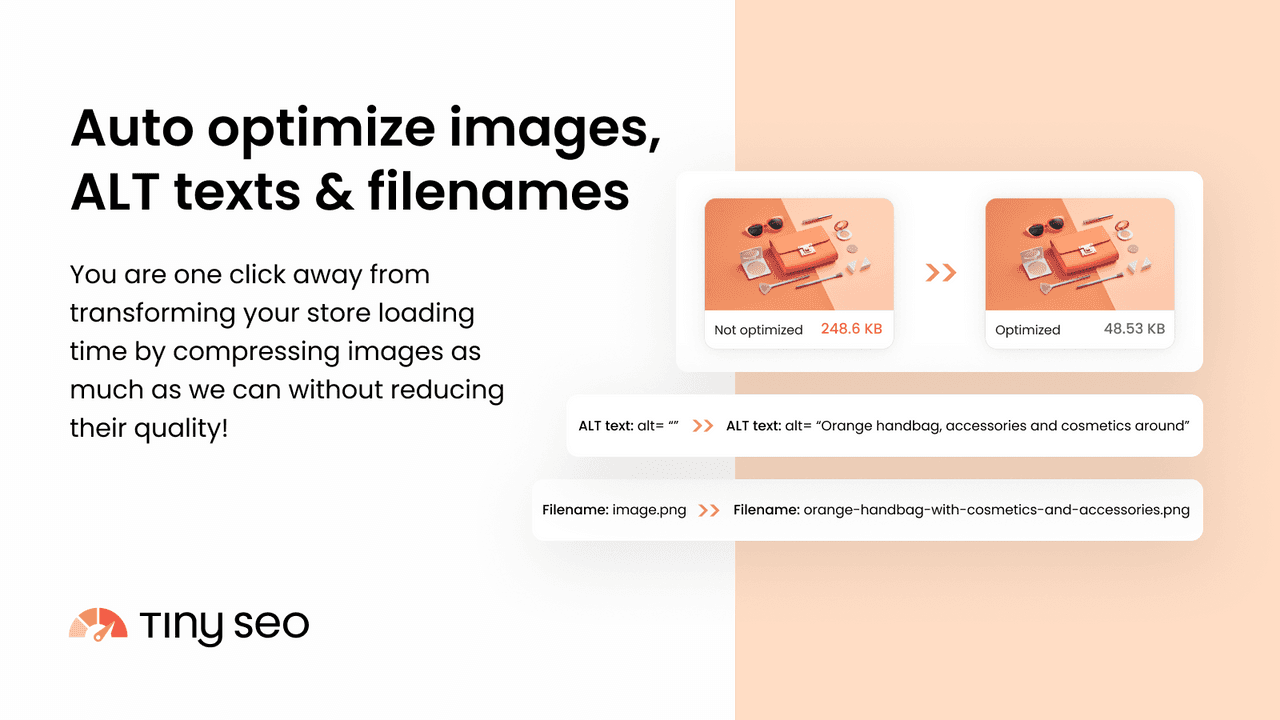
The image and speed engine is the core strength: every image runs through lossless compression that reduces file size by 30 to 70 percent without visible quality loss, and Core Web Vitals scores typically improve within days. Lazy loading, asset preloading, and JS/CSS minification round out the speed toolkit, and the LCP win on product pages comes directly from optimizing the hero product image.
Beyond speed, the feature set is genuinely broad: JSON-LD structured data set up without technical knowledge, LLMs.txt generation for AI search visibility, IndexNow integration for instant Bing indexing, bulk metadata and ALT text editing, AI meta generators for product titles and descriptions, broken link detection with 404 and 301 redirect management, an HTML sitemap, and a smart site audit with detailed SEO manager reports. The app is localized across many languages including English, French, Spanish, German, Italian, Chinese, Japanese, and others — useful for international catalogs.
Where it falls short: the free plan caps at 50 image optimizations per month, so high-volume or frequently-changing catalogs (dropshipping, POD) will need a paid tier or pay-as-you-go credits. As with any schema-generating app, running Tiny SEO alongside a second SEO app that also outputs JSON-LD can create duplicate structured data — pick one schema source and disable it elsewhere. For most stores wanting speed, schema, and meta automation under one roof, those are minor tradeoffs.
Pricing: Free plan (50 image optimizations/month). Paid plans from around $14/mo, scaling by image-optimization volume.
Best for: solo operators and non-technical merchants who want an AI audit agent to scan every page and apply fixes in one click, without learning SEO terminology.
Avada takes an automation-first approach built around an AI SEO Audit Agent that scans every page for issues — from meta tags to slow images — and applies AI-powered fixes in one click. The on-page optimizer handles speed (lazy loading, minification) and technical SEO (structured data, sitemaps, redirects), while a built-in SEO checklist walks you through each step and now explicitly targets answer engine optimization (AEO) alongside traditional Google ranking.
Merchants consistently praise the app for making SEO accessible to non-experts, the user-friendly interface, and responsive 24/7 support. The feature set covers broken link detection, 404 pages, sitemaps, Google structured data, bulk optimization across hundreds of products, and image compression that improves load speed without losing quality. It is localized across English, Danish, German, French, Dutch, Portuguese (Brazil), Swedish, Vietnamese, Chinese (Simplified), and Spanish.
Where it falls short: the one-click-fix model is convenient but gives you less granular control than a manual tool, so power users optimizing for specific keyword and schema strategies may find it limiting. As an all-in-one it overlaps heavily with Tiny SEO, so run one or the other rather than both.
Pricing: Free plan available. Paid tiers billed in USD every 30 days; see the listing for current options.
Best for: stores prioritizing JSON-LD structured data, rich snippets, and automated multi-language SEO across global markets.
Sherpas: Smart SEO is the schema specialist of this list. It specializes in JSON-LD implementation, letting you manage schema markup without touching a line of code, and its audit tool is built specifically to identify missing schema opportunities that lead to rich snippets in search results. That focus matters in 2026, where AI search leans heavily on structured data to understand a product catalog.
On top of schema, Smart SEO handles AI-driven bulk metadata generation and automated multi-language SEO — essential for global Shopify brands that need titles, descriptions, and schema that translate per locale. It also covers the technical basics: broken link detection and fixing, image ALT text, and sitemap management.
Where it falls short: it is less of a dedicated speed-and-image powerhouse than Tiny SEO, so image-heavy stores chasing Core Web Vitals may still want a compression-focused tool alongside it. The deepest value here is structured data and translation, not raw page-speed engineering.
Pricing: Free plan available, plus a 7-day free trial on paid plans starting from $14.99/mo.
Best for: budget-conscious and multilingual stores that want broad technical coverage and a genuinely generous free plan.
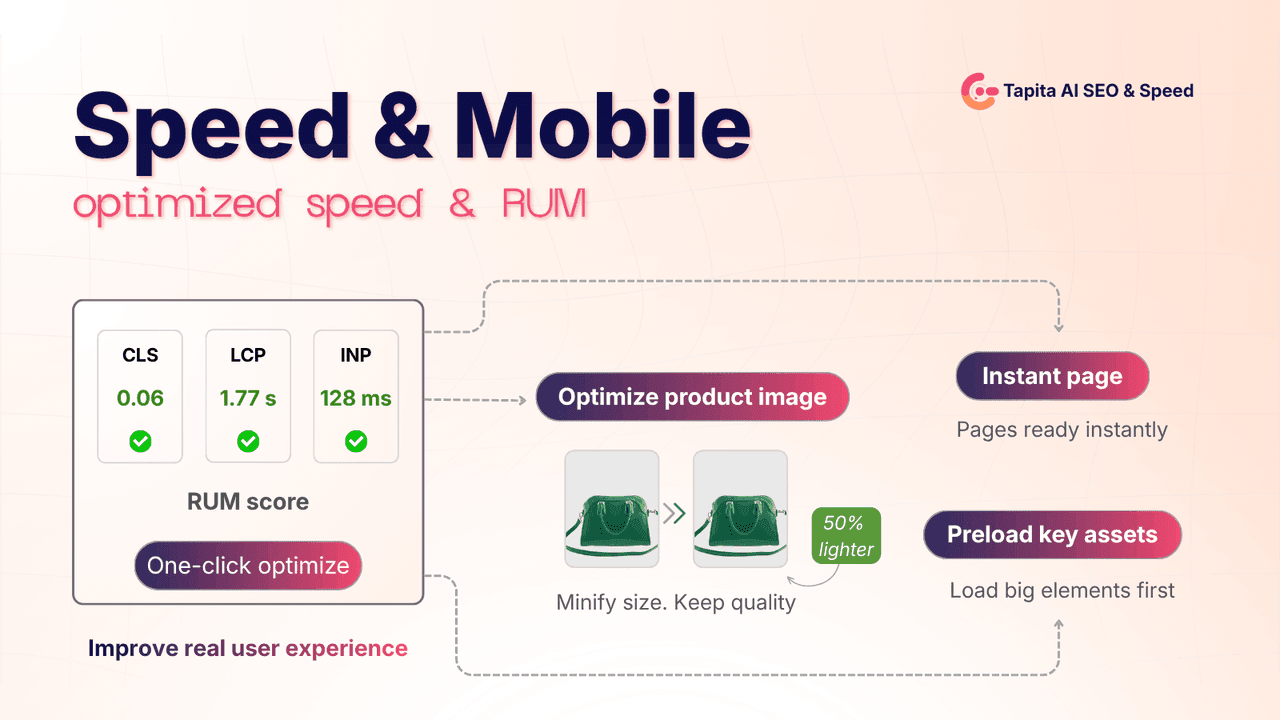
Tapita delivers strong SEO fundamentals at a competitive price point, with a standout feature: multi-language meta tag support that lets you optimize titles and descriptions separately for each language version of your store. The app also includes full-stack SEO audits with a page-by-page breakdown, one-click speed optimization with image compression and lazy loading, JSON-LD structured data, broken link fixing, keyword research, and LLMs.txt generation for AI search visibility.
The free plan is unusually generous, with high quotas such as 30 image compressions per day, and a content optimization tool lets you update each page's content separately based on the app's suggestions. Google Search Console integration, sitemap management, and page indexing controls round out a feature set that punches well above its price.
Where it falls short: the interface is broad and feature-dense, which can feel busy for first-time users, and the per-language optimization workflow rewards stores that actually run multiple locales — single-language stores will not use its strongest differentiator.
Pricing: Free plan (generous quotas). Paid plans from $12.99/mo up to $64.99/mo.
Best for: stores that want to know whether they actually show up when shoppers ask ChatGPT, Claude or Perplexity for product recommendations, and want a plan to get cited in the sources those models trust.
Disclosure: Shoptank is built by Libautech, the publisher of this blog. We have placed it in its own category rather than ranking it against the image and meta tools above, because it does a different job. Traditional SEO apps optimize how Google reads your store. Shoptank optimizes whether AI models recommend it.
The shift behind this is real. A growing share of product research now happens inside AI assistants rather than a search box, and those assistants do not rank your product page the way Google does. They synthesize an answer from sources they trust, such as Reddit threads, editorial blog posts, YouTube videos and review sites, then name specific stores. If your brand is not in those sources, you are invisible to the model no matter how clean your schema is.
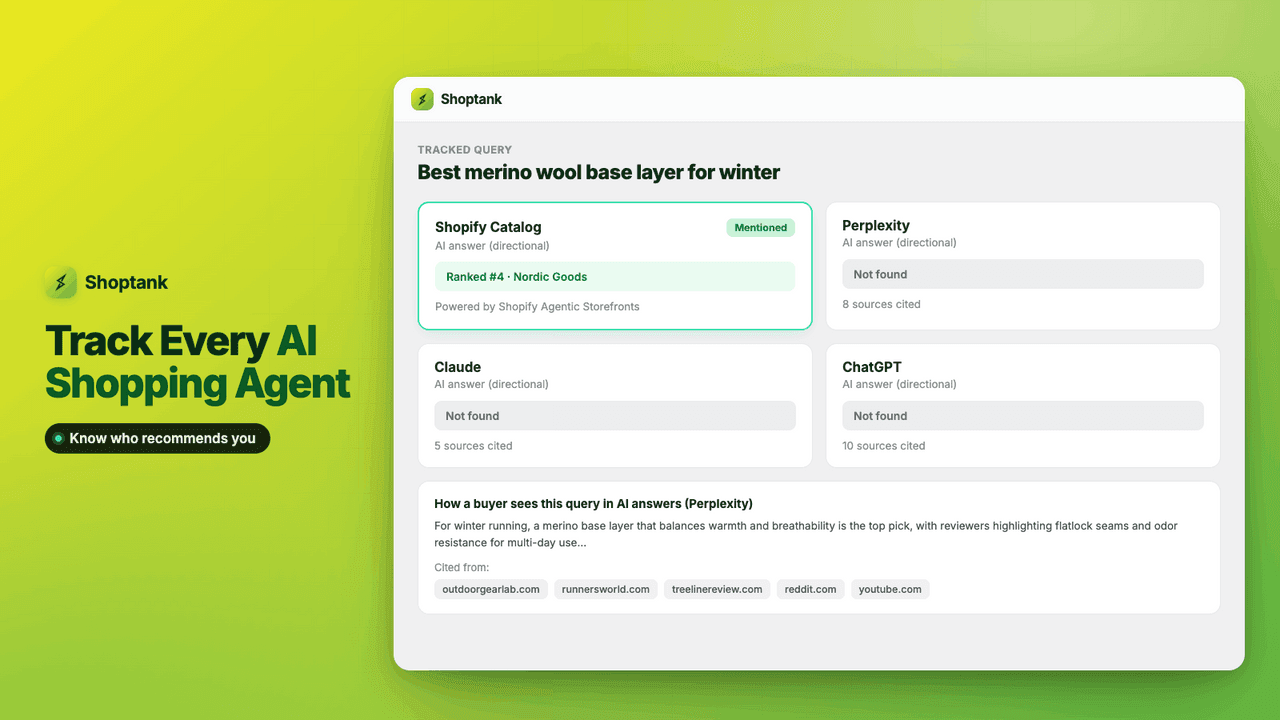
Shoptank tracks this directly. You enter the buyer-intent queries your customers would actually type, for example best collagen for runners or eco friendly yoga mat, and it runs them through ChatGPT, Claude, Perplexity and the Shopify Catalog, then reports whether you appear, at what position, and which sources drove the recommendation. From there it surfaces the specific Reddit threads, blog posts and videos you can act on to get cited, and tracks your position over time as those sources change.
Where it fits in your stack: Shoptank is not a replacement for a technical SEO app. You still need fast pages, clean schema and an LLMs.txt file, and a tool like Tiny SEO handles that. Shoptank sits on top of that foundation and answers the question those tools cannot: am I actually being recommended, and if not, where do I need to show up.
Where it falls short: it is a new app, so it has a shorter track record than the established tools on this list, and there is no free plan, only a 7-day trial. It is also the right tool only if AI search visibility is a priority for you. A store that has not yet covered the technical SEO basics should start there first.
Pricing: No free plan. 7-day free trial. Paid plans from $14.99/mo. View Shoptank on the Shopify App Store.
Best for: small-to-large stores that want deep page audits, keyword research with search volume data, and clear reporting to justify SEO spend to stakeholders.
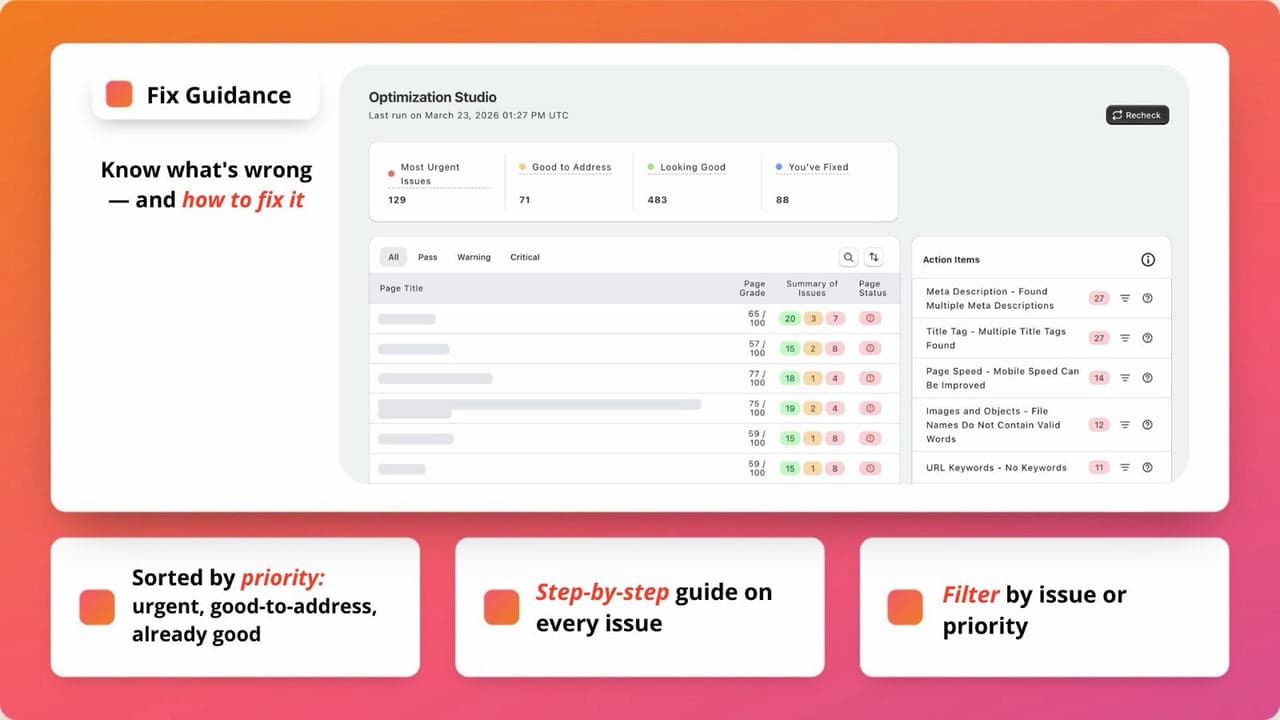
Plug In SEO is the long-established auditing and reporting tool on this list. It offers an SEO scanner that audits your site, broken link fixing, metadata editing, and lets you edit schema markup settings without coding. Its keyword studio surfaces keyword suggestions alongside search volume and competitiveness, and its detailed help center and guides make it a genuinely useful education for merchants newer to SEO best practices.
The reporting angle is where Plug In SEO differentiates: it is built to produce the kind of prioritized, plain-language reports that justify SEO work to a manager or client rather than just dumping a list of errors.
Where it falls short: there is no free plan, only a 14-day trial, and paid plans start at $29.99/mo — the highest entry point on this list — with deep keyword research limited to 20 pages on the entry tier. For stores that mainly need speed and schema, an all-in-one like Tiny SEO covers more ground for less.
Pricing: No free plan. 14-day free trial. Paid plans from $29.99/mo.
For the most complete technical SEO foundation in one app: Tiny SEO Speed Image Optimizer. Image compression, JSON-LD schema, LLMs.txt, broken link fixing, and meta automation with a 5.0 rating and Built for Shopify badge — the default pick for most stores in 2026.
For hands-off automation with an AI audit agent: Avada AI SEO Image Optimizer. One-click fixes, free plan, AEO-ready checklist — ideal for non-technical solo operators.
For structured data and multi-language schema: Sherpas: Smart SEO. JSON-LD without code, missing-schema audit, automated translation SEO for global brands.
For budget and multilingual coverage: Tapita SEO & Speed Optimizer. Per-language meta tags, generous free plan, full-stack audit and LLMs.txt from $12.99/mo.
For AI search visibility: Shoptank. Tracks whether ChatGPT, Claude and Perplexity recommend your store on real buyer-intent queries, and shows you the exact sources to get cited in.
For deep auditing and reporting: Plug In SEO. Detailed page audits, keyword research with search volume, and stakeholder-ready reports.
For most Shopify stores doing $10K-100K/month in revenue, the honest recommendation is singular: Tiny SEO Speed Image Optimizer. It covers all four SEO jobs in one subscription, improves Core Web Vitals within days, and avoids the duplicate-schema and conflicting-meta-tag problems that come from stacking multiple narrow apps. Add a second tool only when you have a specific need its scope does not reach — deep stakeholder reporting (Plug In SEO) or heavy per-locale schema and translation (Sherpas).
This ranking is based on four criteria applied to every Shopify SEO app tested in 2026. First, how well the app covers the four core jobs — page speed and image optimization, structured data and JSON-LD, technical auditing, and meta tag automation — rather than a generic feature checklist. Second, Shopify App Store rating, Built for Shopify status, and merchant-review themes as signals of long-term satisfaction at scale. Third, AI-search readiness, specifically LLMs.txt support and schema that AI engines can cite, which is now a 2026 baseline rather than a nice-to-have. Fourth, pricing structure and total cost at realistic merchant volumes, since a $14/mo entry tier with image-credit overages behaves very differently from a flat $29.99/mo plan.
Every feature and pricing figure in this post was verified directly from the live Shopify App Store listings on June 24, 2026. App pricing and features change frequently — always confirm current details on the official listing before installing. Most stores need only two or three SEO apps; installing five or more overlapping tools injects conflicting code, duplicates schema markup, and can slow your site down worse than having no apps at all.
A Shopify SEO app automates the technical and on-page optimization work that Shopify's admin does not handle natively. Core capabilities include image compression and page-speed optimization for Core Web Vitals, JSON-LD structured data for rich snippets and AI search, technical audits that surface broken links and crawl issues, 404 and 301 redirect management, and bulk meta title and description editing across the catalog. Shopify covers the basics — sitemaps, clean URLs, single-page meta editing — and SEO apps fill the gaps above that floor.
Tiny SEO Speed Image Optimizer (by TinyIMG) leads for most stores because it covers all four SEO jobs — speed, schema, auditing, and meta automation — in one app with a 5.0 rating and Built for Shopify badge. Avada AI SEO is the best hands-off automation pick, Sherpas: Smart SEO leads on structured data and multi-language schema, Tapita is the best value for budget and multilingual stores, and Plug In SEO leads on deep auditing and reporting. Each solves a slightly different sub-job within the category.
Yes, when used correctly and with realistic expectations. SEO apps fix technical issues like broken links, slow page speed, and missing meta tags, optimize the content Google reads through proper alt text, and add structured data for rich snippets that increase click-through rates. What they do not do is replace quality products, build backlinks automatically, or guarantee first-page rankings. Technical fixes such as image compression and schema can improve Core Web Vitals within days, but organic ranking improvements typically take three to six months as Google re-crawls and reassesses your pages.
Most Shopify stores need only two or three SEO apps, not ten. The most common mistake is installing five or more overlapping apps that inject conflicting code, duplicate your JSON-LD schema, and slow your site down worse than having no apps at all. A practical 2026 stack is one all-in-one app for speed, schema, and meta automation, optionally paired with a specialist tool for deep reporting or heavy per-locale schema. Start with one, run the first audit, fix the top issues, and add a second app only when you hit a specific need the first does not cover.
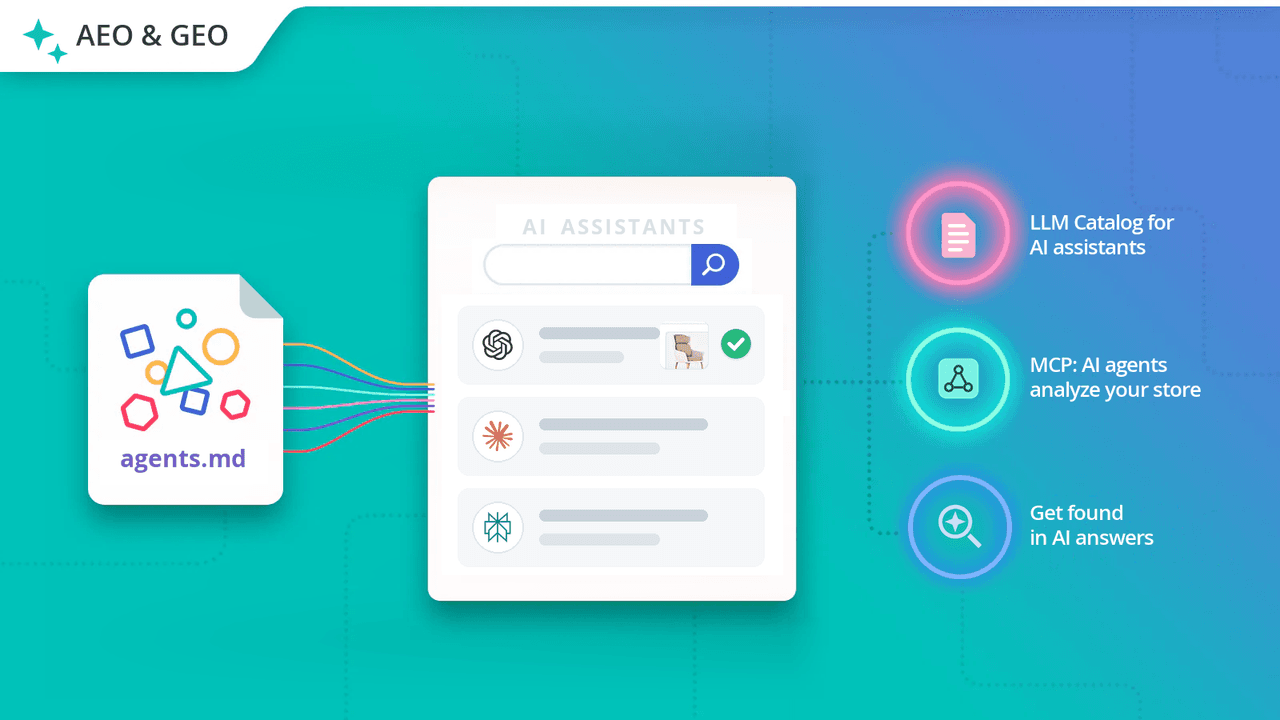
LLMs.txt is a file that describes how AI systems should read and interpret your site, analogous to robots.txt for search crawlers. In 2026 it has become part of the baseline for AI search visibility — brands cited in ChatGPT, Claude, Perplexity, and Google's AI Overviews tend to have clean structured data, well-written product copy, and an LLMs.txt file. Several apps on this list (Tiny SEO, Tapita) generate it automatically. It is not a magic ranking lever, but for stores that get meaningful product-research traffic from AI answers, it is worth having.
Generating an LLMs.txt file and clean schema improves your chances, but it does not tell you whether AI models actually recommend you. To measure that, you need a tool that runs real buyer-intent queries through the models and reports back. Shoptank does this: you enter the questions your customers would ask ChatGPT, Claude or Perplexity, and it shows whether you appear, at what position, and which sources drove the recommendation, so you know where to get cited. It pairs with a technical SEO app rather than replacing one.
Yes. Google's Core Web Vitals — LCP (Largest Contentful Paint), INP (Interaction to Next Paint), and CLS (Cumulative Layout Shift) — are a confirmed ranking factor, and they directly affect where Shopify pages appear in search. On most product pages the LCP element is the hero product image, which is why image optimization is the single highest-leverage speed fix. Image compression, lazy loading, and JS/CSS minification are the quickest wins because their effect on Core Web Vitals shows up in days, well before content and link-based ranking changes take hold.
A well-built SEO app should speed your store up, not slow it down — image compression, lazy loading, and minification all reduce page weight. The risk comes from stacking multiple overlapping apps, each injecting its own scripts and schema. That is where stores end up slower than they started. Apps with the Built for Shopify badge, including Tiny SEO and Avada, are reviewed against Shopify's performance standards. The practical rule is to run one speed-and-schema app rather than several, and to remove any SEO app you are no longer actively using.
Yes, but they are basic. Shopify generates sitemaps automatically, provides clean URLs and canonical tags, lets you edit meta titles and descriptions one page at a time, and offers Shopify Magic for AI content generation. That is the starting line, not the finish. Shopify does not provide technical auditing, schema markup at catalog scale, image compression, rank tracking, broken link detection, or LLMs.txt — which is exactly the gap dedicated SEO apps fill.
We update these lists as new tools launch and existing ones improve. If you are a developer building a Shopify SEO app and want your app considered for inclusion, submit it here — tell us what your app does, who it is for, and include a link to your Shopify App Store listing. We review every submission.
{"@context":"https://schema.org","@type":"FAQPage","mainEntity":[{"@type":"Question","name":"What is a Shopify SEO app?","acceptedAnswer":{"@type":"Answer","text":"A Shopify SEO app automates the technical and on-page optimization work Shopify's admin does not handle natively, including image compression and page-speed optimization for Core Web Vitals, JSON-LD structured data for rich snippets and AI search, technical audits that surface broken links and crawl issues, redirect management, and bulk meta title and description editing across the catalog."}},{"@type":"Question","name":"What is the best Shopify SEO app in 2026?","acceptedAnswer":{"@type":"Answer","text":"Tiny SEO Speed Image Optimizer (by TinyIMG) leads for most stores because it covers speed, schema, auditing, and meta automation in one app with a 5.0 rating and Built for Shopify badge. Avada AI SEO is the best hands-off automation pick, Sherpas Smart SEO leads on structured data and multi-language schema, Tapita is best value for budget and multilingual stores, and Plug In SEO leads on deep auditing and reporting."}},{"@type":"Question","name":"Do Shopify SEO apps actually improve rankings?","acceptedAnswer":{"@type":"Answer","text":"Yes when used correctly with realistic expectations. SEO apps fix technical issues like broken links, slow page speed, and missing meta tags, optimize content Google reads, and add structured data for rich snippets. Technical fixes can improve Core Web Vitals within days, but organic ranking improvements typically take three to six months as Google re-crawls pages."}},{"@type":"Question","name":"How many SEO apps should I install?","acceptedAnswer":{"@type":"Answer","text":"Most stores need only two or three SEO apps, not ten. Installing five or more overlapping apps injects conflicting code, duplicates JSON-LD schema, and can slow your site down worse than no apps at all. A practical stack is one all-in-one app for speed, schema, and meta automation, optionally paired with a specialist tool for reporting or per-locale schema."}},{"@type":"Question","name":"What is LLMs.txt and do I need it for Shopify SEO?","acceptedAnswer":{"@type":"Answer","text":"LLMs.txt is a file that describes how AI systems should read your site, analogous to robots.txt. In 2026 it is part of the baseline for AI search visibility - brands cited in ChatGPT, Claude, Perplexity, and Google AI Overviews tend to have clean structured data and an LLMs.txt file. Apps like Tiny SEO and Tapita generate it automatically."}},{"@type":"Question","name":"How do I know if my store shows up in ChatGPT or Claude answers?","acceptedAnswer":{"@type":"Answer","text":"Clean schema and an LLMs.txt file improve your chances but do not tell you whether AI models actually recommend you. A tool like Shoptank runs real buyer-intent queries through ChatGPT, Claude, Perplexity, and the Shopify Catalog and reports whether you appear, at what position, and which sources drove the recommendation, so you know where to get cited. It pairs with a technical SEO app rather than replacing one."}},{"@type":"Question","name":"Are page speed and Core Web Vitals really ranking factors?","acceptedAnswer":{"@type":"Answer","text":"Yes. Google's Core Web Vitals - LCP, INP, and CLS - are a confirmed ranking factor that directly affects where Shopify pages appear in search. On most product pages the LCP element is the hero product image, which is why image optimization is the highest-leverage speed fix. Compression, lazy loading, and minification show up in Core Web Vitals within days."}},{"@type":"Question","name":"Will an SEO app slow down my Shopify store?","acceptedAnswer":{"@type":"Answer","text":"A well-built SEO app should speed your store up through compression, lazy loading, and minification. The risk comes from stacking multiple overlapping apps each injecting scripts and schema. Built for Shopify apps including Tiny SEO and Avada are reviewed against performance standards. Run one speed-and-schema app rather than several."}},{"@type":"Question","name":"Does Shopify have built-in SEO features?","acceptedAnswer":{"@type":"Answer","text":"Yes but they are basic. Shopify generates sitemaps, provides clean URLs and canonical tags, lets you edit meta titles and descriptions one page at a time, and offers Shopify Magic for content. It does not provide technical auditing, schema at catalog scale, image compression, rank tracking, broken link detection, or LLMs.txt - the gap dedicated SEO apps fill."}}]}{"@context":"https://schema.org","@type":"Article","headline":"Best Shopify SEO Apps (2026) - Technical Auditing, Structured Data, Page Speed and Meta Tag Automation Ranked","description":"The 6 best Shopify SEO apps in 2026 across five jobs - page speed and image optimization, structured data and JSON-LD schema, technical auditing, meta tag automation, and AI search visibility. Compare Tiny SEO Speed Image Optimizer, Avada AI SEO, Sherpas Smart SEO, Tapita, Plug In SEO, and Shoptank with verified June 2026 features and pricing.","author":{"@type":"Organization","name":"Libautech","url":"https://libautech.com"},"publisher":{"@type":"Organization","name":"Libautech","url":"https://libautech.com","logo":{"@type":"ImageObject","url":"https://libautech.com/images/logo.png"}},"datePublished":"2026-06-24","dateModified":"2026-06-24","mainEntityOfPage":{"@type":"WebPage","@id":"https://libautech.com/best-shopify-apps/best-shopify-seo-apps-technical-audit-structured-data-page-speed"}}