
Best Shopify Product Recommendation Apps (2026)
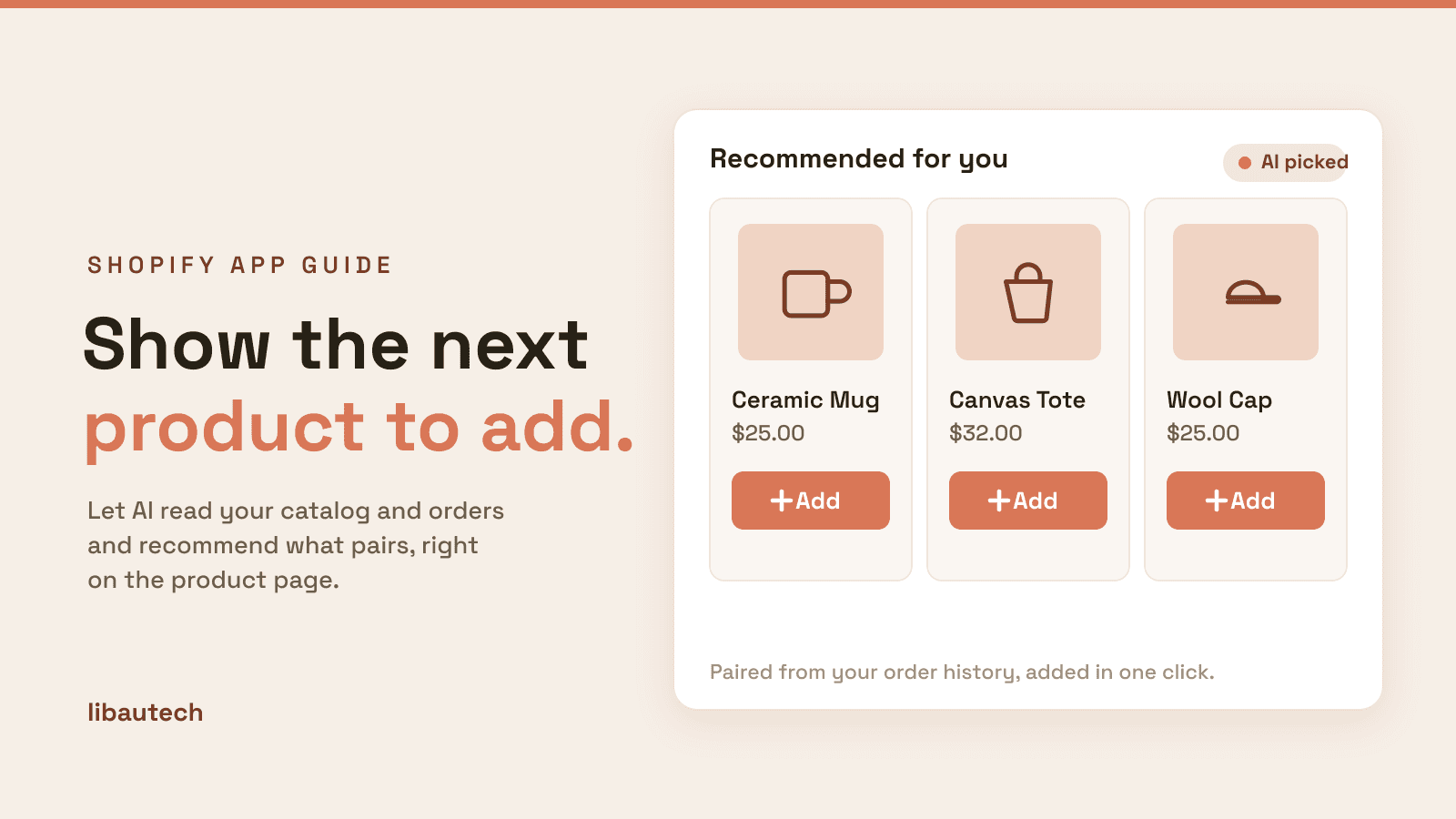
The best app to add product recommendations on Shopify product pages in 2026 is Libautech Bundles & Upsell, our own app, because it does the one thing the rest do not: full AI offer creation. Instead of only suggesting products, the AI reads your catalog and order history and builds finished, ready-to-launch offers, the pairing, the discount and the placement, which you approve or edit before they go live. Shopify Search & Discovery is the best free starting point, Rebuy the pick for Plus-scale stores that want a deep rules engine, Frequently Bought Together by Code Black Belt for a single focused FBT block, Wiser for recommendations that follow the shopper into email, and Upsell.com (formerly ReConvert) for stores building around post-purchase too.
Key takeaways
- Recommending a product is half the job; the other half is packaging it into an offer with the right discount and placement. Apps that only recommend leave that half to you.
- We make Libautech Bundles & Upsell and rank it first, because it is the only app here where the AI delivers a finished, editable offer rather than a product suggestion, and it covers product page, cart and post-purchase in one app. Weigh that we have a commercial interest.
- The one number we are behind on is reviews: ours is the newest here at 35, while Upsell.com sits at a 4.8 across more than 2,700 and Frequently Bought Together at a 4.9 across 1,000-plus. We say so, and name the better fit for each job below.
- Watch the pricing model, not just the sticker. A revenue-share fee (0.5 to 0.75 percent of generated sales) looks small but compounds as the feature succeeds.
On this page
- What a product recommendation app actually does
- Who needs a recommendation app, and who does not
- How we ranked these, and a word on bias
- The 6 best product recommendation apps compared
- How to choose between them
- Where to place recommendations on the product page
- Common recommendation mistakes
- What your recommendations are worth
What a product recommendation app actually does
A product recommendation app shows shoppers additional products they are likely to want, based on the product they are viewing, what other customers bought together, or manual rules you define. On the product page this takes three main forms: a frequently bought together block with a combined add to cart, individual add-on checkboxes below the buy button, and a related products carousel.
The mechanism that matters is friction. A recommendation the shopper can accept with one click gets accepted. A recommendation that opens a new product page and restarts the decision mostly does not. Shopify's own product recommendations render complementary and related items natively, which is a fine place to start, but they do not package a pairing into a discounted, one-click offer.
In 2026 there is a second layer: offer creation. Recommending a product is half the job; the other half is packaging it into an offer with the right discount and placement. Apps that only recommend leave that half to you, and it is the half that takes the time.
Who needs a recommendation app, and who does not
A recommendation app earns its keep when you have complements to pair. If your catalog is single hero products with nothing to add, it is premature. Match yourself to a row before you install anything.
| Your store | Best first move | Why |
|---|---|---|
| Under 50 SKUs, still validating | Free manual pairing first | Prove recommendations move revenue before paying for automation. |
| Growing store, no offers yet | AI offer creation | Let the AI build the pairing, discount and placement so you launch in minutes. |
| Hundreds of SKUs, a team | A rules and personalization engine | Manual pairing is impractical; a rules engine ranks per shopper, if someone owns it. |
| Only want one widget | A single-purpose FBT block | If cart and post-purchase are handled elsewhere, a focused widget is simplest. |
How we ranked these, and a word on bias
The disclosure first. We make Libautech Bundles & Upsell, and we rank it first, so read this with that in mind. We rank it first because it is the only app on this list where the AI delivers a finished, editable offer rather than a product suggestion, and because one app covers product page, cart and post-purchase, so you are not stacking three recommendation apps that each inject their own scripts. On recommendation quality itself the specialists are strong, and where it is behind is public proof: ours is the newest app here at 35 reviews, while Upsell.com and Frequently Bought Together have thousands. We name the better fit for each job in the how to choose section, and our figures are read from the live App Store listing, same as everyone's.
The five criteria we score on: does it create the offer or only suggest products; does it work natively on the product page without slowing it; how deep is the personalization; what does it cost at real volume, including any revenue-share fee; and how much setup time it demands. Ratings and review counts are from the Shopify App Store as of August 2026.
The 6 best product recommendation apps compared
| App | Rating | Reviews | Price | Free plan | Best for |
|---|---|---|---|---|---|
| Libautech Bundles & Upsell | 4.9 | 35 | From $9.99/mo | 7-day trial | AI builds the offers, one app for the whole journey |
| Shopify Search & Discovery | 2.8 | 455 | Free | Yes | Zero-budget starting point |
| Rebuy | 4.7 | 741 | From $25/mo | Yes | Plus-scale rules engine with an owner |
| Frequently Bought Together | 4.9 | 1,030 | From $14.99/mo | Yes | One focused FBT block |
| Wiser | 4.9 | 513 | From $9/mo | Free to install | Recommendations plus email and retention |
| Upsell.com (ReConvert) | 4.8 | 2,782 | From $4.99/mo | Yes | Stores focused on post-purchase too |
Built for Shopify badge: Libautech, Frequently Bought Together and Upsell.com carry it; Rebuy and Wiser do not; Shopify Search & Discovery is first-party and not badged.
1. Libautech Bundles & Upsell
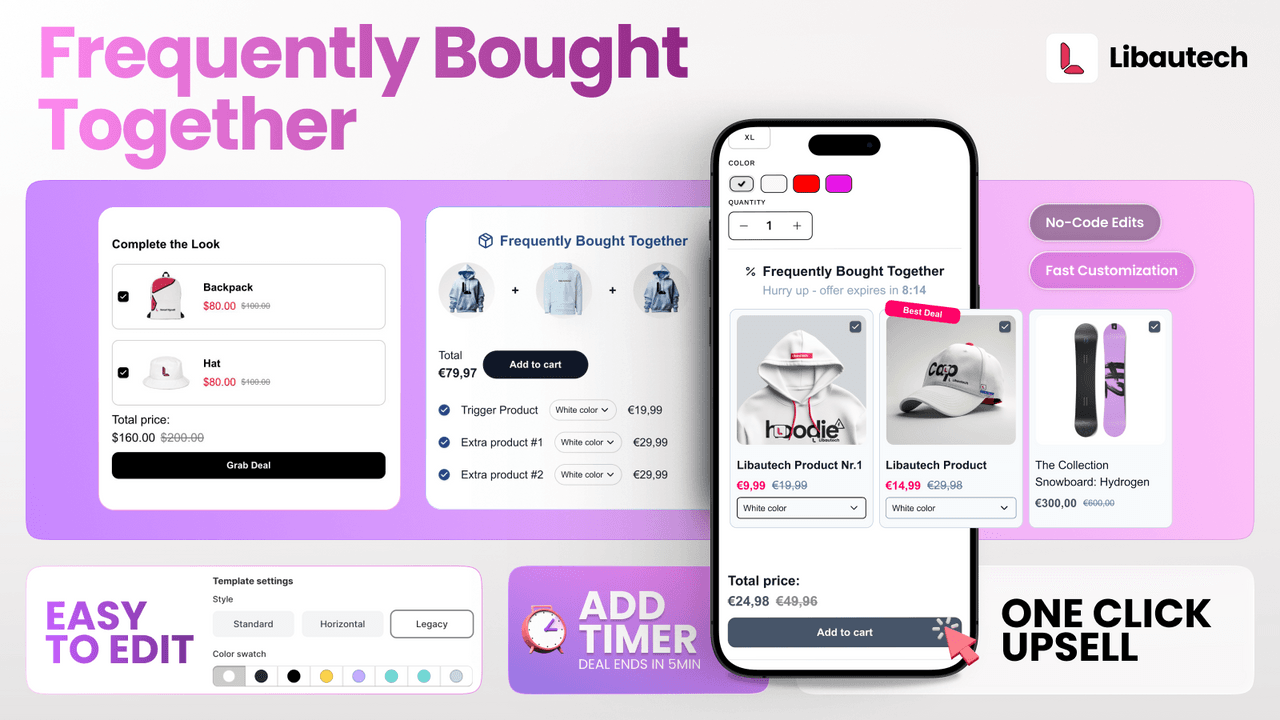
Bundles & Upsell (our app, 4.9 across 35 reviews, Built for Shopify) is the only app on this list with full AI offer creation: the AI reads your catalog and order history and produces finished offers, choosing which products pair, what discount converts without giving away margin, and where the offer appears. You review, edit or approve, and it is live. Every product-page format is covered from one dashboard, frequently bought together pairings with a combined one-click add, product add-ons shown as optional extras, and bundle offers with built-in discounts, and the same offers extend to the cart drawer and popup, so a shopper who skips the on-page recommendation gets a second, contextual chance. Setup is AI-assisted: you describe the offer in plain language and Claude drafts it.
Strengths: with other apps the AI picks products and you still build every offer by hand; here the offer arrives built. And because one app covers product page, cart, checkout and post-purchase, you are not stacking three recommendation apps that each add their own scripts.
Watch-outs: we will be straight, it has the smallest review base here at 35, because it is the newest app on this list, so it has less public proof than Upsell.com's 2,700-plus or Frequently Bought Together's 1,000-plus.
Best for: stores that want product-page recommendations live in under 15 minutes with AI doing the offer construction, and room to expand into cart and post-purchase later without switching apps.
2. Shopify Search & Discovery
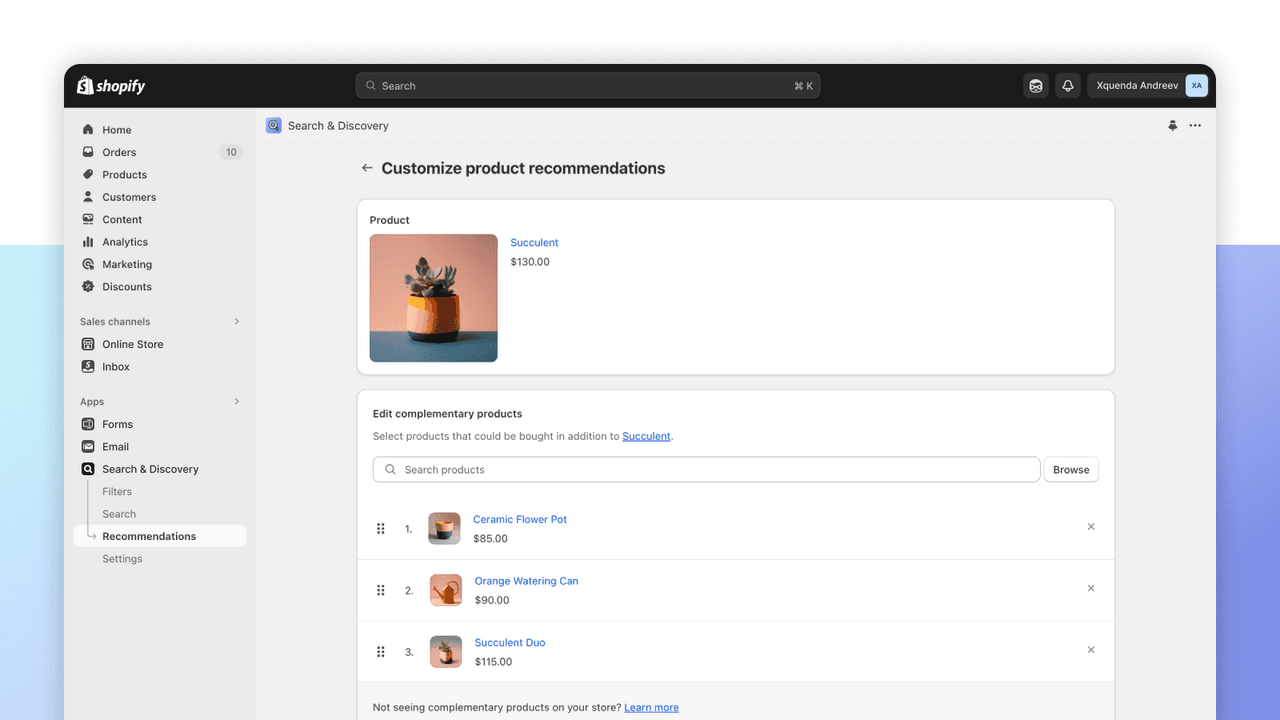
Shopify's own free app (2.8 across 455 reviews) lets you manually define complementary and related products that render in your theme's recommendation sections. There is no AI pairing and no combined add to cart, but the price is zero and the integration is as native as it gets.
Strengths: free, official and enough for a small catalog where you personally know which two products pair with each bestseller.
Watch-outs: manual placement only, no combined add-to-cart, no offer analytics. The modest rating reflects merchants expecting more automation than hand-curated recommendations provide.
Best for: new stores validating whether recommendations move the needle before paying for automation.
3. Rebuy
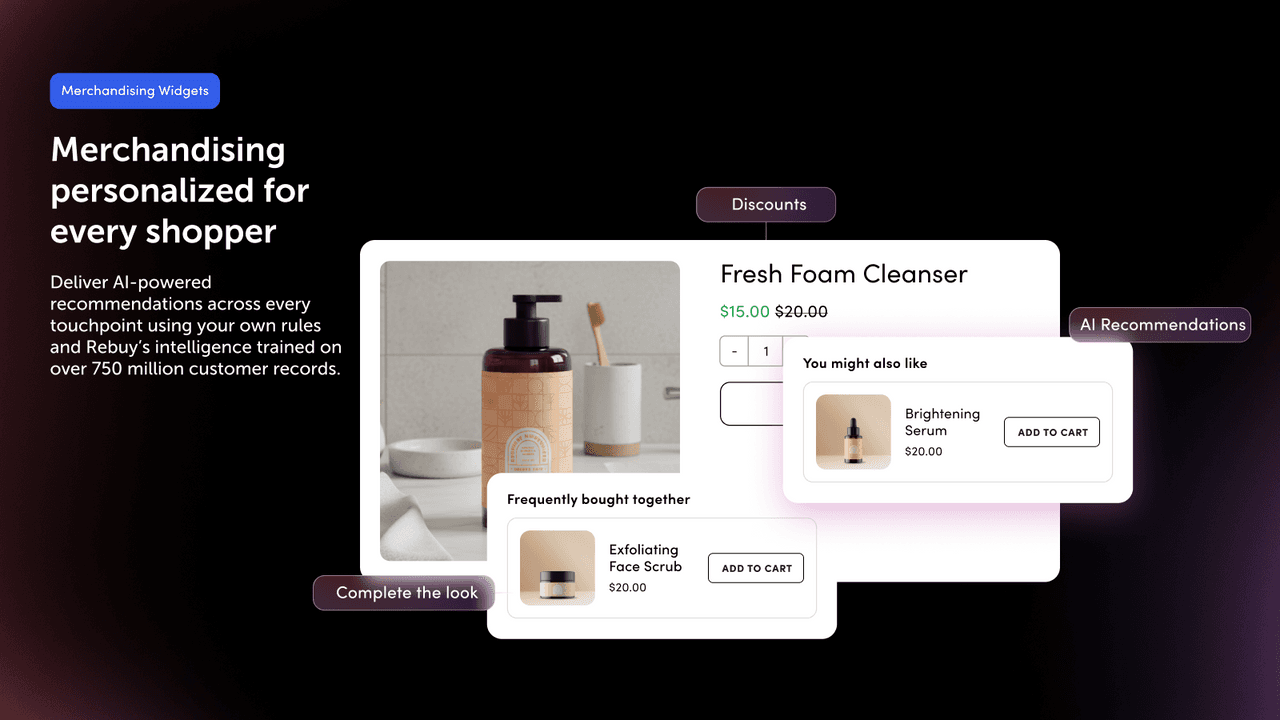
Rebuy (4.7 across 741 reviews) is the heavyweight: an AI rules engine that personalizes recommendations across product pages, cart, checkout and post-purchase, with deep data integrations. The AI is powerful at ranking and personalizing what to show, but the offers themselves are configured through its rules engine, and that configuration takes real time. Pricing starts at $25 a month and scales with order volume.
Strengths: strong personalization at scale for catalogs with hundreds of products where manual pairing is impractical.
Watch-outs: it is a build-it-yourself rules engine, not offer creation, and it rewards a team member who owns the tool. It does not carry the Built for Shopify badge.
Best for: high-volume and Shopify Plus stores with someone to own the setup.
4. Frequently Bought Together by Code Black Belt
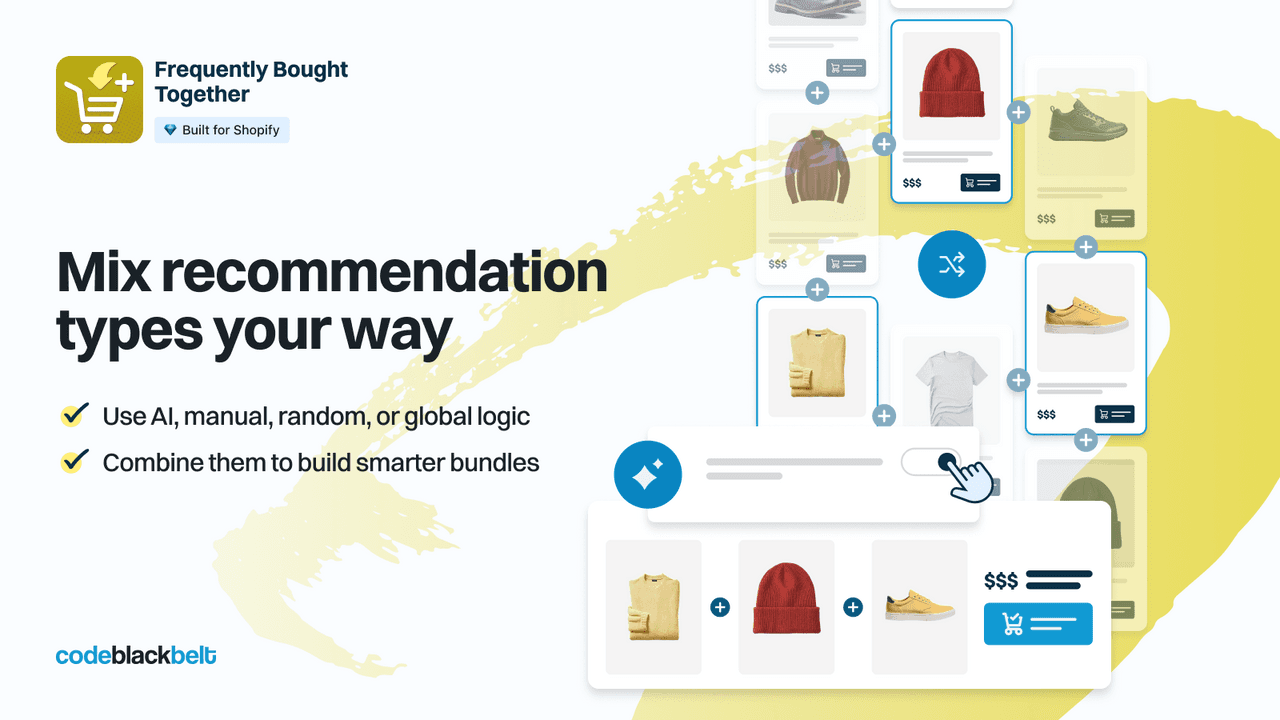
Running since 2017 (4.9 across more than 1,000 reviews, Built for Shopify), this app does exactly one thing: an Amazon-style frequently bought together block powered by AI analysis of your order history. No cart offers, no post-purchase, no bundles beyond the block itself.
Strengths: extreme focus means simple setup and predictable behavior, with a long, well-reviewed track record.
Watch-outs: it is the FBT block and nothing more, so you will need other tools for cart and post-purchase.
Best for: stores that already have tools for cart and post-purchase and only want the FBT block. Free plan, then $14.99 to $39.99 a month by orders.
5. Wiser
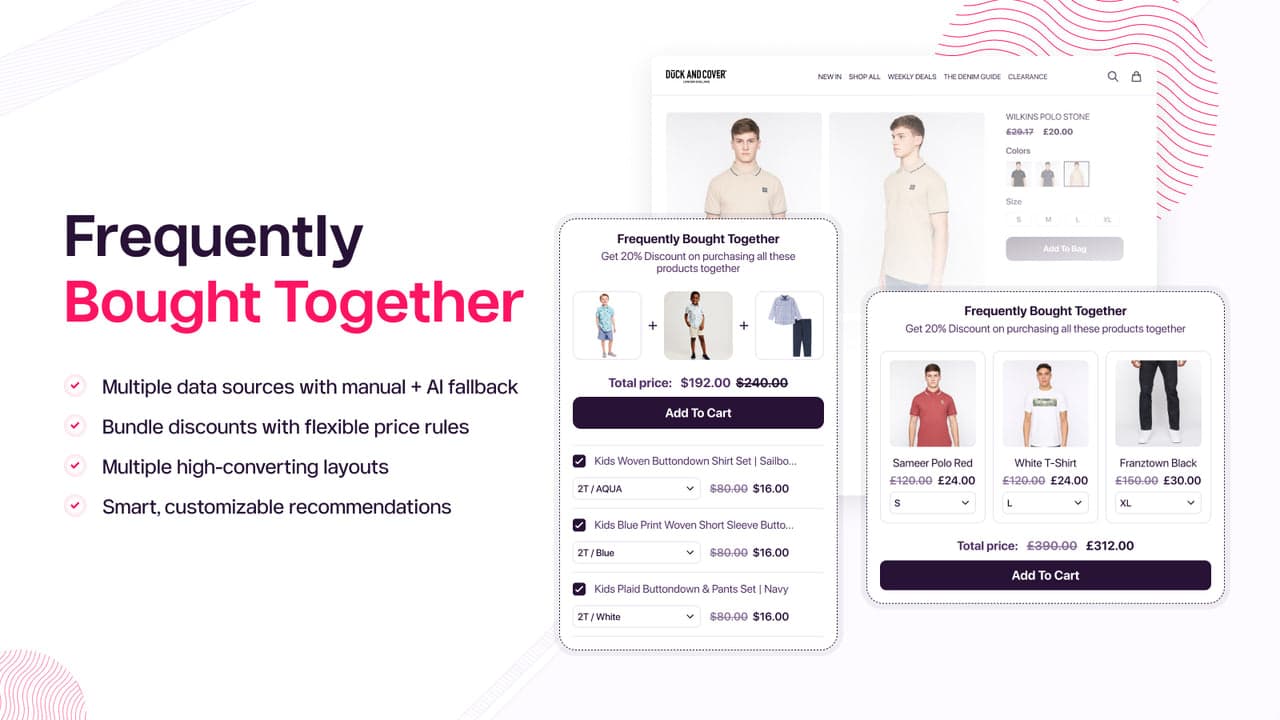
Wiser (4.9 across 513 reviews) combines product-page recommendations with email recommendations and recently-viewed widgets, positioning itself as a personalization suite rather than a single widget.
Strengths: useful when you want recommendations to follow the shopper into email without a separate tool.
Watch-outs: broad rather than deep, and it does not build finished offers or carry the Built for Shopify badge. Check whether your plan adds a revenue-share fee at volume.
Best for: stores investing in retention alongside on-site recommendations. Free to install, then from $9 a month.
6. Upsell.com (formerly ReConvert)
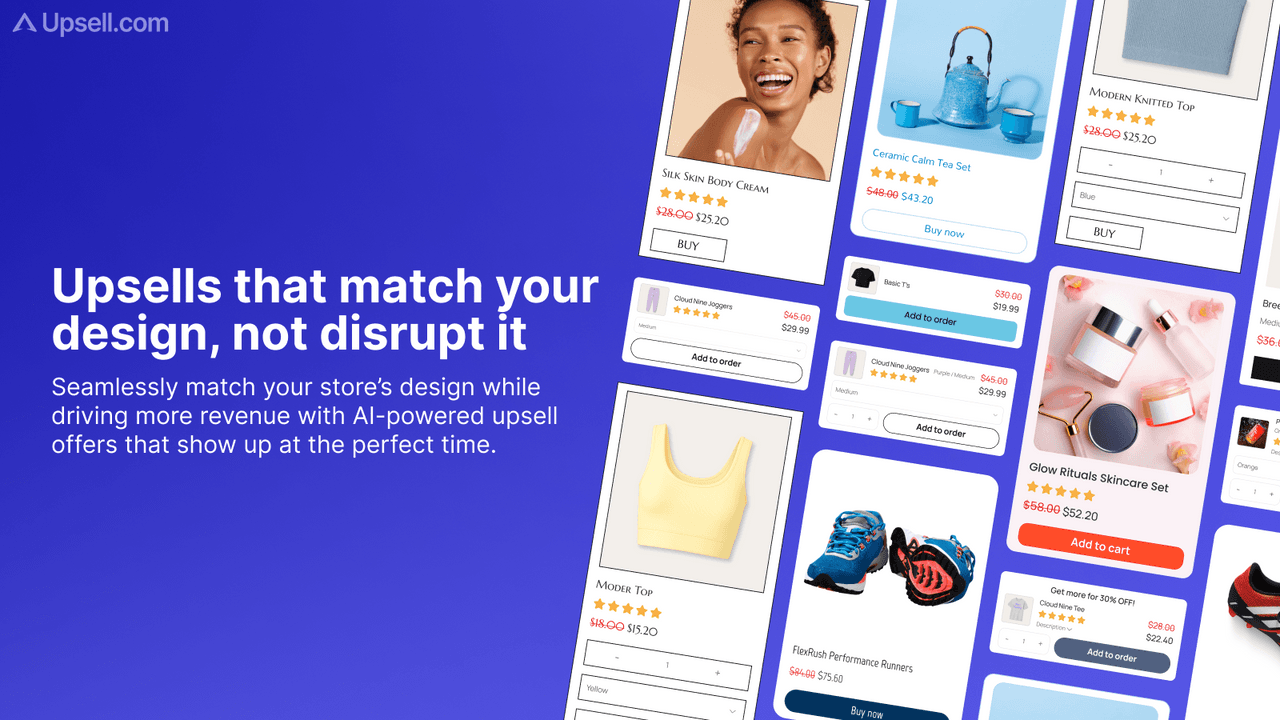
Upsell.com (4.8 across more than 2,700 reviews, Built for Shopify) added AI product recommendations and frequently bought together blocks to what was originally a post-purchase tool. Product-page coverage exists, but the app's depth is on the thank-you page.
Strengths: the deepest track record here by far, and the strongest post-purchase surface, so recommendations and reorders run after payment at zero risk to the sale.
Watch-outs: its center of gravity is post-purchase, not the product page. Paid plans start at $4.99 a month plus, on some tiers, a fee on generated revenue that grows at volume.
Best for: stores building around the thank-you page first, with product-page recommendations as a secondary need.
How to choose between them
Answer three questions.
Who builds the offers. If you want them created for you, full AI offer creation (our Bundles & Upsell) is the only option here where the AI delivers a finished, editable offer rather than a suggestion. If you enjoy configuring rules yourself, Rebuy rewards the time. If you only want the one block, Frequently Bought Together is the cleanest single-purpose choice.
Journey coverage. If you will eventually want cart and post-purchase offers, pick one app that covers all of it now rather than migrating later. If post-purchase is the priority, Upsell.com starts there.
Pricing model. Flat tiers are predictable. Revenue-share fees look small but compound as the feature succeeds, so price them at your real volume, not today's. And if the budget is zero, start with Shopify Search & Discovery and prove the lift first.
Which product recommendation app is right for you?
Pick what matters most and we will point you to the best fit. Often it is not ours, and we say so.
Where to place recommendations on the product page
Placement decides acceptance as much as the pairing does.
Add-ons go directly below the add to cart button. That is where a shopper looks after deciding on the main item, so an optional extra reads as helpful, not pushy.
Frequently bought together blocks go below the product description. Far enough not to compete with the buy decision, close enough to catch the shopper still evaluating.
Keep recommendations off the top of the page. Above-the-fold placements compete with the main buy decision and usually lower conversion.
Show one to three items, not more. Order data from upsell tooling consistently shows acceptance dropping as options increase, because choice becomes a comparison task instead of a yes-or-no add.
Common recommendation mistakes
Recommending random bestsellers. A "you may also like" that ignores the viewed product reads as noise. Pairings should come from order history or a deliberate rule.
Sending the shopper to a new page. A recommendation that restarts the decision on another product page mostly fails. Keep the add one click, in place.
Stacking three apps that each inject scripts. Separate apps for product page, cart and post-purchase each add weight to the page. One app across the journey is lighter and cheaper.
Ignoring the pricing model. A 0.5 to 0.75 percent revenue-share fee is invisible at launch and expensive once the feature works. Prefer flat tiers unless the revenue share is genuinely small at your volume.
What your recommendations are worth
Put in your monthly orders, the share of shoppers who accept a recommendation, and what an accepted item adds. The calculator shows the extra revenue a recommendation program adds, monthly and yearly.
Extra revenue a month
$800
Extra revenue a year
$9,600
That is about 40 accepted recommendations a month at $20 each, spread as an average order value lift of about $2 across every order. It is gross added revenue before any offer discount, and it only holds if the recommendation created the bigger order rather than discounting one that would have happened anyway. Watch the pricing model too: a revenue-share fee grows with this number. You can run product-page recommendations from Bundles & Upsell.
Think your app belongs on this list?
We review submissions against the same criteria we rank on and add the ones that qualify. If you build a Shopify app in this category, send it in.
Related guides: Best frequently bought together apps, Add product recommendations, Upselling vs cross-selling and Best upsell apps for clothing.