
8 Best Shopify Stock Alert Apps (2026)
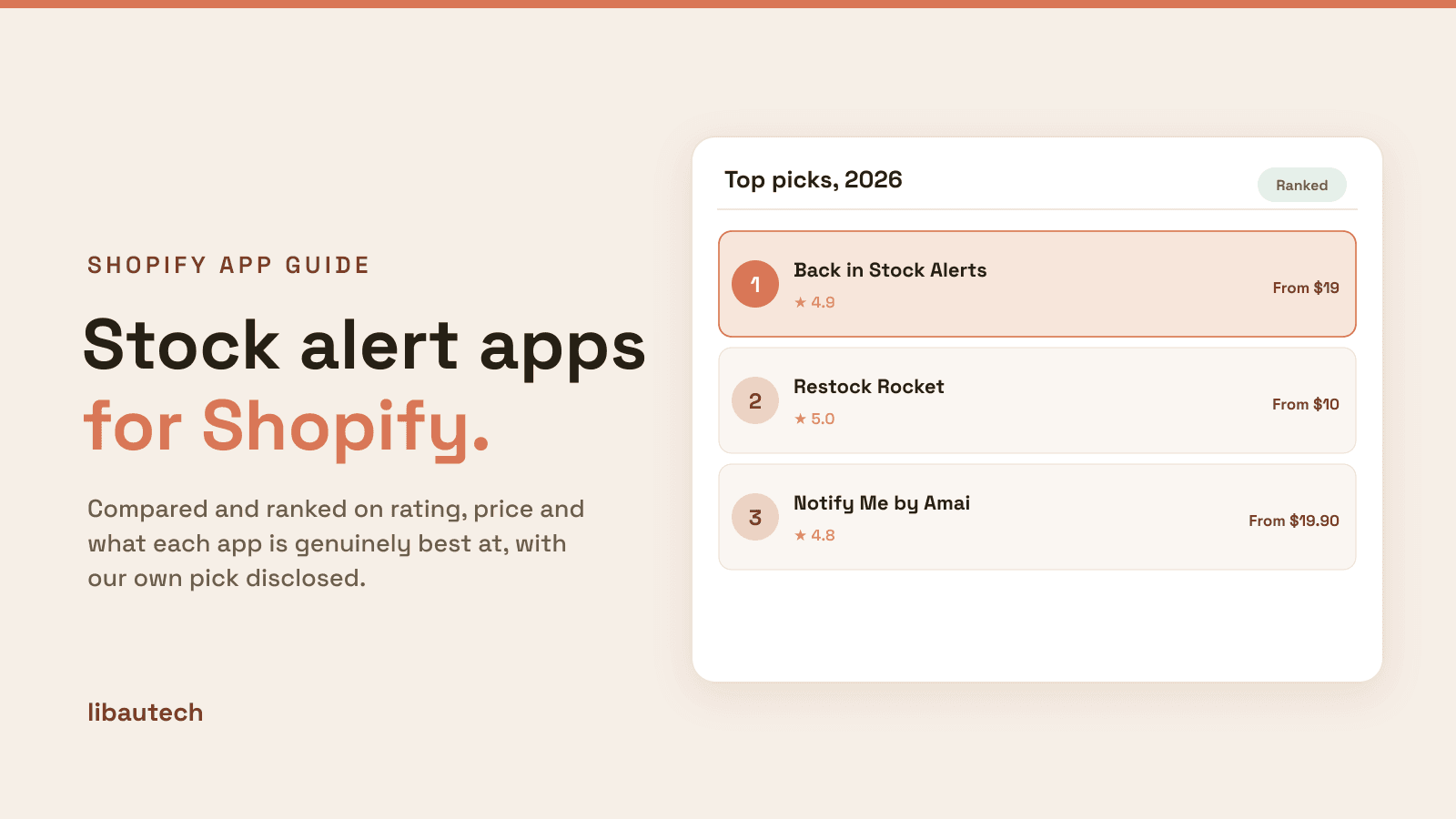
Last updated: April 2026 · Pricing and ratings verified from live Shopify App Store listings on April 30, 2026. Reviewed by the Libautech team — builders of Built for Shopify apps used by 5,000+ merchants across 50+ countries.
Key Takeaways
- Shopify stock alert apps split into three distinct jobs that competitor blogs treat as one. Inventory forecasting apps (Sensible Forecasting, Stockie, Inventory Planner) predict stockouts before they happen and suggest reorder quantities. Low-stock alert apps (Stocky by Shopify, Low Stock Alert by Egnition) notify merchants when inventory drops below threshold. Customer back-in-stock notification apps (Back in Stock Customer Alerts, Notify Me, Restock Rocket) let customers subscribe to email or SMS when sold-out items return.
- Forecasting apps prevent the stockout problem; back-in-stock apps recover sales after the stockout has already happened. Most stores searching "stock alert apps" install only Layer 3 customer notification apps and miss the larger opportunity — a $29/mo forecasting app that prevents 80% of stockouts often delivers more revenue than a $19/mo back-in-stock app that recovers 15-25% of customers who saw the sold-out page.
- Stockouts cost stores meaningful revenue beyond the lost sale itself. The Harvard Business Review study on stockouts found that 31% of customers who hit a stockout buy from a competitor, 26% switch brands permanently, and 21% don't return to the store at all. Even with a back-in-stock notification, only 30-50% of subscribers click through and convert when the product returns.
- Pricing varies dramatically across layers. Forecasting apps run $29-99/mo flat with usage-based scaling at enterprise tiers. Low-stock alert apps run free-$15/mo (Stocky is free for Shopify merchants on certain plans). Customer back-in-stock notification apps run $19-49/mo with per-message fees on premium tiers. The right app costs less than $50/mo for most stores once the layer is identified.
- Back-in-stock notifications convert at 30-50% of subscribers when products return — highest of any retention channel because intent is verified. Customers who subscribed to a back-in-stock alert have already demonstrated explicit purchase intent. The trade-off: subscribers only receive value if and when the product returns, so list growth depends on how often products actually go out of stock.
- The biggest stock-alert mistake is installing only customer back-in-stock notifications without addressing the upstream forecasting problem. A store running back-in-stock notifications without forecasting tools recovers 15-25% of stockout-affected customers but leaves 75-85% of stockout revenue uncovered. Adding inventory forecasting prevents most stockouts in the first place — the two layers stack rather than substitute.
Who Needs a Stock Alert App, and Why?
A stock alert app pays off in two ways. Back-in-stock alerts capture demand you would otherwise lose: when a product sells out, shoppers leave an email and you notify them the moment it returns, recovering sales that would have gone to a competitor. Low-stock alerts on the admin side warn you before a bestseller runs dry, so you reorder in time.
You need one if you sell products that go out of stock, run limited drops, or lose sales to stockouts. If you never sell out and always have inventory, the need is smaller.
The Three Jobs of Shopify Stock Alert Apps
Most roundups of Shopify stock alert apps lump together inventory forecasting tools, low-stock alert apps, and customer back-in-stock notification apps as if they're solving the same problem. They are not. An inventory forecasting app predicts stockouts before they happen and suggests reorder quantities based on historical sales velocity. A low-stock alert app notifies merchants when inventory drops below a configured threshold. A customer back-in-stock notification app lets customers subscribe to email or SMS alerts for sold-out items, then triggers notifications when inventory returns. Different mechanics, different parties being notified, different operational outcomes.
The honest framing: Shopify stock alert apps break into three distinct jobs. Most stores need at least one Layer 1 forecasting tool plus one Layer 3 customer notification tool — picking only one layer leaves either upstream prevention or downstream recovery uncovered.
The first job is inventory forecasting and reorder planning — predicting stockouts before they happen, suggesting reorder quantities based on historical sales velocity, managing supplier lead times, and generating purchase orders. The mechanics: app reads historical sales data, calculates expected demand for each SKU, factors in supplier lead times, and surfaces products approaching stockout in time to reorder. Sensible Inventory Forecasting, Stockie, and Inventory Planner lead this layer. The right pick when stockouts are happening regularly and the operational bottleneck is upstream supply planning rather than downstream customer recovery.
The second job is low-stock merchant alerts — notifying merchants when inventory drops below threshold so they can take action (manually reorder, mark products as backorder, or update sourcing). The mechanics: app monitors inventory levels in real-time and sends email or in-app alerts when SKU inventory drops below configurable thresholds. Stocky by Shopify and Low Stock Alert by Egnition lead this layer. The right pick when forecasting feels like overkill but stockouts still need to be caught before they happen.
The third job is customer back-in-stock notifications — letting customers subscribe to alerts on sold-out product pages, then triggering email or SMS notifications when inventory returns. Different mechanics from forecasting or merchant alerts: the alert recipient is the customer, not the merchant; the goal is converting stockout-blocked customers into completed orders when inventory returns. Back in Stock Customer Alerts, Notify Me by Amai, and Restock Rocket lead this layer. The right pick for capturing stockout-affected customers as a recovery list rather than letting them bounce permanently.
This post ranks 8 apps across the three jobs based on verified April 2026 Shopify App Store data and what each one actually solves.
Stock alert apps stack with broader operational tools. See our guides on best Shopify inventory optimization apps for the broader inventory management layer that complements forecasting, best Shopify inventory sync apps for the related multi-channel inventory layer where stock data flows across sales channels, and best Shopify web push apps for the related customer re-engagement layer that complements back-in-stock notifications.
Quick Comparison: 8 Best Shopify Stock Alert Apps (2026)
| App | Rating | Free Plan | Paid From | Layer | Best For |
|---|---|---|---|---|---|
| Sensible Inventory Forecasting | ⭐ 5.0 (9) | 30-day free trial | $29/mo | Forecasting | Built for Shopify forecasting, simple setup, multi-vendor |
| Stockie Inventory Management | ⭐ 5.0 (70+) | Free trial | $19/mo | Forecasting | Built for Shopify, low-stock alerts plus restock timing |
| Inventory Planner | ⭐ 4.7 (200+) | Free trial | $249.99/mo | Forecasting | Enterprise forecasting, multi-warehouse, advanced PO logic |
| Stocky by Shopify | ⭐ 4.0 (300+) | Free for POS Pro merchants | Free | Low-stock alerts | First-party Shopify app, free for POS Pro merchants |
| Low Stock Alert by Egnition | ⭐ 4.5 (200+) | Yes | $5.95/mo | Low-stock alerts | Affordable threshold-based merchant alerts |
| Back in Stock Customer Alerts | ⭐ 4.9 (1,800+) | Free trial | $19/mo | Back-in-stock | Most-installed back-in-stock app, Klaviyo integration |
| Notify Me by Amai | ⭐ 4.8 (2,300+) | Yes | $19.90/mo | Back-in-stock | Largest review base, generous free tier |
| Restock Rocket Back in Stock | ⭐ 5.0 (700+) | Yes | $10/mo | Back-in-stock | 5.0-star rating, multi-channel email + SMS + push |
Layer 1: Inventory Forecasting and Reorder Planning
This layer is for stores where stockouts are the operational bottleneck. The mechanics: app reads historical sales data, calculates expected demand for each SKU, factors in supplier lead times, and surfaces products approaching stockout in time to reorder. Different mechanics from low-stock alerts: forecasting predicts stockouts weeks in advance based on velocity rather than triggering alerts only when inventory is already critically low. Three apps lead this layer.
1. Sensible Inventory Forecasting
Best for: Shopify stores wanting Built for Shopify-certified inventory forecasting with simple setup, multi-vendor support, and weekly email reports — the focused forecasting pick from a fellow Riga-based SaaS team that ships at meaningful pricing.
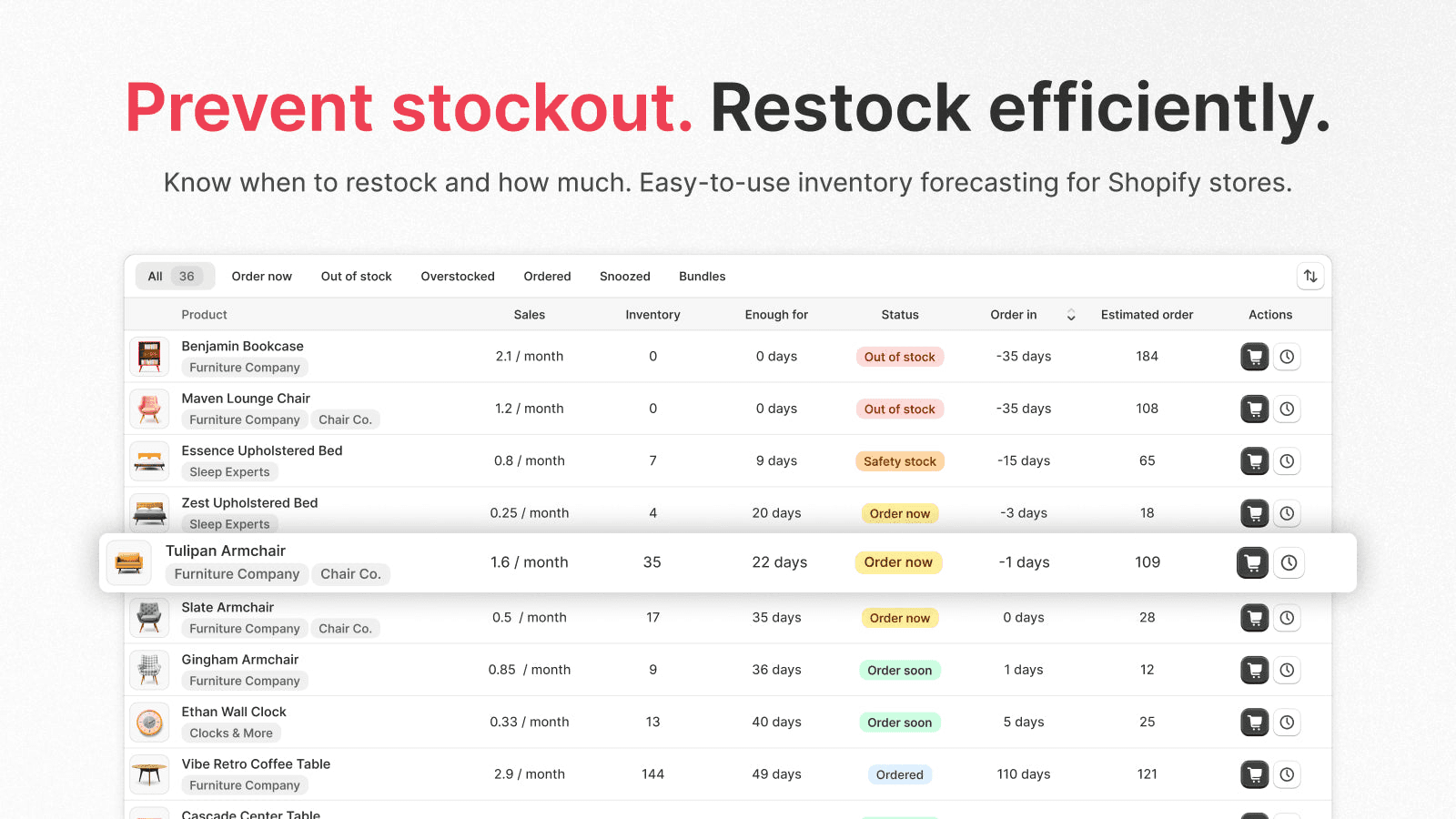
Sensible Inventory Forecasting holds a 5.0-star rating with reviews so far skewed strongly positive across early adopters. Built by sensible.tools (Riga, Latvia) and certified Built for Shopify — Shopify's highest standard for performance, design, and integration. The positioning is focused inventory forecasting with the features that matter most: products needing reorder surfaced in a single dashboard view, suggested reorder quantities based on historical sales velocity, multi-vendor support per product (different products may have different suppliers with different lead times), adjustable lead time and forecasting settings per product, weekly email inventory reports, and CSV/XLSX export of forecasting data for finance and ops teams.
The Built for Shopify certification matters specifically for performance and integration quality. BFS-certified apps meet Shopify's highest standards for storefront performance, code quality, and merchant experience — a meaningful signal for stores that want to avoid the JavaScript bloat and integration friction that lower-tier apps often introduce. Combined with the focused feature set (no over-built UIs, no enterprise-tier complexity), Sensible delivers forecasting at a price point that earns its cost on stores doing $20K+ monthly revenue.
The multi-vendor support handles a common operational gap. Stores sourcing the same product from multiple suppliers (primary supplier with 14-day lead time, backup supplier with 30-day lead time) typically need to manually manage which supplier to reorder from based on quantity and timing. Sensible's multi-vendor logic surfaces both suppliers per product with their respective lead times so merchants can pick the right supplier for each reorder — reducing operational overhead versus apps that assume a single supplier per product.
Core features: forecasting dashboard surfacing products needing reorder; reorder quantity suggestions based on historical sales velocity; multi-vendor support per product with separate lead times; adjustable forecasting settings per product (lead time, demand forecasting period, safety stock); weekly email inventory reports; CSV and XLSX export; integration with bundle apps that split bundles into individual line items; integration with Shopify Online Store 2.0 themes; Built for Shopify certification.
Where it falls short: smaller installed base than Stockie or Inventory Planner reflecting the platform's recent launch — less historical track record at scale. Single $29/mo plan rather than a tiered structure means small stores starting out pay the same as larger stores. Best for stores with established inventory management practices wanting forecasting infrastructure rather than first-time inventory operators.
Pricing: 30-day free trial. $29/month flat.
2. Stockie Inventory Management
Best for: Shopify stores wanting Built for Shopify-certified low-stock alerts combined with inventory forecasting and restock timing under one platform with a larger established review base.
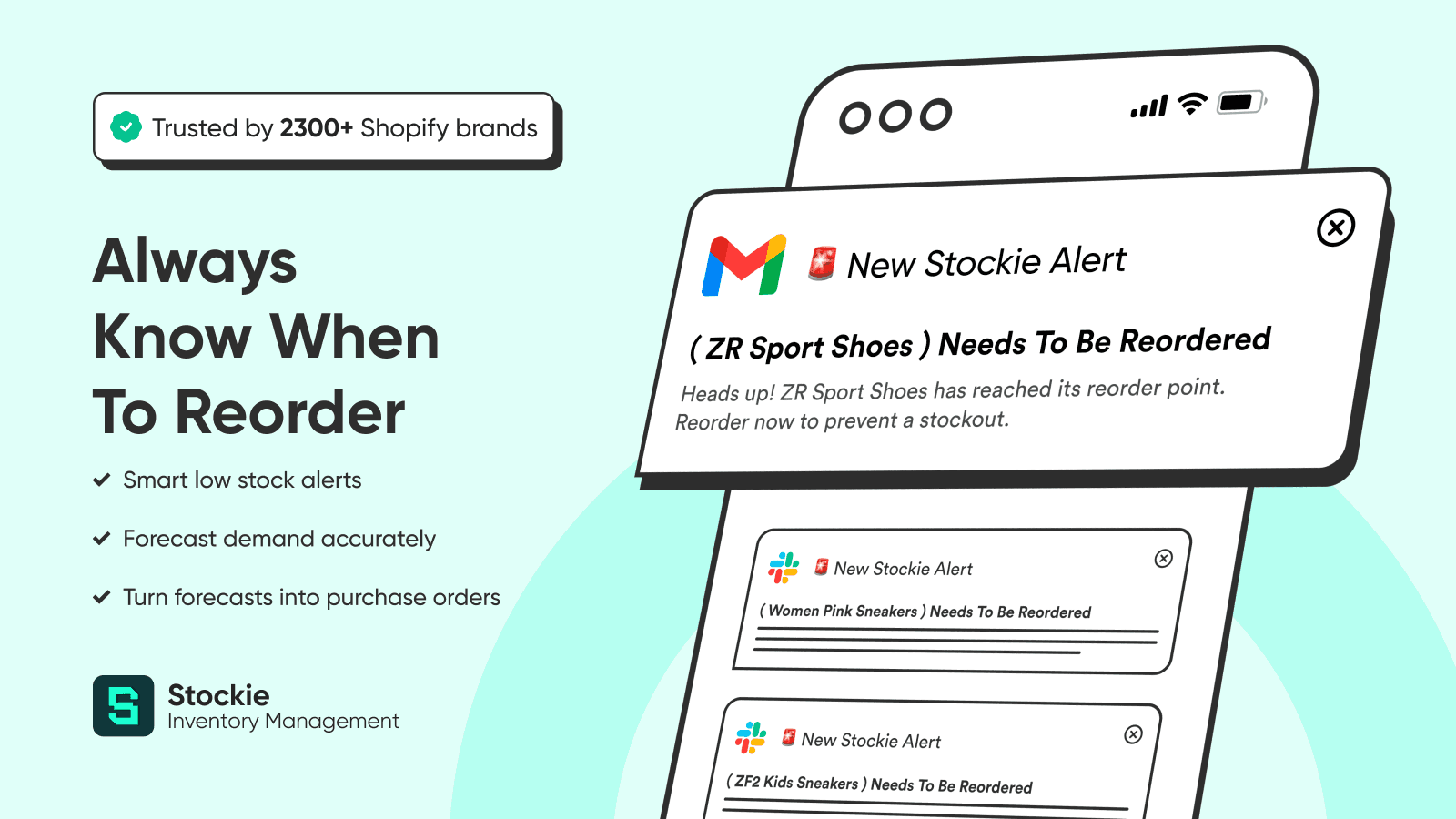
Stockie Inventory Management holds 5.0 stars across 70+ reviews and is also Built for Shopify-certified. The positioning bridges Layer 1 and Layer 2 functionality: low-stock alerts when inventory drops below threshold, plus inventory forecasting that surfaces products approaching stockout based on sales velocity, plus restock timing recommendations. For stores wanting both threshold alerts and forecasting under one app rather than stacking two apps, Stockie covers both jobs at competitive pricing.
The combined positioning matters specifically for mid-sized stores ($20K-200K monthly revenue) where running separate apps for low-stock alerts and forecasting feels like over-engineering. Rather than choosing between Sensible's pure forecasting and Egnition's pure threshold alerts, Stockie handles both with simpler decision logic.
Core features: low-stock alerts with configurable thresholds; inventory forecasting based on sales velocity; restock timing recommendations; multi-warehouse support; email notifications and Slack integration; CSV export; integration with Shopify Online Store 2.0 themes; Built for Shopify certification.
Where it falls short: less depth in pure forecasting than Sensible's dedicated approach. Less depth in pure threshold alerts than Egnition. Best for stores wanting one tool covering both jobs versus dedicated tools for each.
Pricing: Free trial. Paid plans from $19/mo.
3. Inventory Planner
Best for: established Shopify stores at $200K+ monthly revenue wanting enterprise-tier forecasting with multi-warehouse logic, advanced purchase order workflows, and broad integrations with finance and ERP systems.
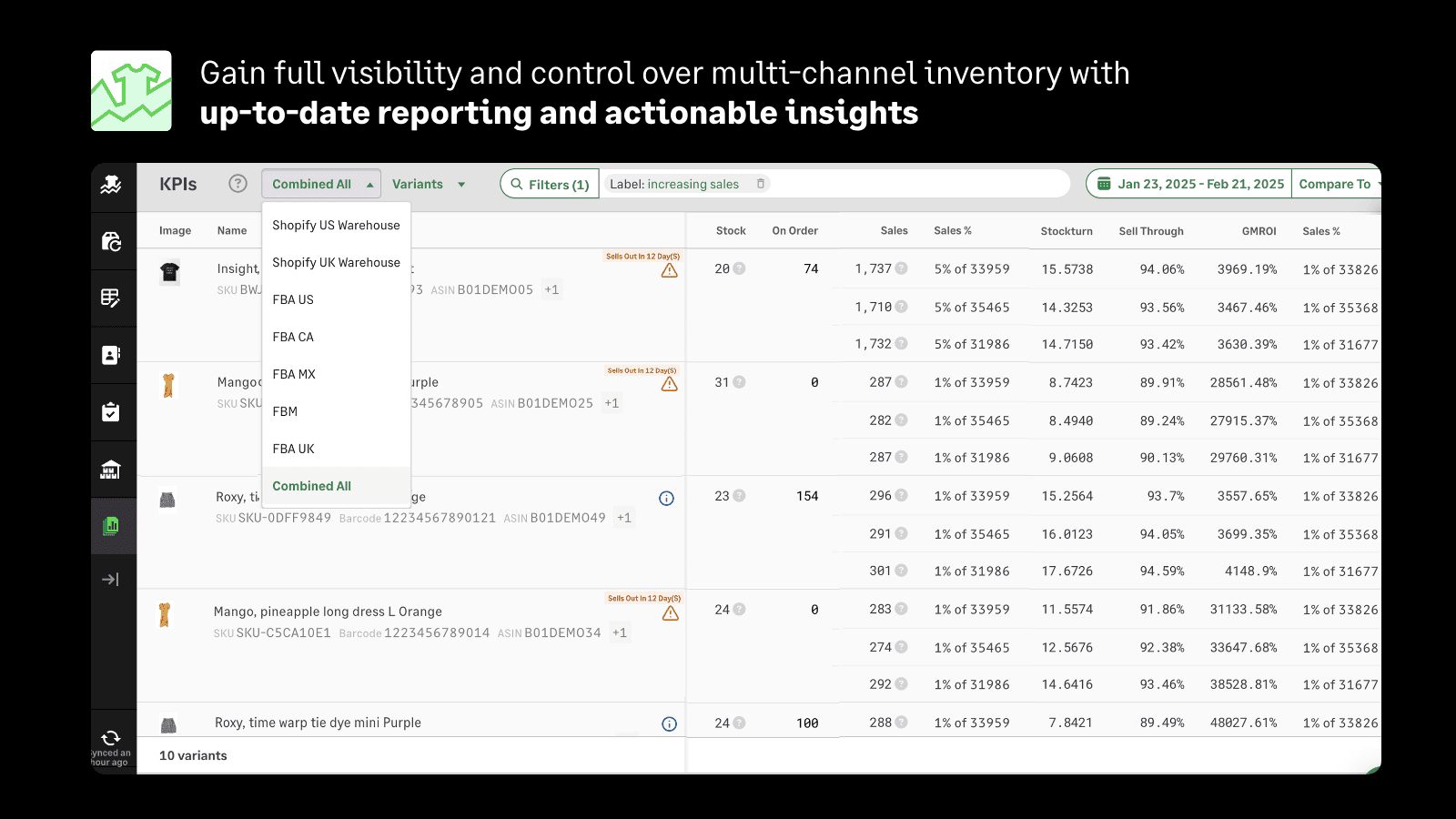
Inventory Planner holds 4.7 stars across 200+ reviews — the longest-established enterprise forecasting platform on Shopify. The positioning is enterprise-tier comprehensive forecasting: multi-warehouse inventory tracking with per-warehouse demand forecasting, advanced purchase order workflows with supplier-specific terms and approval flows, integrations with QuickBooks/Xero/NetSuite for financial visibility, lead time tracking per supplier with seasonal adjustments, and demand forecasting that factors in promotions, seasonality, and lifecycle trends.
The enterprise positioning reflects in pricing. Inventory Planner's $249.99/mo entry tier excludes smaller stores by design — the platform is built for established merchants doing meaningful inventory volume where the comprehensive feature set compounds across thousands of monthly SKU movements. For stores at the right scale, the advanced PO logic and multi-warehouse support typically delivers 5-15% inventory cost reduction versus simpler tools.
Core features: multi-warehouse forecasting with per-warehouse demand calculations; advanced purchase order workflows; supplier management with seasonal lead time adjustments; integrations with QuickBooks, Xero, NetSuite, and major ERPs; demand forecasting accounting for promotions and seasonality; multi-currency support; integration with Shopify Online Store 2.0 themes; merchant dashboard with executive-level inventory analytics.
Where it falls short: pricing entry point ($249.99/mo) excludes stores below $200K monthly revenue. Setup complexity is real for stores configuring multi-warehouse and PO workflows. 4.7-star rating reflects mixed reviews on pricing transparency and support response times. Best for established stores with mature inventory operations rather than smaller stores starting with forecasting.
Pricing: Free trial. Paid plans from $249.99/mo.
The Honest Trade-Off: Forecasting Prevents, Notifications Recover
Worth saying explicitly: forecasting apps and back-in-stock notification apps solve fundamentally different parts of the same revenue problem. Forecasting prevents stockouts before they happen by surfacing products approaching stockout in time to reorder. Back-in-stock notifications recover sales after stockouts have already happened by capturing customers and converting them when inventory returns. The two layers stack rather than substitute.
The math: a store with $50K monthly revenue and 5% stockout rate loses approximately $2,500/month to stockouts. Adding back-in-stock notifications recovers 15-25% of that ($375-625/month) by converting stockout-affected customers when inventory returns. Adding inventory forecasting prevents 70-80% of stockouts in the first place ($1,750-2,000/month). Stacking both layers covers nearly all stockout revenue — forecasting prevents the majority, notifications recover the residual that forecasting still misses.
The signal that forecasting earns its cost: stockouts are happening regularly (monthly stockout rate over 3% on flagship products) and the operational bottleneck is upstream supply planning. The signal that notifications alone are sufficient: stockouts are rare enough that forecasting feels like overkill, but enough customers hit sold-out pages that capturing them as a recovery list earns its cost.
Layer 2: Low-Stock Merchant Alert Apps
This layer is for stores where forecasting feels like overkill but stockouts still need to be caught before they happen. The mechanics: app monitors inventory levels in real-time and sends email or in-app alerts when SKU inventory drops below configurable thresholds. Different mechanics from forecasting: alerts trigger only when inventory is already approaching critical levels rather than predicting stockouts weeks in advance. Two apps lead this layer.
4. Stocky by Shopify
Best for: Shopify POS Pro merchants wanting first-party Shopify inventory management with low-stock alerts, purchase orders, and stocktake workflows — free for POS Pro stores, the right pick for retail-focused merchants.
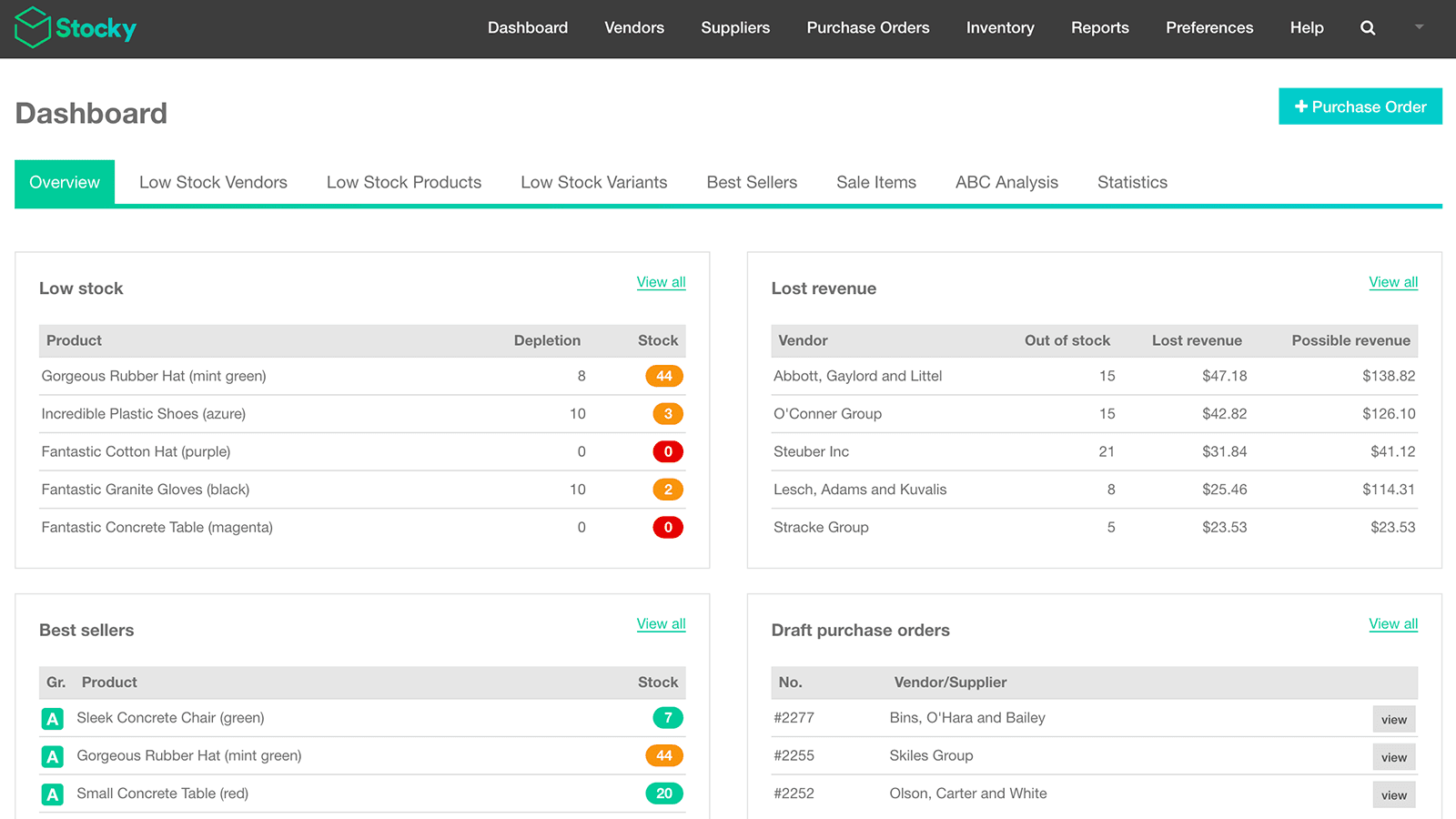
Stocky by Shopify holds 4.0 stars across 300+ reviews. The positioning is first-party Shopify inventory management included free for Shopify POS Pro merchants: low-stock alerts based on configurable thresholds, purchase order generation, supplier management, demand forecasting (basic), and stocktake workflows for retail operations. For Shopify POS Pro merchants, Stocky is the default starting point because it's bundled into the existing POS subscription with no incremental cost.
The first-party advantage matters specifically for retail-focused merchants. Native integration with Shopify POS, customer profiles, and order history means inventory data flows seamlessly between online and in-store operations without third-party API dependencies. For multi-channel retailers running both Shopify online and physical retail through Shopify POS, this consolidation simplifies operations versus stacking third-party inventory apps on top.
Core features: low-stock alerts with configurable thresholds; purchase order generation with supplier management; basic demand forecasting; stocktake workflows for retail operations; integration with Shopify POS Pro; bundled with POS Pro subscription for participating stores; integration with Shopify Online Store 2.0 themes; native checkout extensibility integration.
Where it falls short: 4.0-star rating reflects mixed merchant feedback — some users report UI friction and feature gaps versus dedicated alternatives. Free for POS Pro merchants but requires POS Pro plan ($89/mo additional). Best for retail-focused multi-channel merchants rather than online-only stores where dedicated forecasting tools deliver more value.
Pricing: Free for Shopify POS Pro merchants.
5. Low Stock Alert by Egnition
Best for: small-to-mid Shopify stores wanting affordable threshold-based merchant alerts with email notifications and configurable per-product thresholds — the budget pick for low-stock merchant alerts.
Low Stock Alert by Egnition holds 4.5 stars across 200+ reviews. The positioning is focused affordable threshold alerts at the lowest entry tier in the layer ($5.95/mo): per-product configurable thresholds, email notifications when inventory drops below threshold, daily digest reports, and CSV export of inventory status. For stores wanting threshold alerts without the broader feature set of Stocky or the forecasting depth of Sensible, this focused approach covers the threshold-alert use case at meaningfully lower cost.
The narrow scope is the strength. Where Stocky bundles purchase orders and stocktake workflows that some stores never use, Low Stock Alert focuses specifically on threshold alerts and ships at $5.95/mo entry tier. For stores with simple inventory operations where the alert is the only requirement, this is the right pick.
Core features: per-product configurable low-stock thresholds; email notifications when thresholds hit; daily digest reports; CSV export of inventory status; multi-warehouse support; integration with Shopify Online Store 2.0 themes; merchant dashboard with alert analytics.
Where it falls short: no forecasting capabilities; alerts only trigger when inventory is already approaching critical levels rather than predicting stockouts in advance. No purchase order generation. Best for stores wanting only threshold alerts rather than broader inventory management.
Pricing: Free plan available. Paid plans from $5.95/mo.
Layer 3: Customer Back-in-Stock Notification Apps
This layer captures customers who hit sold-out product pages, lets them subscribe to email or SMS alerts, and triggers notifications when inventory returns. Different mechanics from forecasting or merchant alerts: the alert recipient is the customer, not the merchant; the goal is converting stockout-blocked customers into completed orders when inventory returns. Three apps lead this layer.
6. Back in Stock Customer Alerts
Best for: Shopify stores wanting the most-installed back-in-stock notification app with deep Klaviyo integration, branded email templates, and broad customization — the default pick for stores running mature email marketing.
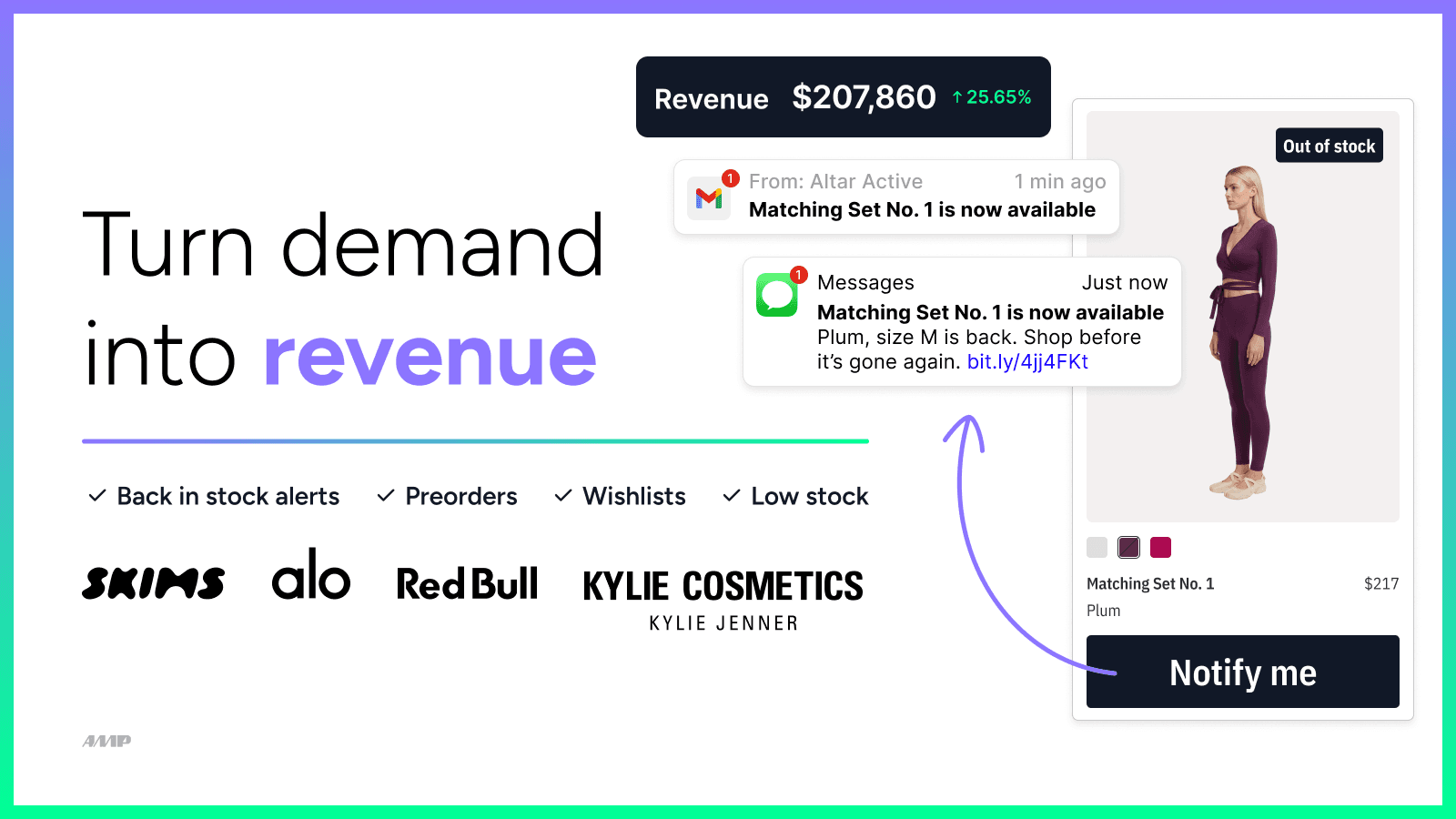
Back in Stock Customer Alerts holds 4.9 stars across 1,800+ reviews — one of the largest review bases in this category and consistently top-ranked for back-in-stock notification mechanics. The positioning is comprehensive back-in-stock notifications with strong Klaviyo integration: "Notify Me" button on sold-out product pages, email and SMS notifications when inventory returns, branded email templates with merchant logo and design language, Klaviyo sync that pushes back-in-stock subscribers into existing email flows, and live demand reports showing which products customers want most.
The Klaviyo integration matters specifically for stores running mature email marketing programs. Rather than treating back-in-stock subscribers as a separate list, Back in Stock pushes subscribers directly into Klaviyo so they automatically enter welcome series, abandoned cart flows, and post-purchase sequences alongside other email subscribers. For stores using Klaviyo as the primary email platform, this consolidation simplifies marketing operations.
Core features: "Notify Me" button on sold-out product pages; email and SMS notifications when inventory returns; branded email templates with custom HTML; Klaviyo integration for subscriber sync; live demand reports showing most-requested products; variant-specific notifications (notify only when specific size/color returns); multi-language support; integration with Shopify Online Store 2.0 themes; merchant dashboard with conversion analytics.
Where it falls short: Klaviyo integration matters less for stores using Mailchimp, Brevo, or other email platforms. Pricing scales with subscriber volume on premium tiers. Setup complexity is real for stores configuring branded templates and multi-language support.
Pricing: Free trial. Paid plans from $19/mo.
7. Notify Me by Amai
Best for: Shopify stores wanting the largest review base in the back-in-stock layer with generous free tier, broad multi-channel notifications, and strong customization at meaningfully accessible pricing.
Notify Me by Amai holds 4.8 stars across 2,300+ reviews — the largest review base in the back-in-stock notification layer. The positioning is comprehensive back-in-stock notifications with generous free tier: "Notify Me" button on sold-out pages, email notifications when inventory returns, SMS notifications on premium tiers, customizable email templates, integration with Klaviyo and Mailchimp, and waitlist functionality showing customers their position in line for limited-stock items.
The free tier matters specifically for stores starting with back-in-stock notifications. Where Back in Stock requires paid trials and Restock Rocket has paid-only premium features, Notify Me's free plan covers basic back-in-stock notifications without paid commitment — useful for stores validating the use case before scaling to paid tiers.
Core features: "Notify Me" button on sold-out pages; email and SMS notifications; customizable email templates; integration with Klaviyo and Mailchimp; waitlist functionality with customer position indicators; variant-specific notifications; multi-language support; integration with Shopify Online Store 2.0 themes; merchant dashboard with subscription analytics.
Where it falls short: less polished Klaviyo integration than Back in Stock's dedicated approach. SMS notifications gated behind premium tiers with per-message fees. Some merchant reviews flag occasional sync delays during high-volume product restocks.
Pricing: Free plan available. Paid plans from $19.90/mo.
8. Restock Rocket Back in Stock
Best for: Shopify stores wanting 5.0-star-rated back-in-stock notifications with multi-channel email + SMS + push delivery and lower entry pricing than competitors.
Restock Rocket Back in Stock holds 5.0 stars across 700+ reviews. The differentiating positioning is multi-channel notification delivery: rather than email-first with SMS as an upsell, Restock Rocket delivers across email, SMS, and web push from the entry tier with consistent pricing. For stores wanting the broadest notification reach without paying for premium-tier SMS access, this multi-channel approach handles all three channels at $10/mo entry.
The 5.0-star rating across 700+ reviews reflects strong merchant satisfaction with both setup speed and ongoing reliability. The narrow focus on back-in-stock notifications (rather than broader retention platforms) means the feature set is polished and reliable for the specific use case.
Core features: "Notify Me" button on sold-out pages; email, SMS, and web push notifications from entry tier; customizable templates; integration with Klaviyo and Mailchimp; variant-specific notifications; multi-language support; integration with Shopify Online Store 2.0 themes; merchant dashboard with cross-channel conversion analytics.
Where it falls short: smaller installed base than Notify Me by Amai or Back in Stock Customer Alerts. Less Klaviyo-specific integration depth. Setup complexity moderate for stores configuring all three notification channels.
Pricing: Free plan available. Paid plans from $10/mo.
Which Stock Alert App to Choose
For Built for Shopify-certified inventory forecasting with simple setup and multi-vendor support: Sensible Inventory Forecasting. 5.0 stars, BFS certification, $29/mo flat, the focused forecasting pick for stores doing $20K+ monthly revenue.
For combined low-stock alerts and forecasting under one BFS-certified app: Stockie Inventory Management. 5.0 stars, 70+ reviews, $19/mo, the bridge pick combining Layer 1 and Layer 2 functionality.
For enterprise-tier forecasting with multi-warehouse and ERP integrations: Inventory Planner. 4.7 stars, $249.99/mo, the established enterprise pick for $200K+ monthly revenue stores.
For first-party Shopify inventory management bundled free with POS Pro: Stocky by Shopify. Free for POS Pro merchants, the right pick for retail-focused multi-channel merchants.
For affordable threshold-based merchant alerts: Low Stock Alert by Egnition. 4.5 stars, $5.95/mo entry, the focused budget pick.
For most-installed back-in-stock customer notifications with deep Klaviyo integration: Back in Stock Customer Alerts. 4.9 stars, 1,800+ reviews, the default Klaviyo-focused pick.
For largest review base in back-in-stock layer with generous free tier: Notify Me by Amai. 4.8 stars, 2,300+ reviews, the broad-adoption pick.
For 5.0-star multi-channel email + SMS + push notifications at lower entry pricing: Restock Rocket Back in Stock. 5.0 stars, $10/mo entry, the multi-channel value pick.
For most Shopify stores in this category, the honest framing is layer-stacking. Install Layer 1 forecasting (Sensible or Stockie) to prevent most stockouts in the first place. Add Layer 3 customer notifications (Back in Stock Customer Alerts, Notify Me, or Restock Rocket) to capture and convert the residual stockouts forecasting still misses. Skip Layer 2 unless POS Pro merchant context (Stocky) or pure budget alert needs (Low Stock Alert by Egnition) apply. The most common stock-alert mistake is installing only customer notifications without forecasting — forecasting prevents 70-80% of stockouts; notifications recover only 15-25% of those that still happen.
How We Ranked These Apps
This ranking is based on four criteria applied to every Shopify stock alert app tested in 2026. First, Shopify App Store rating and verified review volume as of April 30, 2026 — the strongest signal of long-term merchant satisfaction at scale. Second, fit-to-job for which of the three layers each app actually solves (forecasting, low-stock merchant alerts, or customer back-in-stock notifications) rather than treating these as a single category. Third, pricing structure and total cost at realistic merchant volumes — a $5.95/mo threshold alert tool and a $249.99/mo enterprise forecasting platform handle different scopes, and the math depends on which layer the store actually needs based on stockout frequency and inventory complexity. Fourth, Built for Shopify certification status and integration depth, since merchant satisfaction depends on whether the app meets Shopify's quality standards and integrates cleanly with the broader Shopify ecosystem.
Every pricing and feature figure in this post was verified directly from each app's live Shopify App Store listing on April 30, 2026. App pricing structures change — always confirm current pricing on the official listing before installing. Ratings and review counts reflect the Shopify App Store at the time of our last update.
Frequently Asked Questions
What is a Shopify stock alert app?
A Shopify stock alert app handles one of three distinct jobs. Inventory forecasting apps (Sensible Forecasting, Stockie, Inventory Planner) predict stockouts before they happen and suggest reorder quantities. Low-stock merchant alert apps (Stocky by Shopify, Low Stock Alert by Egnition) notify merchants when inventory drops below threshold. Customer back-in-stock notification apps (Back in Stock Customer Alerts, Notify Me, Restock Rocket) let customers subscribe to alerts on sold-out items.
What is the best Shopify stock alert app in 2026?
Depends on the layer. For forecasting: Sensible Inventory Forecasting (5.0 stars, BFS-certified, $29/mo) or Stockie Inventory Management (combined alerts plus forecasting). For enterprise forecasting: Inventory Planner ($249.99/mo). For low-stock merchant alerts: Stocky by Shopify (free for POS Pro) or Low Stock Alert by Egnition ($5.95/mo). For customer back-in-stock notifications: Back in Stock Customer Alerts (4.9 stars, 1,800+ reviews), Notify Me by Amai (2,300+ reviews, largest base), or Restock Rocket (5.0 stars, multi-channel). Pick the layer first based on operational bottleneck.
How much do Shopify stock alert apps cost?
Entry tiers range from free (Stocky by Shopify for POS Pro merchants, Notify Me free plan, Restock Rocket free plan) to $5.95-19/mo for most paid plans. Forecasting apps run $19-29/mo flat with usage-based scaling. Enterprise forecasting platforms like Inventory Planner start at $249.99/mo. The right app costs less than $50/mo for most stores.
What is the difference between forecasting and back-in-stock notifications?
Different mechanics solving different parts of the same problem. Forecasting prevents stockouts before they happen by predicting demand and surfacing products approaching stockout in time to reorder. Back-in-stock notifications recover sales after stockouts have already happened by capturing customers and converting them when inventory returns. Forecasting prevents 70-80% of stockouts; back-in-stock notifications recover 15-25% of stockout-affected customers. The two layers stack rather than substitute.
How much revenue do stockouts cost stores?
Significant. Beyond the immediate lost sale, the Harvard Business Review study on stockouts found that 31% of customers who hit a stockout buy from a competitor, 26% switch brands permanently, and 21% don't return to the store at all. A store with $50K monthly revenue and 5% stockout rate loses approximately $2,500/month in immediate revenue plus longer-term customer lifetime value erosion that compounds over time.
What conversion rates do back-in-stock notifications deliver?
30-50% of subscribers click through and convert when products return — the highest conversion rate of any retention channel because intent is verified. Customers who subscribed to back-in-stock alerts have already demonstrated explicit purchase intent and just need inventory to return. The trade-off: subscribers only receive value if and when the product returns, so list growth depends on how often products actually go out of stock.
Should I install both forecasting and back-in-stock apps?
For most stores, yes. Forecasting prevents 70-80% of stockouts in the first place. Back-in-stock notifications recover 15-25% of stockout-affected customers when inventory returns. Stacking both layers covers nearly all stockout revenue — forecasting prevents the majority, notifications recover the residual that forecasting still misses. Total monthly cost typically runs $40-50/mo for both layers, often returning 5-10x in recovered revenue for stores doing $20K+ monthly.
What is Built for Shopify certification?
Built for Shopify is Shopify's highest standard for app quality, requiring apps to meet specific benchmarks for storefront performance, code quality, design integration, and merchant experience. BFS-certified apps have been audited by Shopify and meet stricter standards than uncertified alternatives. For stores prioritizing storefront performance and integration quality, BFS certification is a meaningful trust signal — Sensible Inventory Forecasting and Stockie Inventory Management both carry the certification.
Can I forecast inventory without an app?
For very small catalogs (under 50 SKUs) with stable demand, manual spreadsheet forecasting works. Most stores hit the limit at 100+ SKUs or variable demand patterns where manual forecasting becomes operationally impossible — calculating reorder points across hundreds of SKUs with different lead times, sales velocities, and supplier relationships requires automation. Forecasting apps earn their cost when stockouts are happening regularly and the operational overhead of manual forecasting exceeds the app subscription.
Will stock alert apps slow down my Shopify store?
Forecasting and merchant alert apps run server-side without storefront JavaScript bloat — no measurable page-speed impact. Customer back-in-stock notification apps add a "Notify Me" button on sold-out product pages with minimal JavaScript that loads asynchronously after page interactivity. Built for Shopify-certified apps in this category have been audited for Shopify performance standards. Always test page speed before and after install with Google PageSpeed Insights to confirm impact on your specific theme.
Think Your App Belongs on This List?
We update these lists as new tools launch and existing ones improve. If you are a developer building a Shopify inventory forecasting, low-stock alert, or back-in-stock notification app and want your app considered for inclusion, submit it here — tell us what your app does, who it is for, and include a link to your Shopify App Store listing. We review every submission.