
Best Shopify Inventory Optimization Apps 2026
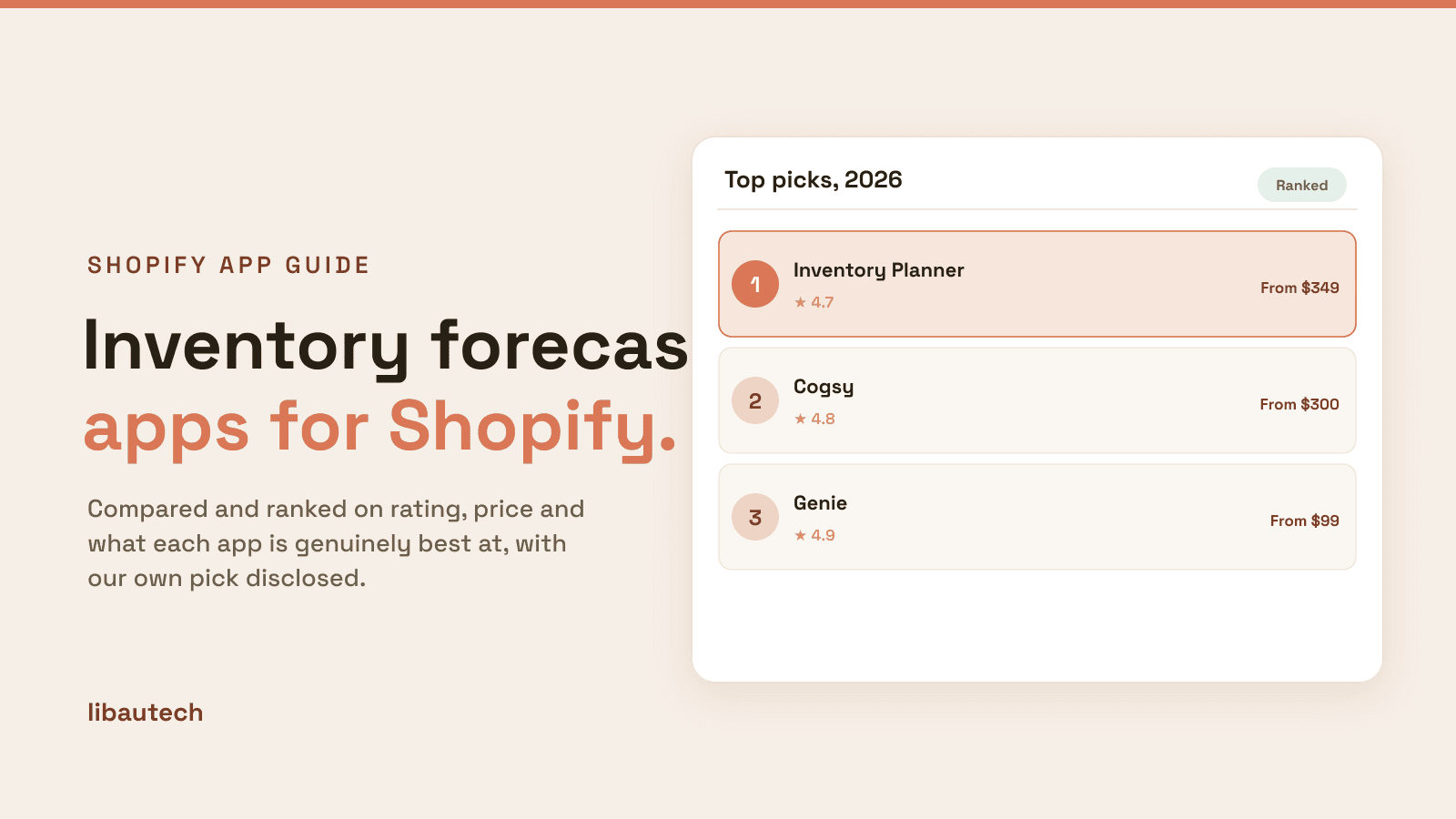
Last updated: May 2026 · Pricing and ratings verified from live Shopify App Store listings on May 4, 2026 · Reviewed by the Libautech team — builders of Bundles & Upsell and 8 other Built for Shopify apps used by 5,000+ merchants across 50+ countries.
Key Takeaways
- Inventory carrying costs typically run 20-30% of inventory value annually. The wrong reorder timing or overstocking compounds that cost dramatically. Inventory optimization apps target the two most expensive errors: stockouts (lost sales plus often the lost customer) and overstock (cash tied up in slow-moving SKUs that may eventually need to be discounted to clear).
- The Shopify inventory optimization category splits into three jobs that competitor blogs lump together — AI demand forecasting (Inventory Planner, Cogsy, Genie) for stores with seasonal or trending products, automated reordering and PO management (Stocky, Sumtracker) for SKU-heavy operations, and multi-warehouse allocation (Brightpearl, Cin7 Core, Linnworks) for stores fulfilling from multiple locations.
- Inventory Planner is the most-validated AI demand forecasting platform on Shopify, used by thousands of mid-market stores for seasonal forecasts, supplier order suggestions, and SKU-level demand modeling. The 4.7/5 rating reflects depth that lighter forecasting tools cannot match for stores with complex seasonal patterns.
- For Shopify Plus merchants, Stocky is included free and covers basic forecasting, supplier coordination, and PO management. The free option fits stores that do not yet need full AI demand modeling. Most stores eventually outgrow Stocky and graduate to Inventory Planner or Cogsy as forecasting accuracy becomes critical to revenue and cash flow.
- Pricing varies dramatically across the category. Stocky free with Plus, Sumtracker from $50/mo, Genie from $99/mo, Inventory Planner from $349/mo, Cogsy from $300/mo, full ERPs (Brightpearl, Cin7 Core, Linnworks) include forecasting at $300-3,000+/mo. Match the price tier to inventory turnover rather than buying ahead of operational complexity.
- For stores with $500K-plus annual inventory turnover, inventory optimization typically pays back within 3-6 months through reduced stockouts (capturing more sales) and lower carrying costs (less cash tied up in slow inventory). The ROI math is the strongest in the entire ecommerce app ecosystem when applied at the right scale.
Who Needs an Inventory Optimization App, and Why?
An inventory optimization app forecasts demand and plans reorders, so you buy the right amount at the right time and avoid both stockouts on bestsellers and cash tied up in overstock. Better forecasting protects sales and frees working capital.
You need one if you carry many SKUs, have variable demand, or feel the pain of running out or over-ordering. A tiny catalog with steady, predictable sales can plan by hand.
The Three Jobs of Shopify Inventory Optimization Apps
Most inventory optimization roundups treat AI forecasting, automated reordering, and multi-warehouse allocation as one category. They are not. Inventory Planner is purpose-built for AI demand forecasting at SKU level. Stocky is purpose-built for purchase order management with basic forecasting. Brightpearl is a full commerce ERP that includes inventory optimization as one feature among many. Different mechanics, different pricing, different operational tiers — and different right answers depending on what the store actually needs to optimize.
The first job is AI demand forecasting. Predict SKU-level demand based on historical sales velocity, seasonality patterns, marketing campaigns, supplier lead times, and target service levels. The mechanics are: the app analyzes sales history at the SKU level, models seasonality and trend components, factors in marketing event impact, and outputs forecasts plus reorder recommendations that account for lead times. Best fit for stores with seasonal demand, trending products, or significant marketing-driven sales spikes where simple reorder-point logic produces stockouts and overstock simultaneously. Inventory Planner, Cogsy, and Genie all live in this segment with different price tiers.
The second job is automated reordering and PO management. Generate supplier purchase orders at optimal times based on lead times and reorder points, manage supplier coordination, track stocktakes, and handle bundle component inventory. The mechanics are: the app monitors inventory levels against reorder points, generates POs when levels drop, sends them to suppliers, tracks supplier confirmation and delivery, and updates inventory when goods arrive. Best fit for SKU-heavy operations where the manual PO workflow is the bottleneck rather than the forecasting accuracy. Stocky and Sumtracker live in this segment, with Sumtracker adding bundle-component tracking that Stocky lacks.
The third job is multi-warehouse allocation. Route incoming orders to the optimal warehouse based on customer proximity, stock availability, and shipping cost, while keeping inventory levels balanced across locations. The mechanics are: the app maintains a real-time view of stock at each warehouse, applies routing rules (closest with stock, lowest cost, fastest delivery), and updates inventory at all locations as orders ship. Best fit for stores fulfilling from multiple locations where suboptimal routing costs meaningful shipping and split-shipment money. Brightpearl, Cin7 Core, and Linnworks live in this segment as full ERPs with multi-warehouse logic built in.
How We Ranked These Apps
The ranking weighs four dimensions: forecasting depth (does the model account for seasonality, marketing events, and supplier lead times, or is it just sales velocity), automation quality (does the PO and reorder workflow actually save operator time), scale fit (where the price-to-value math actually works), and Shopify App Store rating verified live on May 4, 2026 with review volume context. Apps that solve a specific inventory job exceptionally well rank higher in their job category than apps with broader feature sets but weaker depth in any single area. Native Shopify inventory features handle basic stock tracking but do not provide forecasting, automated reordering, or multi-warehouse allocation, so unlike most app categories, every recommendation here is a third-party app rather than a native Shopify feature.
1. Inventory Planner
Rating: 4.7/5 · Pricing: From $349/mo · Best for: Mid-market stores with seasonal demand patterns needing accurate SKU-level forecasts and automated supplier order suggestions · Job solved: AI demand forecasting with seasonality, marketing event integration, and multi-channel demand modeling
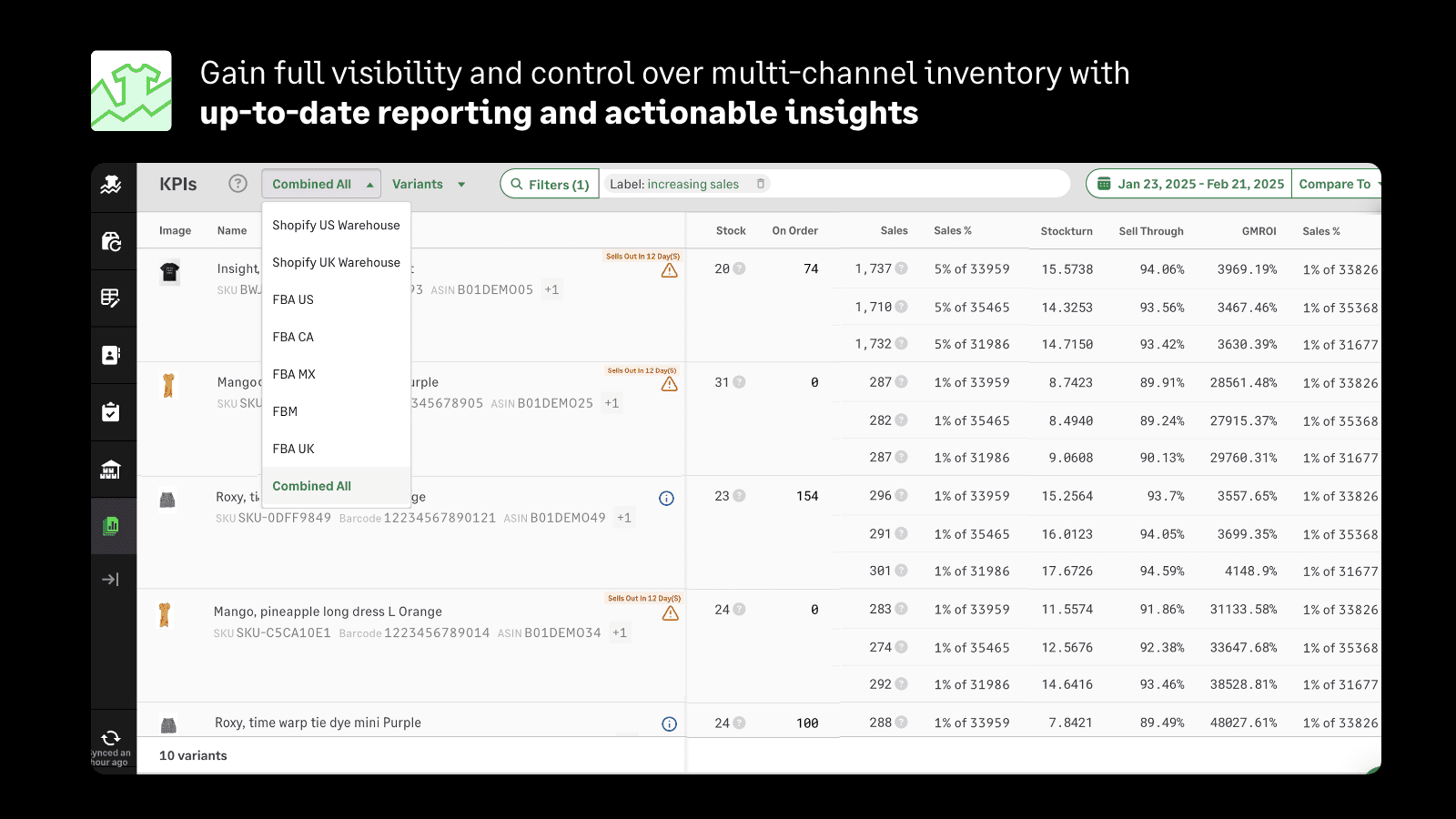
Inventory Planner is the dominant AI demand forecasting platform on Shopify. The forecasting model considers sales velocity, seasonality, marketing pushes (uploaded promotional calendars), supplier lead times, and target service levels to recommend exactly how much of each SKU to order and when. Custom dashboards track stockout risk, overstock SKUs, and forecast accuracy over time so the merchant can validate that the model is improving rather than degrading.
For stores with $1M-plus inventory and seasonal demand (apparel, gifts, outdoor gear, beauty), Inventory Planner typically reduces stockouts 30-60% and cuts overstock 20-40% within the first year. The multi-channel coverage (Shopify, Amazon, eBay, wholesale) keeps forecasts accurate across all sales channels rather than producing channel-specific blind spots. Where it falls short: pricing is mid-market+ only, and smaller stores find similar value at lower cost in Genie or Stocky. The 4.7/5 rating across thousands of reviews reflects strong satisfaction in the target segment with weaker fit when forced into smaller-scale use cases where the depth is wasted.
2. Cogsy
Rating: 4.8/5 · Pricing: From $300/mo · Best for: DTC brands using forecasting to drive marketing planning, cash flow management, and inventory financing decisions · Job solved: DTC-focused inventory operating system with cash flow and marketing integration alongside forecasting
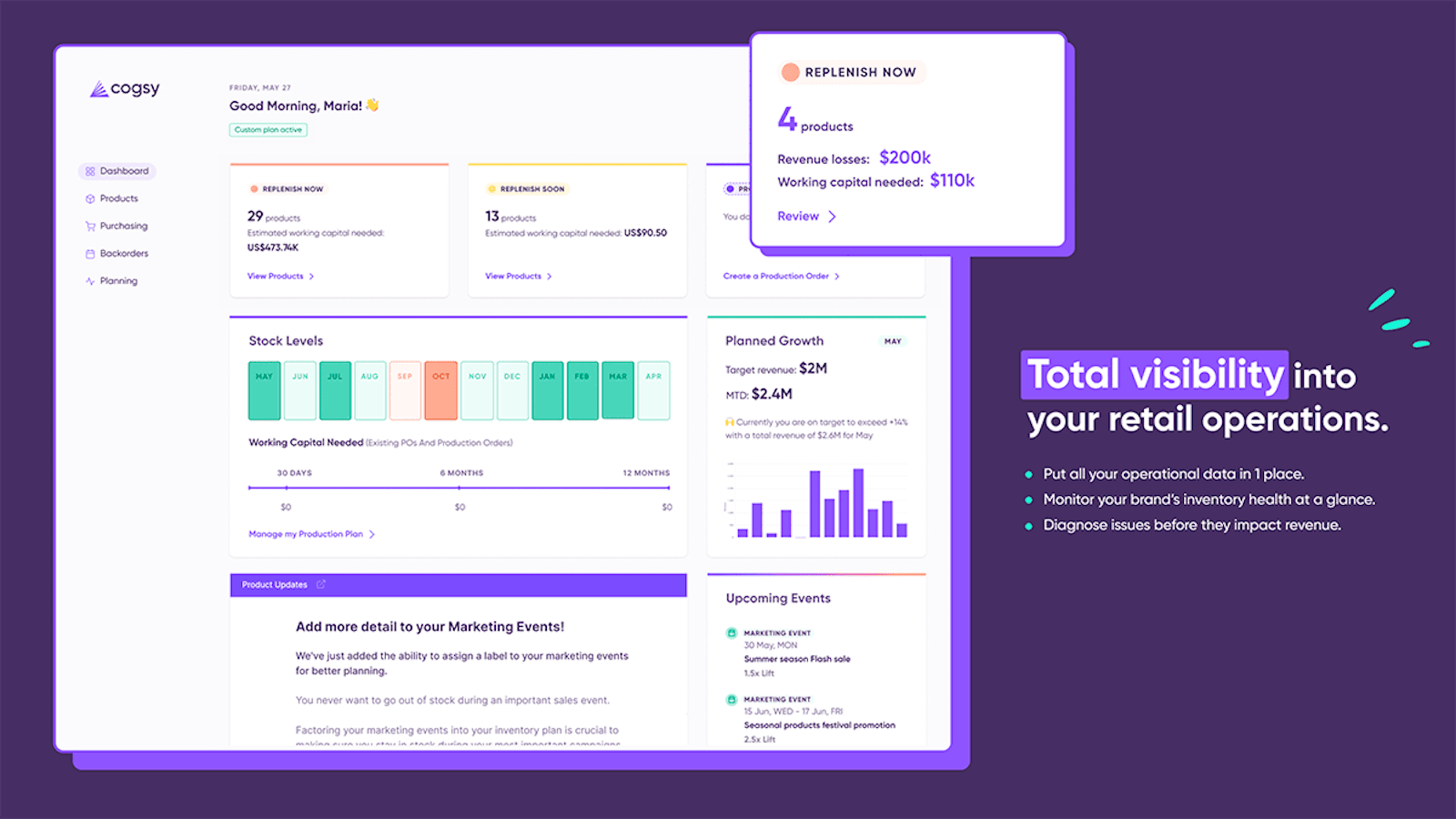
Cogsy is positioned as the operating system for DTC inventory. Beyond standard forecasting, it ties inventory directly to marketing spend (when do you stock up before a campaign?), cash flow (when does that PO need to be paid, and against what expected revenue?), and inventory financing decisions (which SKUs are good candidates for inventory loans?). For DTC brands at $1M-$20M revenue who treat inventory as a strategic lever rather than just an operations problem, Cogsy provides financial framing that other forecasting tools do not.
Strong reviews from brands running ad-driven sales spikes reflect the value proposition — Cogsy answers the question "how much do we need to order to support a $50K Facebook campaign next month?" in a way that Inventory Planner and Genie do not natively address. Where it falls short: less feature depth for retail or wholesale-heavy stores where the DTC marketing-cash-flow framing is not the binding constraint, and pricing is mid-market+ at $300 per month minimum. The 4.8/5 rating reflects strong satisfaction in the DTC segment specifically with weaker fit for non-DTC operational models.
3. Genie: Inventory and Forecasting
Rating: 4.9/5 · Pricing: From $99/mo · Best for: Smaller stores starting their inventory forecasting journey at affordable pricing before committing to enterprise-tier tools · Job solved: Affordable AI demand forecasting with sales velocity tracking, reorder point alerts, and basic seasonality detection
Genie offers AI demand forecasting at one of the lower price points in the category. Sales velocity tracking, reorder point alerts, and basic seasonality detection help stores transition from spreadsheet-based forecasting to automated SKU-level recommendations. The 4.9/5 rating across reviews indicates Genie genuinely delivers value at the price point — merchants in the target segment (smaller stores graduating from spreadsheets) consistently rate the app among the best on the Shopify App Store.
For stores doing $250K-$2M revenue with 100-500 SKUs, Genie typically delivers most of the forecasting value of Inventory Planner at one-third the cost. Where it falls short: less feature depth than Inventory Planner for complex multi-channel forecasting where seasonal patterns differ by channel, and the smaller user base means fewer integrations into adjacent tools (ERPs, attribution platforms, advanced analytics). Stores graduate to Inventory Planner once revenue exceeds $2-5M and the forecasting complexity outpaces what Genie's lighter feature set can model accurately.
4. Sumtracker
Rating: 4.7/5 · Pricing: From $50/mo · Best for: SKU-heavy stores with bundle products needing accurate inventory tracking accounting for bundles, kitting, and component inventory · Job solved: Bundle and component inventory tracking with multi-channel sync across Shopify, Amazon, Etsy, and eBay
Sumtracker handles a specific inventory complexity that simpler tools mishandle: bundle and component tracking. When a customer buys a 3-pack bundle, Sumtracker correctly decrements component inventory rather than just the bundle SKU. Multi-channel sync (Shopify, Amazon, Etsy, eBay) keeps inventory consistent across channels for stores selling individual SKUs and bundles simultaneously, which is the use case where most generic inventory tools produce double-counting errors that destroy margin invisibly.
Reorder point alerts, PO generation, and supplier coordination make this a reasonable starter inventory tool for stores with bundle complexity that simpler tools cannot handle correctly. Where it falls short: forecasting features are basic compared to Inventory Planner — Sumtracker is primarily an inventory tracking and PO tool with reorder logic rather than a true demand forecasting platform. The UI is functional but dated, which slows operator workflows compared to more polished alternatives. The 4.7/5 rating reflects mid-market satisfaction in the bundle-heavy segment specifically.
5. Stocky (Shopify Native)
Rating: 4.0/5 · Pricing: Free with Shopify Plus · Best for: Shopify Plus merchants needing free inventory operations including PO management, demand forecasting, and supplier coordination · Job solved: Native PO management, basic demand forecasting based on sales velocity, supplier coordination, stocktakes, and reorder point alerts
Stocky is included free with Shopify Plus and covers the basic inventory operations job: purchase orders, demand forecasting based on sales velocity, supplier coordination, stocktakes, and reorder point alerts. Native integration with Shopify products and inventory means no separate sync layer to break, which is a meaningful reliability advantage over third-party tools that depend on API sync intervals.
For Plus merchants whose forecasting needs are simpler (steady demand, predictable SKUs, no seasonal complexity), Stocky covers the basics without an additional subscription. Most stores eventually outgrow it for serious AI forecasting and graduate to Inventory Planner or Cogsy once revenue and complexity justify the upgrade. Where it falls short: the 4.0/5 rating is the lowest in this list and reflects mid-market frustration with feature limitations rather than failures of the core feature set. Stocky does what it claims (basic PO management, simple forecasting), but it does not extend into AI seasonality, marketing event integration, or multi-channel forecasting — Plus merchants who need those features end up paying for Inventory Planner anyway, which makes Stocky a transitional tool rather than a permanent answer.
6. Brightpearl
Rating: 4.4/5 · Pricing: From $375/mo · Best for: Multi-channel retail brands at $1M-$20M wanting inventory optimization plus accounting plus orders plus CRM in one platform · Job solved: Mid-market commerce ERP with built-in demand forecasting, automated reordering, multi-warehouse allocation, and supplier coordination
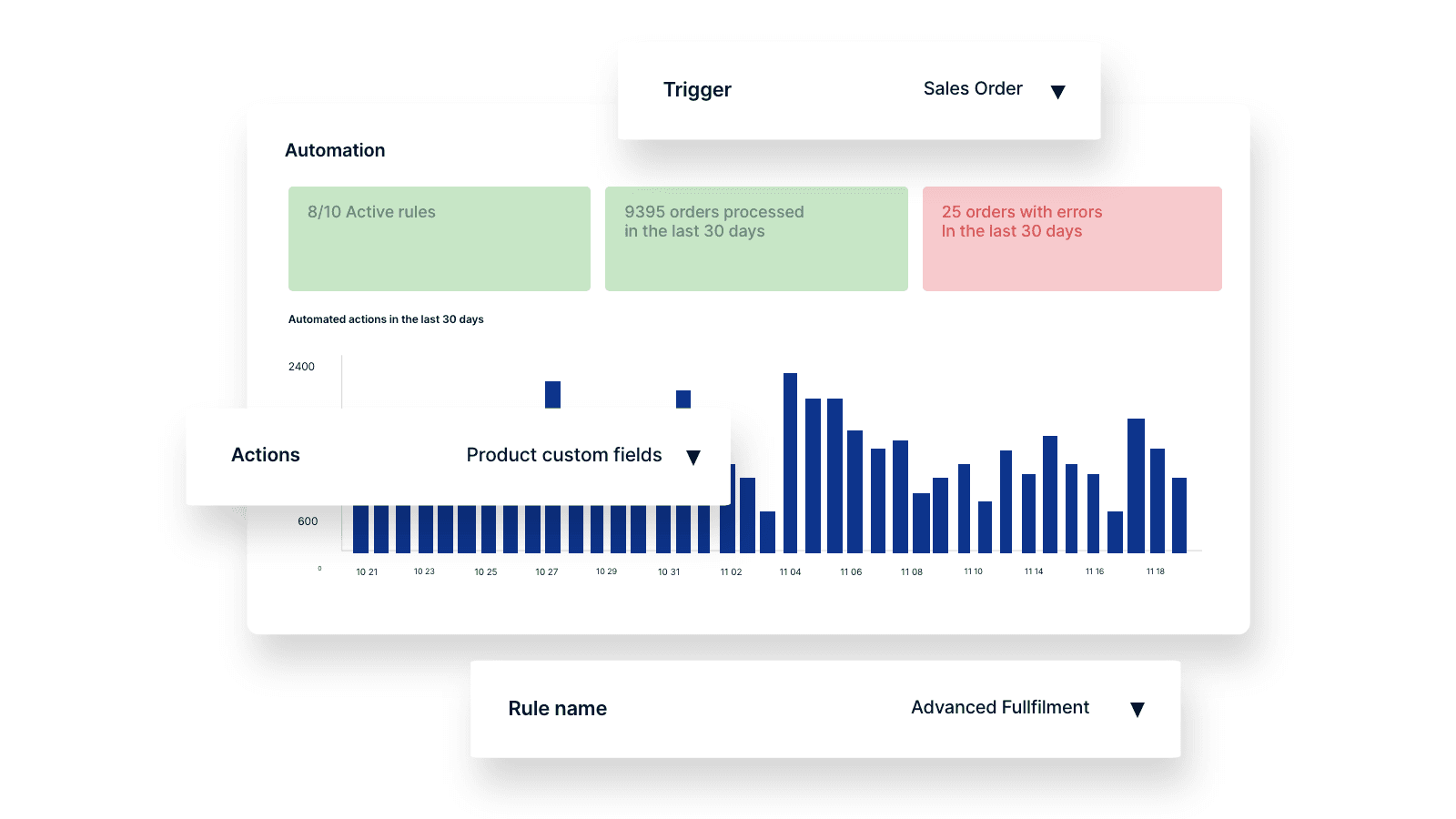
Brightpearl is the mid-market commerce ERP with built-in inventory optimization. Demand forecasting, automated reordering, multi-warehouse allocation, and supplier coordination all live in the same platform as accounting, orders, and CRM. The integrated view is the key benefit — inventory decisions inform marketing, cash flow forecasts, and supplier negotiations all from one dataset rather than reconciling across multiple disconnected tools.
For multi-channel retail brands looking for a unified platform rather than best-of-breed apps, Brightpearl is the standard pick. The forecasting depth is between Stocky and Inventory Planner — better than basic sales-velocity logic but less sophisticated than Inventory Planner's dedicated AI model. Where it falls short: pricing is mid-market+, and stores under $1M generally do not need this level of platform integration. Stores that genuinely need only inventory optimization without the broader ERP scope should pick Inventory Planner standalone rather than paying for Brightpearl's full feature set just to access the forecasting layer.
7. Cin7 Core
Rating: 4.6/5 · Pricing: From $349/mo · Best for: Inventory-complex stores with multiple warehouses, manufacturing, kitting, or batch tracking needing deep inventory ERP capabilities · Job solved: Deep inventory ERP with multi-warehouse allocation, manufacturing BOMs, kitting, batch tracking, and demand forecasting
Cin7 Core is built around inventory complexity. Multi-warehouse allocation, manufacturing BOMs (bills of materials), kitting, batch tracking, expiration dates, and serial numbers are first-class features rather than afterthoughts. Demand forecasting and reorder automation work alongside the deeper inventory features, which means stores manufacturing or assembling products do not need to coordinate between separate forecasting and inventory tracking tools.
For stores manufacturing or assembling products (food, supplements, custom hardware, kitted gift sets), Cin7 Core handles complexity that lighter forecasting tools cannot model. The integrated B2B portal lets wholesale buyers self-serve with custom price lists. Where it falls short: forecasting is less sophisticated than Inventory Planner for pure forecasting use cases — Cin7 Core's strength is inventory complexity handling rather than demand modeling depth, and stores that need both must often pair Cin7 Core with Inventory Planner. Setup time is longer than dedicated forecasting tools because the inventory complexity surfaces during configuration.
8. Linnworks
Rating: 4.5/5 · Pricing: From $300/mo · Best for: UK and EU multi-marketplace sellers needing centralized inventory allocation across Shopify plus Amazon plus eBay plus Etsy with strong European fulfillment integration · Job solved: Multi-marketplace inventory allocation and order routing with European carrier integration and demand forecasting
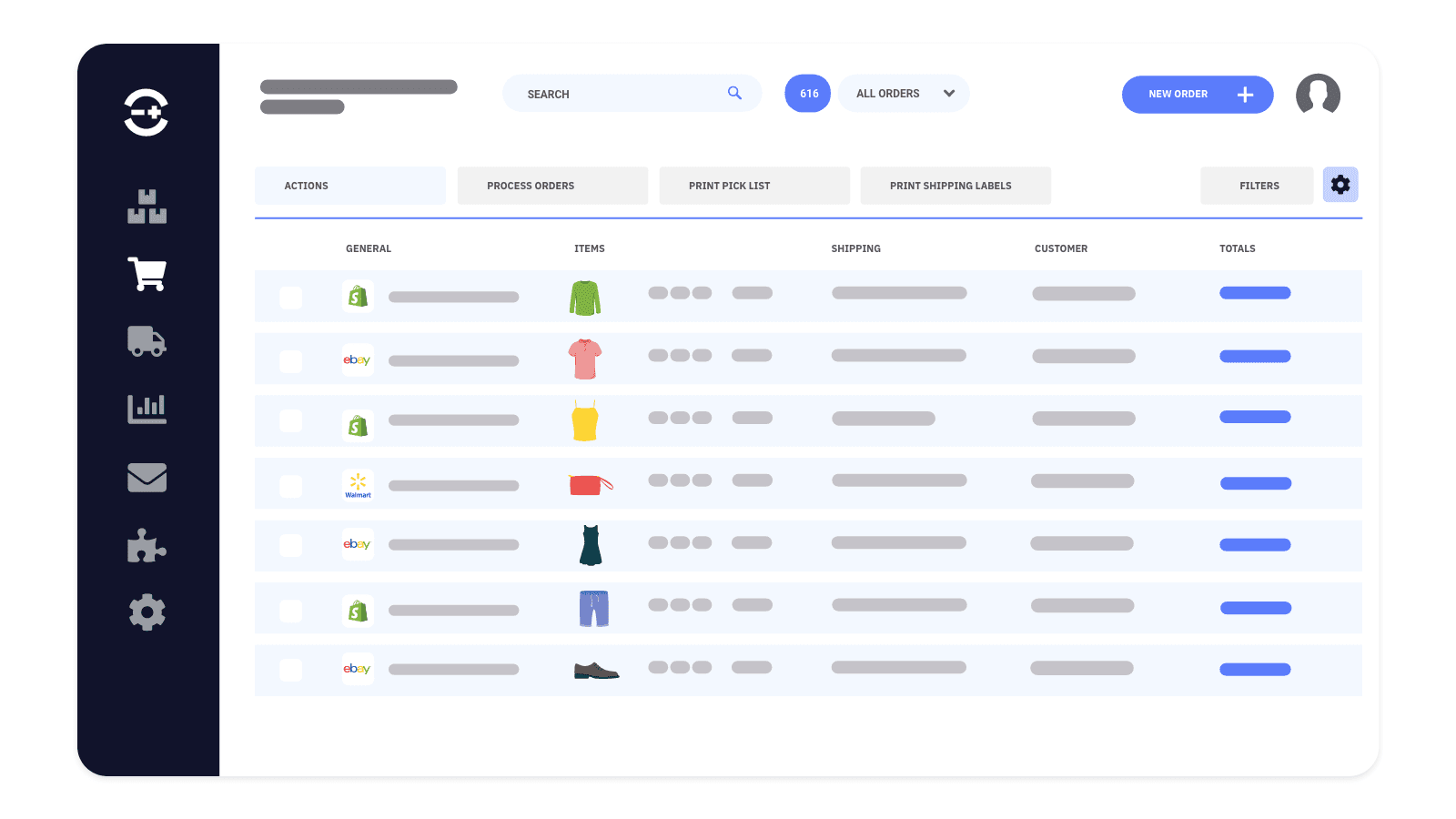
Linnworks dominates the UK and EU multi-marketplace operations market. Centralized inventory allocation across Shopify, Amazon, eBay, Etsy, and OnBuy keeps stock consistent everywhere with proper allocation rules so a single SKU does not oversell across multiple channels. Built-in demand forecasting layers on top of the allocation engine, and the European carrier integration (Royal Mail, DPD, ParcelForce, Hermes) handles fulfillment complexity that US-built tools handle poorly.
For UK and EU multi-marketplace sellers with multiple warehouses, Linnworks is typically the right operational platform regardless of revenue tier because the European logistics and multi-marketplace integration is the binding constraint. Where it falls short: less strong in US-only setups where Brightpearl or dedicated US tools cover similar ground at lower cost, and the forecasting layer is not as sophisticated as Inventory Planner for pure forecasting use cases. The 4.5/5 rating reflects strong satisfaction in the target European multi-marketplace segment with weaker fit when forced into US-centric or single-channel use cases.
Shopify Inventory Optimization Apps Comparison Table
| App | Job | Rating | Pricing | Best For |
|---|---|---|---|---|
| Inventory Planner | AI demand forecasting | 4.7/5 | From $349/mo | Mid-market with seasonal demand |
| Cogsy | DTC inventory planning | 4.8/5 | From $300/mo | DTC brands forecasting cash flow |
| Genie | Affordable forecasting | 4.9/5 | From $99/mo | Smaller stores starting forecasting |
| Sumtracker | Inventory + bundles tracking | 4.7/5 | From $50/mo | SKU-heavy stores with bundles |
| Stocky (Shopify) | Native PO + forecasting | 4.0/5 | Free with Shopify Plus | Plus merchants — free starter |
| Brightpearl | Full ERP with forecasting | 4.4/5 | From $375/mo | Multi-channel mid-market retail |
| Cin7 Core | Inventory ERP | 4.6/5 | From $349/mo | Multi-warehouse + manufacturing |
| Linnworks | Multi-marketplace allocation | 4.5/5 | From $300/mo | UK/EU multi-marketplace sellers |
Picking the Right Stack by Store Profile
The decision tree for most stores is simple once revenue and operational complexity are considered. Mid-market store with seasonal demand needing best-in-class AI forecasting: Inventory Planner is the right pick — the category leader, and the depth justifies the cost at $1M-plus inventory turnover. DTC brand using forecasting for marketing and cash flow planning: Cogsy is the right pick — strongest financial framing for the DTC operational model. Smaller store starting forecasting at affordable price: Genie is the right pick — best value at lower scale and the 4.9/5 rating reflects exactly that fit.
SKU-heavy store with bundles or kits: Sumtracker is the right pick — best bundle inventory accuracy. Shopify Plus merchant wanting free inventory ops: Stocky is the right pick — free starter included with Plus, and most stores can run on Stocky for years before genuinely needing the upgrade. Multi-channel retail wanting one unified platform: Brightpearl is the right pick — best mid-market commerce ERP. Multi-warehouse or manufacturing complexity: Cin7 Core is the right pick — deepest inventory features. UK or EU multi-marketplace sellers: Linnworks is the right pick — strongest European fulfillment integration.
Combined with Libautech's Bundles & Upsell, Sticky Add to Cart, and Announcement Bar (all included on the $14.99 per month Package plan), the inventory-plus-conversion stack covers operational planning and storefront conversion mechanics from one combined toolset. Bundles & Upsell in particular complements inventory optimization by moving slow-moving SKUs through bundle offers — the inventory tool tells you which SKUs are slow, and the bundle tool lets you pair them with bestsellers to clear stock at full price rather than markdown clearance.
What Native Shopify Already Handles
Shopify's native inventory capabilities cover the basics. Stock levels per SKU, low-stock alerts at configurable thresholds, basic inventory reports, multi-location inventory tracking up to 1,000 locations on Plus, and the cost-per-item field that supports basic margin reporting. For stores with 50 SKUs, steady demand, and a single warehouse, Shopify's native features plus a manual quarterly review with a spreadsheet is usually enough — paid inventory optimization apps do not earn their cost at this scale.
What native Shopify still does not handle: AI demand forecasting with seasonality and marketing event integration (Inventory Planner, Cogsy, Genie needed), automated PO generation and supplier coordination (Stocky for Plus or Sumtracker for non-Plus needed), bundle and component inventory tracking (Sumtracker needed for bundle-heavy stores), multi-warehouse allocation with routing rules (Brightpearl, Cin7 Core, Linnworks needed), and any form of cash flow modeling tied to inventory decisions (Cogsy needed for DTC brands). Before installing a paid inventory optimization app, audit whether Shopify's native low-stock alerts plus a manual reorder discipline would suffice for the current scale — most stores under $500K revenue never genuinely need a paid optimization app.
How Inventory Optimization Pairs with Conversion Tools
Inventory optimization handles the supply side of the operation, but the storefront still has to convert traffic into orders before any of that inventory infrastructure becomes useful. The inventory stack and the conversion stack solve different problems and rarely conflict — inventory tools tell the merchant what to stock and when, while conversion tools influence how much of that stock actually sells through. Both belong in a healthy Shopify operation, and the cost of either stack is small compared to the revenue impact of getting both right.
Libautech's Sticky Add to Cart keeps the buy button visible while customers read product copy, which means the SKUs Inventory Planner forecasted accurately actually convert into orders rather than getting browsed and abandoned. Bundles & Upsell directly compounds inventory optimization by moving slow-moving SKUs through bundle offers — Bundles & Upsell can route specific SKUs into bundle offers based on inventory levels, turning slow-moving stock into AOV-driving bundles instead of markdown clearance. Announcement Bar runs the storewide messaging that pushes traffic toward the SKUs the inventory tool flagged as overstocked when a deliberate sell-through campaign is needed. All three are available on the $14.99 per month Package plan, paying back faster than most inventory tools in saved markdown losses.
Common Inventory Optimization Mistakes
The biggest inventory optimization mistake is buying a sophisticated tool before having the data quality to feed it. Stores install Inventory Planner with 18 months of messy historical sales data, miscategorized SKUs, and inconsistent cost-per-item values, then complain that the forecasts are inaccurate. The fix is to clean the underlying data before subscribing — accurate SKU categorization, correct cost-per-item values across the catalog, and clean sales history for at least 12 months. The half-week of data cleanup work pays back the entire first year of forecast accuracy, and stores that skip it discover the model produces noise rather than signal.
The second common mistake is treating forecasting as set-and-forget. Inventory Planner or Cogsy produces a recommendation, the merchant places the PO, and then nobody checks whether the forecast was accurate when the next reorder cycle arrives. The fix is to run a monthly forecast accuracy review — compare the previous month's forecast to actual sales, identify SKUs where the model was meaningfully wrong, and adjust either the model parameters or the SKU categorization to improve the next cycle. Stores that skip this review cycle see forecast accuracy degrade over 12-18 months as product mix shifts and seasonal patterns evolve.
The third is ignoring lead time accuracy. Forecasting models depend on supplier lead time inputs, and stores typically enter the lead time once at setup and never update it. Suppliers slip from 4-week lead times to 6-week lead times during peak season, and the model cannot account for the slip if the configured lead time is still 4 weeks — the result is stockouts that the forecast technically predicted correctly but the reorder timing missed because the lead time was wrong. The fix is to update lead times quarterly based on actual recent supplier performance rather than the original quoted lead times.
How Inventory Optimization Affects Cash Flow and Margin
The single highest-leverage benefit of clean inventory optimization is cash flow. Inventory is usually the largest current asset on a Shopify retailer's balance sheet, which means optimizing inventory levels directly frees working capital for other uses — paid acquisition, new product development, hiring, or simply reduced borrowing costs. A store with $1M in average inventory that reduces overstock by 25% recovers $250,000 in cash that was previously tied up in slow-moving SKUs, which is meaningful capital at any revenue scale.
Beyond cash flow, the margin impact compounds over multiple cycles. Stockouts cost lost sales (typically 5-20% revenue lift on stocked-out periods when fixed) and often the customer relationship — customers who arrive ready to buy and find products unavailable do not always return. Overstock costs markdown losses (typically 30-60% margin compression on clearance SKUs) plus the warehouse and capital costs of carrying the inventory. Stores that get inventory optimization right see compounding margin lift of 5-15 percentage points across the full year, which on a $5M revenue store is $250,000-750,000 in incremental profit that goes straight to the bottom line.
FAQ — Shopify Inventory Optimization Apps
What is the best Shopify inventory optimization app in 2026? For mid-market stores with seasonal demand and the need for sophisticated forecasting, Inventory Planner is the category leader. For DTC brands tying inventory to marketing and cash flow, Cogsy. For smaller stores starting forecasting, Genie at $99 per month offers most of the forecasting value at one-third the cost. For Shopify Plus merchants wanting free inventory ops, Stocky covers the basics without an additional subscription.
How much does inventory optimization cost on Shopify? Wide range. Free options exist (Stocky for Plus). Affordable AI forecasting starts at $99 per month (Genie). Mid-market dedicated forecasting runs $300-500 per month (Inventory Planner, Cogsy). Full commerce ERPs with built-in forecasting (Brightpearl, Cin7 Core, Linnworks) start at $300-375 per month and typically run $1,500-3,000 per month for active stores at scale.
What is the difference between inventory sync apps and inventory optimization apps? Inventory sync apps (Stock Sync, Trunk, native Shopify) keep inventory consistent across sales channels but do not predict demand. Inventory optimization apps (Inventory Planner, Cogsy, Genie) forecast future demand to drive reorder timing and quantity decisions. Most stores at scale need both — sync to keep stock accurate now, optimization to plan future stock levels.
Does Shopify have built-in inventory forecasting? Native Shopify inventory tracking is basic — stock levels, low-stock alerts, and simple reports. Real demand forecasting requires Stocky (free with Plus) or a dedicated app like Inventory Planner. Shopify's native reports are useful for diagnosing stockouts after the fact, not predicting them in advance.
How does AI demand forecasting work for inventory? AI demand forecasting models analyze historical sales data, seasonality patterns, day-of-week and month-of-year cycles, marketing event impact (sales spikes during promotions), supplier lead times, and target service levels (how often you are willing to stock out). The model outputs SKU-level recommendations: how much to order, when to order, and which SKUs to deprioritize. Modern AI models from Inventory Planner, Cogsy, and Genie typically achieve 70-85% forecast accuracy depending on data quality.
How long does it take to see ROI from inventory optimization? Most stores see meaningful ROI within 3-6 months of implementation. The two main mechanisms: reduced stockouts (recovering lost sales — typically 5-20% revenue lift on stocked-out periods) and lower carrying costs (less cash tied up in slow-moving SKUs — typically 15-30% reduction in average inventory). Stores with seasonal demand typically see ROI within one full season cycle.
Should I use Stocky or Inventory Planner? Stocky is free with Shopify Plus and covers basic inventory operations — PO management, supplier coordination, simple forecasting based on sales velocity. Inventory Planner is paid ($349-plus per month) but offers AI-driven forecasting with seasonality, marketing event integration, and multi-channel demand modeling. Plus merchants typically start on Stocky and graduate to Inventory Planner once forecasting accuracy becomes critical to revenue and cash flow.
Can inventory optimization apps integrate with my ERP? Most yes. Inventory Planner integrates with NetSuite, Brightpearl, Cin7 Core, and others. Cogsy connects to QuickBooks and Xero. Genie integrates with QuickBooks. For stores running a full ERP, the inventory optimization layer typically reads from the ERP's source-of-truth data and writes back recommended POs.
Final Word
Inventory optimization is the highest-ROI operational investment most Shopify stores can make once revenue passes $500,000 annually. The discipline is to install the right tool for the actual operational complexity (forecasting depth, multi-channel coverage, multi-warehouse allocation, bundle component tracking) rather than the most expensive option by default — and to clean the underlying data before expecting the model to produce accurate forecasts. Cheap and right beats expensive and wrong every quarter, and the merchants who treat inventory optimization as ongoing infrastructure rather than a one-time setup are the ones who compound margin and cash flow improvements year over year. Match the tool to the operational complexity, clean the data, run monthly forecast accuracy reviews, and the inventory math will compound rather than erode.