Best Shopify Volume Discount Apps for Higher AOV (2026)
Last updated: March 2026
Studies consistently show that increasing average order value is more cost-effective than acquiring new customers. One of the most reliable ways to do it is volume discounts, giving shoppers a financial reason to buy more in a single transaction. When a customer sees they save 20 percent by buying five units instead of two, the math is simple and the decision is easy.
But not every Shopify store needs the same type of discount tool. Volume discounts, bundle apps, and wholesale pricing tools all overlap in this category and serve different purposes. Volume discount apps primarily handle quantity breaks on single products. Buy more, pay less per unit. Bundle apps focus on combining different products at a reduced total price. Wholesale pricing tools create separate pricing tiers for different customer groups like retailers or B2B buyers. The best apps often do more than one of these things, which is why choosing the right one requires understanding what your store actually needs.
This guide covers the best Shopify apps for volume discounts as of 2026, including ratings, pricing, honest pros and cons, and clear guidance on which tool fits which situation.
Quick Comparison Table
Use this table to find the right app at a glance before reading the full breakdown below.
| App | Rating | Starting Price | Best For | Free Trial |
|---|---|---|---|---|
| Libautech Bundle & Upsell | 4.8 ⭐ | Free plan available | All-in-one upsell + volume | Yes |
| Kaching Bundle Quantity Breaks | 4.9 ⭐ | Free plan available | Clean quantity breaks, fast setup | Yes |
| Dealeasy | 5.0 ⭐ | Free plan available | Newer stores, simple tiers | Yes |
| Bundle Bear | 4.8 ⭐ | From $9.99/mo | Transparent pricing tables | Yes |
| Selleasy | 4.9 ⭐ | Free plan available | Upsells + quantity breaks combined | Yes |
| VolumeBoost by HulkApps | 4.7 ⭐ | From $10/mo | Customer-tag-based tiers | Yes |
| Bundler | 4.8 ⭐ | Free plan available | Mix-and-match bundles | Yes |
| Wholesale Pricing Discount B2B | 4.8 ⭐ | From $14.99/mo | B2B and wholesale stores | Yes |
| Bold Discounts | 4.6 ⭐ | From $19.99/mo | Flash sales + volume discounts | Yes |
| Quantity Breaks & Discounts | 4.7 ⭐ | From $7.99/mo | Simple, reliable quantity breaks | Yes |
| Discounted Upsells | 4.5 ⭐ | From $14.99/mo | Cart-level volume nudges | Yes |
Ratings are based on Shopify App Store data as of early 2026. Verify current pricing on each app listing before installing.
What to Look for in a Volume Discount App
Before picking an app, it helps to think through what actually separates a good volume discount tool from a frustrating one.
Checkout reliability is the most important thing. Some apps apply discounts by modifying the price shown on the product page but fail to carry that discount through to checkout correctly. Always test a full purchase from product page to order confirmation before going live.
Theme compatibility is a close second. Volume discount widgets need to render correctly in both your desktop and mobile layout, including cart drawers, which many themes use instead of a dedicated cart page. Not all apps handle cart drawers well.
Discount logic matters more than it seems. Some apps only support percentage discounts. Others support fixed-amount discounts or flat per-unit pricing. If your pricing strategy relies on a specific discount type, confirm the app actually supports it before you commit.
The difference between auto-apply and manual discounts is worth understanding too. Auto-apply discounts update the price as soon as the customer adds enough units to their cart. Manual discounts require the customer to enter a code. Auto-apply converts better because it removes friction, but it can conflict with other active discount codes depending on how the app handles stacking.
Finally, analytics. If you cannot see which discount tier is generating the most revenue, you are running volume discounts blind. The best apps tell you how many orders included a tiered discount and at what level, so you can adjust thresholds based on actual behavior rather than guesswork.
The Best Shopify Volume Discount Apps in 2026
Libautech Bundle and Upsell
Rating: 4.8 | Pricing: Free plan available | Best for: Stores that want volume discounts and upsells in one tool
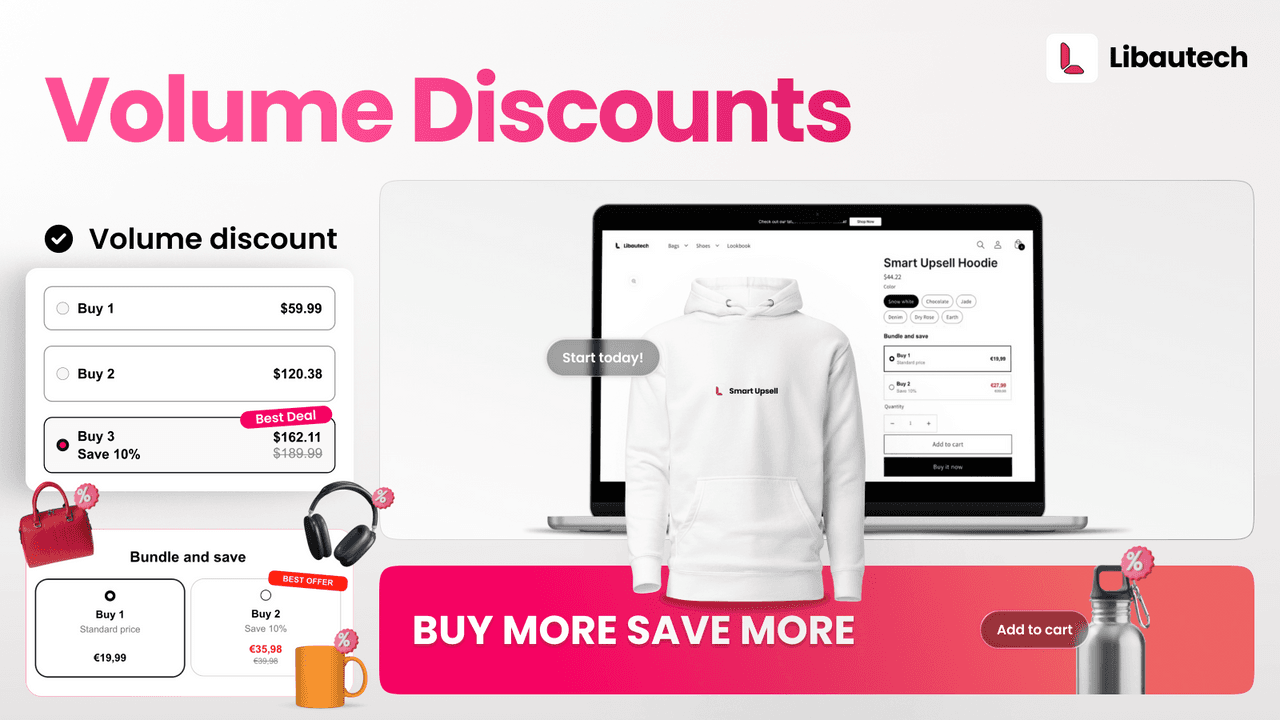
Libautech Bundle and Upsell is built by Libautech, the publisher behind this blog, so consider that context when reading this entry. That said, it earns its place on this list because it handles volume discounts as part of a broader upsell system rather than as a standalone feature. You can create tiered quantity breaks on the product page, combine them with frequently bought together offers, and layer in cart upsells and post-purchase offers, all managed from one dashboard. For stores that want to run volume discounts without adding a second app for upsells, this reduces complexity meaningfully.
Where it works well: stores with multiple product lines that benefit from both cross-sell and quantity-break offers at the same time.
Where it may not be the best fit: stores that only need a simple quantity break widget and prefer a focused, lightweight tool.
Pros: All-in-one upsell and volume discount system, no coding required, free plan available
Cons: More features than some stores need, publisher bias in this review
Kaching Bundle Quantity Breaks
Rating: 4.9 | Pricing: Free plan available, paid plans from around $14.99/mo | Best for: Merchants who want clean, fast quantity break setup
Kaching is one of the most reviewed volume discount apps on the Shopify App Store and maintains a consistently high rating. The setup is fast, the quantity break widget integrates cleanly with most themes, and the pricing table clearly shows customers what they save at each tier. Merchants frequently mention how little time it takes to go from installation to a live discount running on the product page.
Where it works well: stores of any size that need reliable quantity breaks without complexity.
Where it may not be the best fit: merchants who need customer-tag-based pricing or B2B-specific features.
Pros: High rating, fast setup, clean UI, free plan
Cons: Limited to quantity breaks, less powerful for wholesale or complex pricing structures
Dealeasy
Rating: 5.0 | Pricing: Free plan available | Best for: Newer stores, simple volume setups
Dealeasy is one of the newer entrants in this category and has quickly earned a perfect rating from a growing number of reviews. It handles volume discounts, free shipping bars, and quantity break widgets in a lightweight package. The interface is straightforward and the app is designed to be installed and operational within minutes. Because it is newer, it has fewer long-term reviews than more established options, but the early signal is strong.
Where it works well: newer Shopify stores that want to test volume discounts without committing to a complex or expensive tool.
Where it may not be the best fit: larger operations that benefit from a more established app with longer support history.
Pros: Perfect early rating, free plan, quick setup, includes free shipping bar
Cons: Fewer total reviews than established competitors, limited advanced features
Bundle Bear
Rating: 4.8 | Pricing: From $9.99/mo, free trial available | Best for: Stores that want transparent, well-designed pricing tables
Bundle Bear focuses on displaying tiered pricing tables clearly on the product page. The visual design of the widget is one of the strongest on this list. Customers see exactly what they save at each quantity level before adding anything to their cart. Transparency at this stage tends to increase conversion on the discount offer because there is no ambiguity. The app also integrates with Shopify's native discount system, which reduces the risk of conflicts at checkout compared to apps that use custom discount logic.
Where it works well: stores where product page design matters and where presenting discount tiers visually is part of the brand experience.
Where it may not be the best fit: merchants on tight budgets who need a free option.
Pros: Excellent visual widget design, native discount integration, strong checkout reliability
Cons: No permanent free plan, fewer features beyond the pricing table widget
Selleasy
Rating: 4.9 | Pricing: Free plan available, paid plans from around $8.99/mo | Best for: Upsells and quantity breaks working together from day one
Selleasy is well regarded across the Shopify merchant community for its reliability and clean interface. It combines frequently bought together recommendations with bundle discounts and quantity break offers in a system that is relatively straightforward to configure. Merchants consistently praise the support team for responsiveness, which matters when you are troubleshooting a discount setup before a sale event.
Where it works well: stores that want upsell and volume discount functionality without the learning curve of more complex tools.
Where it may not be the best fit: stores that need advanced analytics or deep B2B pricing customization.
Pros: High rating, good free plan, upsell and quantity breaks combined, responsive support
Cons: Less granular analytics than dedicated volume discount tools
VolumeBoost by HulkApps
Rating: 4.7 | Pricing: From $10/mo, free trial available | Best for: Stores that need customer-tag-based tiered pricing
VolumeBoost supports multiple discount types including percentage reductions, fixed amount discounts, and flat per-unit pricing. What sets it apart from simpler tools is its support for customer-tag-based pricing, meaning you can create different discount tiers for different customer segments. A loyalty member tag can unlock better rates than a first-time visitor sees. The app also includes a cart message feature that tells customers how many more units they need to add to reach the next discount tier.
Where it works well: stores with loyalty programs, membership tiers, or any structure where different customers should see different prices.
Where it may not be the best fit: straightforward stores that only need one universal discount tier.
Pros: Customer-tag-based pricing, multiple discount types, cart progress messaging
Cons: Higher starting price than some alternatives, interface can feel complex for simple use cases
Bundler
Rating: 4.8 | Pricing: Free plan available, paid plans from around $6.99/mo | Best for: Mix-and-match bundles and fixed product sets
Bundler sits more firmly in the bundle category than the pure volume discount category, but it handles both. Fixed bundles, mix-and-match bundles, and quantity break offers can all be configured within the same app. The mix-and-match feature is particularly useful for stores selling products that naturally go together, skincare sets, supplement stacks, kitchen tools, because it lets customers build their own bundle from a curated selection while still getting the volume savings.
Where it works well: product categories where customers naturally want to combine different items and where a fixed bundle would feel too rigid.
Where it may not be the best fit: stores that primarily need quantity breaks on individual products rather than multi-product bundles.
Pros: Mix-and-match functionality, good free plan, broad bundle type support
Cons: More oriented toward bundles than pure quantity breaks, widget customization limited on lower plans
Wholesale Pricing Discount B2B
Rating: 4.8 | Pricing: From $14.99/mo, free trial available | Best for: Stores serving both retail and wholesale buyers
This is the most specialized tool on the list and the right choice for a specific type of store. If you sell to both retail customers and wholesale or B2B buyers, you need a pricing system that can serve both segments from the same Shopify store without showing your wholesale prices to retail visitors. Wholesale Pricing Discount B2B handles this through customer-group-based pricing. Volume discounts can be configured per customer group, per product, or across entire collections.
Where it works well: manufacturers, distributors, or any DTC brand that has added a wholesale channel.
Where it may not be the best fit: purely retail stores that do not have a B2B channel.
Pros: Proper B2B and wholesale pricing support, flexible tier configuration, works without a separate store
Cons: Priced for B2B use cases, overkill for retail-only stores
Bold Discounts
Rating: 4.6 | Pricing: From $19.99/mo | Best for: High-volume stores running frequent scheduled promotions
Bold has been building Shopify apps for over a decade. Bold Discounts is the most powerful option for stores that run frequent, time-limited promotions alongside permanent volume pricing. You can schedule flash sales across entire collections, set start and end times, exclude specific products, and manage everything from one dashboard. The feature set is broader than what most small to mid-sized stores need, but for merchants who treat promotional events as a core part of their revenue strategy, Bold provides a level of control that simpler tools do not.
Where it works well: larger stores or fast-growing brands that run regular sale events and seasonal promotions at scale.
Where it may not be the best fit: stores that just need a simple quantity break widget, especially given the higher price point.
Pros: Powerful scheduling tools, broad collection-level discounting, established reputation
Cons: Most expensive option on this list, more features than most stores need, steeper learning curve
Quantity Breaks and Discounts
Rating: 4.7 | Pricing: From $7.99/mo, free trial available | Best for: Reliable quantity breaks without added complexity
This app focuses entirely on quantity-based pricing and does it cleanly. You set the tiers, pick the discount type, and the widget appears on your product page. It supports both percentage and fixed-amount discounts, works across multiple product types, and integrates with Shopify Markets for stores selling across multiple regions.
Where it works well: stores that tried more complex tools and found them overwhelming, or merchants who want quantity breaks running with minimal ongoing maintenance.
Where it may not be the best fit: stores that need bundle creation, customer-segment-based pricing, or upsells.
Pros: Straightforward configuration, Shopify Markets compatible, reliable performance
Cons: Limited feature set by design, no free plan
Discounted Upsells
Rating: 4.5 | Pricing: From $14.99/mo, free trial available | Best for: Cart-stage volume nudges on minimalist store designs
Discounted Upsells applies the volume discount nudge at the cart stage rather than the product page. When a customer opens their cart, the app shows them how close they are to unlocking a discount by adding more units. This works well for stores with minimal product pages where adding a widget would disrupt the design, or where the cart drawer is the primary interaction point.
Where it works well: brands with minimalist product pages, or stores where the cart experience is already optimized.
Where it may not be the best fit: stores where product page impressions are significantly higher than cart opens, as fewer shoppers will see the offer overall.
Pros: Cart-stage approach, works well for minimalist designs, targeted timing
Cons: Reaches fewer shoppers than product page widgets, lower rating than most apps on this list
How to Choose the Right App for Your Store
The decision comes down to three questions.
First, do you only need quantity breaks or do you also want upsells? If it is just quantity breaks, Kaching, Dealeasy, or Bundle Bear will get you there fastest. If you want upsells and volume discounts working together, Libautech Bundle and Upsell or Selleasy handle both without requiring two apps.
Second, do you sell to businesses or wholesale buyers? If yes, Wholesale Pricing Discount B2B is the only tool on this list built specifically for that use case.
Third, do you run frequent promotional events? If your business model involves regular sale events and seasonal discounts across collections, Bold Discounts gives you more scheduling control than the alternatives. If you just want permanent tiered pricing, the more expensive features of Bold are not worth the added cost.
Before committing to any app, test the full checkout flow on both desktop and mobile after installing. Volume discount apps are one of the categories where real-world checkout behavior can differ from what the product page shows, particularly when discount codes or subscription products are involved.
Impact: What Merchants Can Expect
The business case for volume discounts is well established. Tiered pricing directly addresses the most common barrier to larger orders. The customer's perception that buying more than they immediately need represents risk. When that risk is offset by a clear saving, a meaningful portion of shoppers will increase their order size.
The typical effect merchants report after implementing tiered quantity breaks is a measurable lift in average order value, often in the range of 10 to 30 percent depending on the product category and how the tiers are structured. Categories where this works best are consumables, products with natural gift-purchasing behavior, and anything where buying in bulk has obvious practical value for the customer.
The biggest factor in performance is how the discount tiers are structured. Starting with a low threshold, for example, buy two and save five percent, creates an accessible entry point that a higher share of customers will cross, and higher tiers become more attractive once the behavior pattern is established.
Have an App to Recommend?
This guide is updated regularly as the Shopify app ecosystem changes. If you use a volume discount app that belongs on this list, or if you have noticed changes in ratings or pricing, we want to hear from you.
Contact us to suggest an app or report an update
Related reading: how to increase Shopify average order value, best Shopify upsell apps, how to set up product bundles on Shopify.
Related guides: Volume discount profit calculator, Bundle products at a discount, Plus bundle price comparison and Best frequently bought together apps.