Best Platforms to Take Down Fake Stores Copying Your Shopify Store (2026)
You run a Shopify store, and look-alike sites are copying your product photos and page titles onto .shop and .store domains and selling to your customers. Getting them down has two halves: finding them, and taking them down. The platforms below do very different amounts of each. Some hunt the clones for you and run the whole takedown; some wait for you to paste in a URL. Some are built for a global brand with a legal team; one is built for a Shopify store that just wants the copy gone.
We compared eight platforms on the six things that actually decide which one fits:
- Who it is built for: enterprise, mid-market DTC, or a small store.
- Detection: does it find the clones itself, or do you supply the URLs?
- Takedowns: automated, run by a human team, or only prepared for you to send?
- Review: does a person check findings before you act, or do you get raw alerts?
- Pricing model: annual contract, monthly retainer, per takedown, or free to scan and pay per notice?
- DMCA: does it sign the notice for you, or leave the sworn statement to you?
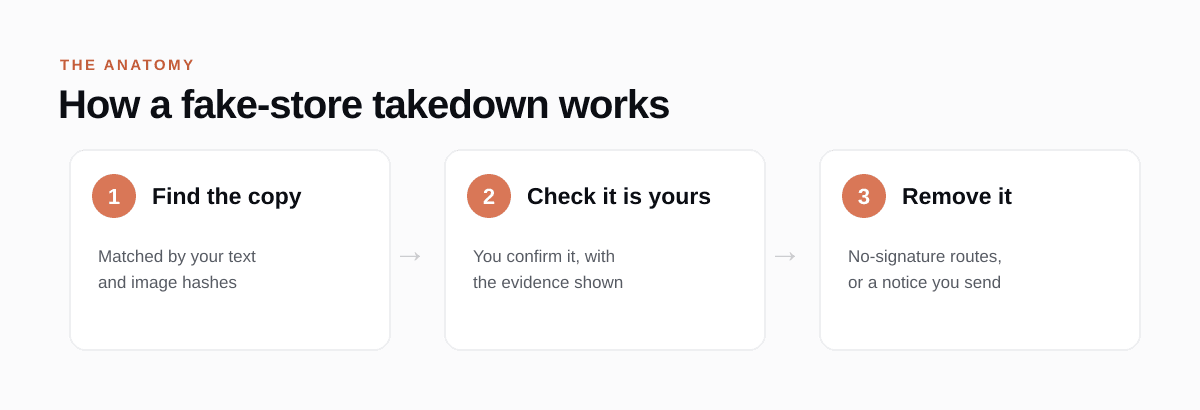
The eight platforms at a glance
| Platform | Built for | Finds clones itself? | Takedowns | Reviewed by a human? | Pricing model | Signs your IP notice? |
|---|---|---|---|---|---|---|
| Katcher | Any store or brand | Yes, by text and image hash | Sends the no-signature routes itself; prepares IP notices for you | You verify, with the evidence | Free to scan, then $75 per notice | No, it prepares everything and you send it |
| Red Points | Enterprise and mid-market | Yes, automated | Managed team plus automation | Yes, IP-Ops team | Custom quote, not public | Prepares and submits; who signs is not stated |
| BrandShield | Enterprise, regulated and high-risk | Yes, automated | Managed human team | Yes | Custom quote, not public | Submits as agent; who signs is not stated |
| Corsearch | Enterprise, up to Fortune 500 | Yes, automated | Automation plus analysts | Yes | Custom quote, not public | Actions takedowns; DMCA not specified |
| MarqVision | Enterprise and mid-market | Yes, automated | One-click, plus a legal team | Shared, AI and you | Custom annual, not public | Submits under a letter of authorization; who signs is not stated |
| Netcraft | Enterprise and government | Yes, automated | Automation plus team, very fast | Yes, near-zero false positives | Custom quote, not public | Uses abuse reports, not DMCA |
| Bustem | eCommerce and DTC brands | Yes, image and reverse search | Managed team, you approve | Yes | Not public, no lock-in | Files under a power of attorney |
| DMCA.com | Individuals and small business | No, you supply the URLs | A person writes and sends it, or DIY | Yes, on managed cases | Free badge; $10 to $15/mo; $199+/takedown | Drafts and files; who signs is not stated |
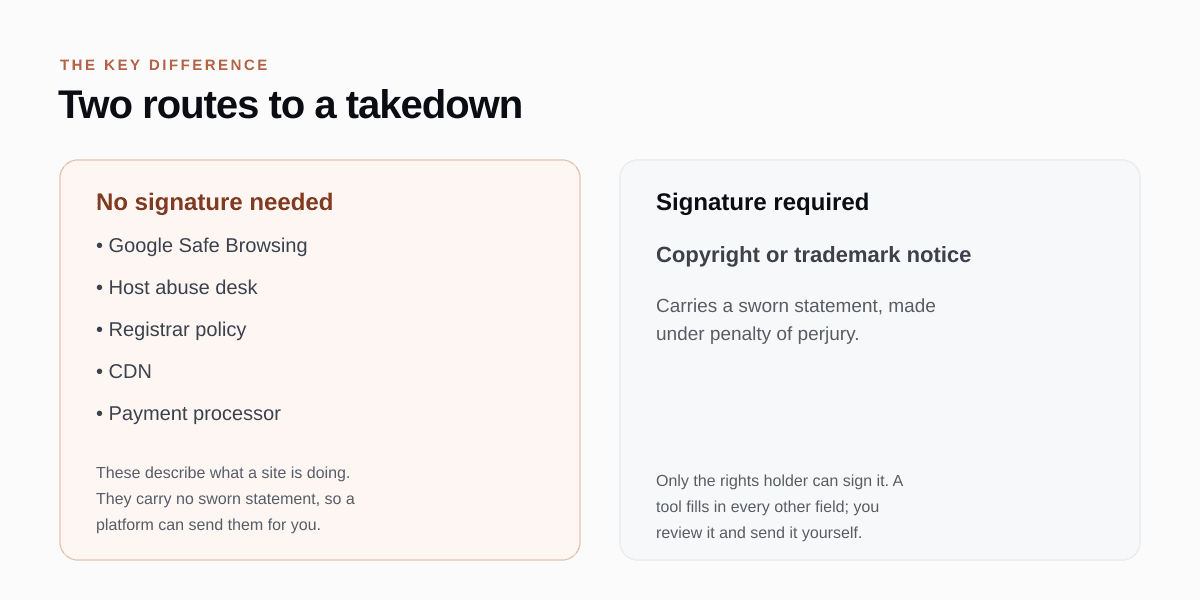
A note on that last column, because it matters more than it looks. A copyright or trademark notice carries a sworn statement, made under penalty of perjury, that the sender owns the rights and the seller is not authorised. Only the rights holder can truthfully make it. Several of these vendors "prepare and submit" or "file" notices for you; almost none states publicly who actually signs that sworn line. Two, MarqVision and Bustem, document a letter of authorization or power of attorney, which is the clearest sign a vendor acts as your agent. Ask any vendor this question directly before you sign.
Ranked for a large enterprise brand
- Red Points — the default hands-off pick. It detects across 5,000+ marketplaces plus domains, social and ads, and its IP-Ops team runs unlimited takedowns over the AI.
- Corsearch — Fortune 500 scale, in-house investigators and test purchases behind the automation.
- BrandShield — strongest for regulated and high-risk verticals; staffs IP lawyers and claims a 98% takedown success rate.
- MarqVision — fast AI detection across 1,500+ marketplaces with one-click enforcement and a legal escalation team.
- Netcraft — the specialist when the threat is specifically impersonating domains. It takes rogue sites down through direct registrar and host relationships, with a median phishing takedown it puts at about 33 minutes.
Which we would pick: for most enterprises that want one managed vendor across every channel, Red Points. But the scenario here is look-alike storefronts on rogue domains, and that is precisely Netcraft's wheelhouse; if fake domains are the whole problem, it is the faster, more surgical choice. None of the five publishes pricing, so budget on a demo-and-quote cycle.
Ranked for a small Shopify store
- Katcher — built for exactly this. It finds the clones itself, and at $75 a notice it is both the cheapest way to actually get one removed and the only option here that hunts the copies for you.
- DMCA.com — the flat-fee DIY alternative if you can find the URLs yourself. A real person handles the notice, but at $199 per site it costs more per takedown than Katcher and it does not find the clones for you; its free badge tier covers one takedown a year.
- Bustem — it will find and remove the clones for you, but pricing is a sales call and it asks you to sign a power of attorney, which is heavier than a small store usually needs.
The five enterprise suites are more effort and cost than a small store can justify, and none will quote you without a demo, so they are off this list.
Which we would pick: Katcher, if you want the clones found for you and would rather pay $75 a notice than sign a contract, and you can live with two limits: it does not watch marketplaces yet, and it prepares your copyright and trademark notices but leaves the sworn line for you to send. If you would rather find the fake URLs yourself and send flat-fee notices, DMCA.com works, though at $199 a site it is dearer per takedown.
Katcher
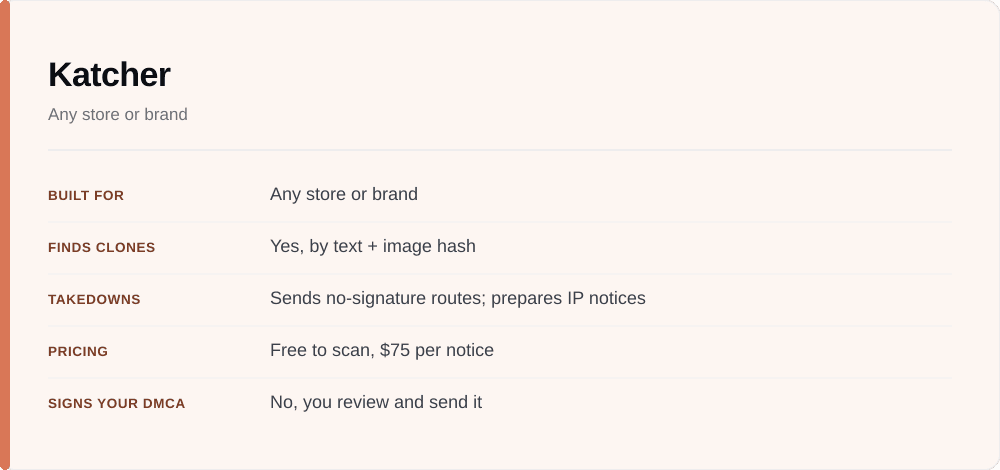
Katcher is built for any store or brand whose photos and page titles have been copied onto look-alike domains, Shopify stores very much included. It finds those stores itself by matching your text and the image hashes of your product photos, so you are not the one hunting for URLs.
What it does next it splits the way the law splits it. For the routes that need no signature and make no claim about who owns what — Google Safe Browsing, the host's abuse desk, the registrar under its own published policy, the CDN, the payment processor — Katcher sends and chases the reports itself, and stores come down as a result. For a copyright or trademark notice, which carries a sworn statement only the rights holder can make, it fills in every other field and you review it and send it from your own address. It never signs that statement as you.
You see the evidence behind each store and how to confirm it yourself, because only you know which sellers you have authorised. Pricing is simple: scanning is free, and each takedown notice is $75.
Where it stops, plainly: the evidence is text and image-hash matching, and it does not monitor marketplaces yet. If your problem is fakes on Amazon or a dozen marketplaces, one of the enterprise suites below is the better tool. If it is look-alike storefronts copying your product pages, that is the narrow job it is built for.
The split matters in practice: the no-signature routes are ones a tool can legitimately send and chase for you, while a copyright or trademark notice is the one document only you can swear to, so Katcher stops exactly at the signature. You approve nothing you have not seen the evidence for, there is no contract, and at $75 a notice the cost only lands when you decide a copy is worth acting on.
Red Points
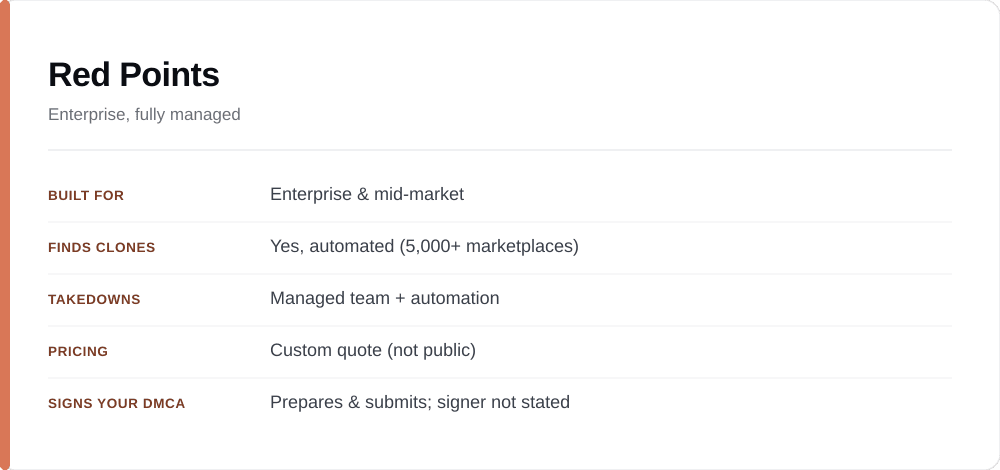
Red Points is a fully managed brand-protection platform for enterprise and mid-market brands. It detects infringements itself across a stated 5,000+ marketplaces plus websites, social and ads, an IP-Ops team validates and removes them, and a dedicated CSM sits over the account. Its own material says it prepares and submits DMCA notices once an infringement is confirmed, though it does not state publicly who signs the sworn statement. Pricing is a tailored flat-fee subscription with unlimited takedowns, quoted after a demo. Strength: end-to-end enforcement at scale with a human team over the AI. Limitation: no public or self-serve pricing, and it is heavyweight for a very small store.
In practice that means detection across marketplaces, websites, social, paid ads and rogue apps, with coverage chosen from Starter, Professional and Enterprise tiers that carry no public prices. The advertised model is unlimited takedowns with no per-action fees, plus a dedicated CSM and a Platform Outcomes Manager who, in Red Points' words, reviews every case.
BrandShield
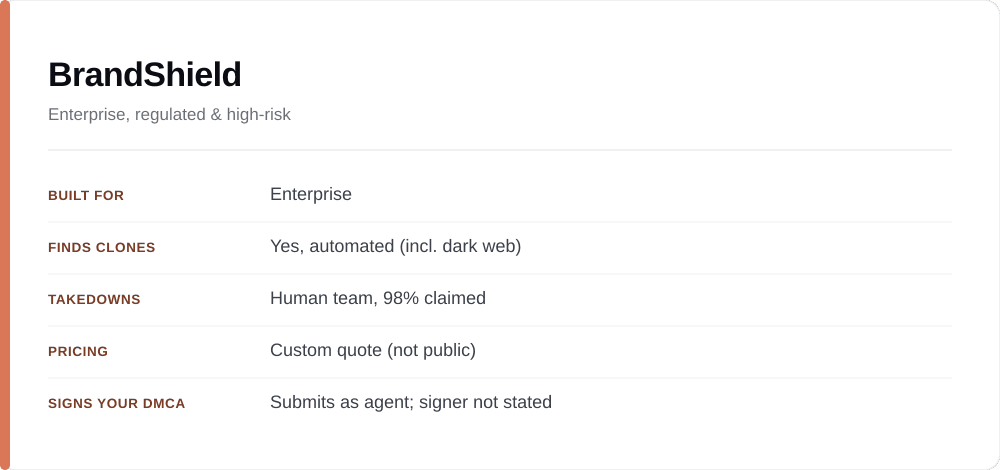
BrandShield is an enterprise digital-risk platform aimed at regulated and high-risk sectors: pharma, finance, luxury, crypto. AI crawlers detect clones and infringing listings automatically, and a human team of enforcement managers and IP lawyers executes takedowns, with a claimed 98% success rate and human-in-the-loop verification. It handles notices, including DMCA, as an authorized agent; who signs the sworn statement is not stated publicly. Pricing is custom and demo-gated. Strength: legal-grade managed enforcement across many channels. Limitation: enterprise-only, no public pricing, no self-serve.
Under the hood it leans on logo and product recognition, OCR, NLP and clustering to group related listings, and covers marketplaces, domains, social, paid ads and the dark web. Enforcement runs through a named Enforcement Manager with audit trails, which is why it positions itself for legal-grade workflows in regulated industries. Everything routes through a demo; there is no self-serve plan.
Corsearch
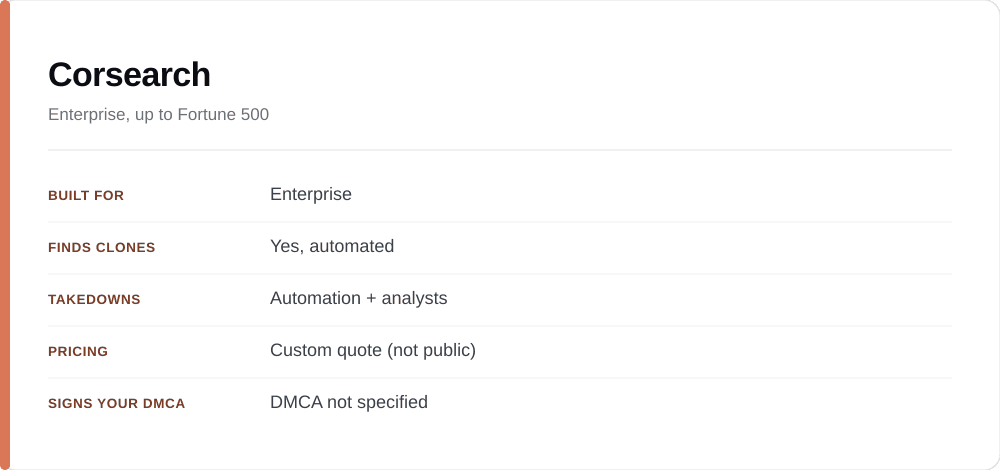
Corsearch protects large global brands, including a stated 200+ Fortune 500 clients. Its AI detects across marketplaces, social, websites, search and app stores; analysts and in-house investigators validate findings, and it runs takedowns on your behalf with rule-based auto-moderation on top. Notably, its Investigations product only prepares enforcement-ready case files for your legal or law-enforcement partners to act on. It does not name DMCA specifically or say who signs. Every route is demo-gated with no public pricing. Strength: breadth of coverage plus investigator-led enforcement. Limitation: enterprise-only and opaque on price.
Scale is the selling point: a stated 40 in-house investigators, more than 100 global enforcement partners and thousands of test purchases behind the automation, protecting 200-plus Fortune 500 brands. One nuance worth reading closely is that its Investigations product prepares enforcement-ready case files for your legal or law-enforcement partners to act on, rather than actioning them itself, so check which product you are buying.
MarqVision
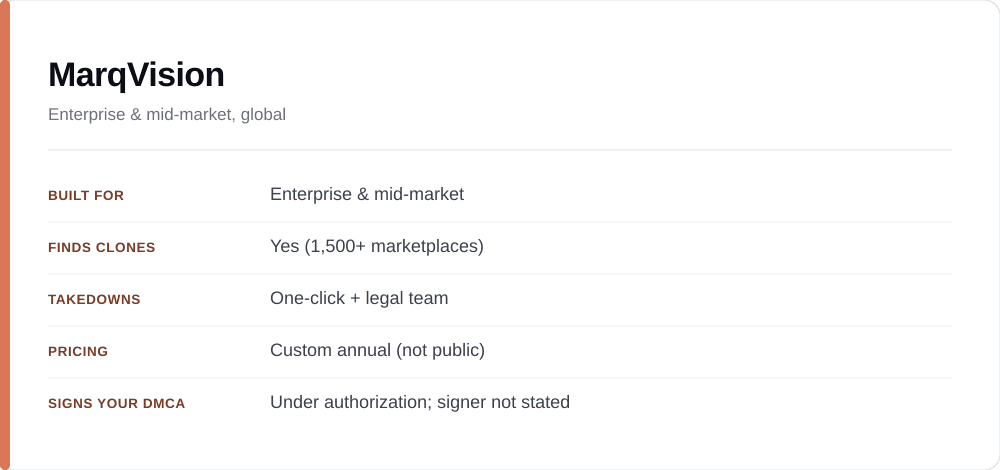
MarqVision uses generative AI to detect infringements across a stated 1,500+ marketplaces in 118 countries, with one-click enforcement from the dashboard and a legal team (MarqLaw) for escalations, customs and offline cases. Under a letter of authorization it submits notices on your behalf, though it states the service does not include legal representation and does not say who signs the sworn line. Pricing is a sales-led annual contract with no public numbers; a free one-time brand scan is the only low-friction entry. Strength: fast, automated detection-to-enforcement at global scale. Limitation: enterprise contract, letter of authorization, no public pricing.
Detection uses SKU-level generative-AI matching and an LLM keyword framework to sweep marketplaces, social and other channels, with claims of 99%-plus accuracy and roughly fifteen minutes from detection to enforcement. Escalations go to its legal arm, MarqLaw, for seller takedowns, customs, litigation support and offline investigations, and the company states plainly that the service does not include legal representation.
Netcraft
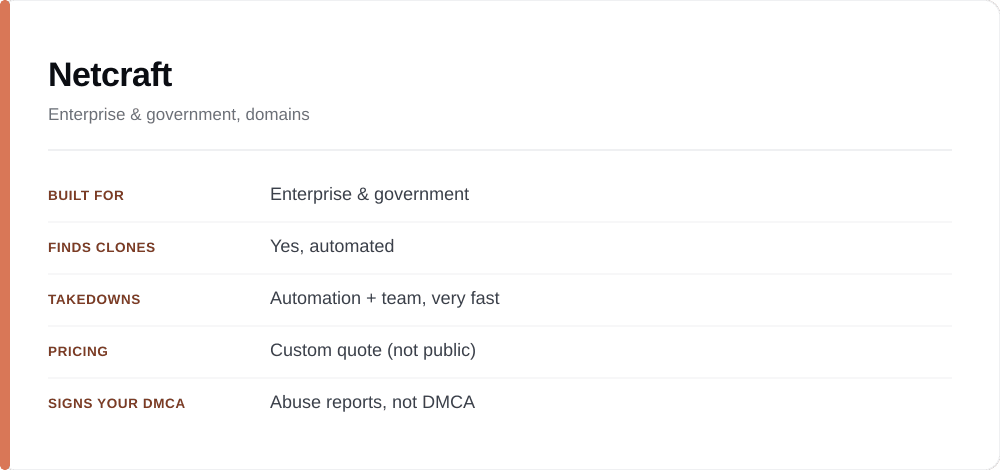
Netcraft is a cybercrime and brand-impersonation firm for enterprises and governments. It discovers impersonating and look-alike domains itself through continuous crawling and threat intelligence, validates them with enforcement-grade evidence at a stated 0.02% false-positive rate, and takes them down fast, 75% via direct registrar and host API relationships rather than manual abuse queues. Its route is abuse reports, not DMCA; it has publicly argued DMCA is too slow. Pricing is a custom quote. Strength: the fastest, most surgical domain takedowns here. Limitation: enterprise-only, and focused on rogue infrastructure rather than marketplace-listing removal.
Its detection is tuned to impersonation specifically: it generates structured queries from your protected brand names to catch domain variations and permutations, and processes tens of billions of datapoints across more than a hundred attack types. Because its takedowns run on abuse reports and direct registrar and host relationships rather than copyright notices, it is the strongest fit here when the problem is a wave of look-alike domains rather than counterfeit listings on marketplaces.
Bustem
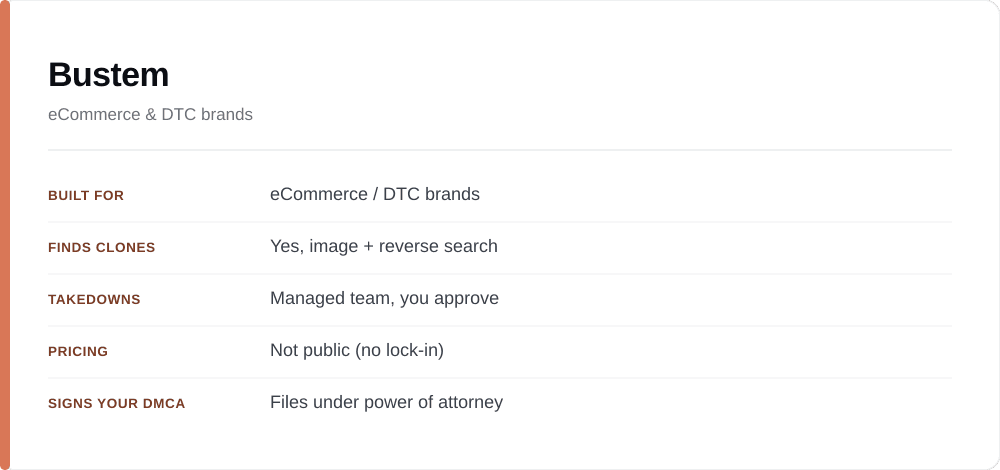
Despite a reputation as a photographer's reverse-image tool, Bustem's current site positions it as eCommerce and DTC brand protection, from startups to nine-figure brands. It scans the web itself with image recognition and reverse search, a human team confirms findings, and you approve before anything is sent. It files DMCA takedowns on your behalf, but onboarding requires you to sign a power of attorney authorizing it to act as your agent. Pricing is not public: no lock-in and a 500% ROI guarantee, quoted on a call. Strength: done-for-you discovery and enforcement under power of attorney. Limitation: opaque pricing behind a sales call, and the power-of-attorney step is more than many small stores want.
Beyond finding the copies, its enforcement team pursues several levers at once: DMCA takedowns, domain seizures, host shutdowns and payment-processor lockouts, with most requests processed in 24 to 48 hours and the customer approving each one first. The trade-offs are that pricing is quoted on a call with no public figures, and onboarding requires signing a power of attorney so it can act as your agent.
DMCA.com
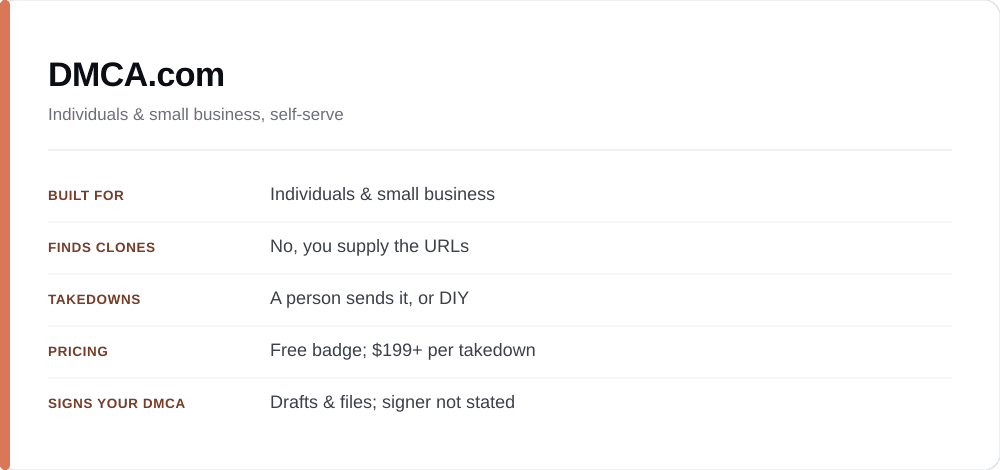
DMCA.com is the low-cost, self-serve option, aimed at individuals, creators and small businesses. It does not find clones for you in its core service: you paste the link to the copy and the link to your original, and a real person writes and sends the notice, or you use a DIY toolkit. Pricing is genuinely transparent, the only vendor here that publishes it: a free badge tier with one takedown a year, subscriptions at $10 to $15 a month, and flat managed takedowns at $199, $399 or $599 per site. It drafts and files on your behalf; who signs the sworn statement is not stated. Strength: cheap, no contract, real humans, published prices. Limitation: no automated discovery, so you have to find every fake URL yourself.
The free badge tier covers 100 badges, three domains and one takedown a year, with paid subscriptions at $10 and $15 a month and a DIY toolkit around $10 a month for people who send notices themselves. It is the only vendor here with fully published prices, which is its real advantage; the cost is that there is no automated discovery, so you find and supply every infringing URL.
How to choose in one line
If you are a large brand with fakes everywhere, buy a managed suite (Red Points for breadth, Netcraft if it is purely rogue domains) and accept a demo-and-quote cycle. If you are a Shopify store watching look-alike domains copy your pages, you want something that finds them for you without a contract, which is where Katcher fits at $75 a notice, with DMCA.com as the flat-fee, find-them-yourself alternative. And whichever you pick, ask who signs the sworn statement before you sign anything yourself.