What Data Can Shopify Bundle Apps Access? I Checked 15
Checked November 23, 2026. Updated November 24, 2026. By Davis Paipa.
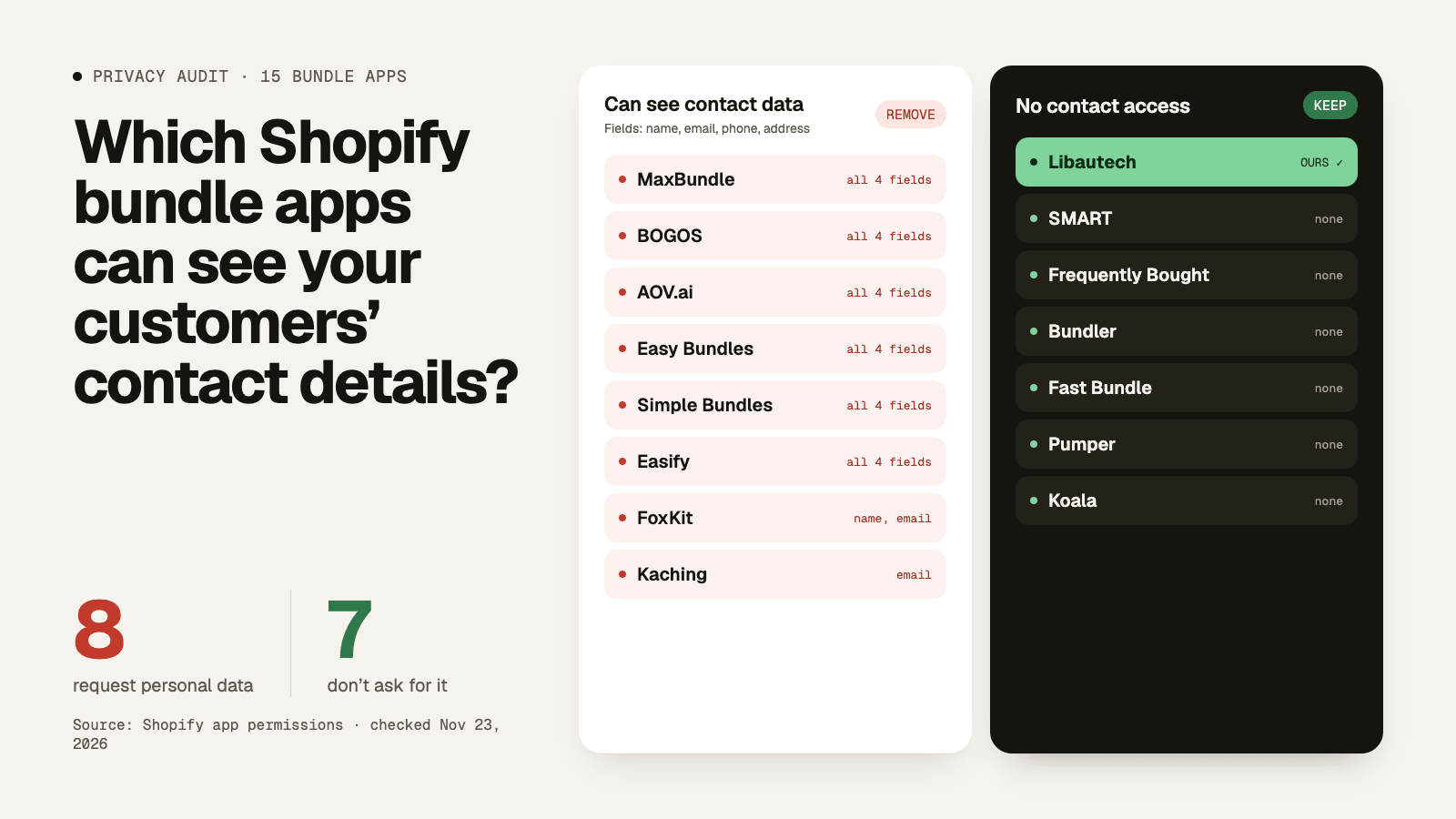
I installed 15 Shopify bundle and upsell apps on a test store and checked the data permissions Shopify displays for each. 8 listed access to shopper email addresses, and 6 of those also listed phone numbers and physical addresses. 7 listed no shopper contact fields, our own app among them. I also read what each developer says it stores, how long it keeps it, and what happens after uninstall. If you use an app only for bundles or quantity discounts, start by asking which feature needs your shoppers' contact details.
Disclosure: I run Libautech, and we build Libautech: Upsell & Bundle App, which competes with the apps below. It is in the same table with the same facts, marked as ours and not graded.
Which Shopify bundle apps can see your customer data?
The 15 apps: 14 bundle apps picked by their Shopify App Store ranking on November 23, 2026, plus our own. I installed each one on a test store, read what Shopify shows under Settings > Apps > Privacy, then read the privacy policy each developer links.
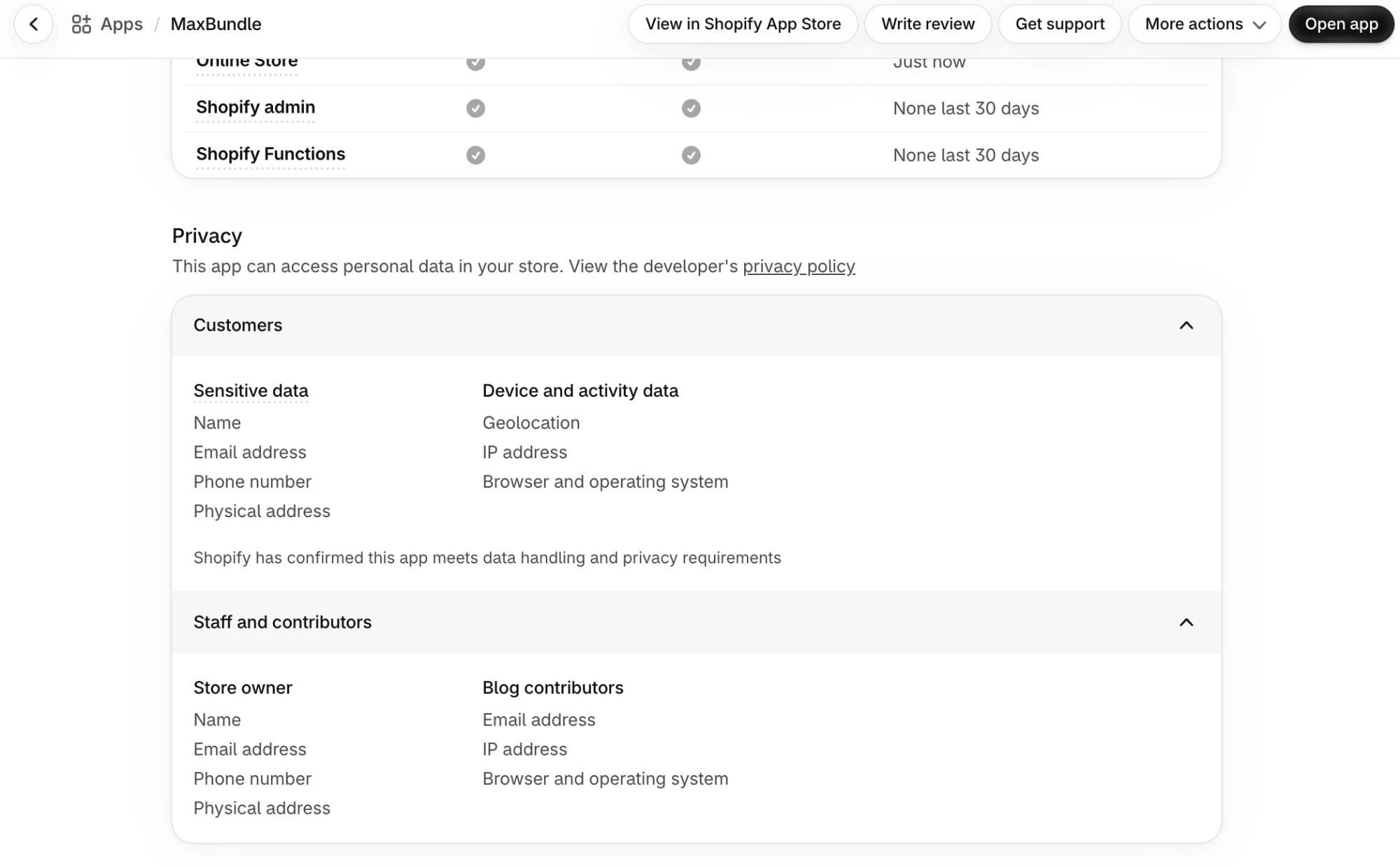
Shopify's screen shows what an app can access. It does not show what the app copies to its own servers. For that you only have the developer's word, in the policy. So the table shows access, and each review below covers both. Each row links to the developer's policy and to my screenshot of that app's Privacy section in the test store admin, taken on November 23, 2026.
| App | Name | Phone | Address | Browsing and cookie ID | Sources | |
|---|---|---|---|---|---|---|
| MaxBundle | Yes | Yes | Yes | Yes | No | Policy · Screenshot |
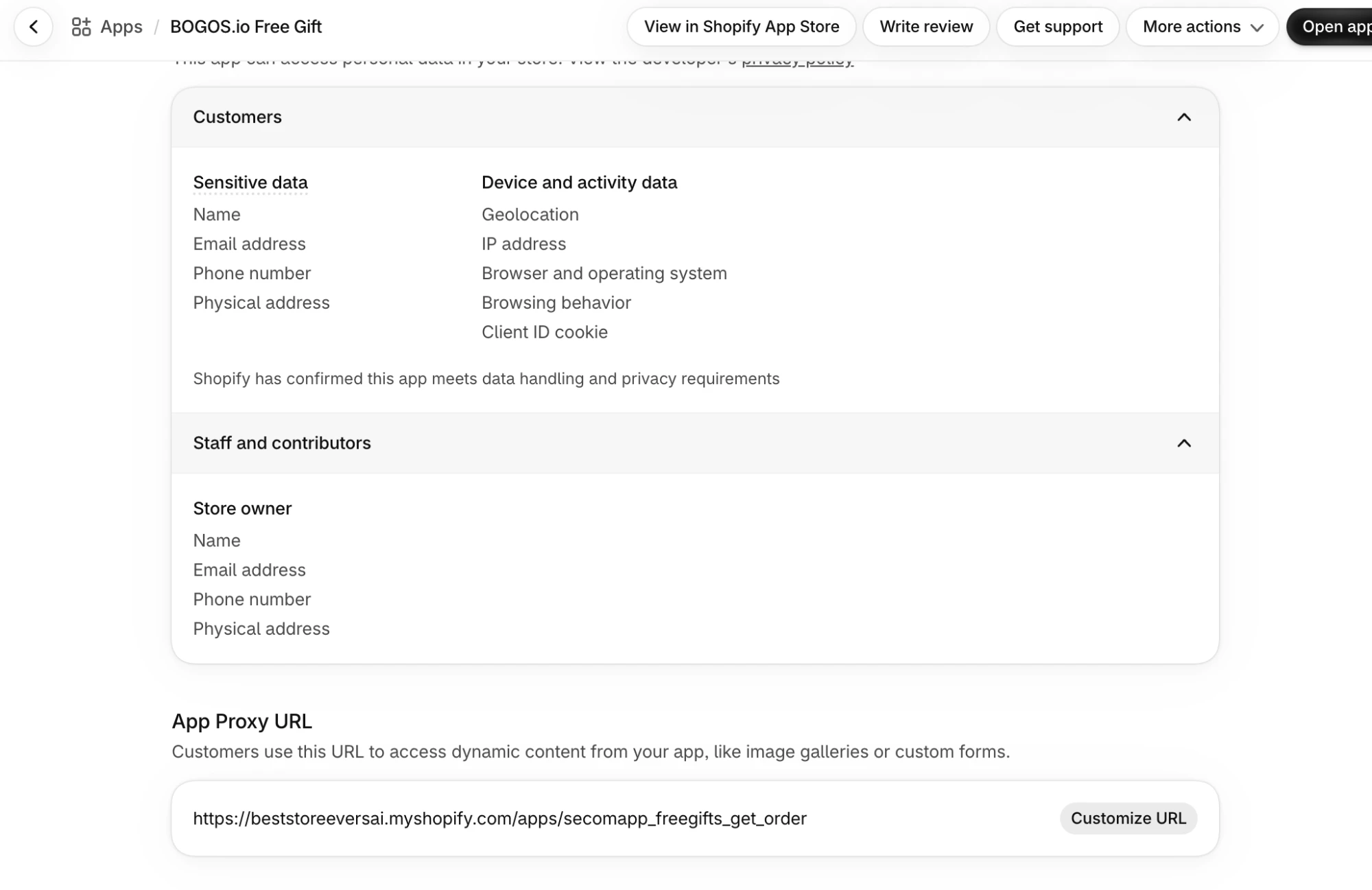
| BOGOS.io Free Gift | Yes | Yes | Yes | Yes | Yes | Policy · Screenshot |
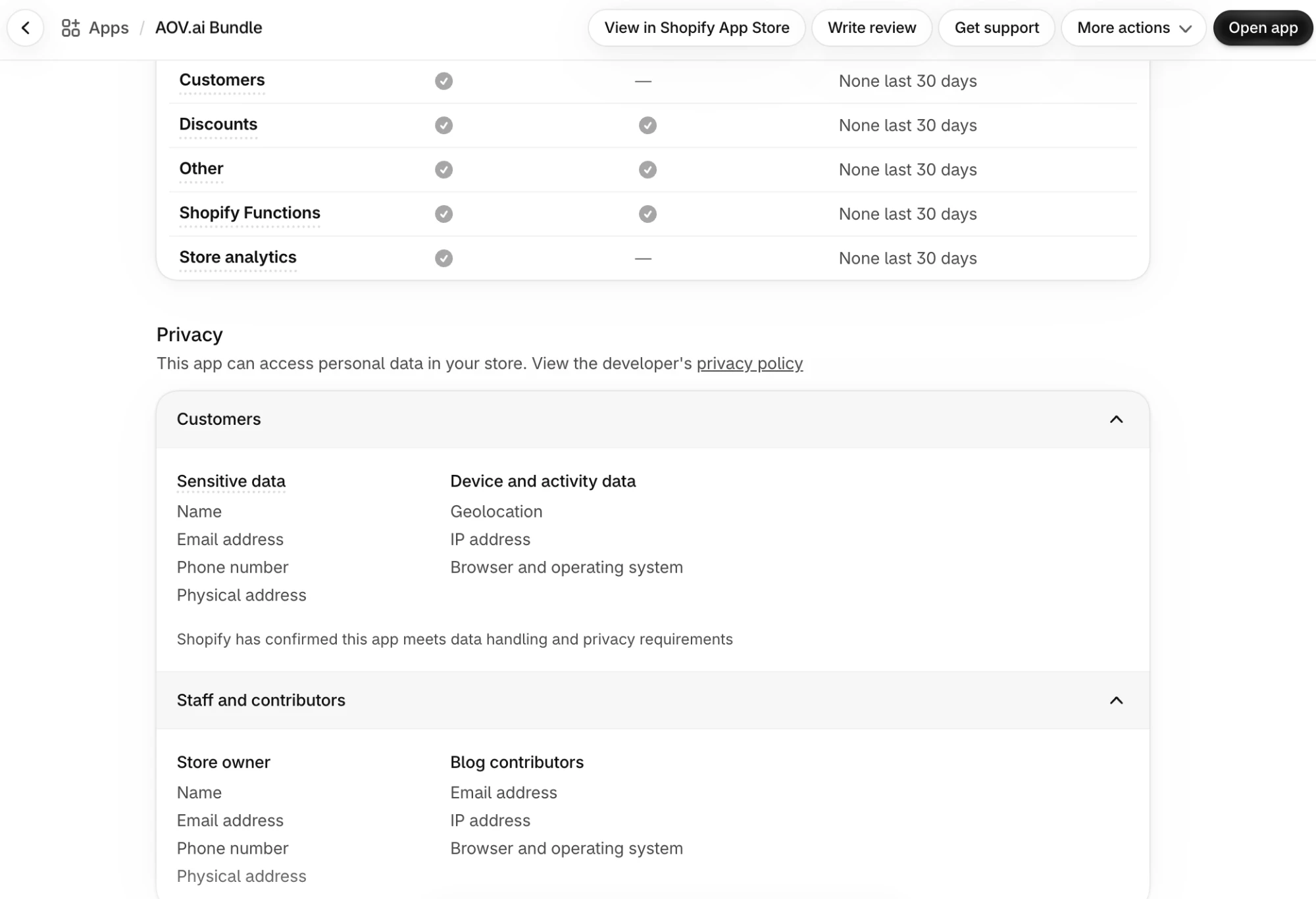
| AOV.ai Bundle | Yes | Yes | Yes | Yes | No | Policy · Screenshot |
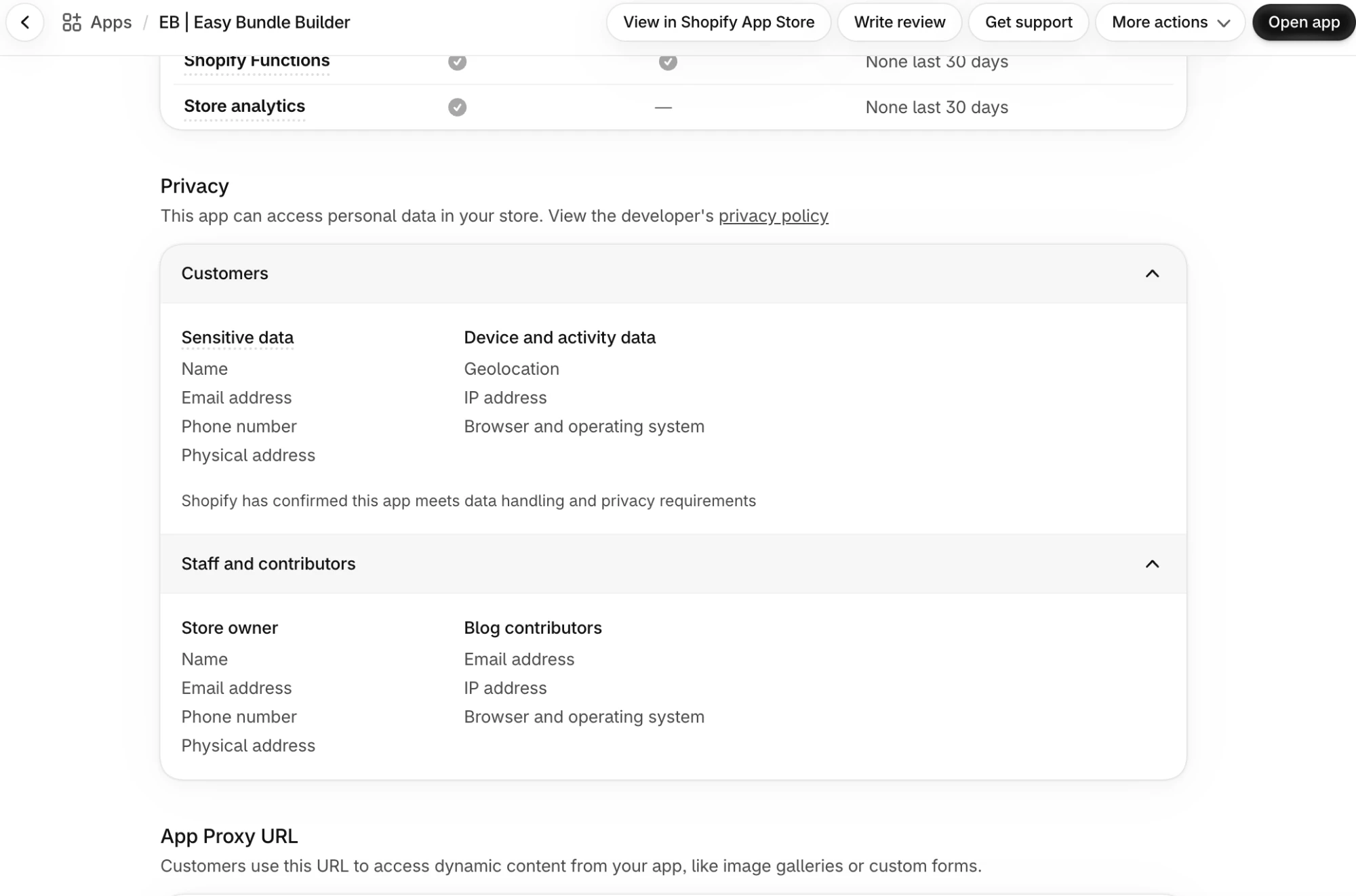
| EB Easy Bundle Builder | Yes | Yes | Yes | Yes | No | Policy · Screenshot |
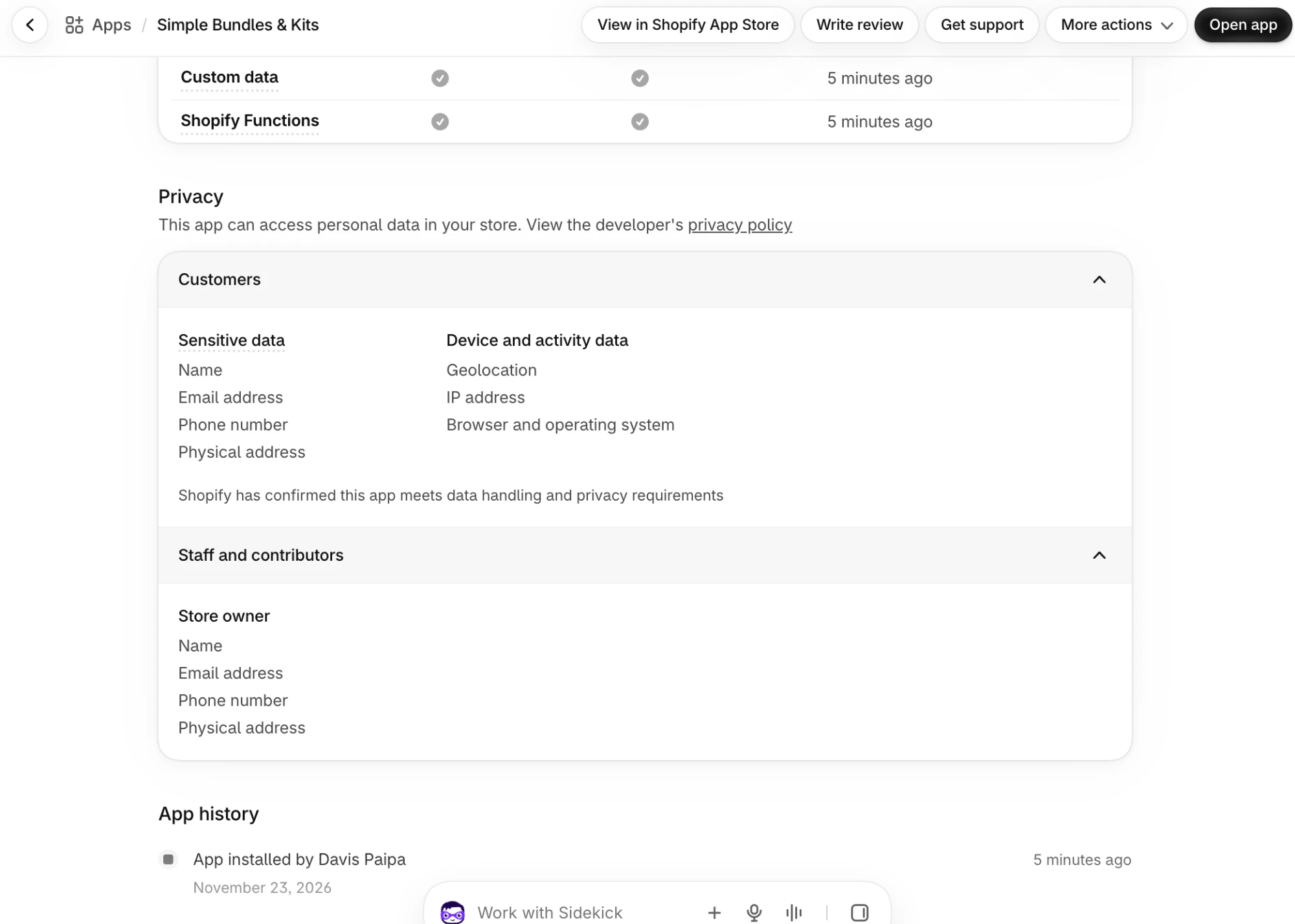
| Simple Bundles & Kits | Yes | Yes | Yes | Yes | No | Policy · Screenshot |
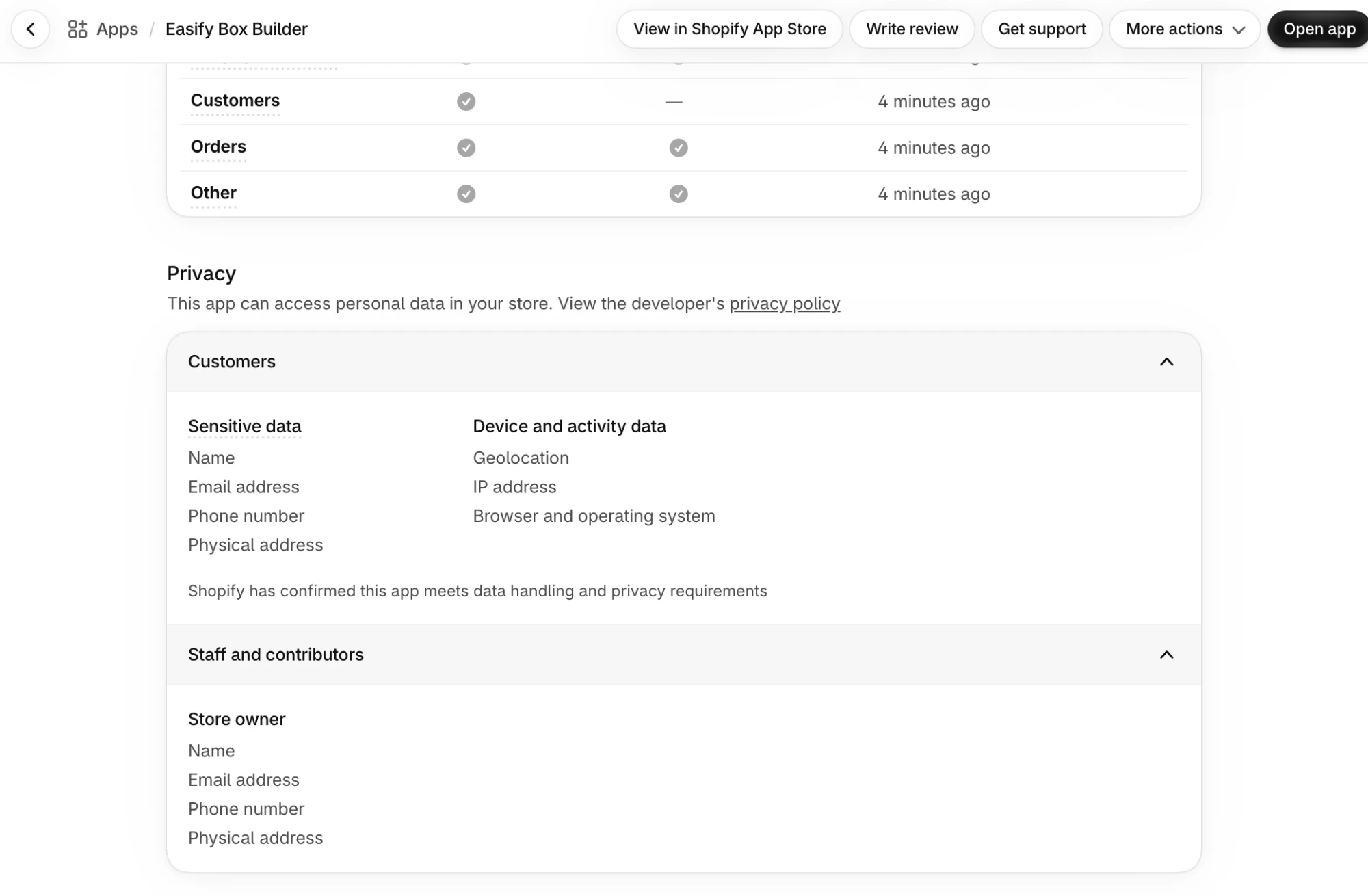
| Easify Box Builder | Yes | Yes | Yes | Yes | No | Policy · Screenshot |
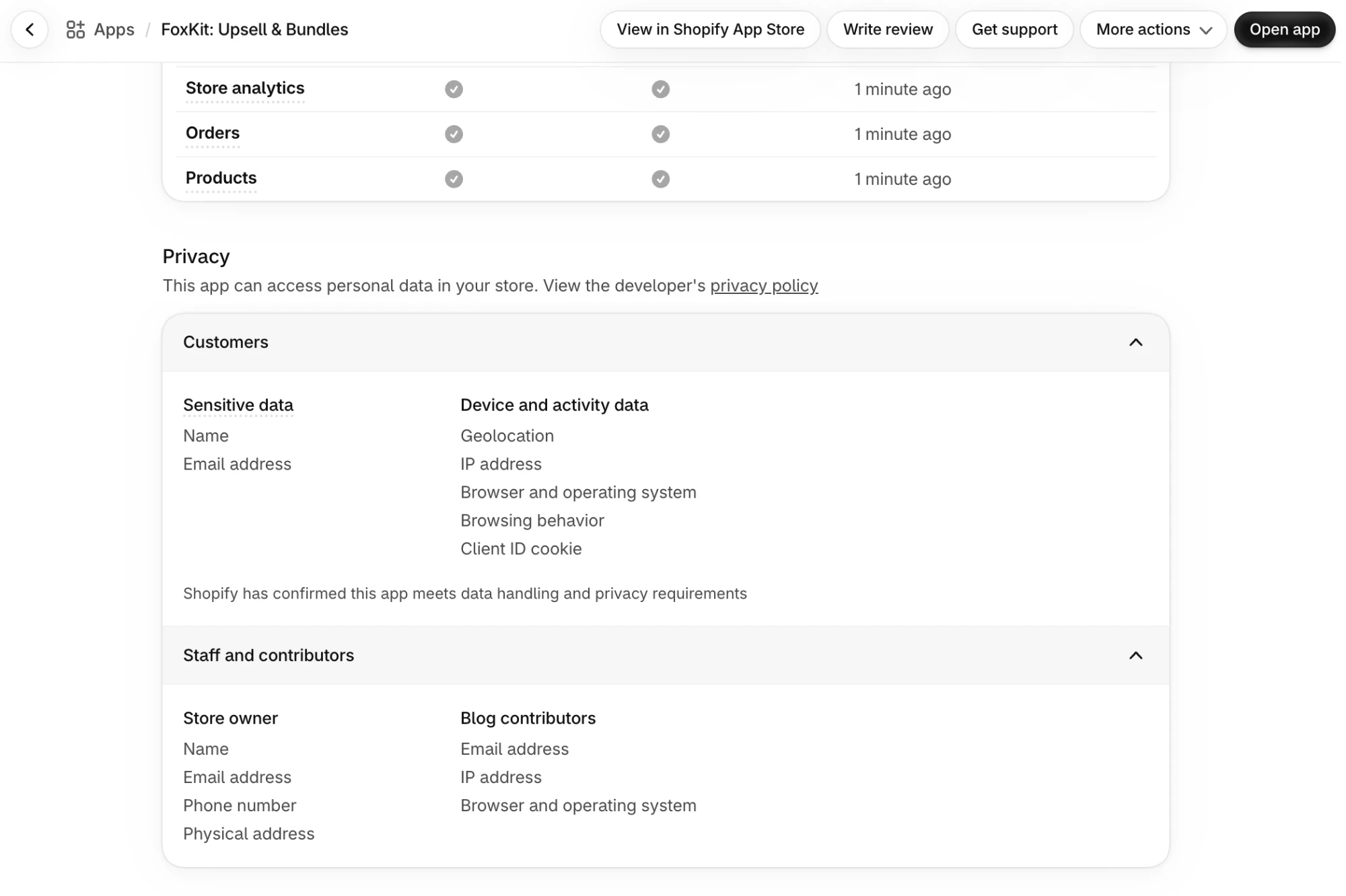
| FoxKit: Upsell & Bundles | Yes | Yes | No | No | Yes | Policy · Screenshot |
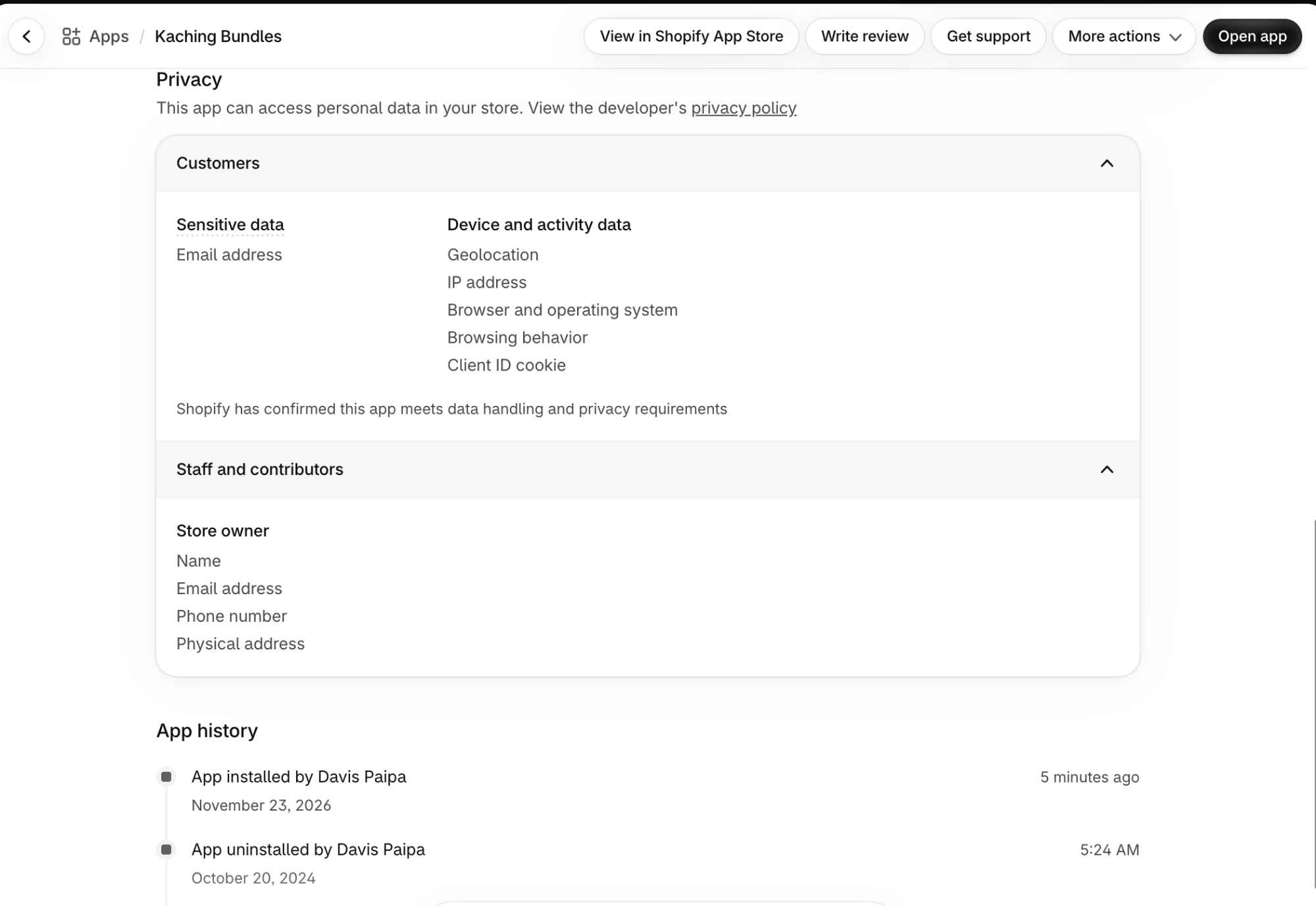
| Kaching Bundles | Yes | No | No | No | Yes | Policy · Screenshot |
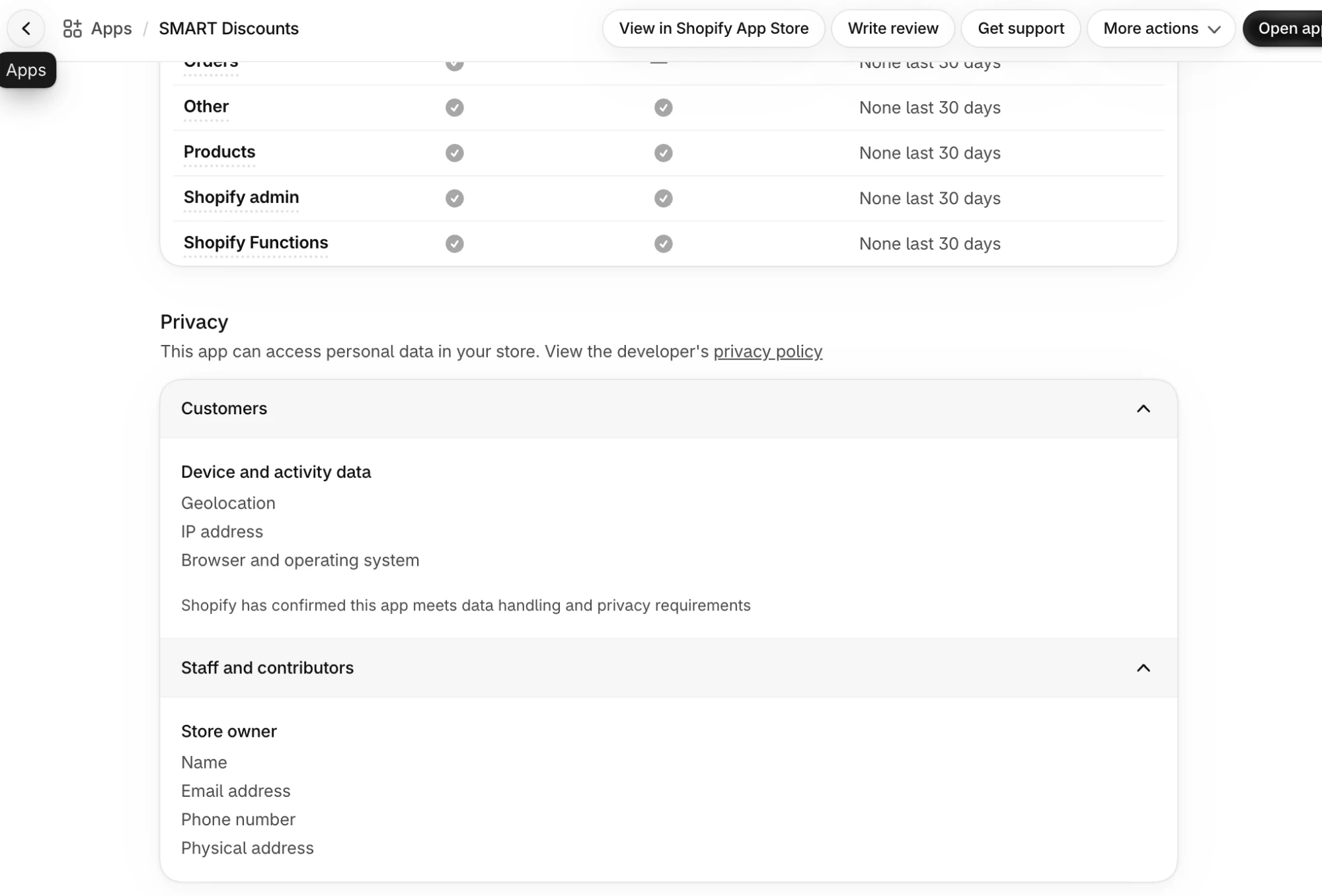
| SMART Discounts | No | No | No | No | No | Policy · Screenshot |
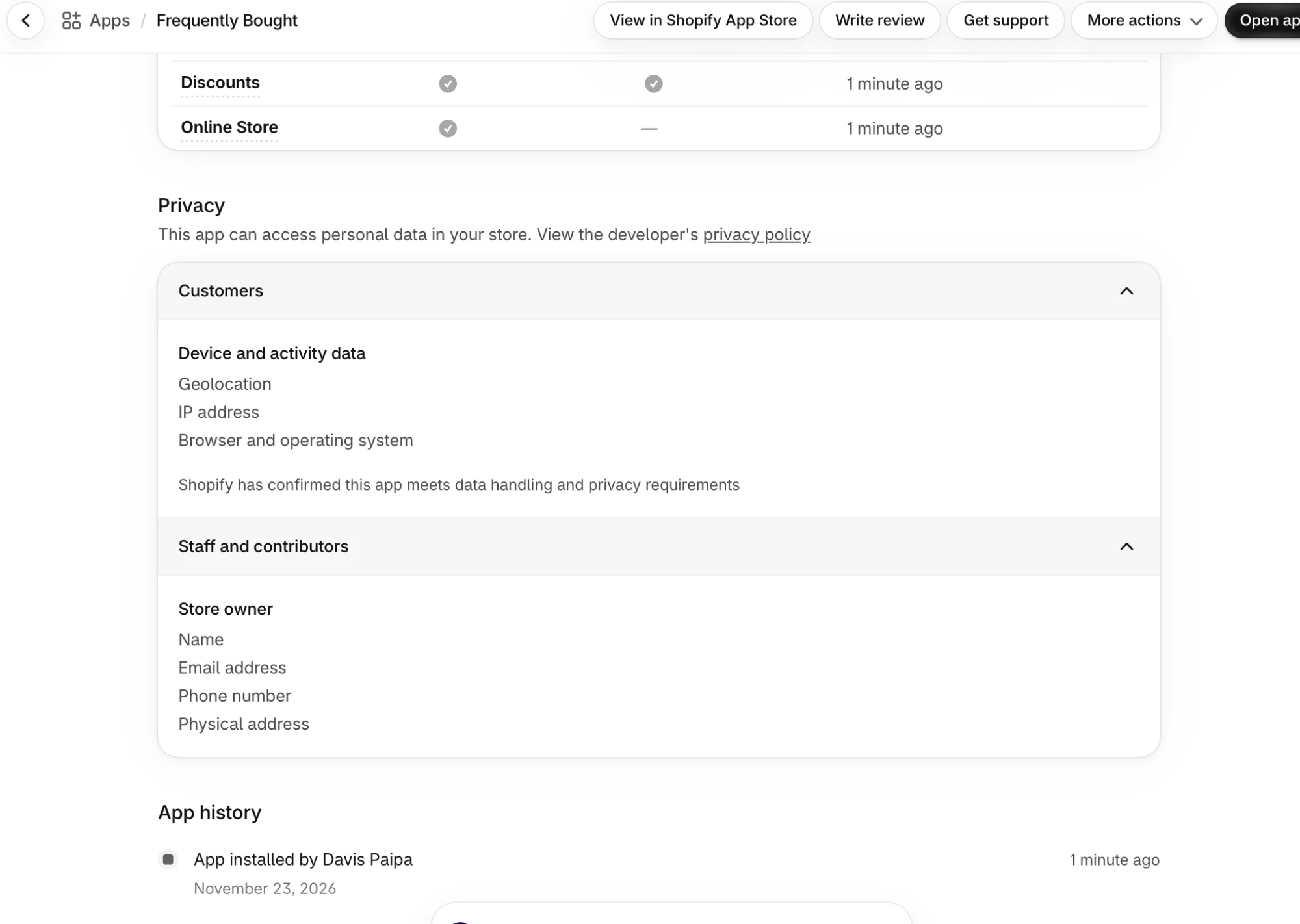
| Frequently Bought | No | No | No | No | No | Policy · Screenshot |
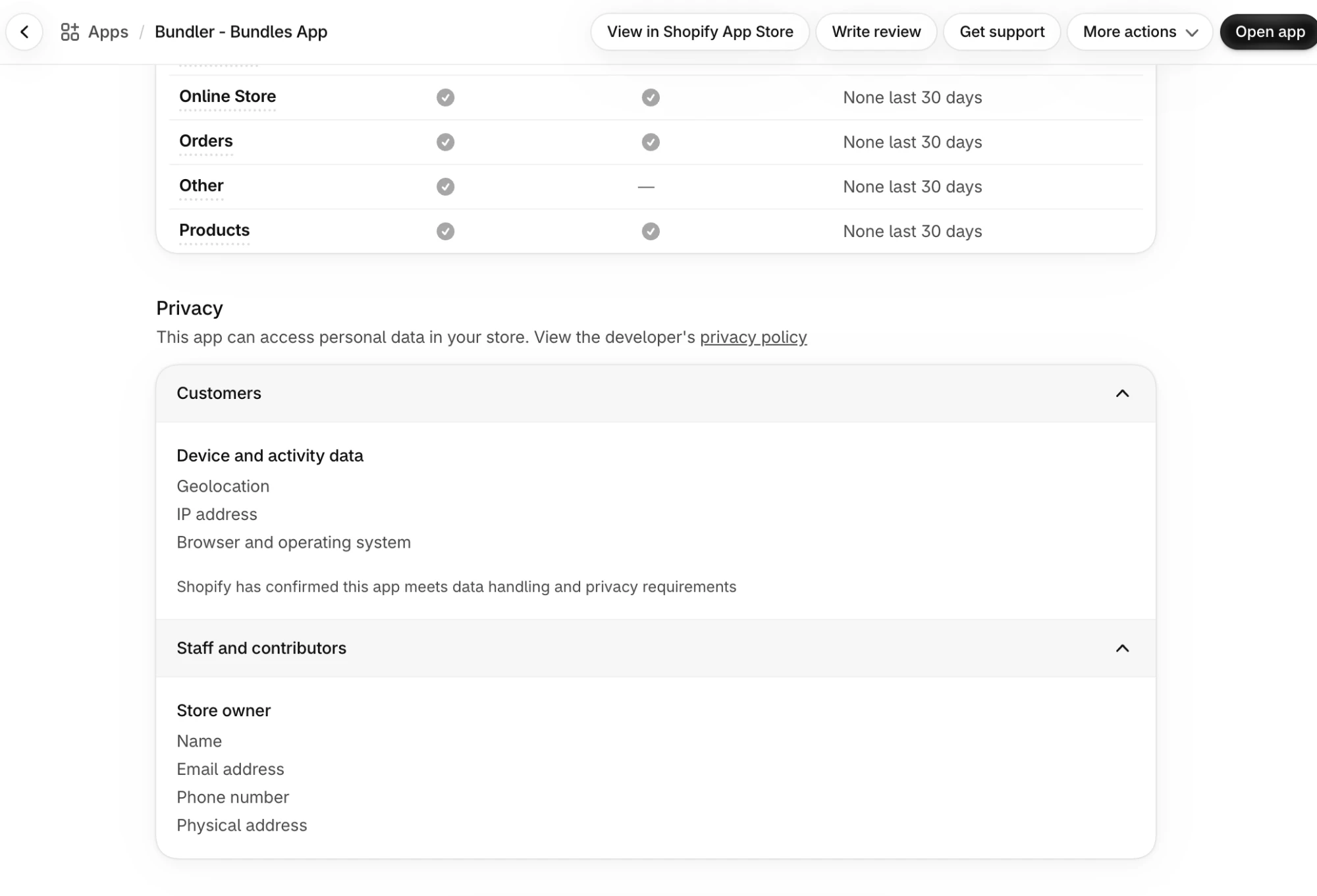
| Bundler | No | No | No | No | No | Policy · Screenshot |
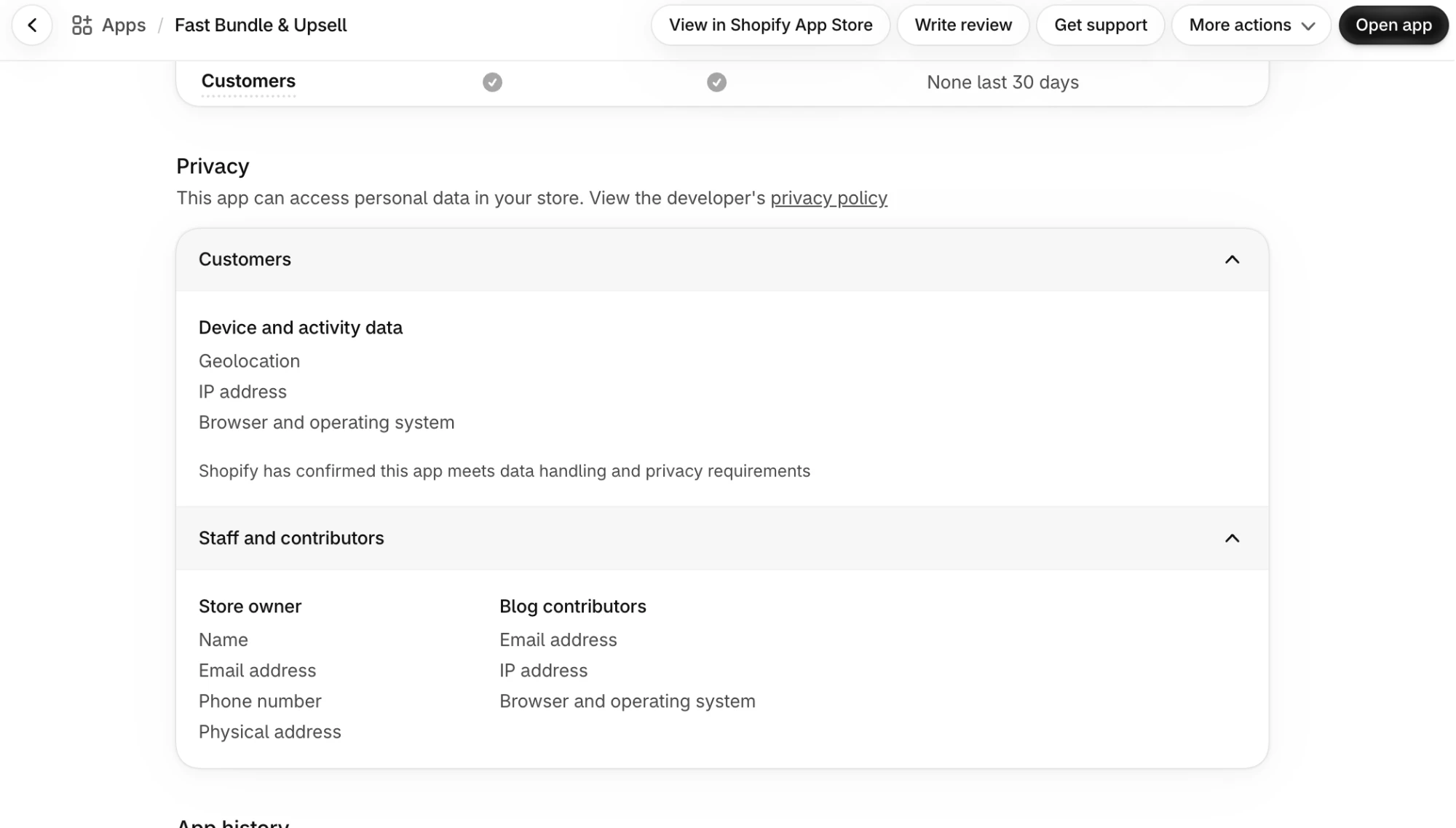
| Fast Bundle & Upsell | No | No | No | No | No | Policy · Screenshot |
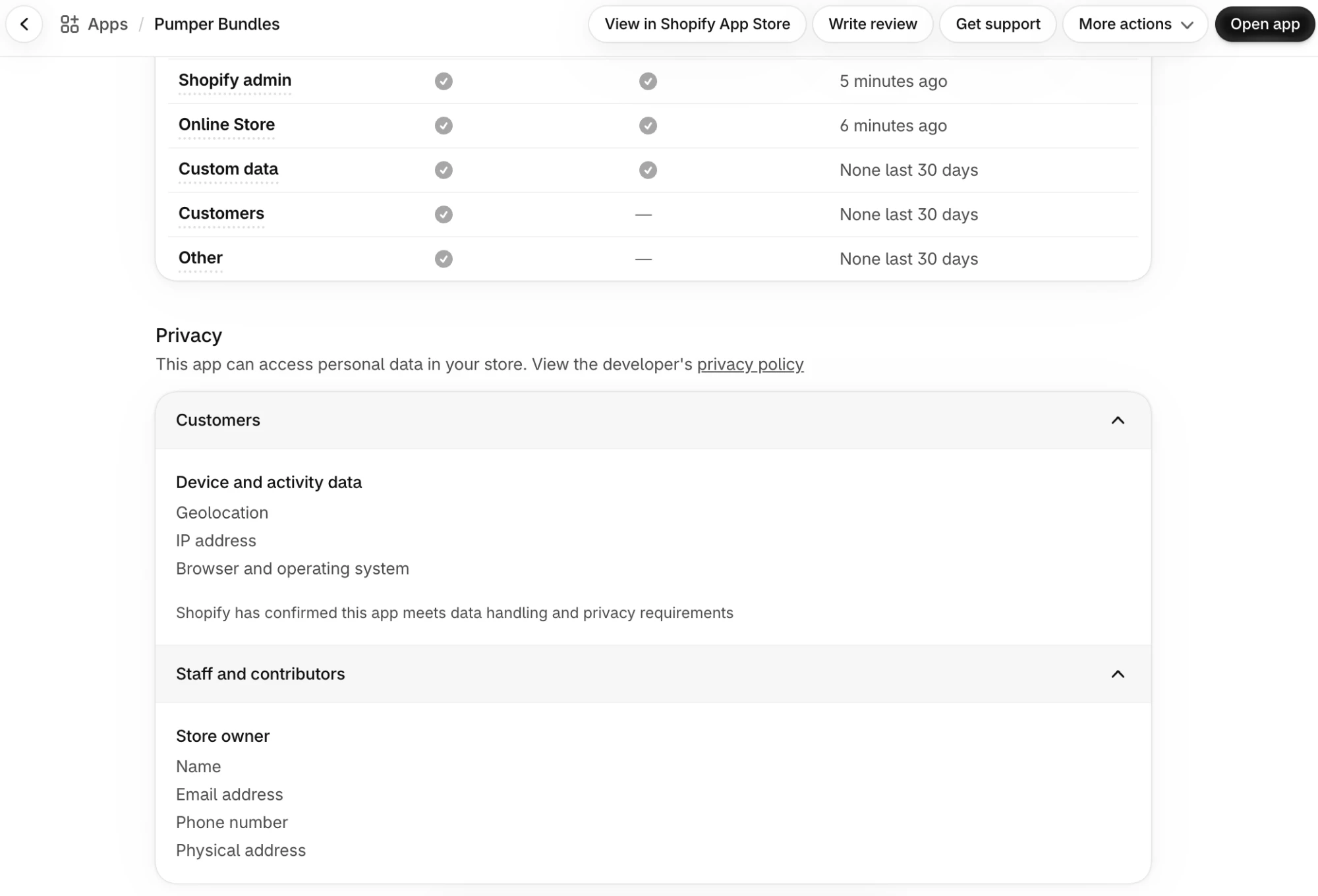
| Pumper Bundles | No | No | No | No | No | Policy · Screenshot |
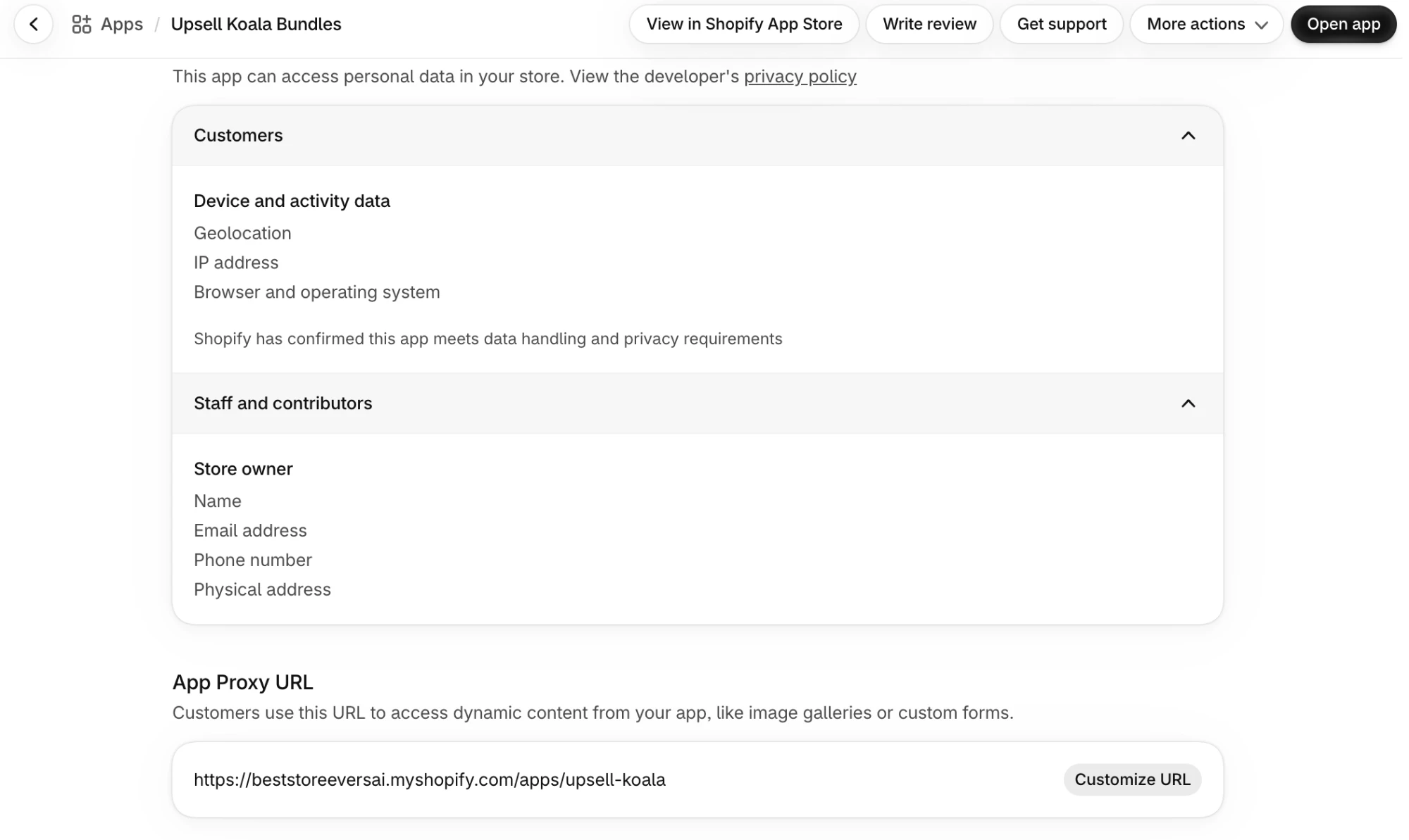
| Upsell Koala Bundles | No | No | No | No | No | Policy · Screenshot |
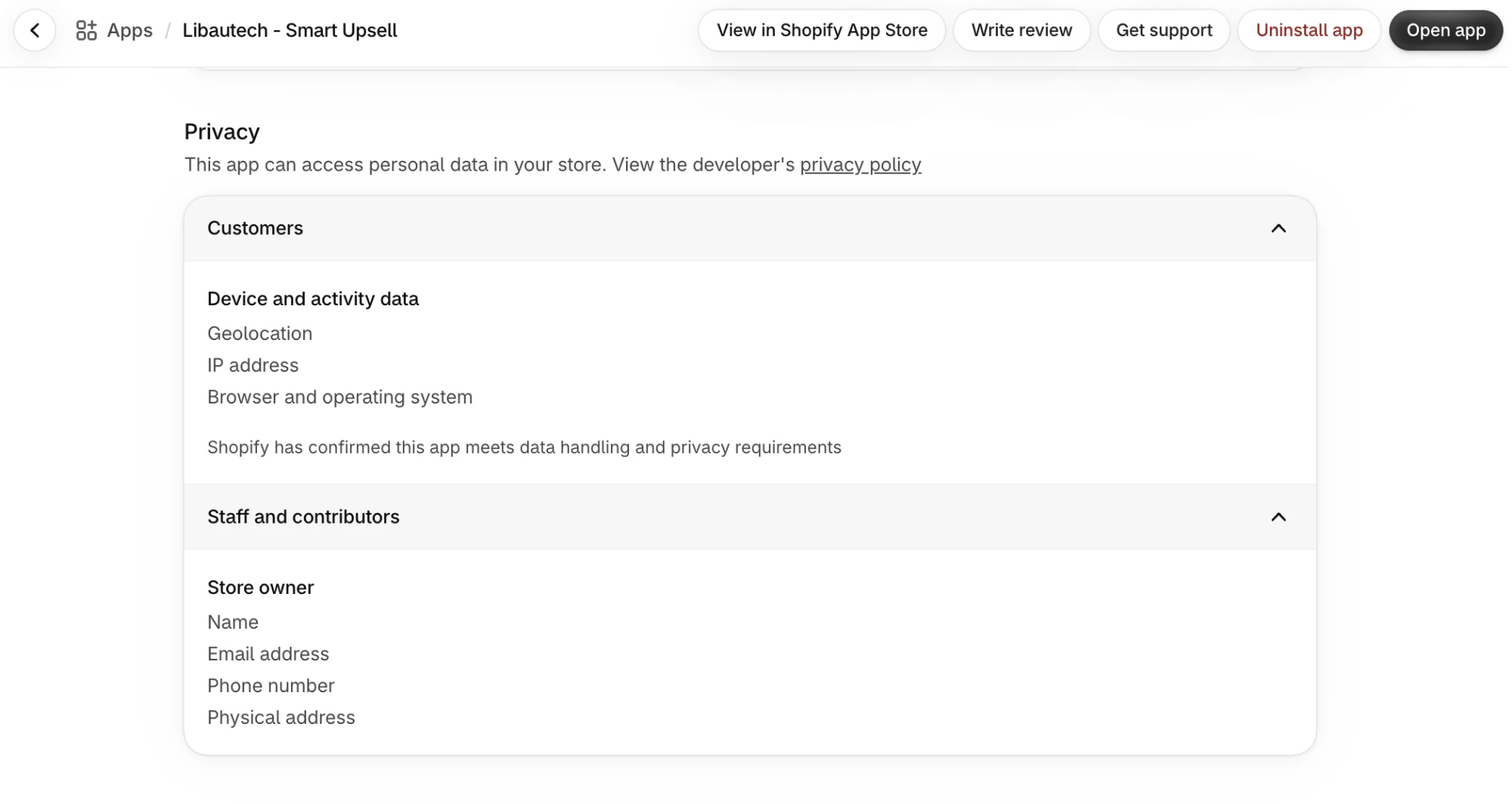
| Libautech: Upsell & Bundle App (ours, not graded) | No | No | No | No | No | Policy · Screenshot |
All 15 can also see customer geolocation, IP address, and browser and operating system, and all 15 carry Shopify's note that the app meets its data handling and privacy requirements.
Seven of the 15, ours included, do the job with no customer contact details at all. Keep that in mind when a developer says the access is required.
Why I ran this check
On November 20, 2026, Triple Whale confirmed "unauthorized access to certain of its internal systems", found on October 31 and contained on November 1, in its statement. It has not said how the attackers got in, how many stores were affected or which data types. In its own notice to customers, UK drinks brand Sneak Energy said that its customers' names, emails, phone numbers, mailing addresses and total spend held by Triple Whale were accessed. That is one merchant's account, and the incident-wide scope is still open. Triple Whale reported unauthorized access to its own internal systems. An analytics app at least has a reason to hold customer data, and a bundle app has far less, so I checked what the popular ones can see.
Shopify has rules. They stop at the app's server.
- Customer personal data is locked by default. A public app has to request it and pass a review. Shopify splits it into two levels: level 1 is customer data without name, address, phone and email. Level 2 includes those fields.
- Order history is limited. An app gets the last 60 days of orders unless Shopify approves access to all orders, per the permissions guide.
- Uninstall triggers a delete request. 48 hours after you uninstall, Shopify sends the app a
shop/redactmessage so it can erase your store's data, per the compliance docs.
Shopify controls what an app can pull. It does not control the app's database. Once customer records are copied to the developer's servers, security is their job, and the delete request is a request. You cannot see whether the rows are gone.
How I checked each app
Every app gets the same 6 checks, and every finding links to where I found it.
- Access. Which personal data and store areas Shopify lists for the app.
- Privacy policy. What it says it collects, and whether it says it stores customer data or only processes it.
- Location and third parties. Where the data is hosted and which other companies receive it.
- Retention. How long data is kept and what happens after uninstall.
- Security record. Published certifications such as SOC 2 or ISO 27001, and any known incidents.
- Fit. Whether the features explain the access.
This is my view of what a bundle app needs, after 5 years of building these apps:
| Data | Needed to show bundles? | Why an app might ask anyway |
|---|---|---|
| Products, variants, prices, inventory | Yes | Nothing works without it |
| Discounts | Yes | Bundle and volume pricing |
| Orders, as totals and line items | Usually | Revenue reports and offer attribution |
| Customer name, email, phone, address | Rarely | Email features, customer targeting, or because orders came with it |
| Browsing behavior, IP address, device | Rarely | Personalized recommendations and tracking pixels |
Access is a fact Shopify shows. What an app keeps is the developer's word. So instead of a verdict, each review ends with what to ask the developer. My own rule as a store owner: if I use an app only for bundles and the developer cannot name the feature that needs my shoppers' contact details, I remove it.
App by app: what each can see, and what to ask
MaxBundle: name, email, phone and address
MaxBundle by Codexade, Mohali, India. On the App Store since August 2023.
- Can access: customer name, email, phone number and physical address. Also orders from the last 60 days, with edit rights.
- What the policy says: nothing about the app. The linked policy covers visitors to the Codexade website. It does not mention MaxBundle, merchant stores or shopper data.
- After uninstall: not stated in the policy reviewed.
- Security record: not stated in the policy reviewed.
- What to ask the developer: which feature needs shopper phone numbers and addresses, which of those fields the app stores and where, and when they are deleted after uninstall. A policy that covers the app itself would answer most of this.
BOGOS.io Free Gift: name, email, phone, address and browsing
BOGOS by Secomapp, Hanoi, Vietnam.
- Can access: the widest list of the 15. Customer name, email, phone number and address, plus browsing behavior and a client ID cookie.
- What the policy says: "We do not collect any personal data from the customers of our merchants." The same policy says the team may temporarily look through customer data from orders to detect fraud. It names Mixpanel, Zendesk, Customer.io and Clarity as third-party services. It says data may be processed outside your country, including in the United States.
- After uninstall: store data is deleted within 30 days.
- Security record: an internal incident response process is described. No certification is named, and there is no promise on when merchants get told.
- What to ask the developer: the policy says it collects nothing from shoppers, while the app can read phone numbers, addresses and browsing behavior. Ask which features use that access, and whether it is still needed if you use only free gifts and bundles. The 30 day deletion promise is clearer than most.
EB | Easy Bundle Builder: name, email, phone and address
Easy Bundles by Skai Lama, Indore, India. On the App Store since September 2022.
- Can access: customer name, email, phone number and address. View access to the Customers area and to store analytics.
- What the policy says: the linked policy is a general company notice that does not name the app. It lists names and email addresses as data it collects. As I read it, it points two ways on hosting: AWS servers in the United States in one place, hosted in India in another. It also says customer data is not shared with any entity, while listing ad networks and business partners as recipients of data.
- After uninstall: not stated in the policy reviewed. The policy allows keeping personal information for up to 60 months after an account goes idle.
- Security record: encrypted servers are mentioned. No certification is named.
- What to ask the developer: which feature needs shopper contact details, where the app's data is hosted, which partners receive it, and when it is deleted after uninstall.
FoxKit: Upsell & Bundles: name and email
FoxKit by FoxEcom, listed in San Jose, US. On the App Store since August 2021.
- Can access: customer name and email, but no phone number or address. Browsing behavior and a client ID cookie. View and edit access to orders.
- What the policy says: the policy lists each permission with its reason, which most of these policies do not. Orders are read for order and sales data. Storefront events are tracked through Shopify's pixel API. It does not say which customer fields end up stored, or where. Data may be transferred to Canada and the United States.
- After uninstall: not stated in the policy reviewed. No retention period is given.
- Security record: it commits to telling affected users about a breach without undue delay. No certification is named.
- What to ask the developer: FoxKit also ships popups and back in stock alerts, which collect emails, so the access has a visible reason. Ask whether name and email access is still needed if you turn those features off, and how long stored customer data is kept.
Kaching Bundles: email only
Kaching Bundles by Kaching Bundles & Upsells, Vilnius, Lithuania. On the App Store since August 2022.
- Can access: customer email, but no name, phone number or address. Browsing behavior and a client ID cookie. Edit access to orders from the last 60 days.
- What the policy says: the policy, updated September 11, 2025, lists the store URL, the owner's email and installed themes. It covers IP address and browsing data from cookies and pixels. It does not mention customer email addresses. Some data goes to Google Analytics, and data may be transferred to Canada and the United States.
- After uninstall: not stated in the policy reviewed. Order information is kept until you ask for deletion.
- Security record: not stated in the policy reviewed.
- What to ask the developer: the narrowest access of the eight. Ask what the customer email is used for, since the policy does not mention it, and whether it is needed when you use only bundles. Order data is kept until you ask, so request deletion when you uninstall.
Easify Box Builder: name, email, phone and address
Easify by Easify, Hanoi, Vietnam. On the App Store since April 2025, currently listed as Easify Product Bundle Builder.
- Can access: customer name, email, phone number and address. View access to the Customers area. Edit access to orders from the last 60 days.
- What the policies say: Easify has two, and they disagree. The app policy the listing links names hosting "such as AWS or Vercel", analytics "such as Google Analytics or Mixpanel" and targeted advertising, and keeps order data "unless and until you ask us to delete" it. The company policy, updated September 24, 2026, says the Box Builder runs on Akamai cloud in Dallas, Texas, that staff in Vietnam access data, that its apps use no analytics, and that "we do not collect or store a shopper's name, email address, phone number, or shipping or billing address." Both say Easify keeps order IDs, line items and the shopper's box selections.
- What the storefront script does: I read the box builder's storefront script as served on Easify's demo store on November 23, 2026 (build file
index-CbH2o4uA.js), following the code path for a logged-in shopper opening a box. It reads the shopper's name, email, tags and company in the browser, to show or hide boxes by the rules you set, and asks Easify's server only for the box settings, through your store's/apps/box-builderlink. In the storefront script I reviewed, I found no code sending shopper names or email addresses to Easify. I did not verify server-side processing after an order was placed. - After uninstall: the company policy says deletion is completed within 30 days of Shopify's delete request. The app policy says data stays until you ask.
- Security record: the company policy lists encryption in transit and at rest, multi-factor authentication and a breach notice to merchants without undue delay. No certification is named.
- What to ask the developer: the newer company policy is one of the better ones here, and the storefront script I reviewed is consistent with it. Ask why the app still requests phone and address access that this policy says it never collects, and which of the two policies applies to your store.
AOV.ai Bundle: name, email, phone and address
AOV.ai Bundles by AOV.ai, part of Avada, Hanoi, Vietnam. On the App Store since September 2024.
- Can access: customer name, email, phone number and address. View access to the Customers area and to store analytics.
- What the policy says: the policy says it collects customer information, purchases and product views, but not customer emails, addresses or other personally identifiable information. It also says it may add information to shopper profiles from third-party sources. It has no date, and it still cites the EU-U.S. Privacy Shield, a framework the EU's top court struck down in 2020.
- After uninstall: not stated in the policy reviewed. Web logs are kept for 5 years and reports for up to 10 years.
- Security record: password protection, encrypted transmission and role-limited access. No certification is named.
- What to ask the developer: why the app requests full contact details when the policy says it collects no personal data, which third-party sources feed shopper profiles, and for a dated policy that no longer relies on Privacy Shield.
Simple Bundles & Kits: name, email, phone and address
Simple Bundles by Freshly Commerce, Kitchener, Canada. On the App Store since March 2021.
- Can access: customer name, email, phone number and address. View access to the Customers area. Edit access to orders and fulfillment, last 60 days.
- What the policy says: the policy, a PDF updated January 12, 2026, mostly covers visitors to the company's websites. It does not say which shopper data from orders the app stores. For its Bundle Magic feature it says only product-level order information is used. No host or country is named. Google Analytics is used.
- After uninstall: uninstall is not mentioned. Personal information is kept no longer than 3 months after an account is terminated.
- Security record: general wording only. No certification is named.
- What to ask the developer: the app splits bundles into single items for fulfillment, which means working inside orders, so some access has a visible reason. Ask which shopper fields from those orders the app keeps, where, and for how long.
SMART Discounts: no contact details
SMART by E-TRADE PARTNER, Warsaw, Poland. On the App Store since December 2024, currently listed as SMART Bundles App & Upsells.
- Can access: no customer name, email, phone number or address. Orders are view only, last 60 days. It has edit access to the Customers area, but Shopify's privacy list shows no contact fields.
- What the policy says: one generic policy for all of the developer's apps, effective May 15, 2026. What gets collected depends on the app and its permissions. No host is named, and data may be processed outside the European Economic Area.
- After uninstall: no timeline. Deletion requests from Shopify are handled under App Store rules.
- Security record: "reasonable" measures. No certification is named.
- What to ask the developer: why it needs edit access to the Customers area, where data is hosted, and when it is deleted after uninstall. The generic policy answers none of these.
Frequently Bought: no contact details
Frequently Bought Together by Code Black Belt, Zaragoza, Spain. On the App Store since March 2017. Its policy names Shop Circle, UK, as the owner.
- Can access: no customer contact details. On the store side, view access to products and to all order history, edit access to discounts and view only access to the Online Store.
- What the policy says: the developer's data protection page says the app "does not use, collect or store any personal data from your customers." Order data for recommendations arrives anonymised from Shopify. No cookies and no trackers.
- After uninstall: the company policy says data is deleted within 30 days at most.
- Security record: the policy cites GDPR Article 32. No certification is named.
- What to ask the developer: little. The access matches the policy, and both match the job. It reads all order history rather than 60 days, so you can ask what it keeps from older orders.
Bundler: no contact details
Bundler by Bundler.app, Ljubljana, Slovenia. On the App Store since July 2019.
- Can access: no customer contact details. View and edit access to orders and products.
- What the policy says: the policy says the service "does NOT use or store any kind of customer information from your orders" unless you ask for it and give permission. Data sits on restricted servers, with no country or host named.
- After uninstall: not stated in the policy reviewed. The policy has no date.
- Security record: general wording only. No certification is named.
- What to ask the developer: when data is deleted after uninstall, and where it is hosted. The access and the policy otherwise say the same thing.
Fast Bundle & Upsell: no contact details listed
Fast Bundle by Fast Bundle, Richmond, Canada. On the App Store since November 2020.
- Can access: no customer contact details on Shopify's privacy list. View and edit access to the Customers area. Orders from the last 60 days.
- What the policy says: the policy is one of the two most detailed here. Servers are in the United States. Customer data is stored as anonymized IDs and encrypted at rest and in transit. Its list of synced order fields still includes the customer and their email, which Shopify's current privacy list does not show.
- After uninstall: merchant data is deleted 30 days after uninstall.
- Security record: it commits to telling Shopify and affected merchants within 24 hours of learning about a breach. No certification is named.
- What to ask the developer: which order fields are synced today, the policy's list or what the permission screen shows. Its 30 day deletion rule and 24 hour breach promise are the strongest pair of commitments here.
Pumper Bundles: no contact details
Pumper by Profit Pumper, listed in Wilmington, US. On the App Store since May 2023. Its policy names Proveway Pvt Ltd, India, and Henq eCommerce LLC, USA.
- Can access: no customer contact details. View access to the Customers area.
- What the policy says: the policy, effective March 9, 2026, says the app collects order IDs, products, order values and discounts. It says it does not collect or store customer names or emails. Hosting is on AWS and DigitalOcean, in the United States and India. Google Ads and Facebook Ads are listed as recipients for marketing, without saying which data they get.
- After uninstall: not stated in the policy reviewed. Deletion requests are processed within 30 days.
- Security record: it promises prompt notice of a breach. No certification is named.
- What to ask the developer: which data goes to Google Ads and Facebook Ads. The access and the policy otherwise agree.
Upsell Koala Bundles: no contact details
Koala Bundles by ProfitKoala, Vilnius, Lithuania. On the App Store since March 2024.
- Can access: no customer contact details. Shopify shows edit access to orders across all order history, where most apps here stop at 60 days.
- What the policy says: the policy lists store owner details and installed themes. Customer contact fields are not listed. Some data goes to Google Analytics, and data may be transferred to Canada and the United States. The policy has no date.
- After uninstall: not stated in the policy reviewed. Order information is kept until you ask for deletion.
- Security record: not stated in the policy reviewed.
- What to ask the developer: why it needs edit access to all order history. When you uninstall, email them and ask for deletion, because the policy says they wait for you to ask.
Libautech: Upsell & Bundle App: no contact details (our own app, not graded)
Libautech: Upsell & Bundle App by Libautech, Liepāja, Latvia. On the App Store since July 2021. This is my app, so I list the same facts and the same kind of question. The access list is what Shopify shows for it under Settings > Apps, the same screen as for every other app here.
- Can access: no customer contact details. Customer geolocation, IP address, and browser and operating system, like every app here. Edit access to draft orders and to orders from the last 60 days.
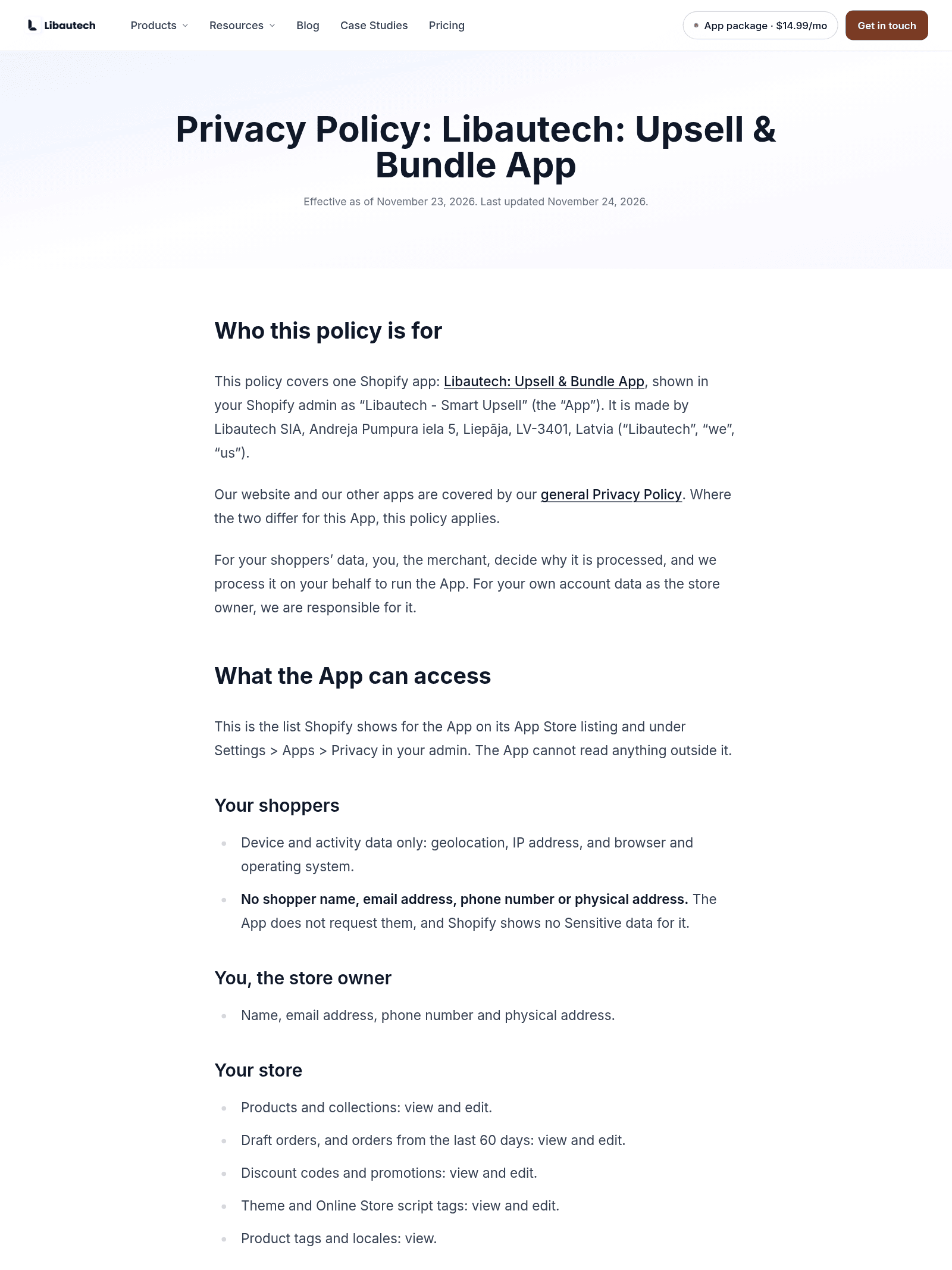
- What the policy says: the app has its own policy, effective November 23, 2026, which the App Store listing links. It names the app and copies Shopify's access list. It says the app reads no shopper names, emails, phone numbers or addresses, and stores the store owner's contact details, the offers and the orders that include an offer. Data is stored on servers in France. The only other recipients named are Shopify and our hosting provider. It lists the device and activity data the app can access, but does not yet say which of those fields the app uses or keeps. I wrote it during this review, after finding in our general policy the same gaps I flag in others.
- After uninstall: store data is deleted within 30 days of Shopify's delete request, which Shopify sends 48 hours after uninstall.
- Security record: SSL encryption, firewalls and monitoring are named. Store owners are emailed within 72 hours of a confirmed breach. No certification is named.
- What to ask us: which of the device and activity data the app uses and keeps. Email info@libautech.com and we will answer, and add the answer to the policy.
How do you check your own store in 10 minutes?
You do not need me for this part. Shopify shows you what every installed app can see, and it shows a new app's access before you install it.
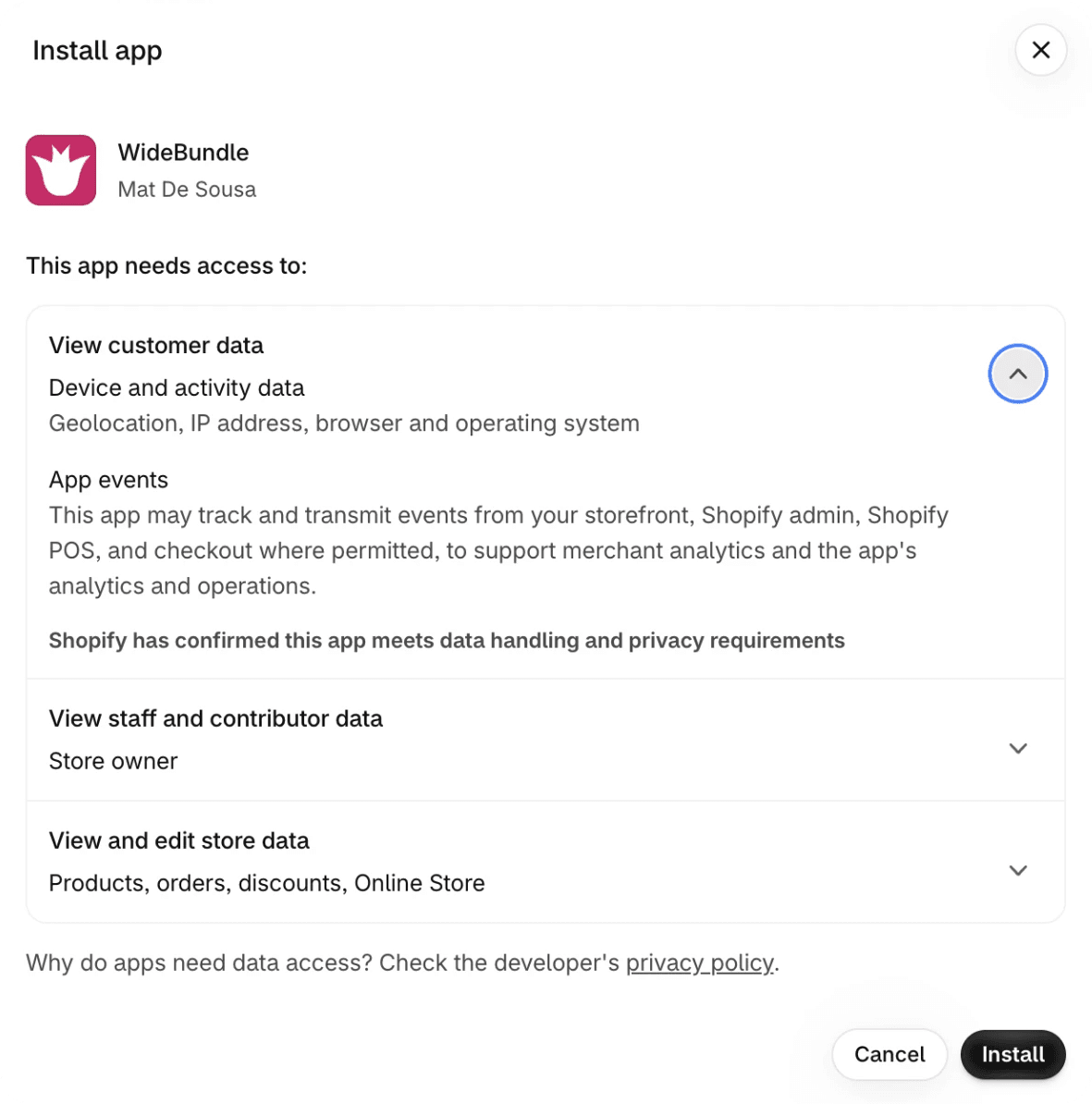
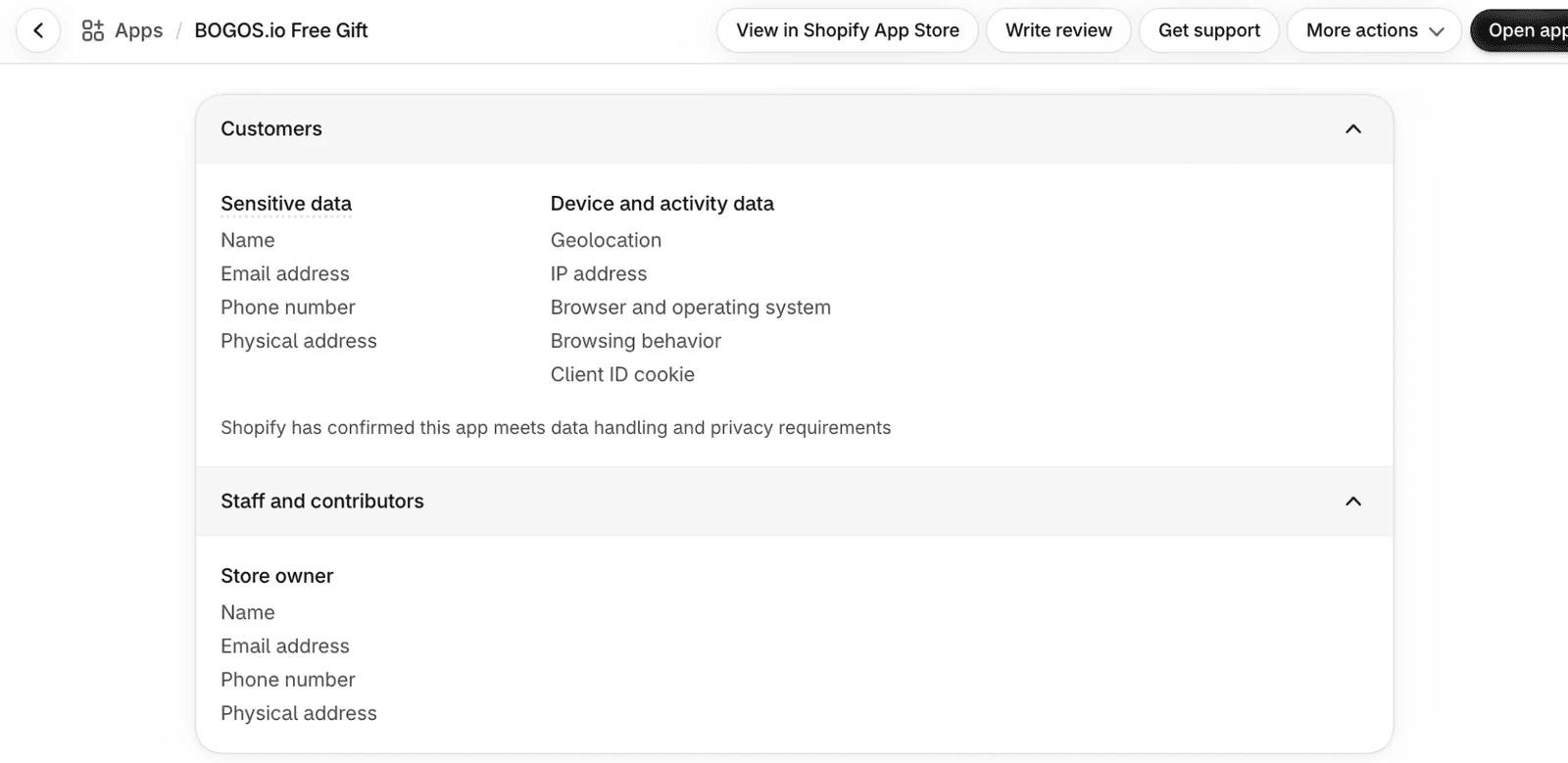
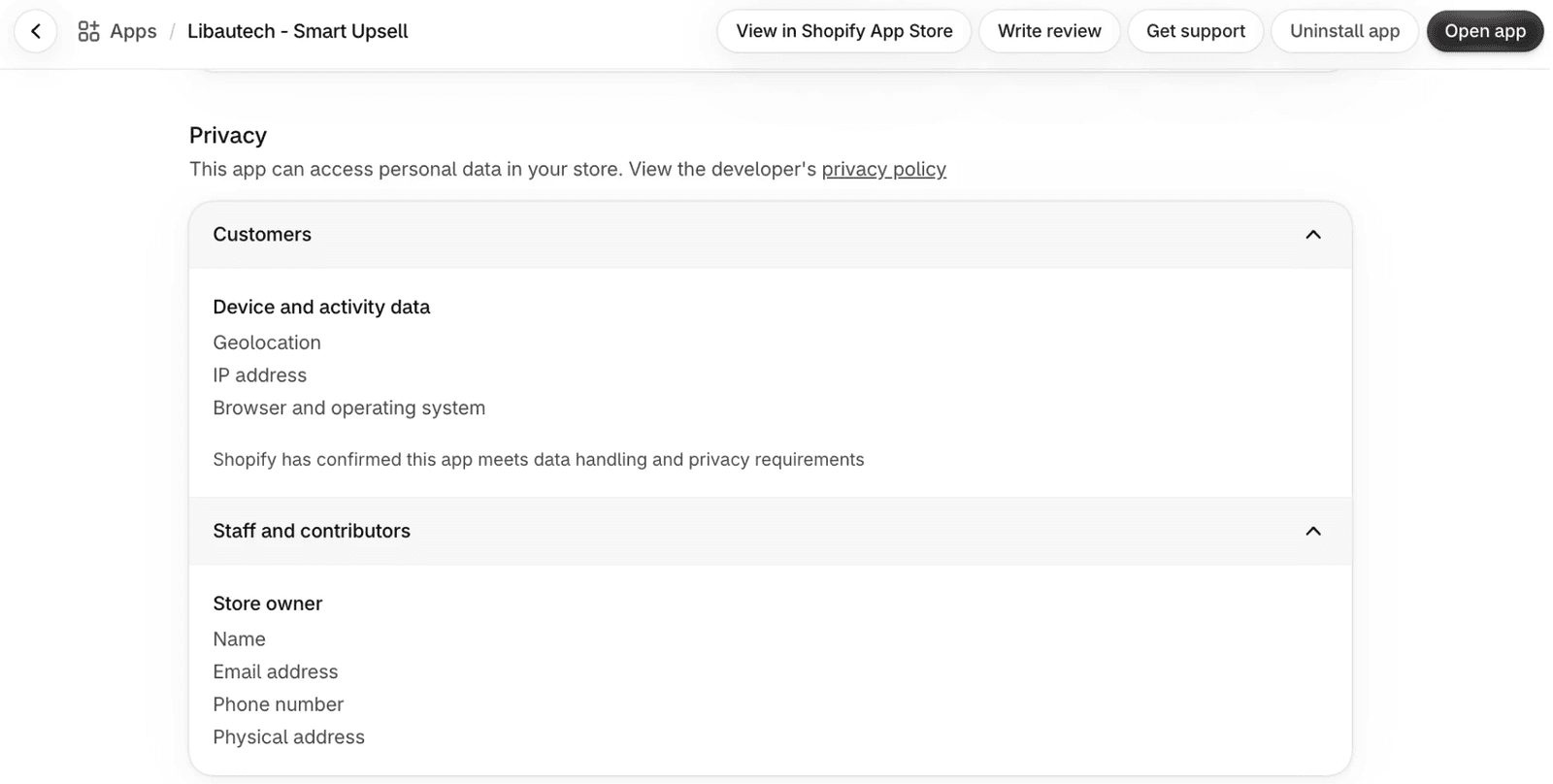
- In your Shopify admin, go to Settings > Apps.
- Click an app and scroll to Privacy. Under Customers, Sensitive data lists the contact details the app can read: name, email address, phone number or physical address. Device and activity data (location, IP address, browser) shows for almost every app. The section is described in Shopify's app permissions guide.
- Uninstall every app you no longer use. Shopify says uninstalling is how you revoke an app's access to your data. An old trial you forgot still has it.
- For each app you keep, compare its access to its job. A bundle widget with access to customer contact details needs a reason.
- If you cannot find the reason, email the developer 3 questions. Do you store my customers' personal data? Where? When is it deleted after I uninstall?
A good developer answers in a day. No answer is also an answer.
How I kept this fair
- Same checklist for our app. Libautech: Upsell & Bundle App gets the same 6 checks, published in the same table and the same list.
- Shopify's screen sets the access columns. The access lists come from Shopify's Privacy section in the admin, not from what developers write. Privacy policies are quoted, linked and dated.
- Corrections welcome. If you build one of these apps and I got something wrong, send the source and I will fix it.
Sources
- Libautech: Upsell & Bundle App privacy policy, updated Nov 24, 2026
- Triple Whale statement on X, Nov 20, 2026
- Shopifreaks: Triple Whale confirms a breach of its internal systems
- DEV Community: Shopify wasn't hacked, one of its apps was
- Shopify Help Center: App permissions and personal information
- Shopify Help Center: Installing and setting up apps
- Shopify dev docs: Work with protected customer data
- Shopify dev docs: Privacy law compliance