
8 Best Shopify Product Content Apps (2026)
Last updated: April 2026 · Pricing and ratings verified from live Shopify App Store listings on April 30, 2026. Reviewed by the Libautech team — builders of Built for Shopify apps used by 5,000+ merchants across 50+ countries.
Key Takeaways
- Shopify product content apps split into three distinct jobs that competitor blogs treat as one. AI product description writers (Bulk Product Descriptions by ChatGPT, AI SEO Optimizer by Logeix, GPT-Powered Description Writer) generate SEO-optimized descriptions at scale. Product information management apps (Metafields Guru, Bonify Custom Fields, Shogun Product Pages) extend product data with custom fields, specs, and structured info. Bulk product editing tools (Bulk Product Editor by Ablestar, Matrixify) handle mass updates to titles, descriptions, prices, and tags across catalogs.
- AI-generated product descriptions need editorial review. Pure AI output tends to read formulaic ("Discover the perfect blend of...") and Google's helpful content guidelines penalize unedited AI mass-produced content. The honest ROI comes from AI-as-draft plus human editing — typically 10-20 minutes editing time per AI-generated description that would have taken 30-60 minutes to write from scratch. AI saves time on first draft; human polish keeps Google quality signals.
- Metafields are Shopify's native solution for extended product data. Modern themes (Dawn, Sense, Refresh, Studio) display metafields directly on product pages without coding. Stores can add specifications, materials, ingredients, care instructions, dimensions, and any structured product info as metafields without third-party apps. Metafield management apps add bulk editing UI and templates beyond Shopify's native admin handling.
- Bulk product editing earns its cost specifically for stores with 100+ products needing periodic mass updates. The math: a store updating 500 product descriptions one-by-one through Shopify admin takes 8-15 hours of clicking; bulk editing apps reduce this to 30-60 minutes through CSV-based workflows or filtered batch operations. For stores with frequent mass updates (seasonal pricing, vendor product imports, SEO refreshes), bulk editing apps pay back in operational time savings.
- Pricing varies dramatically across layers. AI description writers run $9.99-99/mo or per-credit pricing ($0.05-1 per generated description). Metafield management apps run $5.99-49/mo. Bulk editing apps run $14.99-99/mo. The right pick costs less than $50/mo for most stores under 1,000 products once the actual content bottleneck is identified.
- The biggest product content mistake is generating AI descriptions without product knowledge inputs. AI tools that generate descriptions from product titles alone produce generic content; AI tools that accept product specifications, materials, and use-case inputs produce specific, useful descriptions. Spend the time on detailed AI prompts and structured product inputs — quality of input determines quality of output.
Who Needs a Product Content App, and Why?
A product content app writes and optimizes the words on your product pages, descriptions, titles and SEO meta, often with AI, so a large catalog reads well and ranks without you writing every line by hand. Better, consistent content lifts both conversion and search visibility.
You need one if you have a big or fast-changing catalog, import products with thin descriptions, or want SEO-friendly copy at scale. A small, hand-written catalog may not need it.
The Three Jobs of Shopify Product Content Apps
Most roundups of Shopify product content apps lump together AI description writers, metafield management, and bulk editing tools as if they're solving the same problem. They are not. An AI product description writer generates SEO-optimized descriptions at scale using LLMs (typically GPT-4 or similar) — input product details, get formatted descriptions back. A product information management app extends Shopify's native product data with custom fields, structured specifications, and rich content sections — manages what data products carry, not how it's written. A bulk product editing tool handles mass updates across catalogs — changes existing data efficiently rather than creating new content. Different mechanics, different outputs, different operational economics.
The honest framing: Shopify product content apps break into three distinct layers based on what they manage. Most stores benefit from at most two layers based on actual content needs — AI writing for description scaling, bulk editing for catalog maintenance. Metafield management is largely solved natively by Shopify Online Store 2.0 themes; third-party metafield apps deliver bulk editing UI beyond native admin handling.
The first job is AI product description writing — generating SEO-optimized descriptions at scale using machine learning. The mechanics: app accepts product details (title, specifications, brand voice, target keywords), LLM generates formatted description with headings, bullet points, and SEO structure, descriptions write back to Shopify product pages directly. Bulk Product Descriptions by ChatGPT, AI SEO Optimizer by Logeix, and GPT-Powered Description Writer lead this layer. The right pick for stores adding products faster than human writing capacity allows.
The second job is product information management and metafields — extending product data with custom fields, structured specifications, and rich content. Different mechanics from AI writers: doesn't generate text, structures product data so themes can display specifications, materials, ingredients, dimensions, and other structured info on product pages. Metafields Guru, Bonify Custom Fields, and Shogun Product Pages lead this layer. The right pick for stores with technical products needing structured specifications beyond standard descriptions.
The third job is bulk product editing and management — mass updates to titles, descriptions, prices, tags across catalogs. The mechanics: app accepts filter rules to select products (by collection, vendor, type, tag), applies transformations (find-replace, append, prepend, prefix, suffix), processes hundreds of products in single operations, sometimes via CSV import-export workflows. Bulk Product Editor by Ablestar and Matrixify lead this layer. The right pick for stores with established catalogs needing periodic mass updates.
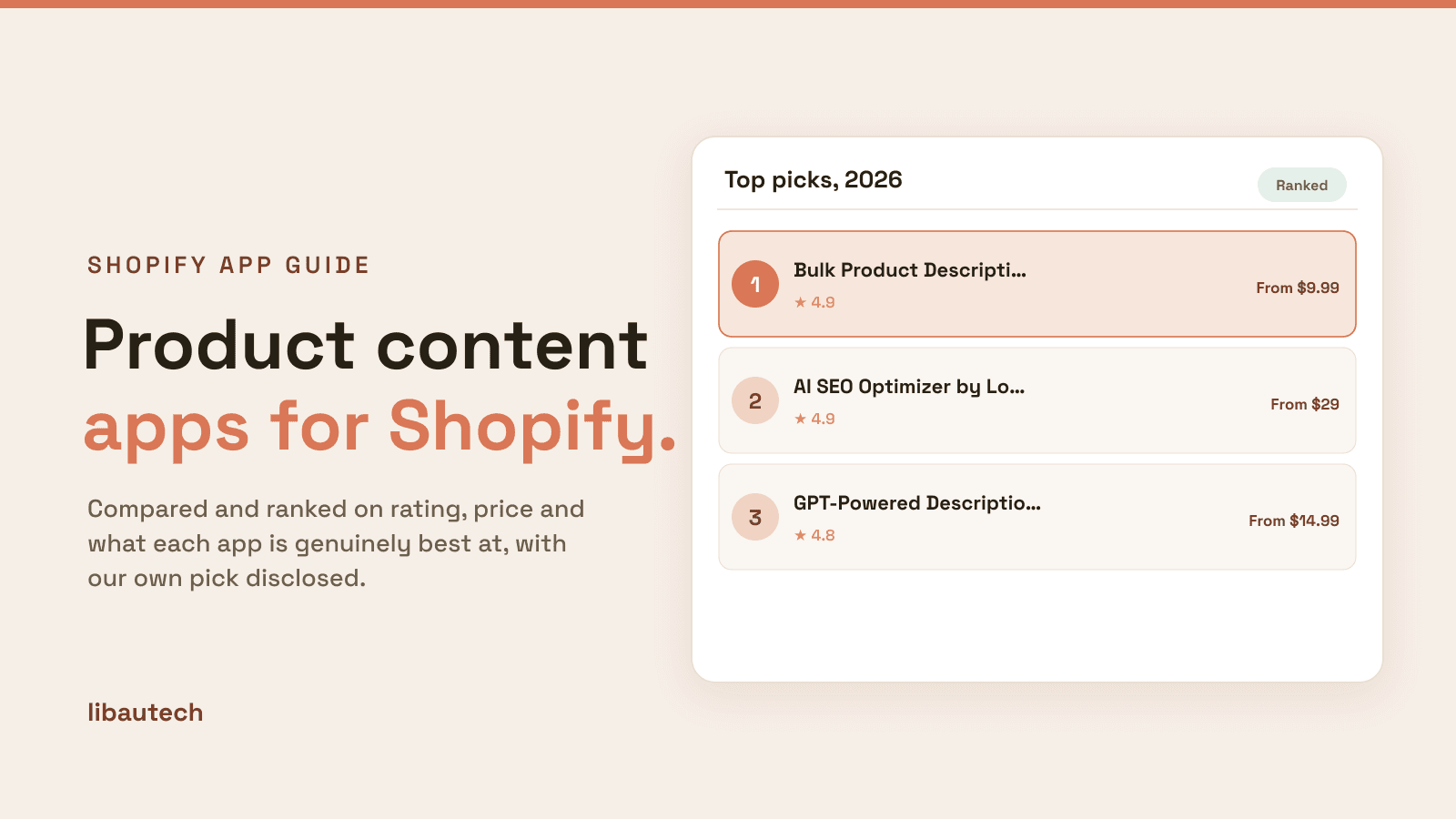
This post ranks 8 apps across the three jobs based on verified April 2026 Shopify App Store data and what each one actually solves.
Product content apps stack with broader merchandising tools. See our guides on best Shopify product display apps for the related product page enhancement layer, best Shopify metafield apps for the dedicated metafield deep-dive, and best Shopify bulk editor apps for the dedicated bulk editor deep-dive.
Quick Comparison: 8 Best Shopify Product Content Apps (2026)
| App | Rating | Free Plan | Paid From | Layer | Best For |
|---|---|---|---|---|---|
| Bulk Product Descriptions by ChatGPT | ⭐ 4.9 (700+) | Yes | $9.99/mo | AI description writing | Most-installed AI description writer |
| AI SEO Optimizer by Logeix | ⭐ 4.9 (300+) | Free trial | $29/mo | AI description writing | Comprehensive AI SEO with descriptions and metadata |
| GPT-Powered Description Writer | ⭐ 4.8 (200+) | Yes | $14.99/mo | AI description writing | Brand voice training, multi-language descriptions |
| Metafields Guru | ⭐ 4.9 (400+) | Yes | $5.99/mo | Metafield management | Most-installed metafield bulk editor |
| Bonify Custom Fields | ⭐ 4.7 (200+) | Yes | $14/mo | Metafield management | Custom field templates with theme integration |
| Shogun Page Builder | ⭐ 4.7 (3,000+) | Free trial | $39/mo | Rich product content | Drag-and-drop product page builder |
| Bulk Product Editor by Ablestar | ⭐ 5.0 (700+) | Yes | $30/mo | Bulk editing | 5.0-star bulk product editor with undo function |
| Matrixify (Excelify) | ⭐ 5.0 (600+) | Free trial | $20/mo | Bulk editing | CSV/Excel-based bulk operations across all data |
Layer 1: AI Product Description Writers
This layer is for stores adding products faster than human writing capacity allows. The mechanics: app accepts product details (title, specifications, brand voice, target keywords), LLM (typically GPT-4 or similar) generates formatted description with headings, bullet points, and SEO structure, descriptions write back to Shopify product pages directly. Three apps lead this layer.
1. Bulk Product Descriptions by ChatGPT
Best for: Shopify stores wanting most-installed AI product description writer with bulk processing and broad language support — the established AI description writer pick.
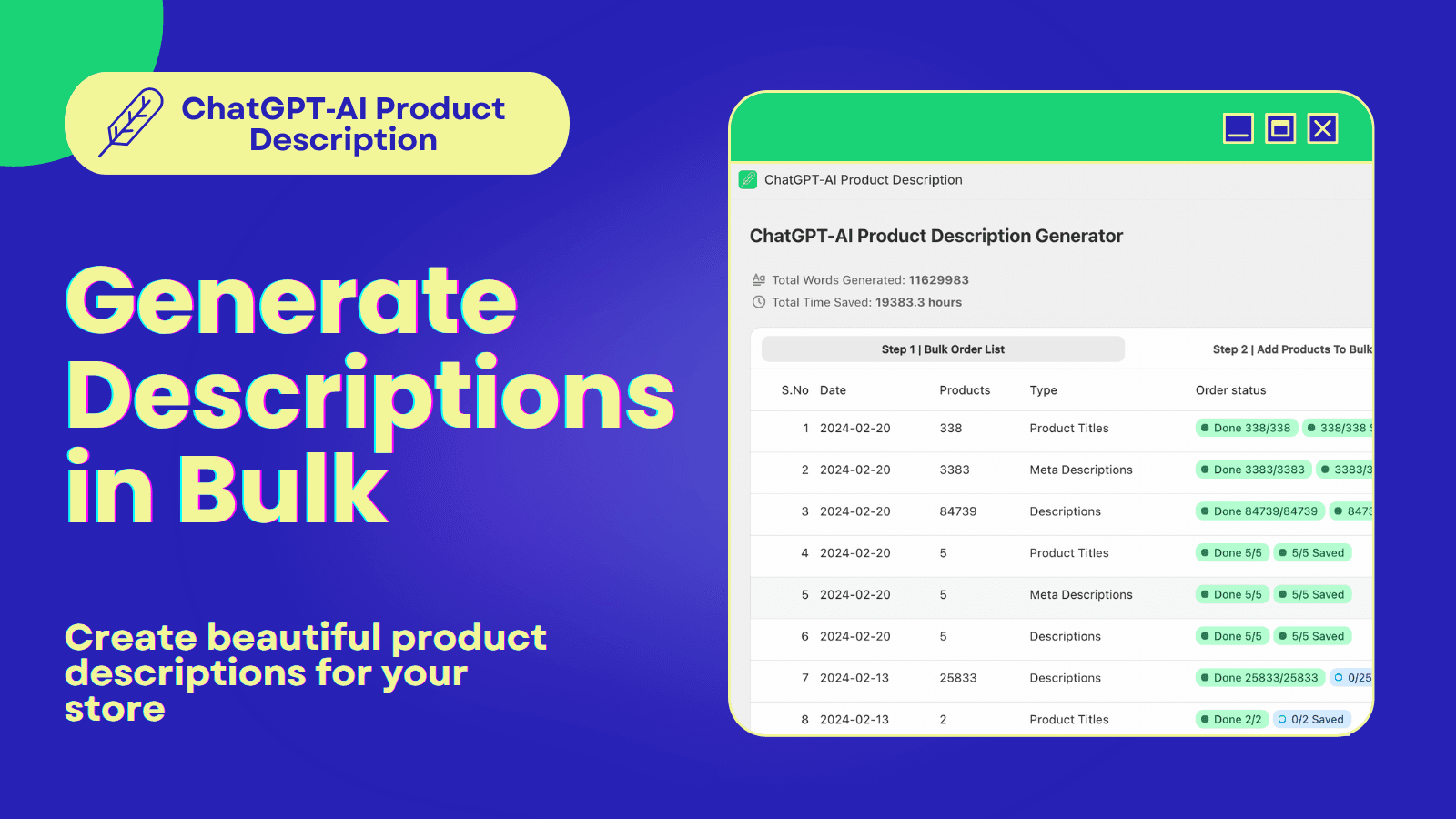
Bulk Product Descriptions by ChatGPT holds 4.9 stars across 700+ reviews — the most-installed AI product description writer on Shopify. The positioning is comprehensive AI description generation: bulk product description generation across catalogs (10-10,000+ products in single operations), SEO-optimized formatting with headings and bullet points, multi-language support for international stores, brand voice configuration, keyword targeting, and integration with Shopify Online Store 2.0 themes.
The bulk processing matters specifically for stores at scale. Stores adding 50-200 products monthly face significant description writing overhead — manual writing takes 30-60 minutes per product, totaling 25-200 hours monthly. AI bulk processing reduces description generation to 1-3 minutes per product (5-30 minutes for the entire monthly catalog) plus 10-20 minutes editing per description. For stores with growing catalogs, this efficiency compounds.
The honest trade-off: pure AI output tends to read formulaic without editorial review. Phrases like "Discover the perfect blend of" and "Elevate your" appear constantly in unedited AI descriptions across stores using similar tools. Google's helpful content guidelines penalize mass-produced unedited AI content for SEO. The right workflow is AI-generated drafts plus 10-20 minute human editing per description — still saves significant time versus writing from scratch, but maintains content quality.
Core features: bulk AI description generation; SEO-optimized formatting; multi-language support; brand voice configuration; keyword targeting; integration with Shopify Online Store 2.0 themes; merchant dashboard with generation history.
Where it falls short: pure AI output requires editorial review for SEO and brand voice. Best for stores willing to invest editing time in AI drafts rather than expecting publish-ready output.
Pricing: Free plan available. Paid plans from $9.99/mo.
2. AI SEO Optimizer by Logeix
Best for: Shopify stores wanting comprehensive AI-powered SEO with descriptions plus metadata, alt text, and broader SEO automation — the comprehensive AI SEO pick.
AI SEO Optimizer by Logeix holds 4.9 stars across 300+ reviews. The differentiating positioning is comprehensive AI SEO beyond just descriptions: AI-generated product descriptions with SEO formatting, AI-generated meta titles and meta descriptions, AI-generated image alt text, AI-generated FAQ content for product pages, broken link detection and repair, sitemap optimization, and integration with Shopify Online Store 2.0 themes.
The comprehensive SEO positioning matters specifically for stores wanting complete on-page SEO without separate apps. Where Bulk Product Descriptions focuses on description generation, Logeix bundles description, metadata, alt text, and FAQ generation under one app — useful for stores wanting AI-powered SEO across the entire product page rather than just description text.
Core features: AI product descriptions; AI meta titles and descriptions; AI image alt text; AI FAQ generation for product pages; broken link detection; sitemap optimization; integration with Shopify Online Store 2.0 themes; merchant dashboard with comprehensive SEO analytics.
Where it falls short: feature breadth means less specialized depth on description generation versus dedicated alternatives. Best for stores wanting bundled SEO functionality rather than focused description writing.
Pricing: Free trial. Paid plans from $29/mo.
3. GPT-Powered Description Writer
Best for: Shopify stores wanting brand voice training and multi-language descriptions for international expansion — the brand-voice AI writer pick.
GPT-Powered Description Writer holds 4.8 stars across 200+ reviews. The positioning is brand-voice AI writing: stores upload existing high-performing descriptions or brand voice guidelines, AI learns brand-specific writing patterns, generates new descriptions matching brand voice, supports 50+ languages for international markets, batch processing across catalogs, and integration with Shopify Online Store 2.0 themes.
The brand voice training matters specifically for established brands with developed editorial standards. Where generic AI output produces formulaic content, brand-voice trained AI generates descriptions that match the brand's actual writing style — useful for brands with strong editorial identity that don't want generic AI tone.
Core features: brand voice training from existing descriptions; multi-language description generation (50+ languages); batch processing across catalogs; SEO-optimized formatting; integration with Shopify Online Store 2.0 themes.
Where it falls short: brand voice training requires effort and existing high-quality content to learn from. Best for established brands with editorial standards rather than new stores building voice.
Pricing: Free plan available. Paid plans from $14.99/mo.
The Honest Trade-Off: AI Descriptions Need Editorial Review
Worth saying explicitly: AI-generated product descriptions need editorial review before publishing. Pure AI output tends to read formulaic regardless of which tool generates it — phrases like "Discover the perfect blend of," "Elevate your," and "Take your X to the next level" appear constantly in unedited AI descriptions across thousands of stores using similar tools. Google's helpful content guidelines specifically penalize mass-produced unedited AI content, and stores publishing AI descriptions verbatim risk SEO penalties.
The right workflow: AI generates drafts at scale, human editor spends 10-20 minutes per description adding specific product knowledge, removing formulaic phrases, and confirming factual accuracy. This still saves significant time versus writing from scratch (30-60 minutes per description) but maintains the content quality Google rewards. The math: AI plus editing saves 50-70% time versus pure manual writing while preserving SEO and brand quality.
The signal that AI description tools earn their cost: store has 50+ products needing descriptions, willing to invest editing time on AI drafts, established brand voice or content standards. The signal that they're premature: store under 20 products where manual writing is faster than configuring AI workflows, or stores expecting publish-ready output without editorial investment.
Layer 2: Product Information Management and Metafields
This layer is for stores with technical products needing structured specifications beyond standard descriptions. The mechanics: app extends Shopify's native product data with custom fields, structured specifications, and rich content sections — themes display this structured info on product pages with custom layouts. Three apps lead this layer.
4. Metafields Guru
Best for: Shopify stores wanting most-installed metafield bulk editor with broad metafield management — the established metafield management pick.
Metafields Guru holds 4.9 stars across 400+ reviews. The positioning is comprehensive metafield management: bulk metafield creation and editing, metafield templates for consistent application across products, CSV import-export for bulk metafield operations, metafield definitions with type validation, integration with Shopify Online Store 2.0 themes, and merchant dashboard with metafield operation history.
The bulk metafield management matters specifically for stores with technical product specifications. Stores selling products with multiple structured attributes (electronics with detailed specs, clothing with material composition, food with nutrition data) face significant metafield setup overhead — Metafields Guru's templates and bulk operations reduce this from manual per-product configuration to template-based application.
The honest trade-off: Shopify's native admin handles basic metafield creation and per-product editing without third-party apps. Metafields Guru adds value specifically for stores with 100+ products needing bulk metafield workflows or complex metafield templates beyond Shopify's native handling.
Core features: bulk metafield creation and editing; metafield templates; CSV import-export for metafields; metafield definitions with type validation; integration with Shopify Online Store 2.0 themes.
Where it falls short: features overlap with native Shopify metafield admin for stores with simple metafield needs. Best for stores with complex metafield workflows rather than basic product specifications.
Pricing: Free plan available. Paid plans from $5.99/mo.
5. Bonify Custom Fields
Best for: Shopify stores wanting custom field templates with strong theme integration and advanced field types — the focused custom fields pick.
Bonify Custom Fields holds 4.7 stars across 200+ reviews. The differentiating positioning is custom field templates with strong theme integration: pre-built templates for common product types (apparel sizing, electronics specs, food ingredients), advanced field types (file uploads, rich text, references), theme integration helpers for displaying custom fields, and integration with Shopify Online Store 2.0 themes.
The template positioning matters specifically for stores wanting structured fields without metafield expertise. Where Metafields Guru provides bulk metafield management for stores already understanding metafield architecture, Bonify provides ready-to-use templates that abstract the metafield complexity — useful for stores adopting structured data without dedicated technical resources.
Core features: custom field templates by product type; advanced field types (file uploads, rich text, references); theme integration helpers; integration with Shopify Online Store 2.0 themes; merchant dashboard with field operation history.
Where it falls short: less flexibility than direct metafield management for stores with custom data requirements. Best for stores wanting template-based structure rather than custom metafield architecture.
Pricing: Free plan available. Paid plans from $14/mo.
6. Shogun Page Builder
Best for: Shopify stores wanting drag-and-drop product page builder with rich content sections beyond standard product templates — the established page builder pick.
Shogun Page Builder holds 4.7 stars across 3,000+ reviews — the largest review base in this entire post and the most-installed page builder on Shopify. The positioning is comprehensive page builder for product pages and beyond: drag-and-drop visual editor for product pages, landing pages, and collection pages, pre-built templates for common page types, A/B testing for product page variants, mobile-optimized output, integration with conversion tools (reviews, upsells, cart), and integration with Shopify Online Store 2.0 themes.
The page builder positioning matters specifically for stores wanting product page customization beyond what themes provide. Standard Shopify themes provide consistent product page templates that match the storefront aesthetic; page builders enable per-product customization where specific products warrant unique layouts (high-ticket items, bundle offers, comparison-heavy products).
Core features: drag-and-drop visual editor; pre-built page templates; A/B testing for page variants; mobile-optimized output; integration with conversion tools; integration with Shopify Online Store 2.0 themes; merchant dashboard with page performance analytics.
Where it falls short: pricing entry point ($39/mo) reflects comprehensive page builder positioning. Modern Shopify themes (Dawn, Sense, Refresh, Studio) provide flexible product page customization through theme editor without requiring third-party page builders. Best for stores needing per-product page customization beyond theme capabilities.
Pricing: Free trial. Paid plans from $39/mo.
Layer 3: Bulk Product Editing and Management
This layer is for stores with established catalogs needing periodic mass updates to titles, descriptions, prices, and tags. The mechanics: app accepts filter rules to select products, applies transformations (find-replace, append, prepend, prefix, suffix), processes hundreds of products in single operations, often via CSV import-export workflows. Two apps lead this layer.
7. Bulk Product Editor by Ablestar
Best for: Shopify stores wanting 5.0-star bulk product editor with strong undo function and broad transformation support — the highest-rated bulk editing pick.
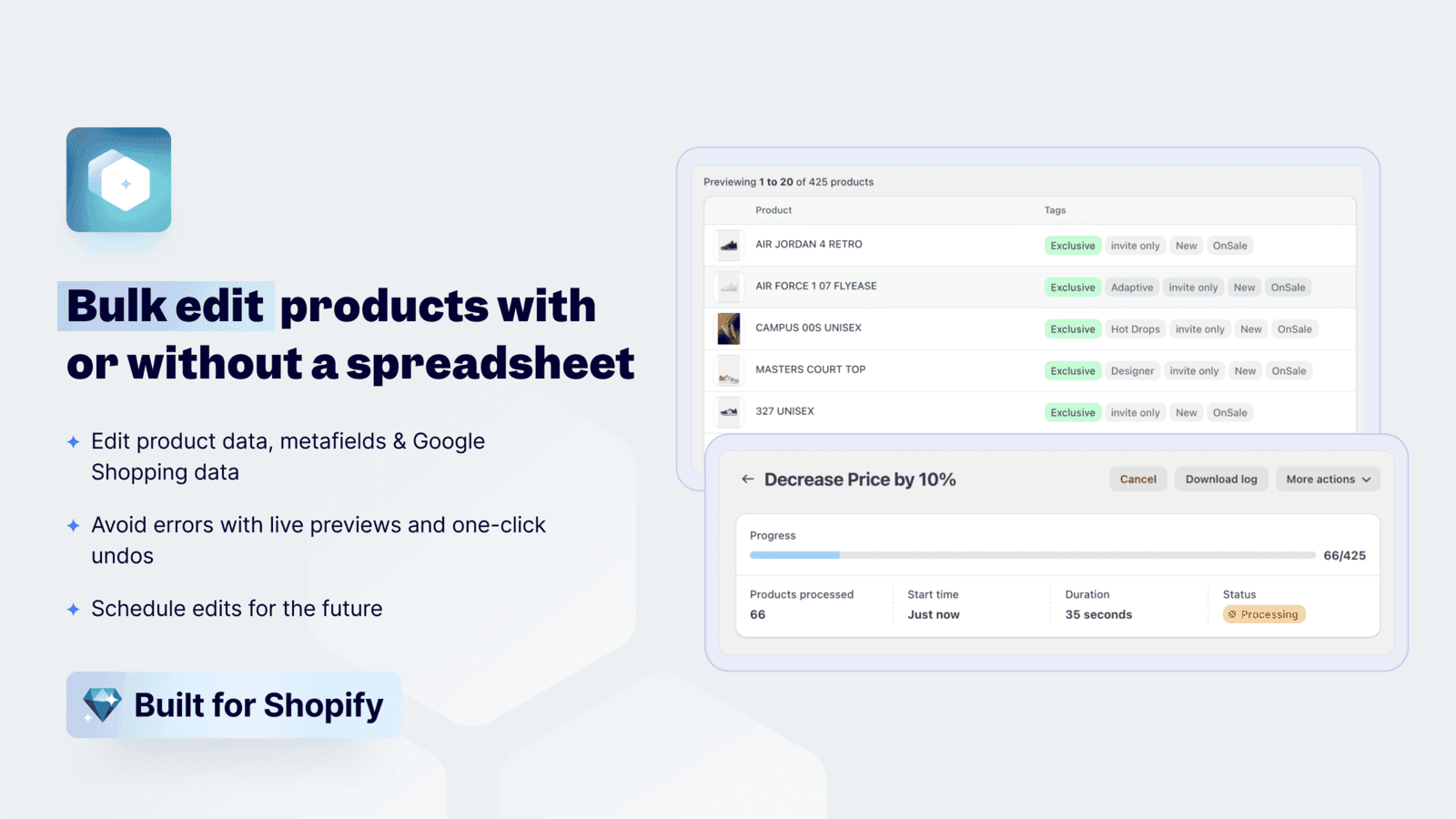
Bulk Product Editor by Ablestar holds 5.0 stars across 700+ reviews — the highest-rated bulk product editor on Shopify. The positioning is comprehensive bulk editing with safety features: bulk update titles, descriptions, prices, tags, vendors, types, and metafields, advanced filter rules to select target products, find-replace with regex support, undo function for reverting bulk operations (the differentiating safety feature), preview mode showing changes before commit, and integration with Shopify Online Store 2.0 themes.
The undo function matters specifically for safety on bulk operations. Bulk editing on 500+ products risks accidentally damaging catalog data when filters or transformations don't work as expected — Ablestar's undo function reverts bulk operations to pre-change state, providing safety net that pure CSV-based tools don't offer. For stores with mission-critical catalog data, this single feature can prevent costly mistakes.
Core features: bulk update titles, descriptions, prices, tags, vendors, types, metafields; advanced filter rules; find-replace with regex; undo function for reverting operations; preview mode for changes; integration with Shopify Online Store 2.0 themes.
Where it falls short: pricing entry point ($30/mo) higher than Matrixify for stores wanting CSV-based workflows. Best for stores prioritizing safety on direct in-app bulk edits.
Pricing: Free plan available. Paid plans from $30/mo.
8. Matrixify (Excelify)
Best for: Shopify stores wanting CSV/Excel-based bulk operations across products, customers, orders, and all Shopify data — the comprehensive data management pick.
Matrixify (Excelify) holds 5.0 stars across 600+ reviews. The differentiating positioning is comprehensive CSV/Excel-based bulk operations beyond just products: bulk operations across products, customers, orders, collections, blog posts, pages, and all Shopify data, Excel and CSV import-export, scheduled exports for backup, complex data transformations through Excel formulas, and integration with Shopify Online Store 2.0 themes.
The cross-data positioning matters specifically for stores managing multiple data types. Where Ablestar focuses on product editing, Matrixify handles bulk operations across the entire Shopify data model — useful for stores doing comprehensive data migrations, periodic bulk updates across multiple data types, or Excel-based catalog management workflows.
Core features: CSV/Excel import-export for products, customers, orders, collections, blog posts, pages; scheduled exports for backup; complex data transformations through Excel formulas; integration with Shopify Online Store 2.0 themes; merchant dashboard with operation history.
Where it falls short: requires comfort with Excel/CSV workflows rather than visual UI editing. Best for technical merchants wanting Excel-driven catalog management rather than UI-based editing.
Pricing: Free trial. Paid plans from $20/mo.
Which Product Content App to Choose
For most-installed AI product description writer: Bulk Product Descriptions by ChatGPT. 4.9 stars, 700+ reviews, $9.99/mo entry, the established AI description pick.
For comprehensive AI SEO with descriptions plus metadata: AI SEO Optimizer by Logeix. 4.9 stars, $29/mo, the comprehensive AI SEO pick.
For brand voice training and multi-language descriptions: GPT-Powered Description Writer. 4.8 stars, $14.99/mo, the brand-voice AI writer pick.
For most-installed metafield bulk editor: Metafields Guru. 4.9 stars, 400+ reviews, $5.99/mo entry, the established metafield management pick.
For custom field templates with theme integration: Bonify Custom Fields. 4.7 stars, $14/mo entry, the focused custom fields pick.
For drag-and-drop product page builder: Shogun Page Builder. 4.7 stars, 3,000+ reviews, $39/mo, the established page builder pick.
For 5.0-star bulk product editor with undo: Bulk Product Editor by Ablestar. 5.0 stars, 700+ reviews, $30/mo, the highest-rated bulk editing pick.
For CSV/Excel bulk operations across all data: Matrixify (Excelify). 5.0 stars, 600+ reviews, $20/mo entry, the comprehensive data management pick.
For most Shopify stores in this category, the honest framing is content-bottleneck-first. Stores adding products faster than human writing capacity allows install Layer 1 AI description writers (Bulk Product Descriptions by ChatGPT for most-installed, Logeix for comprehensive SEO, GPT-Powered for brand voice). Stores with technical products needing structured specs install Layer 2 metafield management (Metafields Guru, Bonify, or Shogun for full page builder). Stores with established catalogs needing periodic mass updates install Layer 3 bulk editing (Ablestar for safety, Matrixify for cross-data CSV workflows). The most common product content mistake is generating AI descriptions without product knowledge inputs — spend the time on detailed AI prompts and structured product inputs; quality of input determines quality of output.
How We Ranked These Apps
This ranking is based on four criteria applied to every Shopify product content app tested in 2026. First, Shopify App Store rating and verified review volume as of April 30, 2026 — the strongest signal of long-term merchant satisfaction at scale. Second, fit-to-job for which of the three layers each app actually solves (AI description writing, metafield management, or bulk editing) rather than treating these as a single category. Third, total cost economics including app pricing, per-credit AI generation costs, and typical time savings versus manual operations — a $9.99/mo AI description tool and a $30/mo bulk editor deliver fundamentally different value, and the math depends on which layer the store actually needs. Fourth, output quality and editorial fit, since merchant satisfaction depends critically on whether the app's output matches the store's editorial standards and Google quality requirements.
Every pricing and feature figure in this post was verified directly from each app's live Shopify App Store listing on April 30, 2026. App pricing structures change — always confirm current pricing on the official listing before installing. Ratings and review counts reflect the Shopify App Store at the time of our last update.
Frequently Asked Questions
What is a Shopify product content app?
A Shopify product content app handles one of three distinct jobs. AI description writers (Bulk Product Descriptions by ChatGPT, Logeix, GPT-Powered) generate SEO-optimized descriptions at scale. Product information management apps (Metafields Guru, Bonify, Shogun) extend product data with custom fields and structured specs. Bulk editing tools (Ablestar, Matrixify) handle mass updates to titles, descriptions, prices, and tags across catalogs.
What is the best Shopify product content app in 2026?
Depends on the layer. For AI description writing: Bulk Product Descriptions by ChatGPT (4.9 stars, 700+ reviews, most-installed). For metafield management: Metafields Guru (4.9 stars). For bulk editing: Bulk Product Editor by Ablestar (5.0 stars with undo function) or Matrixify (5.0 stars, CSV-based). Pick the layer first based on actual content bottleneck.
How much do Shopify product content apps cost?
AI description writers run $9.99-99/mo or per-credit pricing ($0.05-1 per generated description). Metafield management apps run $5.99-49/mo. Bulk editing apps run $14.99-99/mo. The right pick costs less than $50/mo for most stores under 1,000 products once the actual content bottleneck is identified.
Are AI-generated product descriptions safe for SEO?
With editorial review, yes. Pure AI output tends to read formulaic and Google's helpful content guidelines penalize mass-produced unedited AI content. The right workflow is AI-generated drafts plus 10-20 minutes human editing per description — saves significant time versus writing from scratch while maintaining content quality Google rewards. Publishing AI descriptions verbatim risks SEO penalties.
Does Shopify natively support metafields?
Yes. Modern Shopify themes (Dawn, Sense, Refresh, Studio) display metafields directly on product pages without coding. Stores can add specifications, materials, ingredients, care instructions, dimensions, and any structured product info as metafields without third-party apps. Metafield management apps add bulk editing UI and templates beyond Shopify's native admin handling.
What is the difference between metafields and product descriptions?
Different mechanics. Product descriptions are unstructured rich text content displayed in the description section. Metafields are structured data fields with specific types (text, number, date, JSON) that themes display in dedicated UI sections. Descriptions are for narrative product information; metafields are for structured specifications.
How much time do bulk editing apps save?
For stores updating 500 product descriptions one-by-one through Shopify admin: 8-15 hours of clicking. Bulk editing apps reduce this to 30-60 minutes through CSV-based workflows or filtered batch operations. For stores with frequent mass updates (seasonal pricing, vendor product imports, SEO refreshes), bulk editing apps pay back in operational time savings.
Should I use Shogun Page Builder?
Depends on theme customization needs. Modern Shopify themes (Dawn, Sense, Refresh, Studio) provide flexible product page customization through theme editor without requiring third-party page builders. Page builders earn their cost specifically when stores need per-product unique layouts (high-ticket items, bundle offers, comparison-heavy products) beyond what themes support natively.
What's the biggest product content mistake?
Generating AI descriptions without product knowledge inputs. AI tools that generate descriptions from product titles alone produce generic content; AI tools that accept product specifications, materials, and use-case inputs produce specific, useful descriptions. Spend the time on detailed AI prompts and structured product inputs — quality of input determines quality of output.
Can I use multiple product content apps together?
Yes for different layers. Common stack: Bulk Product Descriptions by ChatGPT (AI drafts during product creation) plus Metafields Guru (structured specs) plus Bulk Product Editor by Ablestar (periodic mass updates). Layers don't conflict — each handles a different content production stage. Avoid stacking multiple apps in the same layer.
Think Your App Belongs on This List?
We update these lists as new tools launch and existing ones improve. If you are a developer building a Shopify product content, AI writing, or bulk editing app and want your app considered for inclusion, submit it here — tell us what your app does, who it is for, and include a link to your Shopify App Store listing. We review every submission.