
9 Best Shopify NFT & Tokengating Apps (2026)
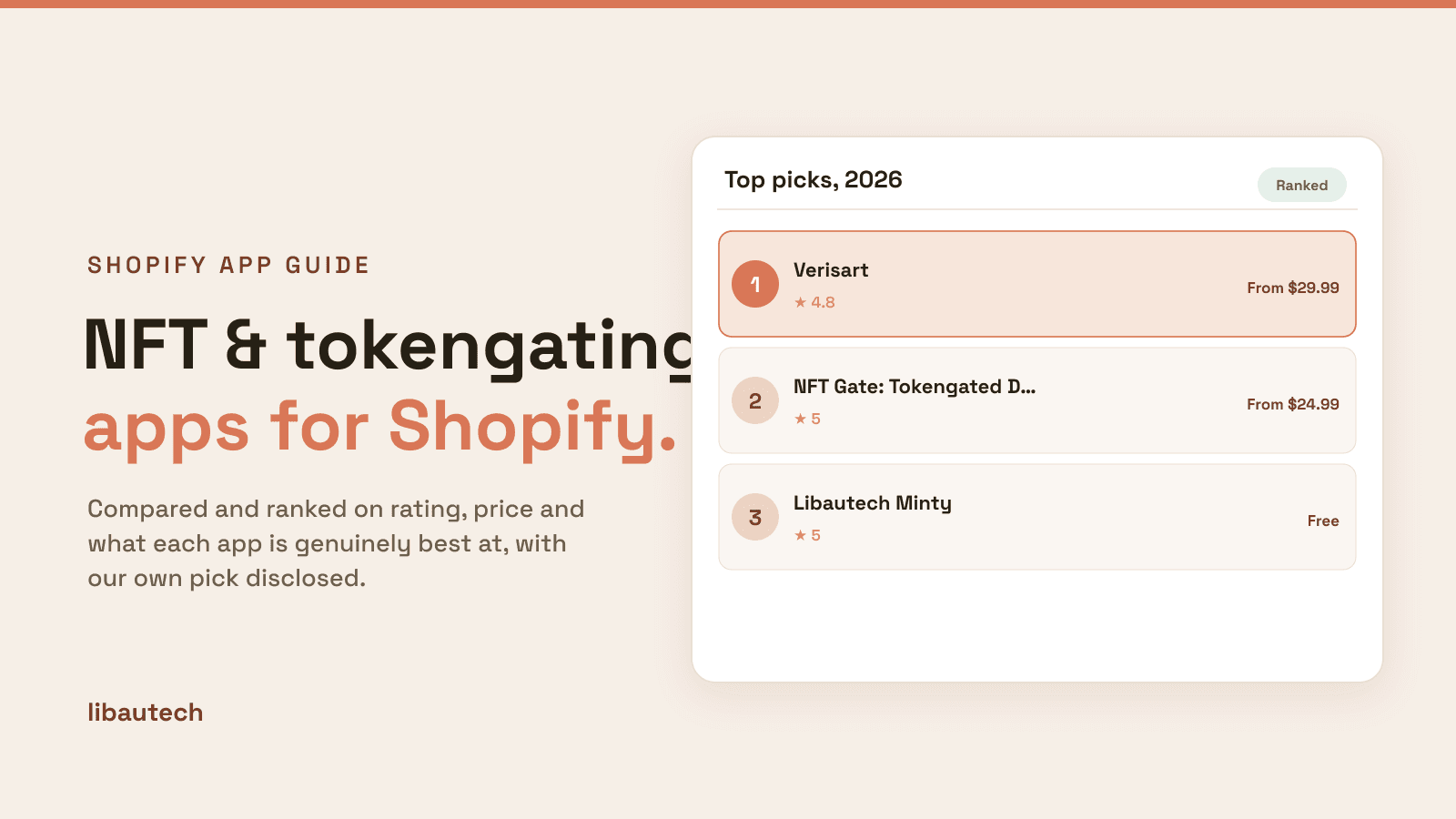
Last updated: April 2026 · Pricing verified April 22, 2026 · Reviewed by the Libautech team, builders of Discord Gate, Minty, and 7 other Shopify apps used by 5,000+ merchants across 50+ countries.
Key Takeaways
- Most Shopify stores do not have an NFT holder audience to gate — honest tokengating advice starts by asking whether your customers actually hold tokens, and most of the time the answer is no. For 95% of Shopify merchants the better fit is community-based gating (Discord roles, membership tiers) rather than on-chain NFT verification.
- NFT and tokengating apps solve four distinct jobs — minting/selling NFTs, gating discounts and products by wallet ownership, certification and provenance for physical goods, and community-based gating without crypto. The right app depends on which job matters for your store.
- PERCS Engage leads for enterprise Web3 brands (Budweiser, Playboy, the Hundreds — 250+ merchants, 20K+ redemptions, $10M+ GMV processed) with advanced EVM token-based gating and professional services support.
- Verisart (4.8/5) is the strongest pick for stores combining NFT sales with physical product certificates of authenticity — used by Johnny Depp, Shepard Fairey, and König Galerie for provenance-backed art and collectibles.
- Libautech Discord Gate (5.0/3) is the Web2-native alternative for community gating, and Libautech Minty (5.0/2) handles Solana NFT and meme token gating — two different jobs from the same Built for Shopify team.
- Before spending weeks on Web3 integration, verify: does your target customer actually hold tokens, have wallets, and know how to connect them? If yes, use PERCS, Verisart, or Minty (for Solana). If no, use Discord Gate — you will get better engagement for a fraction of the setup cost.
Who Needs an NFT & Tokengating App, and Why?
An NFT and tokengating app lets you mint digital collectibles and gate products, discounts or content to holders of a token or NFT. It rewards a community, adds a new digital product line, and creates exclusive access that deepens loyalty.
You need one if you run a web3 or community-driven brand, want holder-only perks, or sell digital collectibles alongside physical goods. Most mainstream stores do not need it.
The Four Jobs of Shopify NFT and Tokengating Apps
Most tokengating roundups list 10 Web3 apps and rank them by feature count, implicitly assuming every Shopify store should add NFT verification to checkout. That framing misses the core question: does your store actually have an NFT holder audience to gate? For most Shopify merchants, the answer is no. Tokengating apps solve four distinct jobs, and the right app depends heavily on whether your customers are Web3-native or Web2-native.
The first job is NFT minting and selling. Creating your own digital collectible collection — whether tied to physical products, as standalone art drops, or as loyalty rewards — and selling them through your Shopify store to card buyers and crypto buyers alike. Verisart handles this for EVM chains; Minty handles it for Solana. The global NFT market is projected to grow from $3.6B in 2024 to $22.8B by 2034, but most Shopify stores entering this space are better served testing with a small drop before committing to full minting infrastructure.
The second job is token-gated discounts and product access. Verifying that a customer holds a specific NFT, ERC-20 token, POAP, or wallet allowlist entry, and then granting them exclusive discounts, early access to product drops, limited-edition variants, or discount codes. This is the core Web3 commerce use case — and also the job where audience fit matters most. If your community genuinely owns your tokens, this drives retention. If they do not, the integration sits unused.
The third job is certification and provenance. Attaching blockchain-verified certificates of authenticity to physical products — art, collectibles, luxury goods, limited-run apparel — that customers can verify, transfer, and resell with provenance intact. Verisart is the category leader here, working with Johnny Depp, Shepard Fairey, and König Galerie on authenticated art and collectibles. This is a genuinely strong use case for art and luxury categories where provenance affects resale value; less relevant for general commerce.
The fourth job is community-based gating without crypto. Gate discounts and products by Discord server role, Patreon tier, or membership status rather than on-chain wallet ownership. For the vast majority of Shopify merchants who have active Discord servers, loyalty programs, or membership tiers but no NFT collection, this is the job that actually matches their business. Libautech Discord Gate handles this directly: connect Discord, assign roles to customers, and trigger discounts based on role — no wallet connection, no gas fees, no Web3 onboarding required.
This post ranks 9 apps across all four jobs with verified April 2026 pricing and honest positioning for who each app is actually for.
Tokengating stacks with other customer-engagement tools. See our guides on best Shopify digital product apps for the delivery mechanics on digital goods (which NFT minting apps do not replicate for non-Web3 digital products), and best Shopify pricing optimization apps for the discount and pricing infrastructure that sits underneath any tokengated offer.
Quick Comparison: 9 Best Shopify NFT & Tokengating Apps (2026)
| App | Rating | Free Plan | Paid From | Networks | Best For |
|---|---|---|---|---|---|
| PERCS Engage | Enterprise | Contact sales | Custom | All EVM chains | Enterprise Web3 brands with real token holder audiences |
| Verisart | ⭐ 4.8 | Free to install | $29.99/mo | Ethereum, Base, Polygon | Art, collectibles, provenance for physical goods |
| Shopthru | Established | Yes | Custom tiers | NFT, ERC-20, POAP, allowlists | Advanced rules engine, multiple token types combined |
| NFT Gate: Tokengated Discounts | ⭐ 5.0 (4) | Free trial | $24.99/mo | Multi-chain (inc. Base) | Simple tokengated discounts, wide network support |
| Libautech Minty | ⭐ 5.0 (2) | Yes | Free plan available | Solana (NFTs + meme tokens) | Solana NFT minting + token gating for Shopify+ |
| Taco Loyalty + Tokengate | Established | Yes (Free Taco) | Base tier | Tezos, ETH, Polygon, Solana, Flow | Traditional loyalty points + optional NFT layer |
| Manifold Merch Bridge | ⭐ 2.5 (7) | Free | — | Ethereum, Polygon | Basic tokengating, drag-drop integration (mixed reviews) |
| Libautech Discord Gate | ⭐ 5.0 (3) | Yes | Free plan available | Discord roles (no blockchain) | Web2 community gating — creators, Discord-native brands |
| Shopify Native Tokengating API | — | Included | Free (dev work) | Custom per implementation | Shopify Plus stores with dev resources, full custom |
Honest Context: Who Actually Needs Tokengating?
Before diving into individual apps, a reality check. Tokengating works well for three specific merchant profiles:
One: established Web3-native brands with an actual NFT collection and an active holder community. Think Budweiser's Heritage Can collection, Playboy's Rabbitars, the Hundreds' Adam Bomb Squad. These brands use PERCS, Verisart, Minty (for Solana), or Shopthru because their customers demonstrably own the tokens being used to gate access.
Two: art and collectibles merchants where blockchain certificates of authenticity add legitimate value to physical products. A Shepard Fairey print sold with a Verisart-verified certificate of authenticity commands higher resale value than one without. The tokengating layer here is secondary — the certification layer is the real value.
Three: creator-led communities with active Discord servers who want to reward active members with exclusive merch drops or member-only discounts. This is where Libautech Discord Gate fits: no wallet, no gas, just Discord role verification mapped to Shopify discount codes.
If your store does not match one of these three profiles, tokengating apps are unlikely to generate meaningful revenue. Installing an NFT app and watching 0.1% of visitors connect a wallet is a common outcome for merchants who install tokengating apps without first validating that their audience holds tokens. Start by asking your customers directly — via survey, email, or Discord poll — whether they hold NFTs, use crypto wallets, and want token-gated experiences. The honest answer dictates which category of app to install.
Job 1: NFT Minting, Selling, and Tokengating as One Platform
1. Verisart
Best for: art galleries, collectibles brands, and luxury merchants that want to combine NFT minting, certification of authenticity for physical works, and tokengated access in one app on EVM chains.
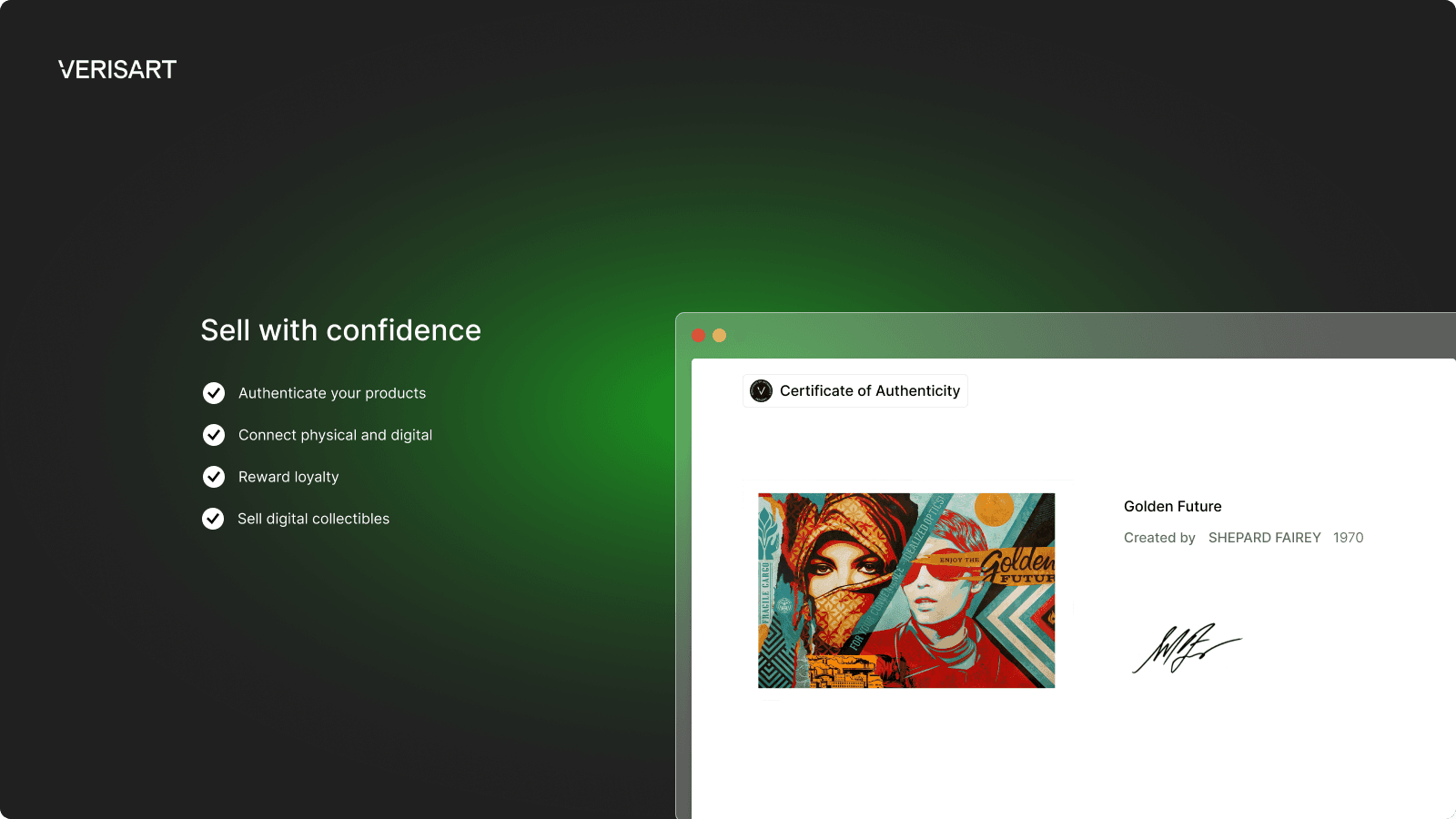
Verisart holds 4.8 stars on the Shopify App Store and is the most established all-in-one tokengating platform in the art and collectibles space. The client roster tells the positioning: Johnny Depp's art collection, Shepard Fairey's Obey Giant, König Galerie (a major Berlin contemporary art gallery). These are provenance-sensitive categories where blockchain certificates of authenticity meaningfully affect resale value and collector confidence.
Core features: mint or import NFTs directly from your Shopify product list (choose blockchain, set royalties, configure editions), sell NFTs alongside physical items on the same product page, card buyers claim NFTs to one of 90+ supported wallets or receive a branded dashboard link, crypto buyers get NFTs direct to wallet, digital blockchain certificates of authenticity for fraud protection on physical products, tokengates that give holders exclusive product access, POS tokengating for in-person retail integration, and support for Ethereum, Base, and Polygon networks with more blockchains on the roadmap.
The certificate-of-authenticity use case is where Verisart genuinely wins. A physical print, a signed collectible, or a limited-edition fashion piece sold with a blockchain-verified CoA attached is meaningfully more valuable to collectors than the same item sold without provenance. For art and luxury categories, this alone justifies the subscription before tokengating revenue enters the calculation.
Where it falls short: the feature set is overkill for general ecommerce brands that do not need provenance certification — a Shopify store selling supplements or apparel does not benefit from blockchain CoAs. Paid tiers at $29.99/mo and $99.99/mo are reasonable for art/collectibles but steep for stores where the NFT layer is a small portion of revenue. Requires some crypto literacy from the merchant team to configure minting parameters correctly. Limited to Ethereum, Base, and Polygon — Solana-based projects need Minty instead.
Pricing: Free to install. Paid plans at $29.99/mo and $99.99/mo.
2. Libautech Minty
Best for: Shopify merchants targeting Solana NFT communities or meme token holders — the Solana-native counterpart to Verisart, with lower transaction costs and faster gating performance than Ethereum-based alternatives.
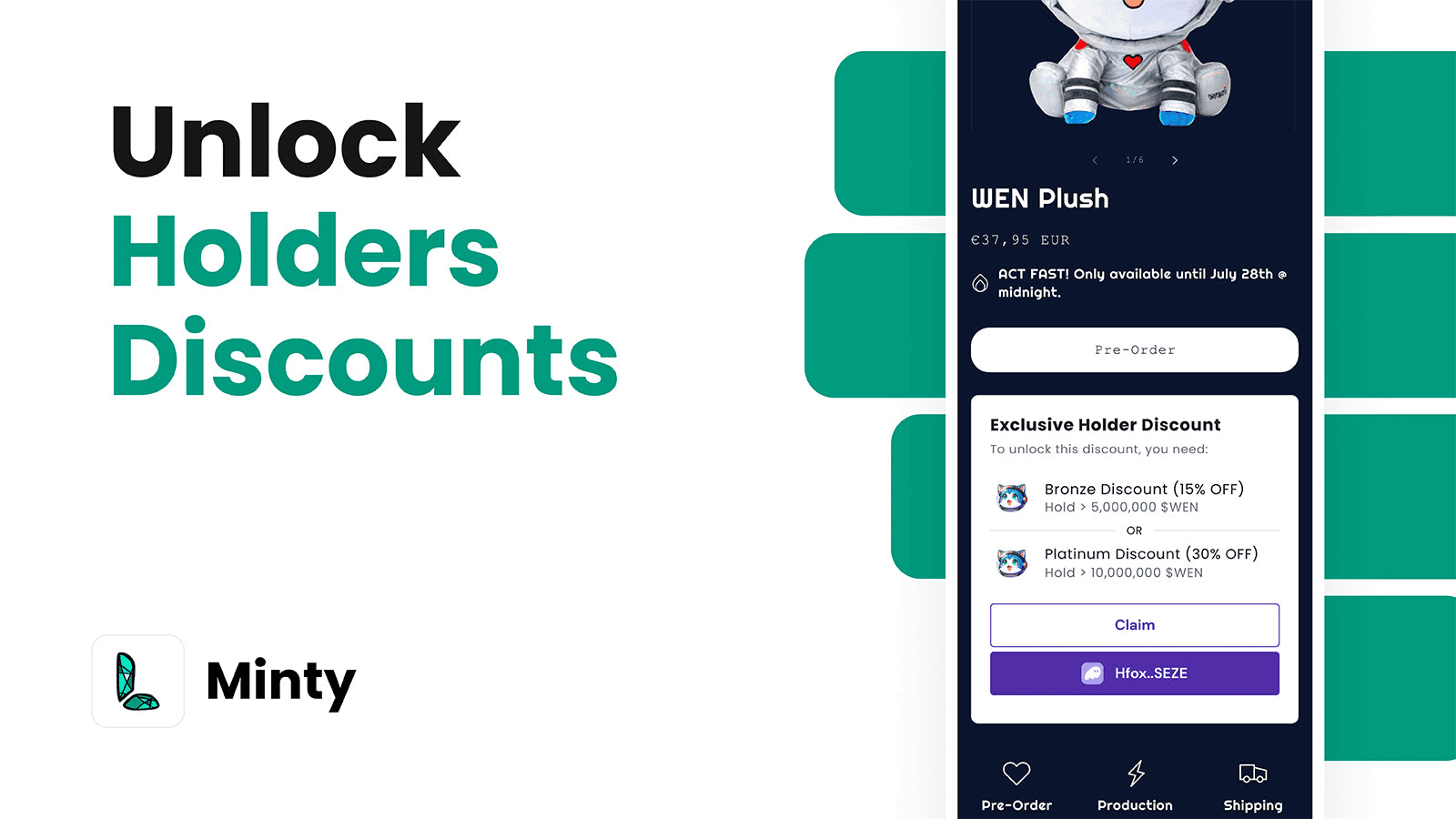
Libautech Minty holds 5.0 stars across 2 reviews on the Shopify App Store with Built for Shopify certification, and is built by Libautech (the same team behind Discord Gate and 7 other Shopify apps used by 5,000+ merchants across 50+ countries). The positioning is specifically Solana-native: create your own Solana NFT collection, import third-party Solana NFTs and meme tokens, and offer token-gated shopping experiences to holders — all with Solana's low-fee, high-throughput transaction model instead of Ethereum's gas costs.
This matters because Solana and Ethereum serve genuinely different communities. EVM chains dominate blue-chip NFT projects (Bored Apes, Pudgy Penguins, Azuki) and enterprise brand activations (Budweiser, Playboy). Solana dominates meme token communities, NFT collections targeting younger Web3-native audiences, and projects optimizing for transaction frequency over transaction size. If your target audience lives on Solana — and Solana NFT trading volume regularly exceeds Ethereum's on the largest marketplaces as of 2026 — using an EVM-only tokengating app means you cannot actually reach them.
Core features: create your own NFT collection on Solana with customizable editions and royalties, import third-party Solana NFTs to offer tokengated perks to existing holder communities, collaborate with established Solana NFT projects to run cross-promotion campaigns, meme token gating (gate discounts by holdings of specific Solana meme tokens — useful for communities built around tokens like BONK, WIF, or community-specific project tokens), token-gated product locks for Shopify Plus stores with no-code setup, and dedicated Libautech support team for implementation guidance.
Real-world use cases: a Solana NFT project (PFP collection, generative art project, gaming NFT community) wants to reward its holders with exclusive merch drops accessible only to wallet addresses that hold the collection — Minty gates the product by collection ownership. A Solana meme coin community wants token holders to get 15% off store purchases — Minty verifies meme token balance and triggers discount. A creator launching a new Solana collection wants to sell physical-plus-digital bundles where the physical product ships with an NFT — Minty handles the minting and sale flow.
Where it falls short: Solana-only — projects on Ethereum, Base, Polygon, or other EVM chains need Verisart or PERCS instead. Small review base (2 reviews as of April 2026) means less historical stress-testing at peak volume, though the Libautech team's 9-app track record with 5,000+ merchants provides external validation. Solana ecosystem moves faster than EVM on token standards and wallet libraries — merchants should expect more frequent feature iteration compared to mature EVM tools. Still requires customers to hold Solana wallets (Phantom, Solflare) and the specific tokens being gated; Solana wallet penetration outside crypto-native audiences is lower than Ethereum.
Pricing: Free plan available. Paid tiers for advanced features.
Job 2: Enterprise Tokengating for Web3-Native Brands
3. PERCS Engage
Best for: enterprise Web3 brands with existing NFT collections, $10M+ annual revenue, and the team resources to configure advanced gating rules across multiple token types.
PERCS Engage is the enterprise tokengating platform for Shopify. The track record speaks to who this app actually serves: 250+ merchants including Budweiser, Playboy, and the Hundreds, with 20,000+ redemptions and $10M+ in GMV processed through tokengated experiences. This is not a starter app — it is the infrastructure brands use when they already have a multi-thousand-holder NFT community and need production-grade gating with dedicated customer success support.
Core features: whitelist audiences holding any EVM-based token (or complex combination of tokens — "must hold NFT X AND own 1,000+ of ERC-20 Y"), customizable connect-wallet buttons that match brand design, tokengate access to products, discounts, giveaways, and limited drops, track wallet addresses and token IDs used to pass through gates for audience analytics, dedicated web3 support team (the "best-in-class service" claim matters at enterprise scale where a mis-configured gate during a major drop loses six-figure revenue), and ongoing feature development based on enterprise merchant feedback.
The economics make sense only at scale. PERCS pricing is custom-quoted rather than listed publicly, which itself signals the target customer — if you have to ask about tier, you are probably not the target. Merchants paying Budweiser-scale agency fees for Web3 activations view PERCS as infrastructure cost, not software subscription.
Where it falls short: wrong fit for mid-market Shopify stores without an existing Web3 community. If your NFT holder audience is under 1,000 wallets, a simpler tool like NFT Gate, Verisart, or Minty covers the same functional needs at a fraction of the cost. EVM-focused — Solana projects need Minty instead. No public pricing tier makes evaluation harder for stores exploring Web3 for the first time. Not suitable for stores that need community-based gating without on-chain verification (use Discord Gate instead).
Pricing: Contact sales for custom enterprise quote. No public free tier.
4. Shopthru
Best for: Web3 brands that need an advanced rules engine — gating based on combinations of NFTs, ERC-20 tokens, POAPs, and allowlists with complex trait or quantity requirements.
Shopthru positions as the advanced rules engine for tokengated Shopify stores: launch a tokengated store in two minutes, use any combination of assets (NFTs, ERC-20s, POAPs, or allowlists), and build complex qualifier logic using traits or quantity thresholds. The "two minutes" marketing claim is optimistic for novice merchants but genuinely fast for operators who already understand Web3 gating concepts.
Where Shopthru wins is in the rules engine depth. Scenarios like "customer must hold at least 3 NFTs from collection X with rarity trait Gold OR must hold 10,000+ ERC-20 tokens of project Y" require logic that simpler tokengating apps cannot express. For projects running tiered access programs (Bronze/Silver/Gold holder tiers with different discount levels and product access), Shopthru handles the complexity natively without custom development.
Core features: wide network coverage including Ethereum mainnet, Polygon, and other major EVM chains, allowlist support for projects that want to gate by wallet address directly rather than token ownership, POAP (Proof of Attendance Protocol) integration for event-based gating, and merchant-controlled UI customization for the wallet connection flow.
Where it falls short: overkill for stores doing simple "holders of our one NFT collection get 15% off" use cases — NFT Gate, Verisart, or Minty cover those simpler scenarios with less configuration overhead. Pricing structure requires custom evaluation (check the current Shopify App Store listing for latest tiers). Some older merchant reviews mention theme-compatibility friction that required specific Shopify theme setup to work reliably.
Pricing: Free plan available. Custom paid tiers based on features and volume.
5. NFT Gate: Tokengated Discounts
Best for: stores with a single NFT collection that want straightforward tokengated discount functionality without an enterprise setup or dedicated rules engine.
NFT Gate holds 5.0 stars across 4 reviews — a small review base but genuinely positive feedback from merchants using the app. The app's positioning is intentionally narrow: reward NFT holders with exclusive discounts, verify NFT ownership at checkout, encourage loyalty and repeat purchases. No minting, no certification, no loyalty points layer — just discount gating tied to wallet ownership.
For stores that already have an NFT collection deployed elsewhere (or are selling NFTs through a different platform like OpenSea or Magic Eden) and simply need to reward holders on their Shopify store, NFT Gate solves the job cleanly. Setup is fast because there are no advanced configuration options to over-engineer, and network support is genuinely broad — the app supports most major EVM chains including newer ones like Base.
Where it falls short: small review base (4 reviews as of April 2026) means less historical stress-testing compared to PERCS or Verisart. Single-purpose focus means merchants needing NFT minting, certificates, or complex rules engines need to pair it with other apps. $24.99/mo starting tier is reasonable but not cheap for stores with small NFT holder audiences. Not suitable for stores without existing token communities.
Pricing: Free trial available. Paid plans from $24.99/mo. Higher tier at $99.99/mo. Yearly plans save 17%.
Job 3: Loyalty-First Tokengating (Points + Optional NFTs)
6. Taco Loyalty Rewards + Tokengate
Best for: stores that want a traditional loyalty points program as the primary mechanism with optional NFT-based tier gating as a secondary layer for existing NFT holders.
Taco (by Taco Labs Inc.) is a loyalty program app first, tokengating app second — which matches how most Shopify merchants actually want to use these concepts. The primary mechanic is traditional: customers spend and earn points, points can be redeemed for exclusive rewards or converted into tradable NFTs for holder transferability. The tokengate layer sits on top as an optional module for merchants who have (or plan to launch) NFT collections.
Core features: loyalty points accrual on purchases, point-based reward redemption, traditional membership tiers (Bronze, Silver, Gold) with tier-specific rewards, NFT-based tier gating as an upgrade path, multi-chain tokengate support including Tezos, Ethereum, Polygon, Solana, and Flow, and a free Taco plan for basic loyalty functionality with upgrades to Base and Plus tiers for advanced features.
The positioning is genuinely useful: a store can start with pure loyalty points (Web2 simple), validate whether loyalty mechanics drive repeat purchases for their customer base, and only add the NFT/tokengating layer if the business case emerges. Most stores never need the NFT layer — the points-based program alone covers the customer retention job — but the optionality is valuable.
Where it falls short: for stores that genuinely want pure Web3 tokengating without a loyalty program layer, Taco is the wrong shape — use PERCS, Verisart, Minty, or NFT Gate instead. Loyalty program depth is less sophisticated than dedicated loyalty tools like Smile.io or LoyaltyLion; merchants with mature loyalty programs may prefer to keep those and add a specialist tokengating app separately. Multi-chain support is a pro for Web3-native merchants and neutral for everyone else.
Pricing: Free Taco plan available. Base and Plus tiers for advanced functionality (check current Shopify App Store listing).
7. Manifold Merch Bridge
Best for: merchants who want free drag-and-drop NFT-based access control with minimal setup — with the caveat that current merchant reviews are mixed.
Manifold Merch Bridge is the free option in the category, offering NFT-based access control via drag-and-drop theme blocks for Ethereum and Polygon NFTs. The simplicity is genuine — installation is fast, wallet connection buttons drop into cart and checkout without code, and NFT verification runs through theme block integration. For merchants experimenting with tokengating before committing budget, the free tier lowers the risk of trying the channel.
Where Manifold matters: the Manifold platform (separate from Merch Bridge) is one of the most trusted Web3 infrastructure tools for NFT minting and contract deployment. Brands that already use Manifold for their NFT smart contracts get natural integration with Merch Bridge on the Shopify side. For Manifold-native projects, this is the path of least resistance.
Where it falls short: 2.5-star rating across 7 reviews as of April 2026 is notably lower than alternatives — merchant feedback cites setup friction, incomplete features at the free tier, and cases where the app did not work reliably with specific Shopify themes. Small review base (7) means the rating could shift in either direction as more merchants try it. Limited to Ethereum and Polygon; no Base, Solana, or other emerging network support. Drag-and-drop interface is simpler than PERCS or Shopthru but also less powerful for complex gating scenarios.
Pricing: Free.
Job 4: Community-Based Gating Without Crypto (The 95% Case)
8. Libautech Discord Gate
Best for: creator-led communities, Twitch streamers, YouTube channels, online educators, and Discord-native brands that want to reward active community members with exclusive discounts — without asking customers to understand wallets, gas fees, or blockchain.
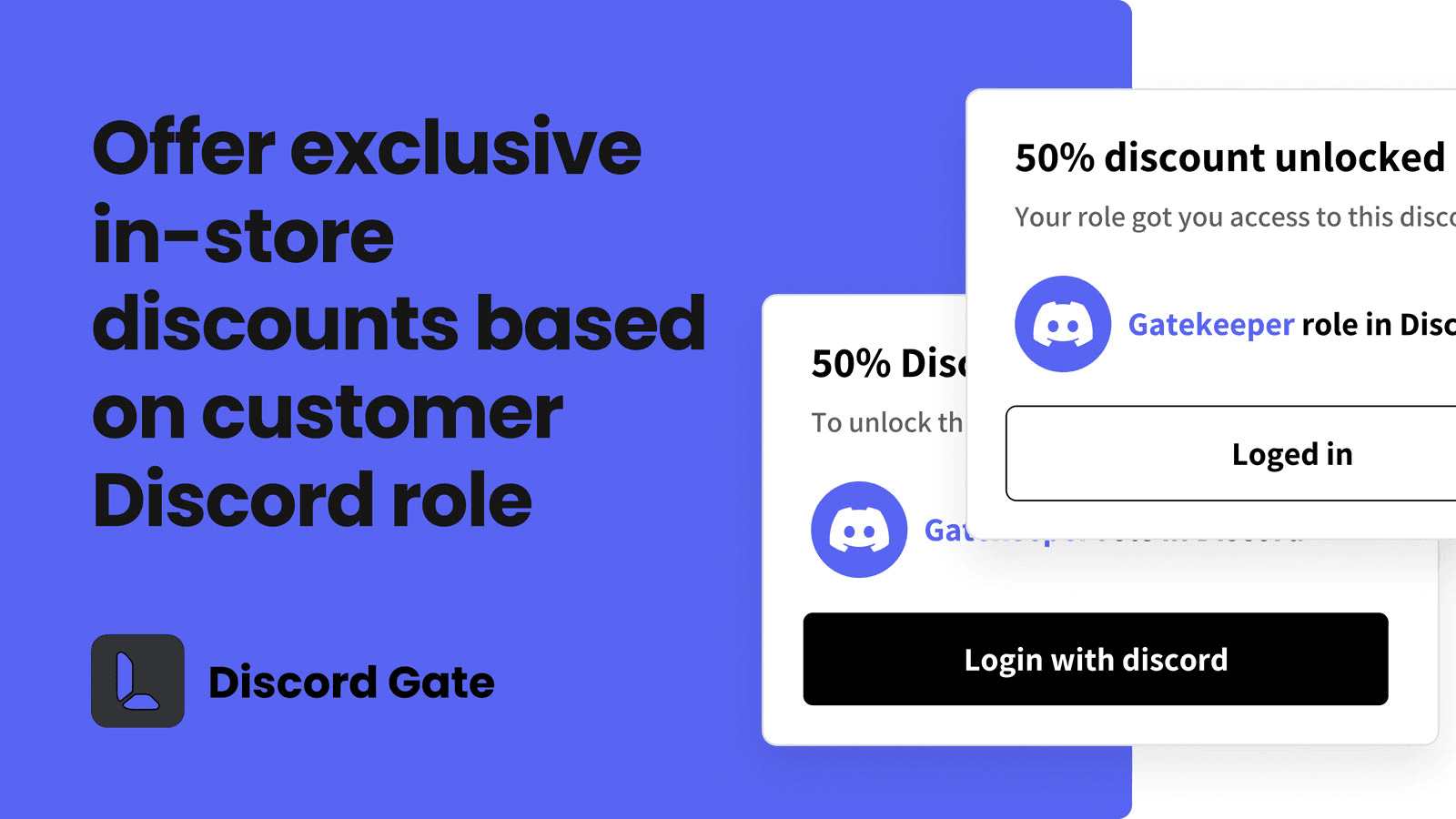
Libautech Discord Gate holds 5.0 stars across 3 reviews on the Shopify App Store and is Built by Libautech — the same team behind Minty and 7 other Shopify apps used by 5,000+ merchants across 50+ countries. The positioning is deliberately Web2-native: gate Shopify discounts and product access by Discord server role instead of on-chain wallet ownership. Customers who hold specific Discord roles (VIP, Patron, Contributor, Mod, Founding Member) automatically unlock role-specific discount codes when they connect their Discord account during checkout.
This is the job most Shopify merchants actually have. A Twitch streamer with an active Discord server of 10,000 subscribers wants to reward their VIP tier with exclusive merch discounts — they do not want to ask those subscribers to acquire wallets, buy gas, and mint NFTs just to get a 20% discount code. A YouTube creator running a Discord-based membership program wants tiered discounts for Bronze/Silver/Gold supporters without spinning up a blockchain collection. An online educator running a community Discord wants to offer course-bundle discounts to students in the Alumni role. Discord Gate solves all three use cases directly.
Core features: Discord bot integration that syncs role membership to Shopify customer tags, role-based discount campaigns with multiple tiers (VIP 40% off, Regular 20% off, Non-member full price), custom campaign creation for multiple product offerings, streamlined setup via the Libautech Discord Bot with guided onboarding, free plan available for initial testing, and full support from the Libautech team for implementation. The technical model is fundamentally simpler than blockchain verification because there is no wallet, no gas, no chain lookups — just an OAuth connection between the customer's Discord account and their Shopify checkout.
Real-world use cases where this wins over on-chain tokengating: gaming communities distributing exclusive merch to guild members, content creators offering patron-tier discounts, educational programs giving alumni exclusive course bundles, product communities running referral rewards by Discord role, brand Discord servers where tier progression (activity-based role promotion) maps naturally to commerce rewards. For every one Shopify store with a real NFT holder audience, there are 20 with an active Discord community — that ratio defines who this app actually serves.
Where it falls short: no on-chain verification means it does not replace PERCS, Verisart, or Minty for Web3-native brands that genuinely need blockchain-based gating. Small review base (3 reviews as of April 2026) reflects that this is a newer entrant in the app portfolio; the Libautech team's 9-app track record with 5,000+ merchants provides external validation. Limited to Discord as the community platform; if your community lives on Patreon, Circle, or elsewhere rather than Discord, this app does not fit. Only applies to stores with active Discord communities — stores without one need to build community first before this adds value.
Pricing: Free plan available. Paid tiers for advanced features.
A Note on Shopify's Native Tokengating API
9. Shopify Native Tokengating API
Best for: Shopify Plus stores with in-house development resources that want fully custom tokengating integrated directly into their checkout without depending on a third-party app.
Shopify provides a native tokengating API as part of its developer platform, documented at shopify.dev. Tokengating apps on Shopify enable merchants to gate access to products, promotions, and content based on the contents of a customer's Web3 wallet — and the native API gives developer-resourced stores the primitive to build custom implementations. This is the "build your own app" option, not an installable solution.
For stores with dev teams capable of building Shopify apps and managing Web3 infrastructure (wallet connect flows, chain lookups, token metadata, gas optimization), the native API provides full control — exact UI, exact gating logic, exact blockchain coverage. Shopify Plus brands with specific tokengating requirements that off-the-shelf apps cannot match take this route to avoid subscription costs and platform dependency.
Where it falls short: requires significant development investment — typically 4-12 weeks of senior developer time to build a basic implementation, longer for production-grade. Ongoing maintenance cost (new chains, token standards, wallet libraries evolving faster than most teams can keep up with). Not an option for stores without in-house engineering. For almost every store that is not enterprise-scale Shopify Plus with dedicated Web3 developers, using PERCS, Verisart, Minty, or Shopthru is faster and cheaper than building custom.
Pricing: Free (platform API). Development and maintenance costs separate.
Which App to Choose
For enterprise Web3 brands with existing multi-thousand-holder NFT communities on EVM chains: PERCS Engage. Custom pricing, Budweiser/Playboy-tier client roster, 250+ merchants, 20K+ redemptions, $10M+ GMV processed.
For art, collectibles, and luxury brands needing NFT minting + certificates of authenticity: Verisart. 4.8/5, $29.99-99.99/mo, used by Johnny Depp, Shepard Fairey, König Galerie.
For Solana NFT projects, Solana meme token communities, and merchants targeting Solana-native audiences: Libautech Minty. 5.0/2, free plan, Built for Shopify, Solana minting + meme token gating.
For Web3 brands needing advanced rules engines across NFT + ERC-20 + POAP combinations: Shopthru. Any asset combination, complex qualifier logic, POAP support.
For stores with a single EVM NFT collection needing simple tokengated discounts: NFT Gate: Tokengated Discounts. 5.0/4, $24.99/mo, broad network support including Base.
For stores wanting loyalty points as primary mechanic with optional NFT layer: Taco Loyalty + Tokengate. Free Taco plan, multi-chain support, loyalty-first architecture.
For merchants wanting free drag-and-drop NFT tokengating (with mixed-review caveat): Manifold Merch Bridge. Free, ETH + Polygon, best for Manifold-native projects.
For creator-led brands, Discord-native communities, Twitch/YouTube creators, and online educators: Libautech Discord Gate. Discord role-based gating, no blockchain required, free plan, fits the 95% of merchants with active communities but no NFT holders.
For Shopify Plus stores with dedicated dev teams building fully custom Web3 flows: Shopify Native Tokengating API. Free platform capability, weeks of development work.
For most Shopify stores in 2026, the honest recommendation is contrarian: start by asking whether your customers actually hold tokens. If yes and they are on EVM chains, install PERCS (enterprise), Verisart (art/collectibles), or NFT Gate (general). If yes and they are on Solana, install Libautech Minty. If no — and this is the overwhelming majority — skip blockchain entirely and install Libautech Discord Gate. You will get higher engagement, lower setup friction, and faster revenue impact by rewarding your Discord community than by asking customers to acquire wallets they do not want.
How We Ranked These Apps
This ranking is based on four criteria applied to every Shopify NFT and tokengating app tested in 2026. First, Shopify App Store rating and verified review volume where available — noting that this category has historically small review bases because the addressable market of Web3-active Shopify merchants is niche. Second, which of the four tokengating jobs each app solves best (NFT minting, token-gated discounts, certification, or community-based gating without crypto) rather than forcing every app into the same comparison. Third, blockchain coverage and which chain ecosystems each app serves — EVM-focused apps (Verisart, PERCS, NFT Gate, Shopthru, Manifold) cover Ethereum, Base, and Polygon; Solana-focused apps (Minty) cover Solana NFTs and meme tokens; multi-chain apps (Taco) span both. Fourth, honesty about audience fit — we flagged clearly when apps are unlikely to generate meaningful revenue for stores without existing token holder communities, because pretending otherwise wastes merchant time and budget.
Every pricing figure in this post was verified from Shopify App Store listings or app vendor pages on April 22, 2026. Tokengating apps and pricing tiers change frequently as the category evolves — always confirm current pricing on the official listing before installing. Ratings and review counts reflect the Shopify App Store at the time of our last update.
Frequently Asked Questions
What is a Shopify tokengating app?
A Shopify tokengating app verifies that a customer holds a specific digital asset (NFT, ERC-20 token, Solana token, POAP, Discord role, or membership credential) and then grants them exclusive access to products, discounts, or content on your store. On-chain tokengating apps (PERCS, Verisart, Minty, Shopthru, NFT Gate) verify wallet ownership via blockchain lookup. Off-chain or Web2 tokengating apps (Libautech Discord Gate) verify community role or membership via OAuth or API integration. Both models gate access — the difference is whether the credential lives on-chain or off-chain.
Does my Shopify store actually need a tokengating app?
Only if one of three profiles fits your store. First: you are a Web3-native brand with an existing NFT collection and holder community — in which case you need PERCS, Verisart, Minty (Solana), Shopthru, or NFT Gate. Second: you sell art, collectibles, or luxury goods where blockchain certificates of authenticity add value — use Verisart. Third: you run an active Discord community, Twitch channel, YouTube membership program, or creator-led brand where community-based gating is the real need — use Libautech Discord Gate. If none of these fit, tokengating apps are unlikely to generate meaningful revenue.
What is the difference between Ethereum and Solana tokengating?
Ethereum (and EVM chains like Base, Polygon, Arbitrum) hosts most blue-chip NFT projects and enterprise brand activations — Bored Apes, Pudgy Penguins, Budweiser, Playboy. Solana hosts meme token communities, faster-transaction NFT collections, and projects optimizing for volume over size. Gas fees are dramatically higher on Ethereum mainnet ($5-50 per transaction at typical congestion) than Solana (fractions of a cent). If your target community lives on Solana, use Libautech Minty. If they live on Ethereum or a Layer 2 like Base or Polygon, use Verisart, PERCS, or NFT Gate. Multi-chain apps like Taco span both ecosystems but with less depth in either.
What is the best Shopify NFT tokengating app in 2026?
Depends on the job and the blockchain. PERCS Engage leads for enterprise EVM Web3 brands (Budweiser, Playboy, the Hundreds). Verisart (4.8/5) leads for art, collectibles, and certification-of-authenticity use cases on EVM chains. Libautech Minty (5.0/2) leads for Solana NFT and meme token gating. NFT Gate (5.0/4) leads for simple tokengated discounts on a single EVM collection. Libautech Discord Gate (5.0/3) leads for community-based gating without crypto — the fit for most Shopify merchants who have active Discord communities but no NFT holder audience.
How much do Shopify tokengating apps cost?
Pricing varies widely by category. Enterprise tokengating (PERCS Engage) is custom-quoted — typically $500-5000/mo for Budweiser-scale activations. Mid-market subscription tokengating (Verisart, NFT Gate, Shopthru) runs $24.99-99.99/mo. Free options exist (Manifold Merch Bridge free, Libautech Discord Gate free plan, Libautech Minty free plan, Shopify native tokengating API platform-included). For most stores, starting with a free tier to validate fit before committing to paid tiers is the low-risk path.
What blockchain networks do Shopify tokengating apps support?
Coverage varies. Verisart supports Ethereum, Base, Polygon. Shopthru supports any EVM-based chain plus ERC-20, POAPs, allowlists. NFT Gate supports multiple networks including Base. Libautech Minty supports Solana (NFTs and meme tokens). Taco supports Tezos, Ethereum, Polygon, Solana, and Flow. Manifold Merch Bridge limits to Ethereum and Polygon. PERCS supports any EVM chain. If you are on a specific chain (Solana, Tezos, Flow), verify support before committing — not every app covers every network.
Can I tokengate without using crypto or blockchain?
Yes. Libautech Discord Gate gates Shopify discounts and products by Discord server role instead of wallet ownership. Customers connect their Discord account during checkout, the app verifies their server roles via Discord API, and role-specific discount codes apply automatically. No wallets, no gas fees, no blockchain onboarding required. For creator communities, Twitch streamers, YouTube memberships, and online educators, this Web2 tokengating model fits the audience better than asking customers to acquire crypto wallets.
How do I know if my customers hold NFTs?
Ask them directly before investing in tokengating infrastructure. Email a survey to your customer list: "Do you own NFTs? Do you use a crypto wallet? Which chain (Ethereum, Solana, Base)? Would you connect your wallet to our store for exclusive access?" Poll your Discord community. Check wallet-connection rates on any existing Web3 integrations. Most Shopify merchants discover that <5% of their customers have wallets — which means on-chain tokengating generates trivial incremental revenue compared to community-based gating. Validate before building, and confirm which chain your audience uses before picking an EVM versus Solana app.
What is the difference between tokengating and loyalty programs?
Traditional loyalty programs (Smile.io, LoyaltyLion) track customer purchase behavior and issue points redeemable for discounts — the credential is internal data in the loyalty app database. Tokengating verifies an external credential (wallet NFT holdings, Discord role, membership tier) and grants access based on that credential. Loyalty programs build retention through behavior; tokengating builds retention through identity (proving you are a specific kind of customer). Taco blends both mechanics; most other tokengating apps focus purely on gating.
Will tokengating apps slow down my Shopify store?
Depends on implementation. Native Shopify tokengating and Libautech Discord Gate add minimal storefront overhead because the verification happens at checkout rather than on every page load. On-chain tokengating apps that inject wallet-connect buttons or verify NFT ownership on product pages can slow initial page render if the wallet library is loaded synchronously — check that any app you install loads Web3 libraries asynchronously and only on pages where the gating actually applies. Enterprise-grade apps (PERCS, Verisart) handle performance correctly; some free options have historically loaded scripts synchronously. Solana wallets (Phantom, Solflare) used by Minty generally load lighter than Ethereum WalletConnect libraries.
Can I combine on-chain tokengating with Discord role gating?
Yes, and some brands do. A Web3-native creator brand might use PERCS, Verisart, or Minty to gate a premium product drop by NFT ownership while simultaneously running Libautech Discord Gate to offer general-merch discounts to Discord community members who do not hold NFTs. The two mechanics address different audience segments — on-chain for token holders, Discord roles for non-crypto community members — and stacking them covers both groups without forcing non-crypto customers to acquire wallets. This is a natural fit for creator-led brands transitioning into Web3.
Think Your App Belongs on This List?
We update these lists as new tools launch and existing ones improve. If you are a developer building a Shopify NFT or tokengating app and want your app considered for inclusion, submit it here — tell us what your app does, who it is for, and include a link to your Shopify App Store listing. We review every submission.