
8 Best Shopify Pricing Optimization Apps (2026)
Last updated: April 2026 · Pricing and ratings verified from live Shopify App Store listings on April 22, 2026. Reviewed by the Libautech team, builders of Bundles & Upsell — a Built for Shopify app that applies percentage and flat-dollar discounts on upsell products ("Add the matching belt for 20% off" or "Add the sample pack for $9 off") to lift AOV without touching base-product pricing. Used by 5,000+ merchants across 50+ countries.
Key Takeaways
- Pricing optimization on Shopify breaks into four jobs — competitor-driven dynamic pricing (reprice against the market), discount campaign execution (run sales and promos reliably), B2B/wholesale tiered pricing (segment customers into price groups), and upsell-driven pricing (percentage or flat discounts on upsell products to lift AOV). The right app depends on which job you need solved.
- Prisync AI holds 4.9 stars across 209 reviews and is the category leader for competitor price tracking and automated repricing on Shopify and Google Shopping.
- Discounty at 4.9 stars across 1,090+ reviews is the most battle-tested discount campaign manager — flash sales, volume discounts, Buy X Get Y — with a Built for Shopify badge and a genuine free plan.
- B2Bridge handles B2B wholesale pricing specifically — tiered volume discounts, net 30 terms, customer-group-based price lists — a fundamentally different job than consumer-facing promotional pricing.
- Most pricing apps change the base product price. Upsell-driven pricing works differently — the base product stays at full price, and a percentage or flat discount applies only when the customer adds the upsell item, preserving brand value while lifting AOV.
- Libautech Bundles & Upsell is not a competitor-tracking or discount-campaign tool — it is the upsell layer that applies percentage or flat-dollar discounts on upsell and add-on products to drive AOV without devaluing the primary catalog.
Who Needs a Pricing Optimization App, and Why?
A pricing optimization app adjusts prices automatically based on rules, competitor prices or demand, so you stay competitive without watching the market by hand. Dynamic and competitor-based pricing can protect margin and win price-sensitive sales.
You need one if you sell in a competitive, price-driven category, carry many SKUs to reprice, or want to test pricing systematically. A brand with strong pricing power may prefer to set prices manually.
The Four Jobs of Shopify Pricing Optimization Apps
Most pricing-optimization roundups list 10 apps that all claim to "optimize your prices" and rank them by star rating. That framing flattens four fundamentally different jobs into one bucket. On Shopify, pricing optimization actually breaks into four distinct categories, and the right app depends on which one you need solved.
The first job is competitor-driven dynamic pricing. Monitoring what competitors charge for your products and automatically adjusting your prices to stay strategically positioned — $0.50 under the market on high-velocity SKUs, matching price on brand-protected items, maintaining margin on exclusive products. This is what Prisync and Intelis do. It requires tracking competitor sites and Google Shopping feeds, matching products by identifier or AI, and setting rules that execute automatically. This job matters most for high-SKU retailers competing in price-sensitive categories (electronics, appliances, cosmetics at commodity tier).
The second job is discount campaign execution. Running flash sales, seasonal promotions, volume discounts, Buy X Get Y offers, and storewide markdowns without Shopify breaking or customers getting confused about which discount stacks. The core feature set is bulk discount creation (apply 20% off to 500 products in one operation), scheduling (activate Friday, deactivate Monday), strikethrough pricing on product pages, exclusion rules (do not discount new arrivals), and coupon-stacking prevention. This is where Discounty and Discount Kit live.
The third job is B2B and wholesale tiered pricing. Showing different prices to different customer segments — retail customers see $49, logged-in wholesale customers see $29 for the same product, with tier breaks at 10+ units ($26) and 50+ units ($22). This requires customer-tag-based price lists, net-30 payment terms, B2B-only volume discounts, and minimum order quantities. B2Bridge and dedicated wholesale apps solve this job. A consumer-facing discount app cannot.
The fourth job is upsell-driven pricing. Instead of discounting base products (which trains customers to wait for sales and erodes perceived value), upsell-driven pricing keeps primary catalog prices stable and applies percentage or flat-dollar discounts only on the upsell or add-on product. "Buy the main product at $89. Add the matching accessory for 20% off." The base product stays at full price. The customer perceives added value at a reduced rate, not a devalued primary product. This preserves brand equity while actively lifting AOV — a fundamentally different economics than markdown-driven selling.
This post ranks 8 apps across all four jobs with verified April 2026 ratings and pricing, and explains which app solves which problem.
Pricing optimization stacks with other merchandising tools. See our guides on best Shopify discount apps for the broader promotional-discount category, best Shopify upsell & cross-sell apps for the dedicated upsell-mechanic category, and best Shopify bundle apps for bundle-pricing mechanics that layer alongside upsell pricing.
Quick Comparison: 8 Best Shopify Pricing Optimization Apps (2026)
| App | Rating | Free Plan | Paid From | Job | Best For |
|---|---|---|---|---|---|
| Prisync AI | Dynamic Pricing | ⭐ 4.9 (209) | No (14-day trial) | $49/mo | Competitor repricing | High-SKU retailers, Google Shopping dominance |
| AI Dynamic Pricing by Intelis | ⭐ 4.8 (37) | No (free trial) | $49/mo | Competitor repricing | AI product matching, Google Shopping feed optimization |
| DynamicPricing AI Optimization | ⭐ 4.7+ | Yes (trial) | Custom | Price A/B testing | Rapid price-testing with AI-driven recommendations |
| Discounty: Bulk Discount Sales | ⭐ 4.9 (1,090+) | Yes | $9.90/mo | Discount campaigns | Flash sales, volume discounts, Buy X Get Y, strikethrough |
| Discount Kit | ⭐ 4.8+ | Yes | $19/mo | Discount campaigns | Tag-based segmentation, B2B toggle, complex rules |
| B2Bridge B2B Wholesale Pricing | ⭐ 5.0 (23) | Yes (free to install) | Custom | B2B tiered pricing | Wholesale price lists, volume discounts, net 30 |
| Inventory Pricing / Pricing.AI | ⭐ 4.7+ | Yes (trial) | Custom | Demand-based pricing | Inventory- and demand-based auto-pricing |
| Libautech Bundles & Upsell | ⭐ 5.0 (36) | Yes | $14.99/mo | Upsell-driven pricing | Percentage + flat-dollar discounts on upsell products |
Job 1: Competitor-Driven Dynamic Pricing (Market-Based Repricing)
This is the pricing-optimization job most people think of when they hear "dynamic pricing" — tracking what competitors charge and automatically repricing to stay strategically positioned. Worth it for high-SKU retailers in competitive categories (electronics, home goods, cosmetics). Overkill for small catalogs or brand-exclusive products where you set the market.
1. Prisync AI | Dynamic Pricing
Best for: high-SKU retailers (500+ products) selling in competitive categories who need automated competitor tracking and rule-based repricing across Shopify and Google Shopping.
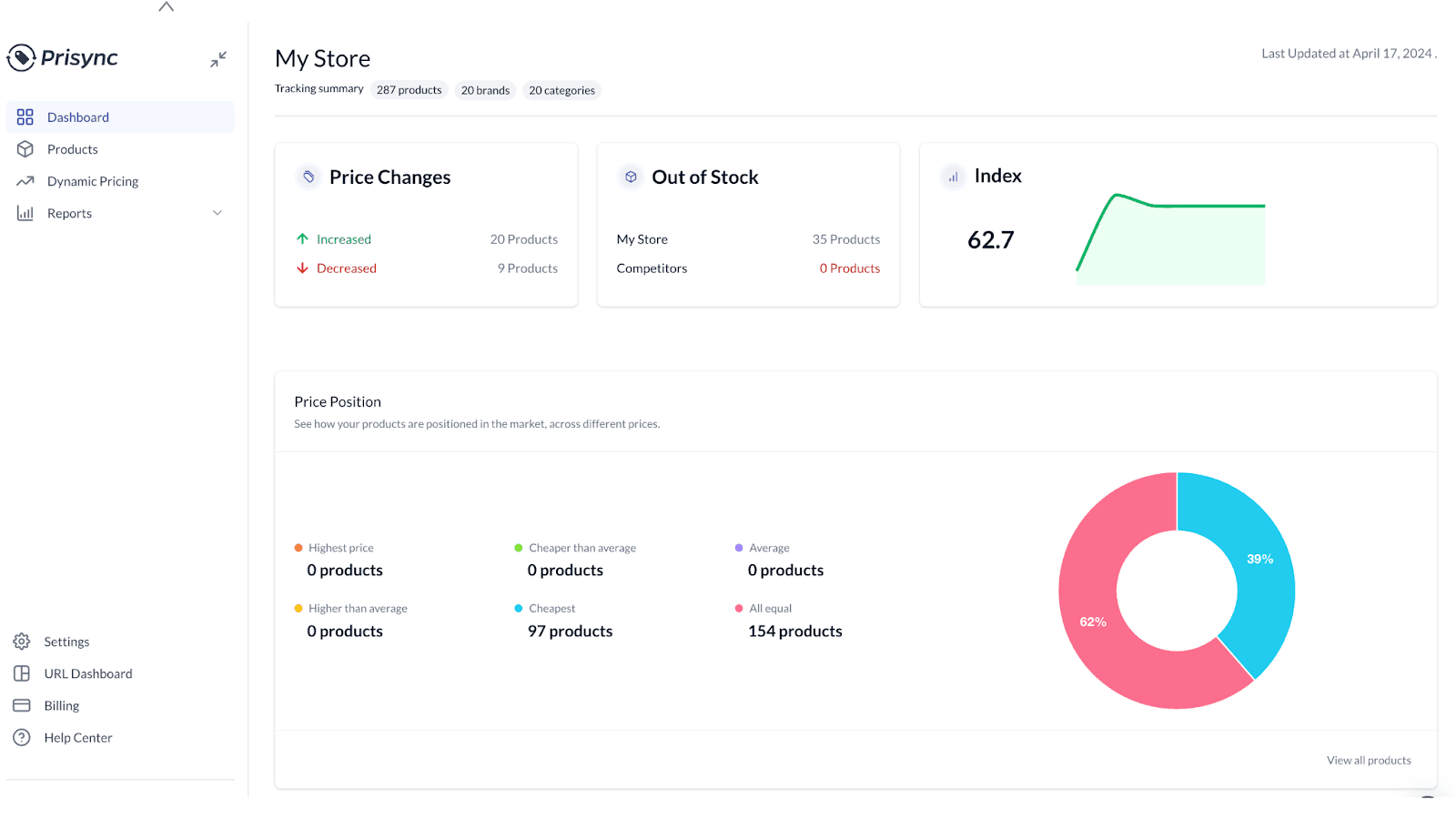
Prisync AI holds 4.9 stars across 209 reviews and is Built for Shopify certified — the clear category leader for competitor price monitoring and dynamic repricing. The app continuously tracks competitor prices across unlimited competitor sites and product variants (size, color, configuration), imports your catalog with a single click, and applies dynamic pricing rules based on competitive position plus your cost inputs (maintain 30% margin, reprice to $0.50 under lowest competitor, never drop below cost).
The feature set that justifies the pricing tier: channel-based competitor tracking (Google Shopping, Amazon, direct competitor sites, all unified in one dashboard), product variant price tracking at the SKU level (a size-medium shirt has a different competitive position than size XL), historical pricing analysis with actionable insights (see how your market share moved when competitors repriced), and AI-powered product matching that links your SKUs to competitor SKUs without manual URL-by-URL entry on large catalogs.
Real-world use case from the review base: a 17,000-product store in Denmark replaced manual competitor spot-checks with Prisync's automated dashboard and reported the app paying for itself within the first month through captured margin on previously underpriced SKUs. The app is a category-leader for merchants selling on Google Shopping specifically — the feed-based repricing directly impacts ad ROAS as product rankings shift with price position.
Where it falls short: pricing starts at $49/mo and scales meaningfully with product count — not cost-effective for stores under 100 SKUs. Does not handle coupons or checkout-time discounts (those subtract from the base price but Prisync prices to the base, so stacked discounts can push sale price under cost if margin floors are not configured carefully). Not useful for exclusive or private-label products where no competitor pricing exists to track against.
Pricing: 14-day free trial. Plans from $49/mo based on tracked product count.
2. AI Dynamic Pricing by Intelis
Best for: scaling brands with 100K+ SKU catalogs that need AI-powered product matching across Google Shopping and competitor sites without manual URL entry.
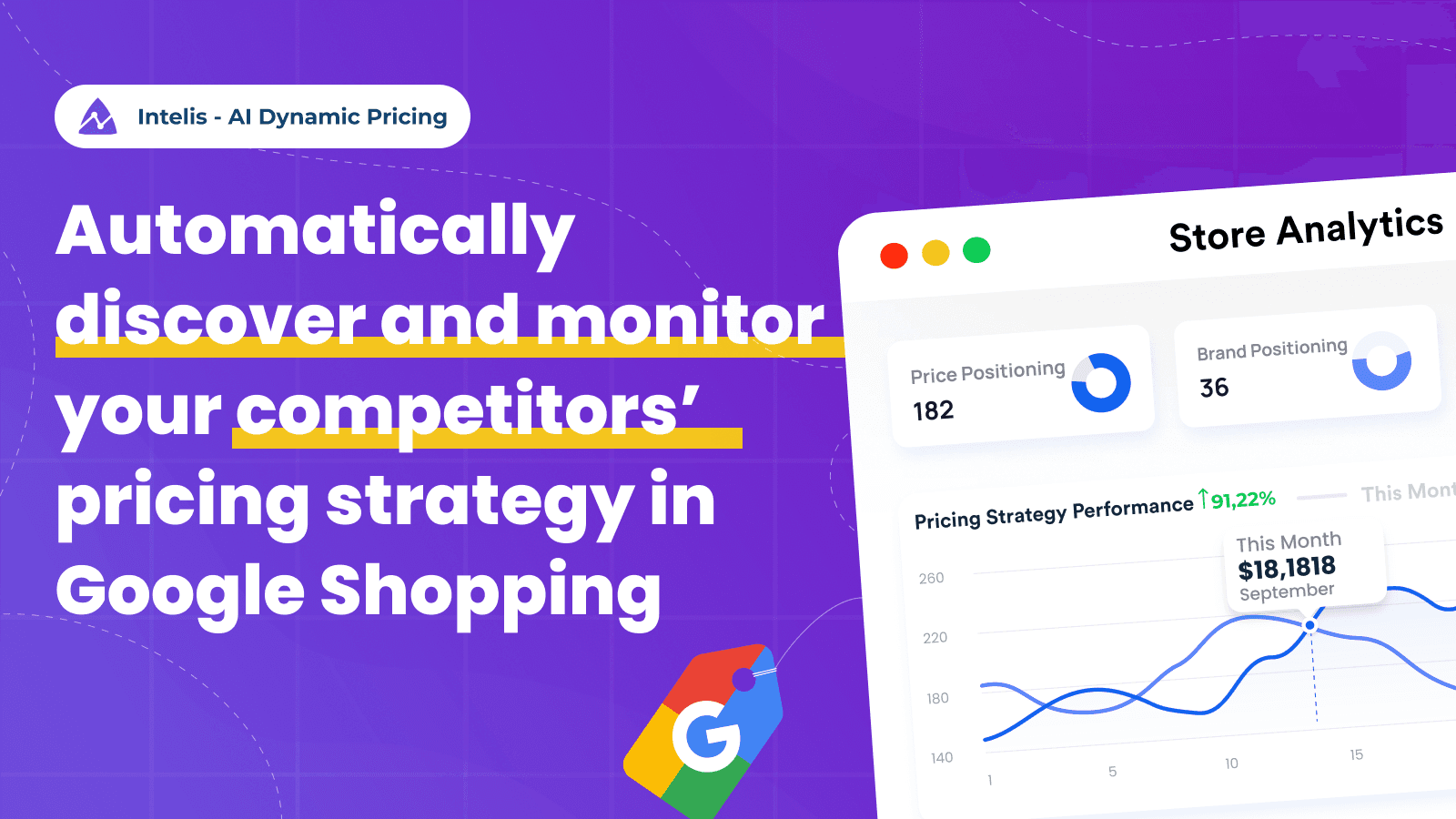
Intelis holds 4.8 stars across 37 reviews on the Shopify App Store (broader review base across external platforms) and positions specifically around Google Shopping feed optimization. The differentiating feature: AI matching that identifies your products against competitor catalogs automatically — for a store with 100,000+ SKUs, manually mapping each product to its competitor equivalents is impossible, and Intelis's matching algorithm is the main reason merchants choose it over Prisync at that scale.
Core features: automated competitor tracking on Google Shopping and direct competitor sites, AI product matching (similar product identification without manual URL setup), dynamic repricing rules with min/max margin floors, Google Ads and Shopping feed optimization (shifting prices based on position within sponsored listings), and detailed analytics on where price position moved sales velocity.
The pricing tiers reflect the enterprise positioning: Basic at $49/mo (up to 100 products, 1 sales channel) and Premium at $149/mo with variant tracking, brand/category analytics, and API access. Annual billing saves 15-17%. For stores doing serious Google Shopping spend, the positioning-vs-ROAS feedback loop is the specific value proposition.
Where it falls short: smaller review base than Prisync (37 vs 209) though reviews are consistently positive. Pricing scales quickly for high-SKU catalogs. Not as widely deployed in non-US markets as Prisync. The feature set overlaps heavily with Prisync — stores typically choose one or the other, not both.
Pricing: Free trial. Basic $49/mo. Premium $149/mo.
3. DynamicPricing AI Optimization
Best for: stores that want AI-driven price A/B testing with adaptive traffic routing — not competitor tracking, but automatic price experimentation on your own catalog.
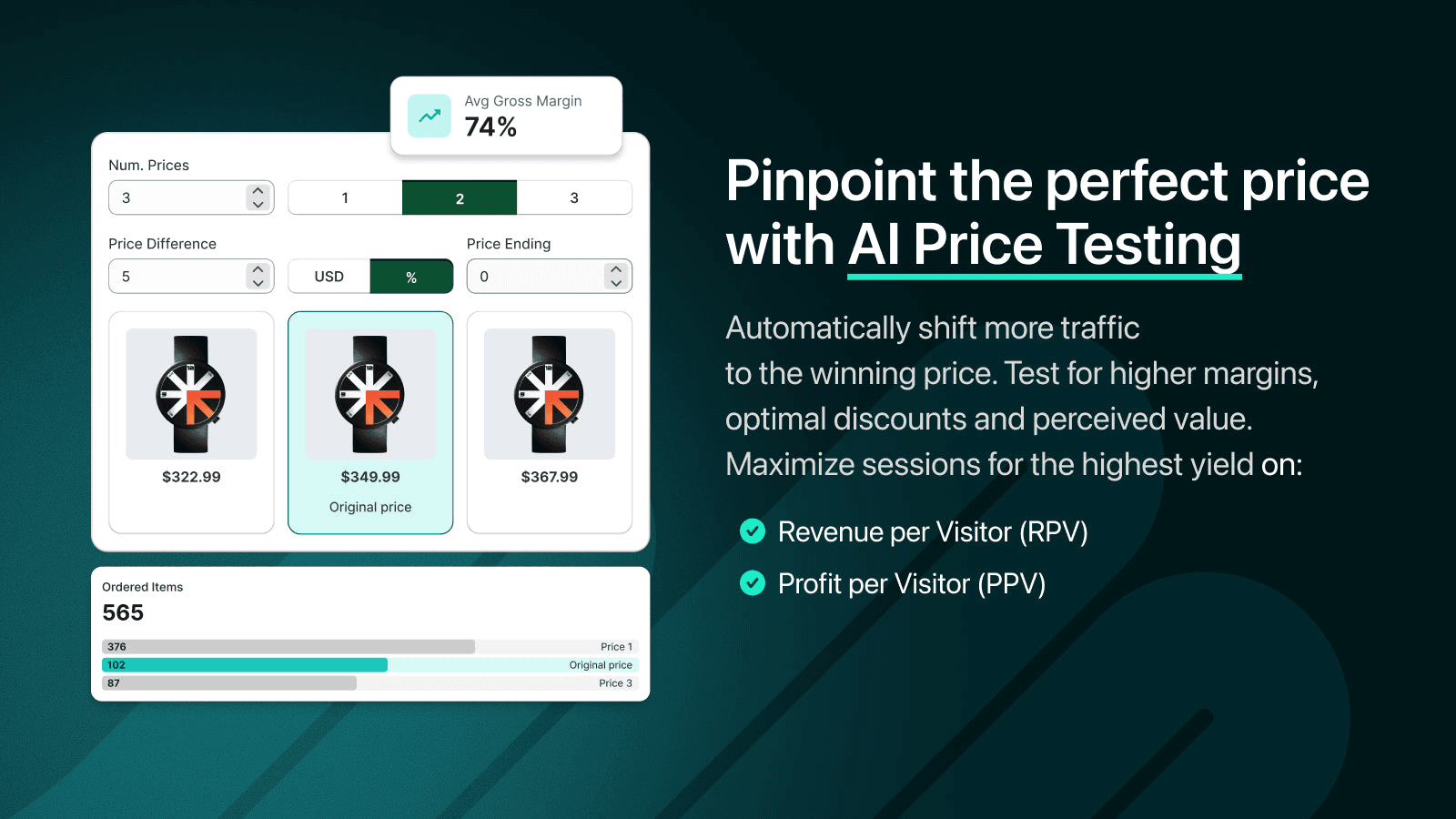
DynamicPricing AI is a different category than Prisync and Intelis — rather than tracking competitor prices, it runs rapid price-testing experiments on your own products and lets AI find the optimal price point per SKU based on actual conversion and margin data. The app monitors which price point performs best across incoming traffic and automatically routes more traffic toward the winning price, converging on the revenue-maximizing point without manual intervention.
Strong use case: stores where pricing psychology matters more than competitor positioning — a premium brand where $79 versus $89 is a testing question (not a market-matching question). The AI model handles the experimentation mechanics (split traffic, track results, adjust ratios, converge) so merchants focus on product selection rather than spreadsheet analysis.
Where it falls short: newer to market than Prisync/Intelis with a smaller review base. Price-testing requires meaningful traffic to converge — low-traffic stores will not see statistically significant results in reasonable timeframes. Custom pricing, not publicly listed on the App Store.
Pricing: Free trial. Custom pricing tied to traffic volume.
Job 2: Discount Campaign Execution (Flash Sales, Volume Discounts, Promos)
4. Discounty: Bulk Discount Sales
Best for: stores that run frequent flash sales, seasonal promotions, volume discounts, or Buy X Get Y offers and need reliable bulk-discount execution without Shopify breaking during high-traffic launches.
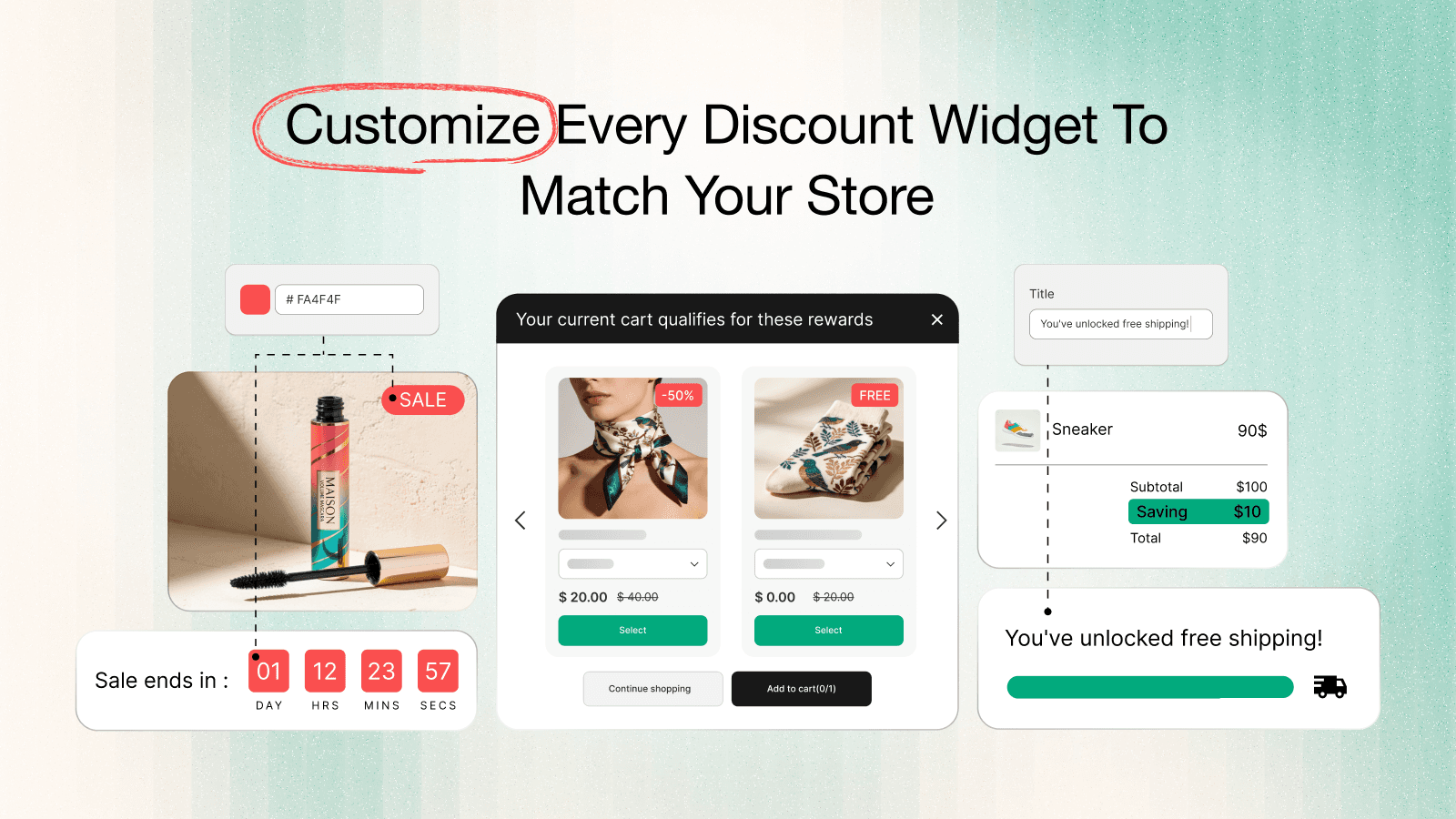
Discounty holds 4.9 stars across 1,090+ reviews and is Built for Shopify certified — the most battle-tested discount-campaign manager in the Shopify App Store. The review volume matters: 1,090 merchants running Black Friday, Cyber Monday, and seasonal launches have stress-tested this app under peak load, making it the default risk-averse pick for stores where a broken discount campaign costs real revenue.
Core features: bulk discount creation across unlimited products in one operation (apply 25% off to 300 SKUs without clicking each one), strikethrough pricing on product pages (customers see the crossed-out original price next to the sale price — proven to lift perceived value), countdown timers on discount campaigns, scheduling that auto-activates and deactivates campaigns at specified times, coupon-stacking prevention (critical for merchants who want to prevent customers from combining a sitewide 20% code with a tier-based bulk discount), shipping bars integrated with discount logic, and volume discount tiers ("Buy 2 save 10%, buy 3 save 15%, buy 5 save 25%").
The merchant reviews specifically cite Black Friday reliability as the reason to switch from Shopify's native discount tools — native discounts can fail silently under peak load, Discounty consistently does not.
Where it falls short: not a competitor-tracking tool (different job). Overkill for stores that run one sale per year. The free plan limits the number of active discounted variants, which scales down quickly for larger catalogs — paid tiers unlock higher limits.
Pricing: Free plan available. Paid from $9.90/mo. 3-day free trial on paid plans.
5. Discount Kit
Best for: merchants with tag-based customer segmentation who need to run different discount campaigns for different customer groups (VIPs, newsletter subscribers, B2B customers) from one dashboard.
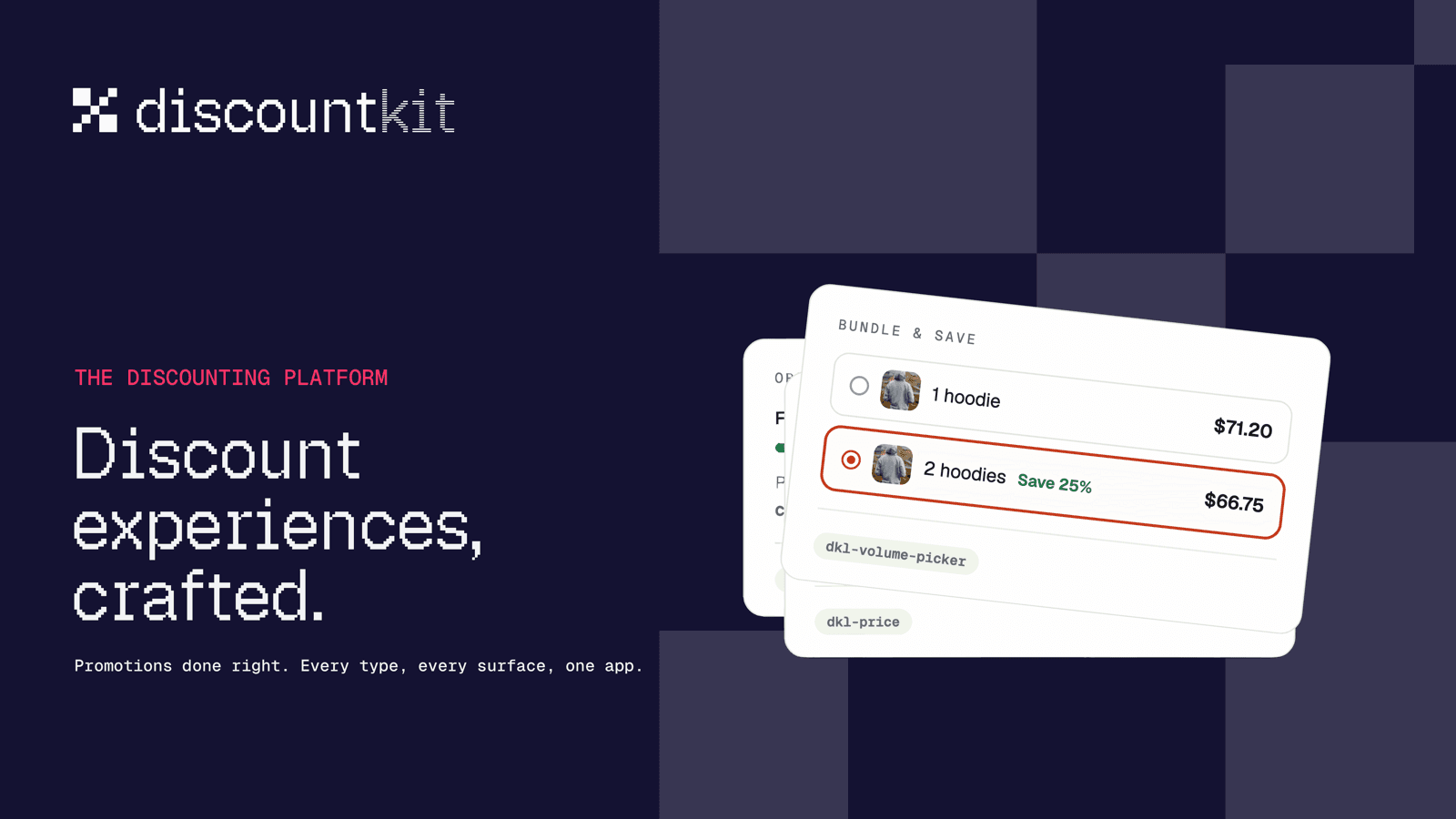
Discount Kit is the more complex rules-engine alternative to Discounty, targeted at merchants with customer-segmentation needs that pure bulk-discount apps do not handle. The app lets merchants build discount cards that apply based on customer tags (so a "vip" tagged customer sees different pricing than an "newsletter" tagged customer), a built-in B2B toggle (though merchant reviews flag the default B2B+B2C behavior as a gotcha to watch), and gift-with-purchase (GWP) logic at the campaign level.
The feature set specifically targets stores that are more complex than "20% off site-wide" — think brands running tiered loyalty programs, stores with active email-capture pipelines where subscribers get different prices, or mixed B2C+B2B catalogs where the rules engine needs to understand which customer gets which discount without merchant intervention.
Where it falls short: card-count limits on lower tiers create friction for merchants running many simultaneous campaigns. Tag-matching is strict — an extra space before or after a tag will prevent discounts from applying, and merchant reviews note this is easy to miss. Not as battle-tested at peak-season scale as Discounty (smaller review base).
Pricing: Free plan available. Paid tiers from $19/mo.
Job 3: B2B and Wholesale Tiered Pricing
6. B2Bridge B2B Wholesale Pricing
Best for: B2B and hybrid B2B/B2C merchants who need customer-group-based price lists, volume discount tiers for wholesale accounts, and net 30 payment terms in a single app.
B2Bridge holds 5.0 stars across 23 reviews and is Built for Shopify certified. The app solves a specific problem that discount apps cannot: showing completely different prices to different customer groups. Retail customers see the public catalog price. Logged-in wholesale customers (tagged as wholesale) see their wholesale price list, which has per-product tiered pricing (1-9 units at one price, 10-49 at another, 50+ at the lowest). Net 30 payment terms flow through checkout with invoicing rather than immediate card capture.
Core features: B2B price lists per customer group (unlimited groups), volume discount tiers with per-product-level granularity, quote-to-order flow for custom enterprise deals, net 30 / net 60 / net 90 payment terms integrated with Shopify's checkout, minimum order quantity enforcement on wholesale accounts, and tax-exempt handling for reseller customers. All configured without custom theme code.
Where it falls short: smaller review base than Prisync or Discounty (23 reviews). Pure-play B2B focus means it is not the right pick for B2C stores with occasional wholesale orders. Pricing is custom-quoted rather than listed, which makes initial evaluation harder.
Pricing: Free to install. Custom pricing tied to wholesale volume and feature set.
Job 4: Demand-Based Inventory Pricing
7. Inventory Pricing / Pricing.AI
Best for: stores selling limited-inventory or trend-driven products (fashion, collectibles, perishables) that want prices to automatically rise as demand spikes or inventory depletes.
Inventory Pricing by Pricing.AI takes a different angle than competitor repricing or campaign-based discounts — it adjusts prices based on your own demand signals and inventory levels. A product selling faster than projected automatically gets a small price increase; a product sitting stale gets a small discount. The logic targets revenue maximization by capturing more margin on hot SKUs and clearing slow inventory before markdown season.
Use cases: apparel brands with seasonal collections (dynamically price down slow-movers before end-of-season markdown), limited-edition drops where initial scarcity justifies a price hold or premium, and perishable goods where timed discounts prevent spoilage loss.
Where it falls short: newer to the Shopify ecosystem with a smaller track record than Prisync-tier apps. Demand signals are noisy on low-volume stores — the algorithm needs meaningful order velocity to make reliable decisions. Can conflict with promotional campaigns running simultaneously if not configured carefully.
Pricing: Free trial. Custom pricing tied to SKU count and order volume.
Job 5: Upsell-Driven Pricing (Percentage + Flat Discounts on Upsell Products)
Everything above adjusts the base product price — up (competitor repricing, demand-based), down (discount campaigns, wholesale tiers). This job works differently: the base product price stays stable, and percentage or flat-dollar discounts apply only on the upsell or add-on product the customer is being offered to add.
This preserves brand equity. Repeatedly marking down the base catalog trains customers to wait for the next sale — a well-documented pricing-strategy failure mode. Upsell-driven pricing keeps primary SKUs at full price (maintaining anchor value) while giving customers a perceived discount on the complementary purchase. The customer feels they are getting added value; the merchant protects margin on the core offer.
8. Libautech Bundles & Upsell
Best for: stores that already have pricing stable on their main catalog and want to apply percentage or flat-dollar discounts specifically on upsell and add-on products to lift AOV without discounting the primary product line.
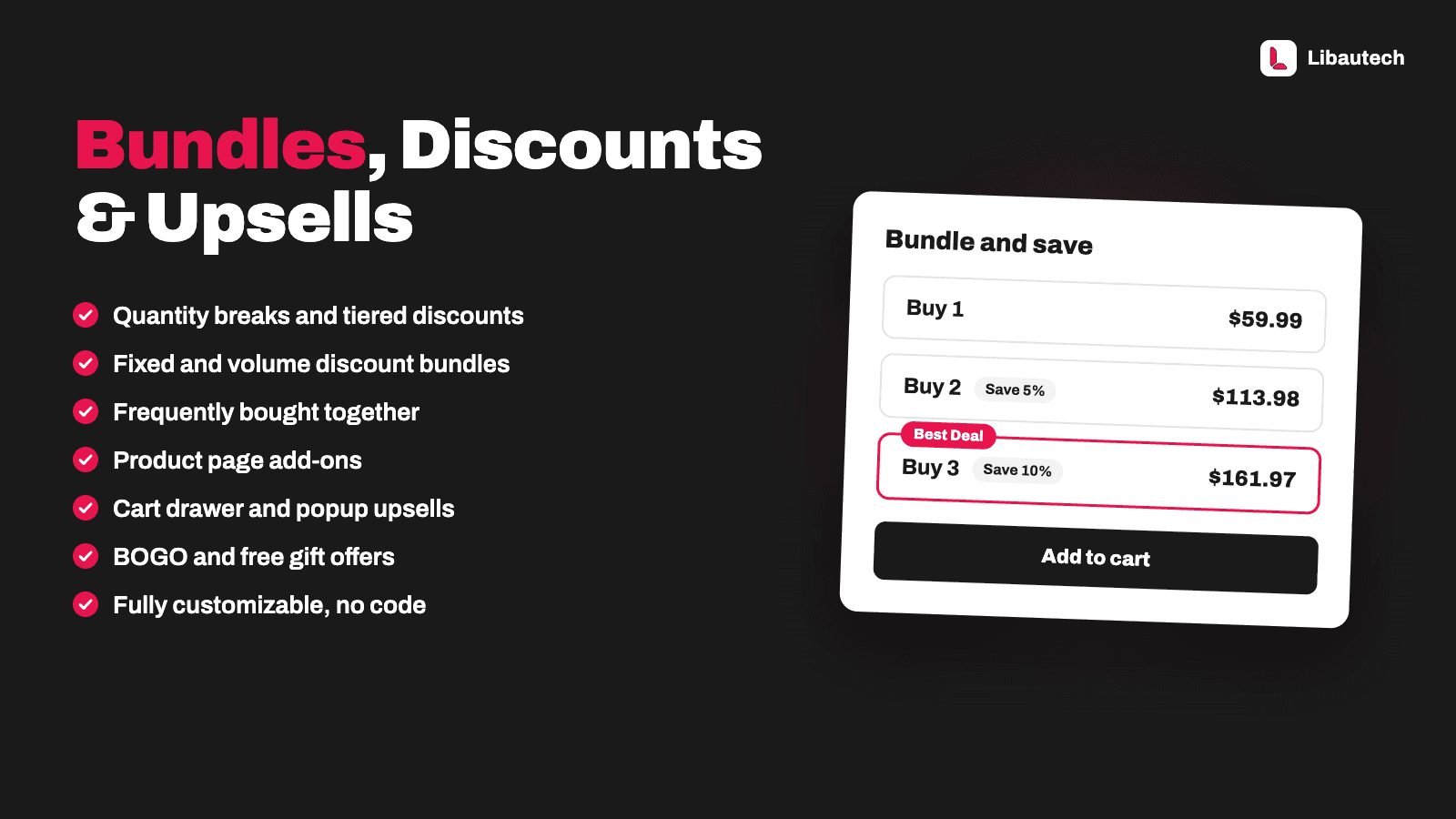
Libautech Bundles & Upsell holds 5.0 stars across 36 reviews and is Built for Shopify certified. The app is not a competitor-tracking tool, not a bulk-discount manager, and not a wholesale B2B app. It is the upsell-driven pricing layer — percentage and flat-dollar discounts applied exclusively to upsell and add-on products inside bundles, product-page cross-sells, cart upsells, and post-purchase offers.
Two discount types matter for this job:
Percentage discounts on upsell products. "Add the matching belt for 20% off" on a jeans product page. The jeans stay at $89 full price. The belt, normally $39, shows at $31 when added as part of the upsell offer. The customer perceives added value on a complementary item, not a devalued primary product. Percentage discounts work well for fashion accessories, tech accessories, consumable add-ons (extra cartridges, refills, sample sizes), and any category where the upsell item has a clear independent retail price.
Flat-dollar discounts on upsell products. "Add the practice workbook for $9 off" on an ebook product page. The ebook stays at $29. The workbook, normally $19, shows at $10 with the flat-$9 discount applied. Flat-dollar discounts often convert better than equivalent percentages for lower-priced upsells because $9 off feels more concrete than "47% off" on a $19 product, and they protect against psychologically awkward percentage math (50% off a $17 item is an odd number; $8 off is clean).
The discount application mechanics matter. Both percentage and flat discounts can be configured at the offer level (show the discount on the offer card before the customer commits), applied automatically at add-to-cart (no coupon code needed — the discount shows in the cart the moment the upsell is accepted), stacked or non-stacked with other discounts (merchants choose whether the upsell discount combines with a sitewide promo or replaces it), and scheduled to run during specific windows (holiday-only upsell discounts that auto-expire).
The surfaces where these discounts appear: product-page bundles ("Buy jeans + belt bundle, save 15%" with the 15% applied as a percentage discount across both items, or flat $12 off the total); product-page add-ons ("Add matching wallet for 20% off" as a separate offer next to the buy button); cart popup upsells (customer adds jeans, popup fires offering the belt at $9 off); frequently bought together sections (AI-recommended complementary items with a bundled discount applied); and post-purchase upsells on the thank-you page ("You just bought the jeans. Add the belt for 25% off, one click, no re-entering payment" — the highest-converting upsell surface on Shopify).
Concrete example: a jewelry store selling $149 necklaces at 2.3% conversion rate with $149 AOV adds Libautech Bundles & Upsell configured with a "Add matching earrings for 20% off" product-page offer. Matching earrings normally $79 show at $63 when added via the upsell. Approximately 14% of necklace buyers accept the upsell. The store's AOV moves from $149 to approximately $157 on blended orders (buyers without upsell stay at $149, buyers with upsell rise to $212 for the combined $149 + $63), a 5.4% AOV lift. Gross margin stays stable because the percentage discount applies only to the incremental upsell purchase, not the original $149 necklace. The $14.99/mo app cost is recovered on the first dozen accepted upsells.
The pairing angle with the other apps on this list is clean. A store can run Prisync for competitor tracking on its main catalog, Discounty for Black Friday sitewide promotions, and Libautech Bundles & Upsell for permanent upsell-driven pricing that protects brand value between campaigns. The three layers do not conflict because they operate on different logic — Prisync adjusts base prices to market, Discounty runs time-bounded campaigns, Libautech discounts only apply on opt-in upsell products the customer has consciously chosen to add.
View Libautech Bundles & Upsell on the Shopify App Store →
Pricing: 7-day free trial. Starter $14.99/mo, Pro $29.99/mo, Unlimited $49.99/mo. Flat-rate, no revenue cap.
Which App to Choose
For automated competitor price tracking and dynamic repricing on Shopify and Google Shopping: Prisync AI. 4.9/209, Built for Shopify, $49/mo, category leader.
For AI product matching at 100K+ SKU scale with Google Shopping feed optimization: AI Dynamic Pricing by Intelis. $49/mo Basic, $149/mo Premium, AI-first positioning.
For AI price A/B testing on your own catalog without competitor tracking: DynamicPricing AI Optimization. Custom pricing, adaptive traffic routing to winning price points.
For flash sales, volume discounts, Buy X Get Y, and Black Friday-grade campaign reliability: Discounty. 4.9/1,090+, Built for Shopify, free plan, $9.90/mo paid — the most battle-tested pick.
For tag-based customer segmentation and complex discount rules across B2C and B2B: Discount Kit. $19/mo, tag-matching rules engine.
For B2B wholesale price lists, volume tiers, and net 30 payment terms: B2Bridge B2B Wholesale Pricing. 5.0/23, Built for Shopify, free to install, custom pricing.
For demand- and inventory-based auto-pricing: Inventory Pricing / Pricing.AI. Limited-edition and seasonal-inventory focus.
For percentage and flat-dollar discounts on upsell and add-on products (without devaluing the main catalog): Libautech Bundles & Upsell. 5.0/36, Built for Shopify, $14.99/mo flat-rate.
For most Shopify stores doing $10K-100K/month in revenue, the honest stack recommendation depends on category. Mainstream retail catalogs competing on Google Shopping: Prisync + Libautech Bundles & Upsell (approximately $64/month combined). Promotion-heavy brands running frequent sales: Discounty + Libautech Bundles & Upsell (approximately $25/month). Hybrid B2C+B2B merchants: B2Bridge + Libautech Bundles & Upsell for wholesale plus consumer upsell pricing. In every case, the upsell-driven pricing layer (Libautech Bundles & Upsell) pairs cleanly because it operates on opt-in upsell products rather than base catalog pricing.
How We Ranked These Apps
This ranking is based on four criteria applied to every Shopify pricing-optimization app tested in 2026. First, Shopify App Store rating and verified review volume as of April 22, 2026 — the signal of long-term merchant satisfaction at scale. Second, which of the four (now five) pricing jobs the app actually solves rather than a generic "pricing" bucket. Third, pricing structure and total cost at realistic merchant volumes — $49/mo for competitor tracking is different than $9.90/mo for discount campaigns is different than $14.99/mo for upsell pricing, and the math differs per store profile. Fourth, Built for Shopify certification and integration depth with Shopify Checkout Extensibility, customer accounts, and subscription apps.
Every pricing figure in this post was verified directly from the live Shopify App Store listing on April 22, 2026. App pricing structures change — always confirm current pricing on the official listing before installing. Ratings and review counts reflect the Shopify App Store at the time of our last update.
Frequently Asked Questions
What is a Shopify pricing optimization app?
A Shopify pricing optimization app automates the pricing decisions most merchants make manually — competitor price monitoring, dynamic repricing, discount campaign execution, B2B wholesale price segmentation, and upsell-based discount application. Different apps solve different sub-jobs. Prisync and Intelis handle competitor-driven repricing. Discounty and Discount Kit handle campaign-based discount execution. B2Bridge handles B2B tiered pricing. Libautech Bundles & Upsell handles upsell-product percentage and flat-dollar discounts.
What is the best Shopify dynamic pricing app in 2026?
Prisync AI leads general-purpose competitor-driven dynamic pricing at 4.9 stars across 209 reviews with Built for Shopify certification — best choice for most high-SKU Shopify retailers tracking competitors on Google Shopping and direct competitor sites. Intelis is the pick for AI product matching at 100K+ SKU catalogs. DynamicPricing AI is the pick for price A/B testing on your own catalog without competitor tracking. The three apps solve slightly different sub-jobs within competitor-driven pricing.
Is dynamic pricing worth it for a small Shopify store?
For stores under 100 SKUs or $5K/mo revenue, competitor-driven dynamic pricing (Prisync at $49/mo) is usually not worth the cost — the revenue lift from optimized pricing is smaller than the subscription on low-volume catalogs. Small stores see better ROI from upsell-driven pricing (Libautech Bundles & Upsell at $14.99/mo) and discount campaign execution (Discounty with a free plan) than from competitor tracking. Once you hit 500+ SKUs or $10K+/mo revenue, competitor repricing becomes meaningful.
What is the difference between bulk discounts and volume discounts on Shopify?
Bulk discounts apply a discount across many products at once (e.g., 20% off 500 items sitewide for a Black Friday sale). Volume discounts apply tiered pricing based on cart quantity of a single product ("Buy 2 save 10%, buy 5 save 25%"). Both are handled by Discounty as separate campaign types, so you do not need two apps. Bulk discounts drive traffic-to-conversion on promo events. Volume discounts lift AOV on steady-state traffic.
How do percentage discounts differ from flat-dollar discounts on upsell products?
Percentage discounts ($20 off becomes "20% off" on a $100 upsell) work better for higher-priced upsells where the percentage communicates meaningful savings. Flat-dollar discounts ($9 off a $19 workbook) work better for lower-priced upsells where the concrete dollar amount feels more tangible than an odd-numbered percentage. Libautech Bundles & Upsell supports both and lets merchants choose per offer. A/B testing the two formats is straightforward — most stores find flat-dollar works better under $30 upsell price and percentage works better above $50.
Can I run competitor repricing and discount campaigns at the same time?
Yes, with careful margin floor configuration. Prisync adjusts base product prices automatically; Discounty applies discount campaigns on top of those base prices. The risk is that a competitor-repriced product plus a 20% Discounty campaign stacks into a below-cost sale price if margin floors are not set in Prisync. Both apps recommend setting a minimum margin floor per SKU so campaign discounts cannot push final sale price below cost. Configure the floor once per SKU during Prisync setup.
What is the difference between B2B wholesale pricing and consumer discount campaigns?
B2B wholesale pricing shows different prices to different customer groups based on login/tag (wholesale customer sees $29, retail customer sees $49 for the same product). Consumer discount campaigns show the same reduced price to all customers during a time-bounded promotion window. The two solve fundamentally different problems and use different apps — B2Bridge for wholesale segmentation, Discounty for consumer promotions. Stores running both should use both apps.
Do pricing apps conflict with Shopify's native discount codes?Most do not, but configuration matters. Shopify's native discount codes apply at checkout to the cart as a whole. Competitor-repricing apps (Prisync, Intelis) change product base prices upstream, so native discounts still apply on top correctly. Campaign apps (Discounty, Discount Kit) include coupon-stacking-prevention controls so merchants can choose whether native codes combine with campaign discounts or replace them. Upsell apps (Libautech Bundles & Upsell) apply discounts to the upsell item specifically and are compatible with sitewide discount codes running on the main product.
How much do Shopify pricing optimization apps cost?
Entry tiers range from free (Discounty free plan, B2Bridge free to install) to $9.90-19/mo (Discounty paid, Discount Kit) to $14.99/mo (Libautech Bundles & Upsell) to $49/mo (Prisync, Intelis Basic) to $149/mo+ (Intelis Premium, enterprise tiers). A typical mainstream Shopify store running one competitor-tracking app plus one upsell app pays approximately $64/mo combined. A promotion-heavy brand running Discounty + Libautech pays approximately $25/mo combined. B2B merchants add B2Bridge (custom pricing). Costs scale with SKU count for competitor trackers and with campaign volume for discount apps.
Will pricing optimization apps slow down my Shopify store?
Apps with the Built for Shopify badge — including Prisync, Discounty, B2Bridge, and Libautech Bundles & Upsell — load widgets asynchronously with no impact on Core Web Vitals or Lighthouse scores. Competitor-tracking apps run primarily in the merchant admin and do not touch storefront performance at all. Discount apps inject product-page elements (strikethrough pricing, countdown timers) that are optimized for performance but do add minor render time — evaluate before launching on a theme-sensitive storefront. Upsell apps load after the primary product render so they do not affect first-paint performance.
Think Your App Belongs on This List?
We update these lists as new tools launch and existing ones improve. If you are a developer building a Shopify pricing-optimization app and want your app considered for inclusion, submit it here — tell us what your app does, who it is for, and include a link to your Shopify App Store listing. We review every submission.