
8 Best Shopify Giveaways & Contests Apps (2026)
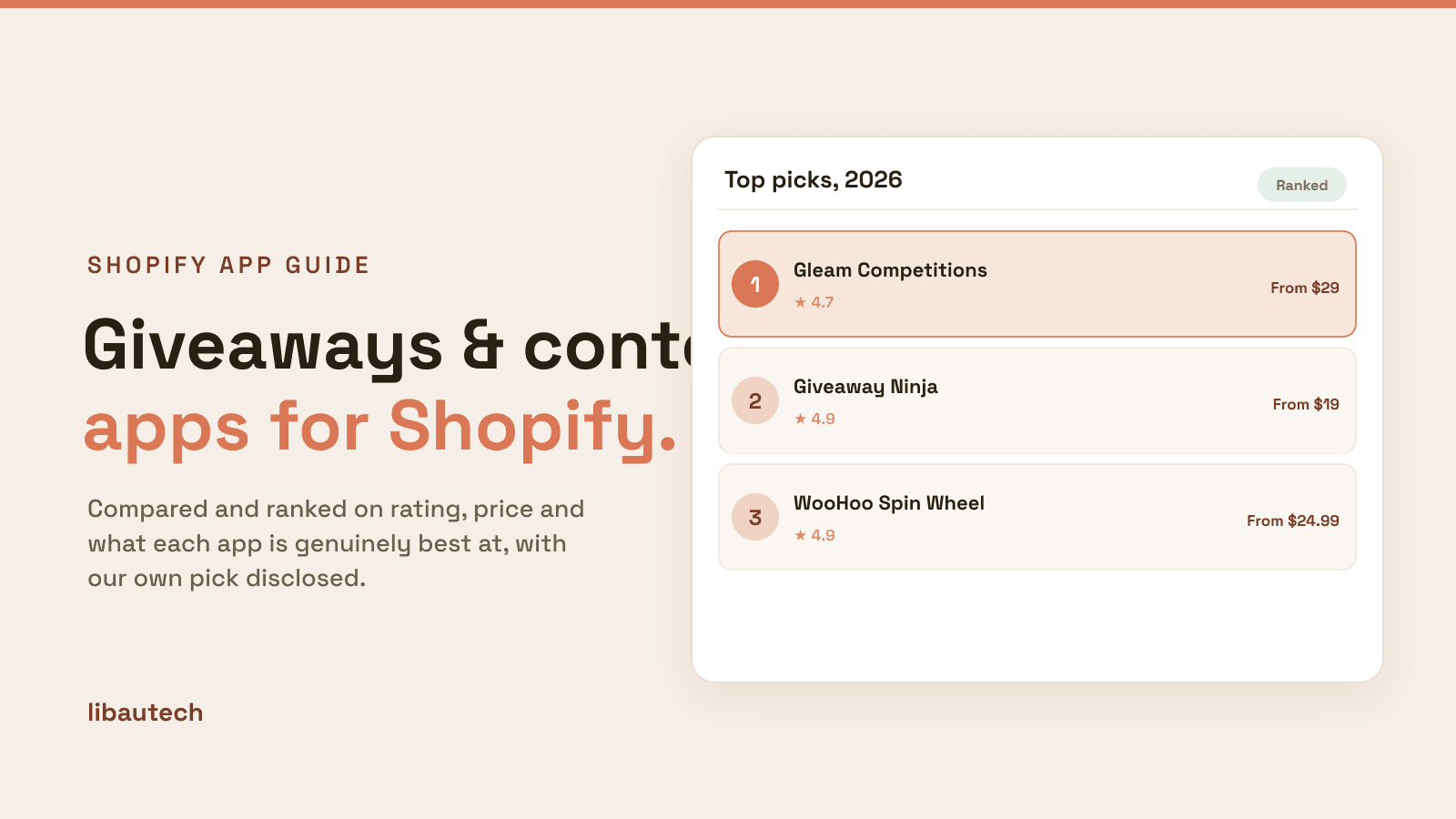
Last updated: April 2026 · Pricing and ratings verified from live Shopify App Store listings on April 30, 2026. Reviewed by the Libautech team — builders of Built for Shopify apps used by 5,000+ merchants across 50+ countries.
Key Takeaways
- Shopify giveaway apps split into three distinct jobs that competitor blogs treat as one. General contest platforms (Gleam Competitions, Giveaway Ninja, Vyper) run full campaigns with entry mechanics, viral sharing, and branded landing pages. Spin-the-wheel apps (Spin-a-Sale, Wheelio, WooHoo) deliver instant-gratification gamified email capture with discount rewards. Social media giveaway tools (Gatsby, Social Boost) convert Instagram followers and social engagement into email/SMS subscribers.
- Spin-the-wheel popups convert at 10-25% of unique visitors versus 2-5% for static email capture popups — the gamification mechanic dramatically lifts opt-in rates because customers see immediate value (a guaranteed discount) rather than a generic newsletter signup. The trade-off: spin-wheel emails skew toward discount-hunters who don't convert as well on full-price purchases.
- General contest platforms convert visitors to entries at 30-50% on landing pages and grow email lists 5-15x faster than organic signup forms during active campaigns. Best results come from prizes valued $200-2,000 — below $200, prize value doesn't motivate sharing; above $2,000, the audience skews toward sweepstakes hunters who never convert.
- Social media giveaway tools target a different problem: converting existing Instagram or TikTok followers into email/SMS subscribers. Comment-based giveaways ("comment to enter") and DM-based opt-ins capture social engagement that would otherwise stay locked in Meta's ecosystem. Critical for stores with 10K+ Instagram followers where social audience monetization is the primary growth lever.
- Pricing varies dramatically across layers. Spin-the-wheel apps start at free or $9-29/mo. General contest platforms run $29-99/mo on entry tiers. Social-specific tools (Gatsby) run $89-199/mo enterprise tiers because Instagram audience monetization typically commands higher revenue per subscriber. Match the app to the actual growth lever before optimizing on price.
- The biggest giveaway-app mistake is running prizes that attract the wrong audience. A $5,000 cash prize draws sweepstakes hunters who never buy. A $200 prize tied directly to your product (a $200 store credit, a year of free shipping, a flagship product bundle) draws customers who actually want what you sell. Prize-audience fit beats prize-value maximization.
Who Needs a Giveaway or Contest App, and Why?
A giveaway or contest app runs viral promotions that grow your email list and social following fast: enter-to-win competitions, refer-a-friend mechanics and spin-to-win popups that trade a discount for an email. Done well, a single giveaway can add thousands of subscribers you can market to long after it ends.
You need one if you want rapid list or audience growth, are launching or running a campaign, or want a viral referral loop. If you already have a large engaged audience and steady signups, the upside is smaller.
The Three Jobs of Shopify Giveaway Apps
Most roundups of Shopify giveaway apps lump together general contest platforms, spin-the-wheel popups, and social media giveaway tools as if they're solving the same problem. They are not. A general contest platform runs full campaigns with multiple entry methods (email signup, follow on social, refer friends, share on TikTok), branded landing pages, and viral sharing mechanics. A spin-the-wheel app delivers instant-gratification gamified popups where customers spin to win a discount in exchange for their email. A social media giveaway tool converts Instagram or TikTok followers into email and SMS subscribers through comment-based giveaways or DM-based opt-ins. Different mechanics, different conversion rates, different cost structures.
The honest framing: Shopify giveaway apps break into three distinct jobs. Most stores need exactly one approach based on their primary growth lever — picking the wrong type either captures the wrong audience or wastes setup effort on mechanics that don't fit the brand.
The first job is general contest and giveaway platforms — full campaign tools with multiple entry methods (email signup, social follows, referrals, UGC submissions, purchase-based entries), branded landing pages, viral sharing rewards, and email list growth. The mechanics: merchant builds a contest with prize and entry rules, app generates a landing page, customers enter through multiple methods, app picks winners and exports email lists. Gleam Competitions, Giveaway Ninja, and Vyper lead this layer. The right pick when stores want to run multi-channel campaigns with broad entry mechanics and email list growth is the primary goal.
The second job is spin-the-wheel and gamified popups — instant-gratification email capture popups where customers spin a wheel, scratch a card, or play a mini-game to win a discount in exchange for their email address. The mechanics: popup appears on storefront, customer enters email, plays the game, receives discount code immediately. Spin-a-Sale, Wheelio, and WooHoo lead this layer. The right pick when stores want maximum-volume email signups with instant conversion mechanics, and discount-hunting audiences fit the brand strategy.
The third job is social media giveaway and follower conversion — tools specifically for converting Instagram and TikTok followers into email/SMS subscribers through comment-based giveaways (customers comment on a post to enter), DM-based opt-ins (customers DM a keyword to subscribe), and ambassador program automation. The mechanics: app integrates with Instagram or TikTok APIs, monitors comments and DMs, captures opt-ins through Meta's authorized flows. Gatsby and Social Boost lead this layer. The right pick for stores with 10K+ social followers where converting existing social audiences is the primary growth lever.
This post ranks 8 apps across the three jobs based on verified April 2026 Shopify App Store data and what each one actually solves.
Giveaway apps stack with broader retention and growth tools. See our guides on best Shopify web push apps for the related re-engagement layer that captures campaign winners back into recurring marketing, best Shopify loyalty and rewards apps for the related customer retention layer where contest winners can convert to loyalty members, and best Shopify email marketing and SMS apps for the broader email/SMS layer that monetizes giveaway-acquired subscribers.
Quick Comparison: 8 Best Shopify Giveaway Apps (2026)
| App | Rating | Free Plan | Paid From | Layer | Best For |
|---|---|---|---|---|---|
| Gleam Competitions | ⭐ 4.7 (200+) | Yes | $29/mo | Contest platform | Most-established contest platform, multi-channel entries |
| Giveaway Ninja | ⭐ 4.9 (300+) | Yes | $19/mo | Contest platform | Affordable giveaways with purchase-based entries |
| Vyper Viral Marketing | ⭐ 4.6 (50+) | Free trial | $49/mo | Contest platform | Viral leaderboards, referral-based contest mechanics |
| Spin-a-Sale | ⭐ 4.6 (500+) | Free trial | $9.99/mo | Spin-the-wheel | Most-installed spin-wheel popup, simple setup |
| Wheelio Spin-the-Wheel | ⭐ 4.7 (700+) | Yes | $14.92/mo | Spin-the-wheel | Customizable wheel design, exit-intent triggers |
| WooHoo Spin Wheel Popup | ⭐ 4.9 (1,000+) | Yes | $24.99/mo | Spin-the-wheel | Multiple game types beyond spin-wheel |
| Gatsby: Convert Followers | ⭐ 4.9 (200+) | Free trial | $89/mo | Social media | Instagram DM giveaways, follower conversion |
| Social Boost Giveaways | ⭐ 4.7 (700+) | Yes | $29.99/mo | Social media | Multi-platform social giveaways, broad entry mechanics |
Layer 1: General Contest and Giveaway Platforms
This layer is for stores running full campaigns with multiple entry methods, branded landing pages, viral sharing rewards, and broad email list growth as the primary goal. The mechanics: merchant builds a contest with prize and entry rules, app generates a landing page, customers enter through multiple methods (email signup, social follows, referrals, UGC submissions, purchase-based entries), app picks winners and exports email lists. Three apps lead this layer.
1. Gleam Competitions
Best for: established Shopify stores wanting the most-established contest platform with the broadest set of entry methods, viral sharing mechanics, and integrations across the full marketing tech stack.
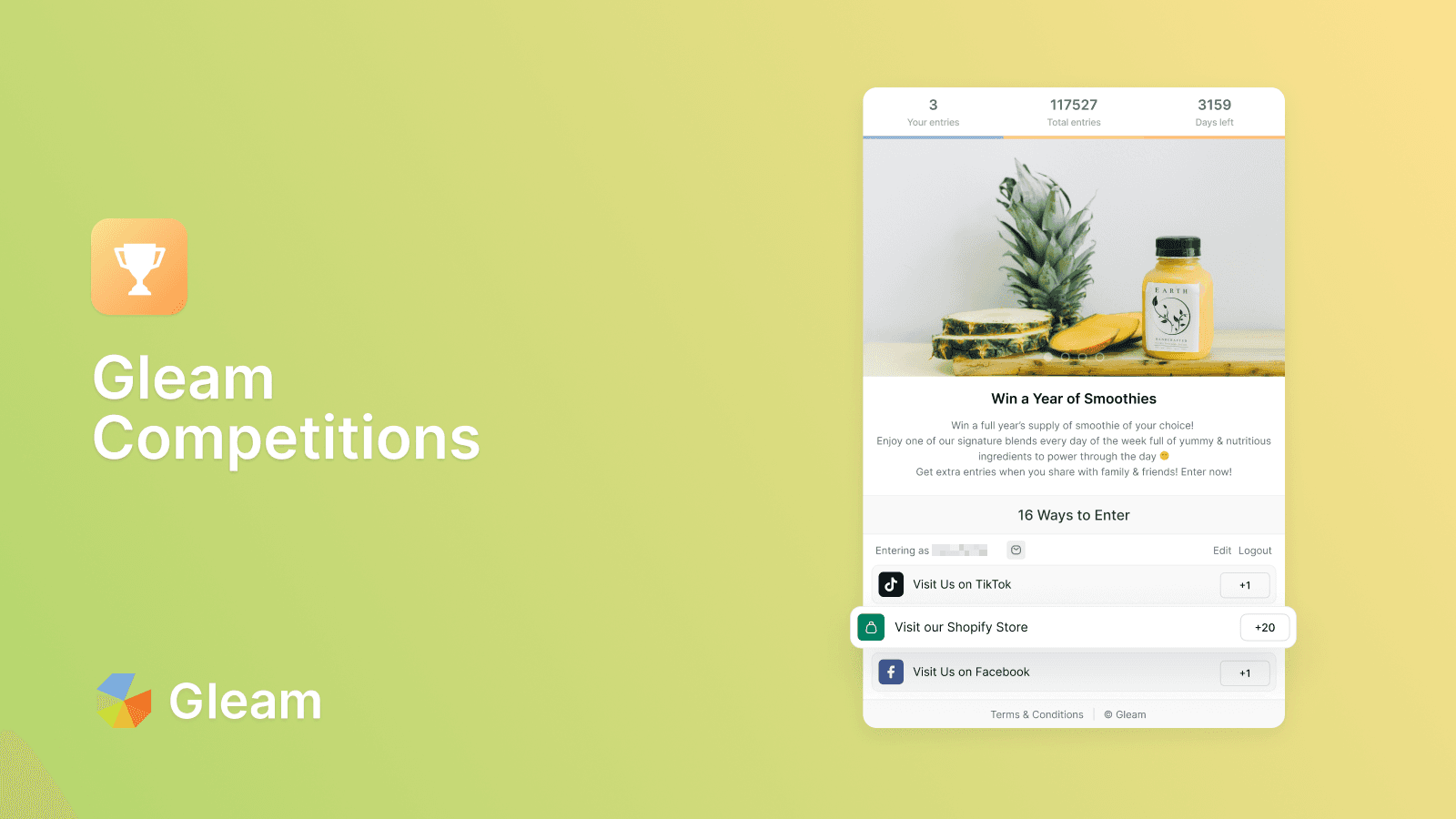
Gleam Competitions holds 4.7 stars across 200+ reviews and is one of the longest-running contest platforms used across ecommerce, content publishing, and SaaS — not just Shopify. The positioning is comprehensive contest infrastructure: 30+ entry methods (email signup, social follows on Instagram/TikTok/Twitter/YouTube, referrals, video views, photo uploads, quiz completions, purchase verification), branded landing pages with custom CSS, viral sharing rewards (entrants who refer friends earn bonus entries), and integrations with email platforms (Klaviyo, Mailchimp, Brevo) and analytics tools (Google Analytics, Facebook Pixel).
The integration depth matters specifically for stores running mature marketing operations. Rather than treating contest signups as a separate email list, Gleam syncs entries directly into existing Klaviyo flows so contest entrants automatically enter welcome series, abandoned cart sequences, and post-purchase flows. The native pixel integration also lets merchants build retargeting audiences from contest landing page visitors, capturing customers who entered but didn't convert immediately.
Core features: 30+ entry method types across multiple social platforms; branded landing pages with custom CSS and HTML; viral referral mechanics with bonus entries; email platform integrations (Klaviyo, Mailchimp, Brevo, others); analytics integrations (GA4, Facebook Pixel); purchase verification for purchase-based contests; CSV export of entries with social handles and emails; multi-language landing pages; integration with Shopify Online Store 2.0 themes; merchant dashboard with conversion analytics.
Where it falls short: pricing scales aggressively with entries — high-volume contests (10,000+ entries) can run $300-1,000/month on premium tiers. Setup complexity is real for stores running their first contest. Some merchant reviews flag occasional UI dating from the platform's longer history. Best for established stores with mature email marketing and analytics rather than first-time contest operators.
Pricing: Free plan available. Paid plans from $29/mo.
2. Giveaway Ninja
Best for: small-to-mid Shopify stores wanting affordable contest mechanics with purchase-based entries and engagement rewards — the budget-friendly entry into the contest platform layer with focused features.
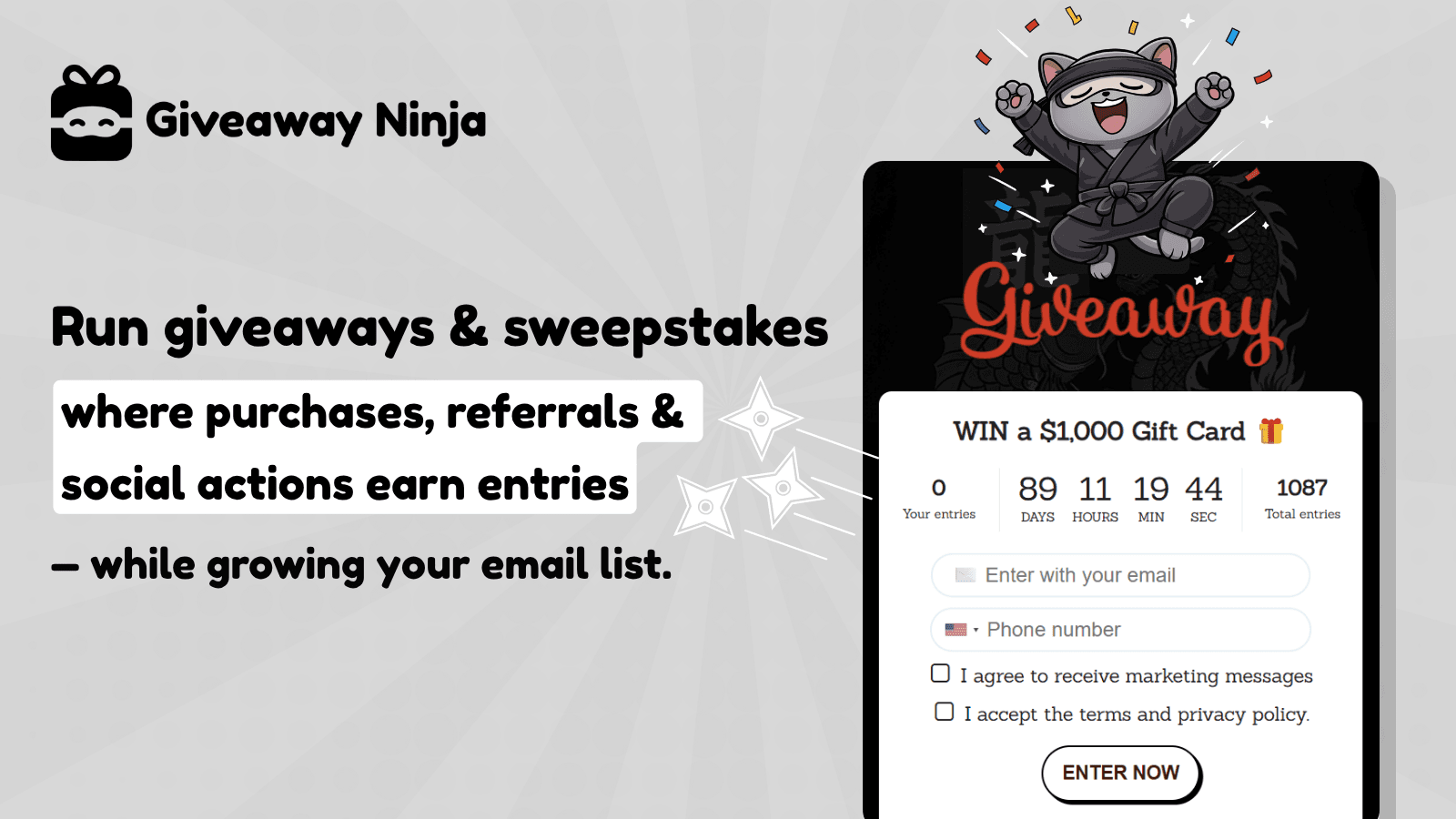
Giveaway Ninja holds 4.9 stars across 300+ reviews. The positioning is affordable contest mechanics at a meaningfully accessible entry tier ($19/mo) with the entry methods that matter most: purchase-based entries (customers earn entries by spending, with order value scaling the entry count), email signups, social follows, and referral rewards. For stores starting with contests where Gleam's premium tiers don't justify their cost, Giveaway Ninja covers the standard use cases at lower monthly investment.
The purchase-based entry mechanic matters specifically for stores where contests should drive revenue rather than just list growth. Rewarding entries based on order value ("$50 order = 5 entries, $100 order = 12 entries, $200 order = 30 entries") incentivizes higher AOV during the contest period rather than just collecting emails from non-buyers. For stores with mature traffic where the bottleneck is conversion rather than top-of-funnel awareness, this purchase-tied mechanic delivers more revenue per contest than pure email capture.
Core features: purchase-based entries with order value scaling; engagement rewards for follows, shares, referrals; branded landing pages with simple customization; refer-a-friend mechanics with bonus entries; photo gallery for UGC contests with voting; entry analytics with cohort breakdowns; integration with Shopify Online Store 2.0 themes; CSV export of entries.
Where it falls short: smaller integration ecosystem than Gleam — fewer email platform connections, no Facebook Pixel native integration. Less polished landing page customization than Gleam at premium tiers. Best for budget-conscious stores rather than established programs needing comprehensive marketing tech integration.
Pricing: Free plan available. Paid plans from $19/mo.
3. Vyper Viral Marketing
Best for: Shopify stores wanting viral leaderboard contests with referral-based mechanics where the goal is exponential audience growth through participant sharing rather than email list capture.
Vyper holds 4.6 stars across 50+ reviews. The differentiating positioning is viral leaderboard mechanics: rather than picking random winners, Vyper contests rank entrants by referral count, with top referrers winning the largest prizes. This shifts the contest mechanic from "enter and hope" to "refer to win" — entrants are motivated to share aggressively because their leaderboard position depends on it.
The viral mechanic matters specifically for stores prioritizing audience growth over list capture. A traditional Gleam-style contest with 1,000 entries might generate 200 referrals on average. A Vyper viral leaderboard contest with the same 1,000 entries typically generates 3,000-5,000 referrals because the referral mechanic is core to winning rather than a bonus entry method. For stores with tight prize budgets where each prize dollar needs to drive maximum reach, Vyper's mechanic compounds.
Core features: viral leaderboard contests with referral ranking; multiple prize tiers (top 10, top 100, random drawings); branded landing pages with custom CSS; referral tracking with unique codes per participant; email platform integrations; CSV export of entries with referral chains; multi-language support; integration with Shopify Online Store 2.0 themes.
Where it falls short: smaller installed base than Gleam or Giveaway Ninja — less historical track record. Niche use case (leaderboard contests don't fit every brand). Pricing entry point ($49/mo) higher than Giveaway Ninja for stores not using the leaderboard mechanic.
Pricing: Free trial. Paid plans from $49/mo.
The Honest Trade-Off: Prize-Audience Fit Beats Prize-Value Maximization
Worth saying explicitly: the most common giveaway mistake is running prizes that attract the wrong audience. A $5,000 cash prize draws sweepstakes hunters — people who enter every contest they see, never engage with the brand afterward, and unsubscribe within weeks. A $200 prize tied directly to your product (a $200 store credit, a year of free shipping, a flagship product bundle, a custom designer collaboration) draws customers who actually want what you sell.
The math: a $5,000 cash giveaway might generate 50,000 entries and 2-5% long-term conversion rate (1,000-2,500 customers). A $200 store credit giveaway might generate 5,000 entries but 15-30% long-term conversion rate (750-1,500 customers). Higher-value cash prizes generate larger raw lists but worse audience-quality lists — the customer-acquisition math often favors smaller, brand-aligned prizes despite the lower headline numbers.
The signal that prize-audience fit is right: contest winners post about the brand authentically, return for follow-up purchases, and share the brand with their network. The signal that it's wrong: contest winners disappear after the prize ships, unsubscribe en masse, and never return. Test prize structure on a small scale before committing to flagship-level contest budgets.
Layer 2: Spin-the-Wheel and Gamified Popups
This layer is for stores wanting maximum-volume email signups with instant-gratification mechanics — customer spins a wheel, scratches a card, or plays a mini-game to win a discount code in exchange for their email address. Different mechanics from contest platforms: opt-in is immediate, prize is a discount rather than a physical item, and the audience skews toward discount-hunting behavior. The right pick when discount-hunting audiences fit the brand strategy and email volume is the priority. Three apps lead this layer.
4. Spin-a-Sale
Best for: Shopify stores wanting the most-installed spin-the-wheel popup with simple setup, customizable prize segments, and broad theme compatibility — the default pick for spin-wheel email capture.
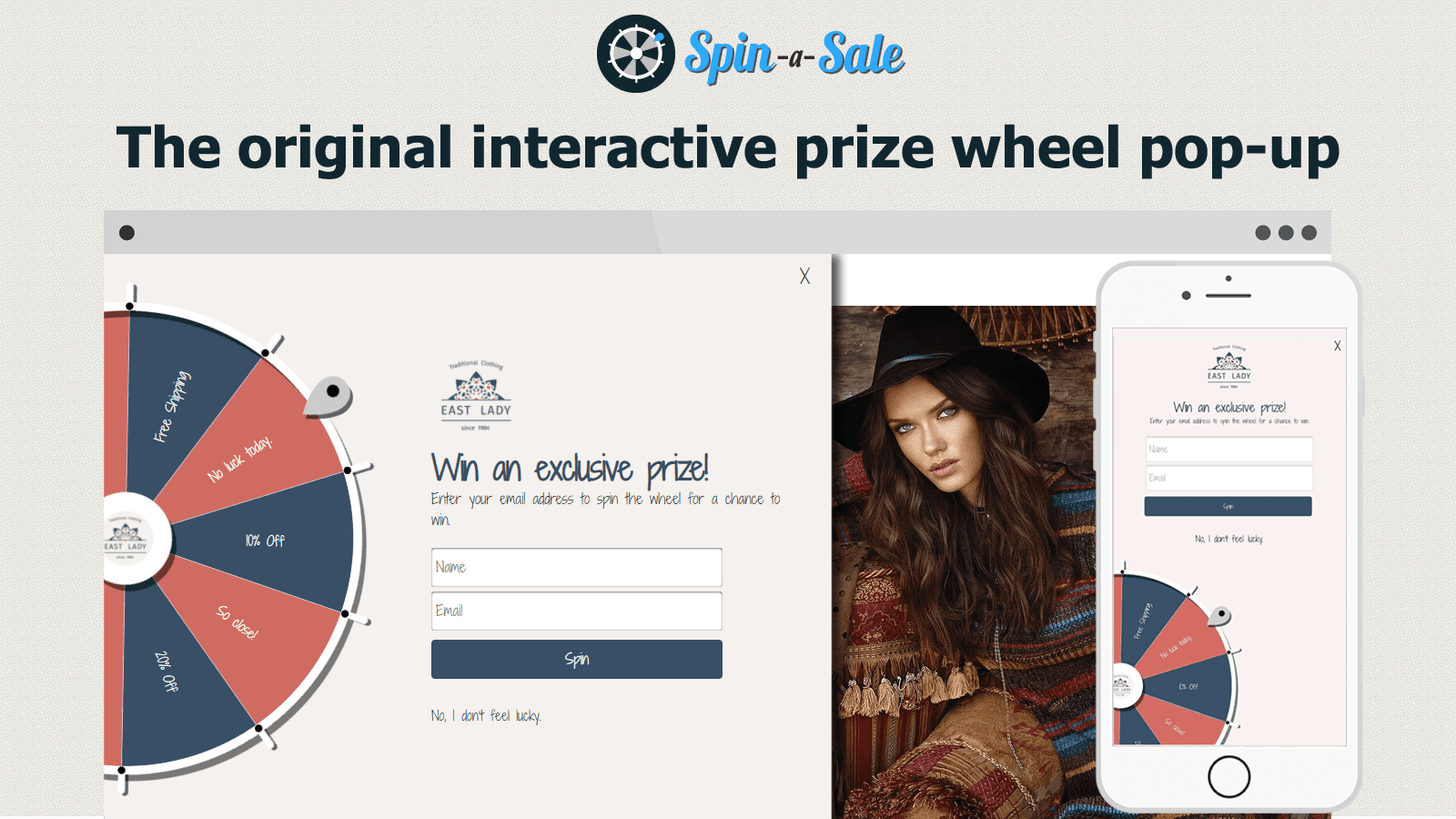
Spin-a-Sale holds 4.6 stars across 500+ reviews. The positioning is the most-installed dedicated spin-wheel app on the Shopify App Store with simple setup, customizable prize segments (configure which discounts appear at which probabilities), exit-intent triggers, and broad theme compatibility across Online Store 2.0 themes. For stores wanting a spin-wheel popup without configuration overhead, Spin-a-Sale's hands-off approach delivers measurable email capture lift on first install.
The probability customization matters specifically for margin-conscious merchants. Default spin-wheel apps configure equal probability across discount segments — if the wheel has 8 segments offering 5%, 10%, 15%, 20%, 25%, 30%, 50%, and "no win," each appears 12.5% of the time. Spin-a-Sale lets merchants weight high-discount segments to appear less frequently while still showing them on the wheel as visual incentive ("50% OFF!" appears prominent but lands at 0.5% probability). This preserves the conversion-driving visual while protecting margin.
Core features: customizable spin-wheel popup with up to 12 prize segments; configurable probability per segment; exit-intent and time-delay triggers; mobile-responsive wheel design; email platform integrations (Klaviyo, Mailchimp, Shopify Email); branded styling with custom colors and copy; multi-language support; integration with Shopify Online Store 2.0 themes; merchant dashboard with conversion analytics.
Where it falls short: 4.6-star rating reflects more polish gaps than 4.9-rated alternatives — some merchant reviews flag occasional theme integration friction. Less customizable than Wheelio at premium tiers. Free trial only — no permanent free plan.
Pricing: Free trial. Paid plans from $9.99/mo.
5. Wheelio Spin-the-Wheel
Best for: Shopify stores wanting fully customizable spin-wheel design with extensive trigger options, A/B testing, and multi-step popup flows — the design-conscious pick for stores with strong brand identity.
Wheelio holds 4.7 stars across 700+ reviews. The differentiating positioning is design customization depth: rather than the simpler Spin-a-Sale model with preset wheel styles, Wheelio offers full visual customization (custom wheel imagery, animated effects, branded backgrounds, multi-step popup flows that combine spin-wheel with subsequent product recommendations or coupon delivery). For stores with strong brand identity where the spin-wheel must match storefront aesthetics, Wheelio's customization handles brand integration that simpler tools force into compromise.
The A/B testing matters specifically for stores optimizing email capture conversion. Wheelio supports A/B tests across spin-wheel variants (different prize segments, different copy, different visual styles) with statistical significance reporting. For stores running 1,000+ daily visitors, this lets merchants iterate on conversion mechanics rather than guessing which configuration converts best.
Core features: fully customizable spin-wheel design with branded imagery; multi-step popup flows; A/B testing across spin-wheel variants; exit-intent, time-delay, and scroll-depth triggers; email platform integrations; segmentation by traffic source (paid ads, organic, referral); mobile-responsive design; multi-language support; integration with Shopify Online Store 2.0 themes; merchant dashboard with A/B test analytics.
Where it falls short: pricing scales with traffic on premium tiers — high-volume stores face significant monthly costs. Setup complexity is real for stores using A/B testing and multi-step flows. Some merchant reviews flag occasional UI complexity from the broader feature set.
Pricing: Free plan available. Paid plans from $14.92/mo.
6. WooHoo Spin Wheel Popup
Best for: Shopify stores wanting multiple game types beyond just spin-wheel — scratch cards, slot machines, dice rolls, and other gamified mechanics under one platform with one subscription.
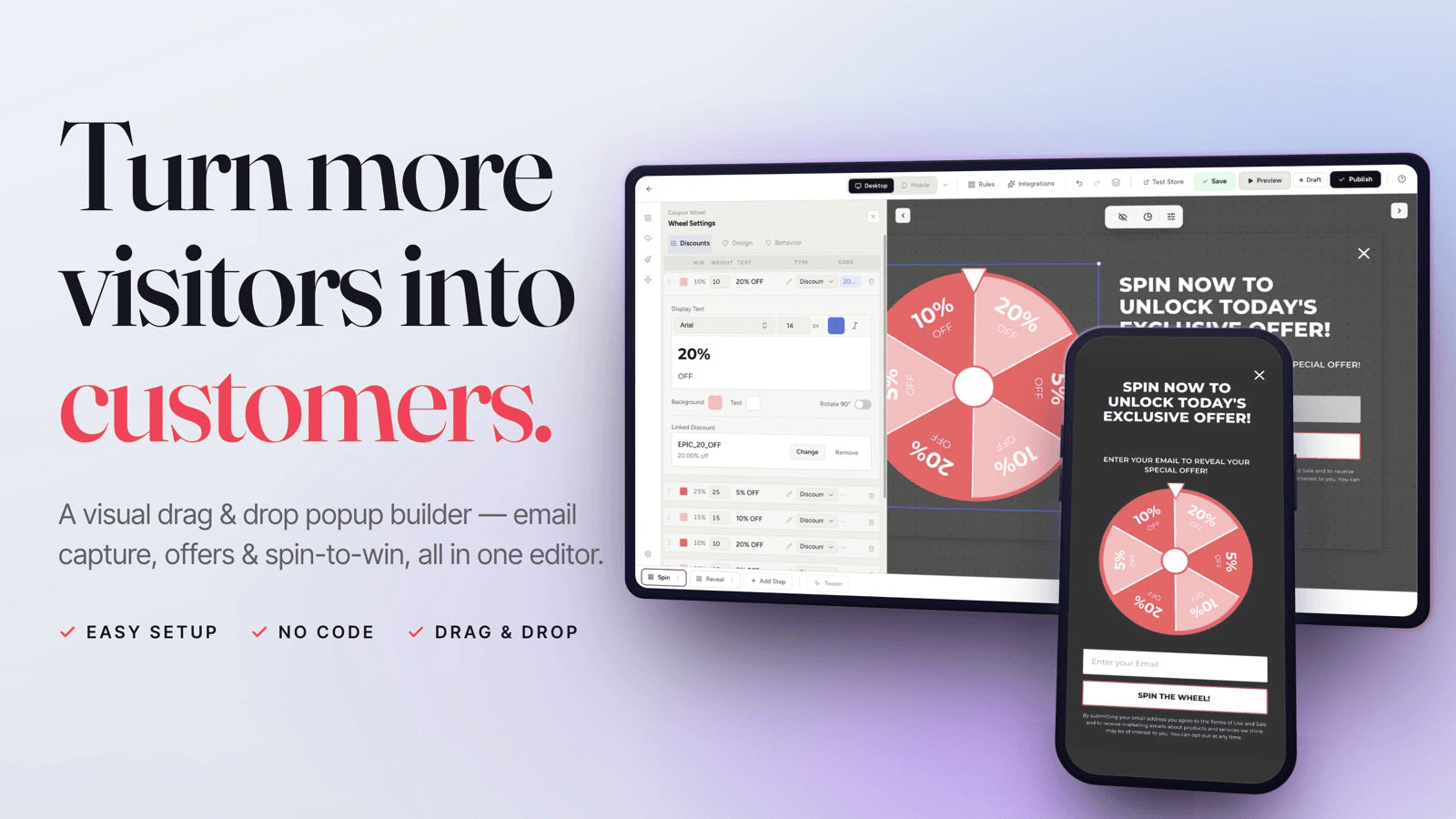
WooHoo holds 4.9 stars across 1,000+ reviews — the largest review base in the spin-the-wheel layer. The differentiating positioning is multi-game variety: rather than spin-wheel only, WooHoo includes scratch cards, slot machines, dice rolls, treasure chests, and other gamified email-capture mechanics under one subscription. For stores wanting to A/B test which game type converts best for their audience or rotate game mechanics seasonally, WooHoo's variety eliminates the need for multiple game-specific apps.
The variety matters specifically for stores with sophisticated audiences. Spin-wheel is now familiar enough to ecommerce shoppers that conversion rates have declined as the novelty wears off — stores running spin-wheel for 12+ months often see 20-30% lower email capture rates than year one. Rotating to scratch cards or slot machines refreshes the mechanic and lifts capture rates 30-50% versus stale spin-wheel deployments.
Core features: multiple game types (spin-wheel, scratch card, slot machine, dice roll, treasure chest); customizable game design and probability; exit-intent and time-delay triggers; A/B testing across game types; email platform integrations; mobile-responsive design; multi-language support; integration with Shopify Online Store 2.0 themes; merchant dashboard with game-type conversion analytics.
Where it falls short: pricing entry point ($24.99/mo) higher than Spin-a-Sale or Wheelio for stores wanting only spin-wheel. Setup complexity is real for stores configuring multiple game types. Best for stores wanting variety rather than focused spin-wheel only.
Pricing: Free plan available. Paid plans from $24.99/mo.
Layer 3: Social Media Giveaway and Follower Conversion
This layer is for stores with 10K+ social followers where converting existing Instagram or TikTok audiences into email/SMS subscribers is the primary growth lever. Different mechanics from contest platforms or spin-wheel popups: app integrates with Instagram or TikTok APIs, monitors comments and DMs, captures opt-ins through Meta's authorized flows. The right pick when social audience monetization is the bottleneck rather than top-of-funnel awareness or storefront email capture. Two apps lead this layer.
7. Gatsby: Convert Followers
Best for: established Shopify stores with 10K+ Instagram followers wanting comprehensive Instagram DM giveaways, ambassador program automation, and follower-to-subscriber conversion under an enterprise-tier platform.
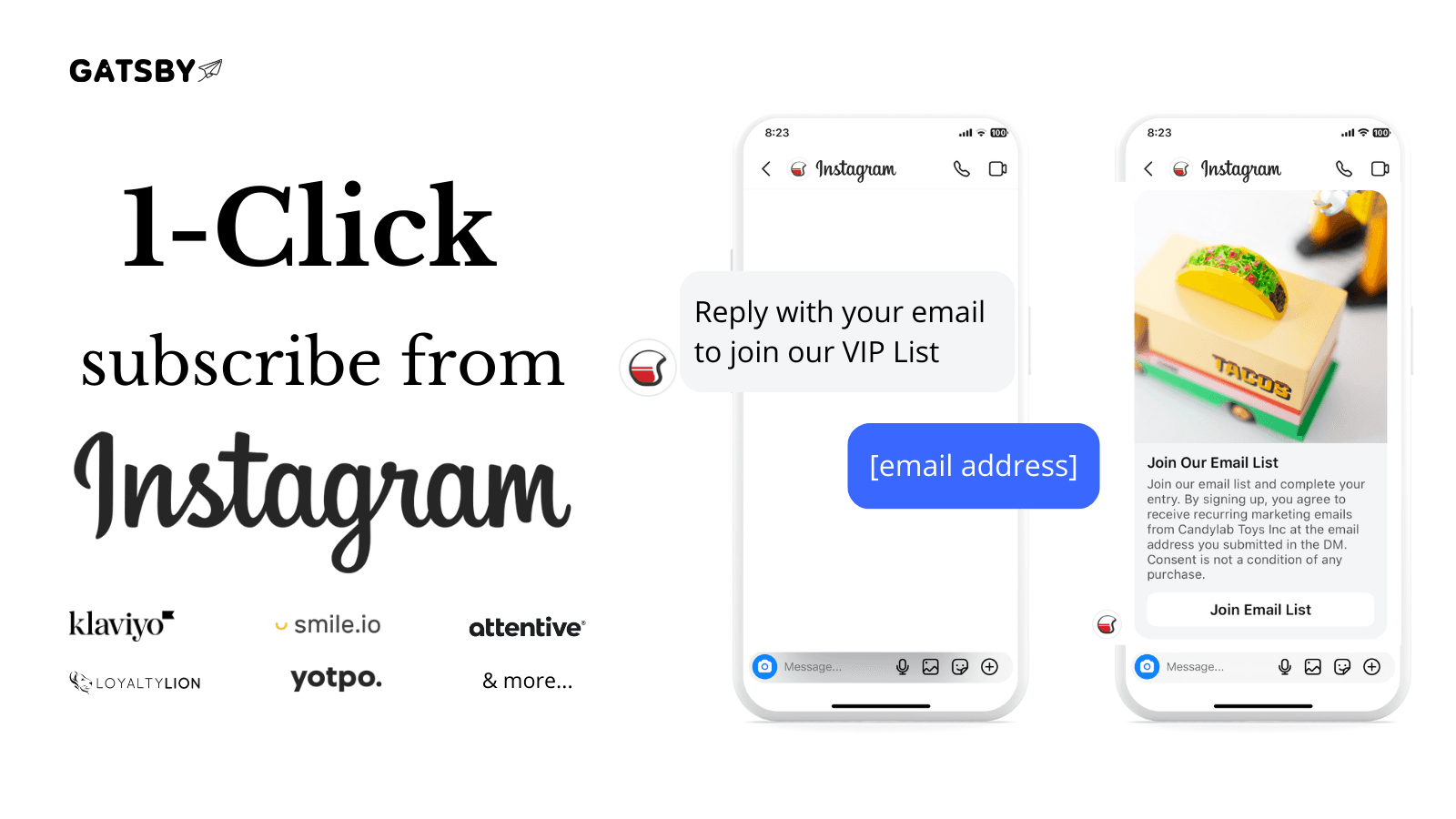
Gatsby holds 4.9 stars across 200+ reviews. The positioning is enterprise-tier social commerce and Instagram audience monetization: Instagram DM giveaways ("DM us 'WIN' to enter"), comment-based contest entries ("comment on this post to enter"), automated ambassador program management, UGC capture with rights management, and follower-to-email/SMS conversion through Meta's authorized opt-in flows. For stores with significant Instagram audiences where converting existing followers is the primary growth lever, Gatsby handles social-specific mechanics that general contest platforms don't support natively.
The pricing structure reflects the enterprise positioning. Gatsby's $89/mo entry tier excludes smaller stores by design — the platform is built for stores with 10K+ Instagram followers where social audience monetization typically generates higher revenue per subscriber than general email list growth. For stores at the right scale, the social-native mechanics typically deliver 30-50% higher conversion than general giveaway tools used for Instagram contests.
Core features: Instagram DM giveaways with keyword opt-ins; comment-based contest entries with automatic comment monitoring; ambassador program automation with referral tracking; UGC capture with rights management workflows; SMS subscriber growth through Instagram DMs; email and SMS sync with Shopify customer profiles; integration with Klaviyo and other email platforms; merchant dashboard with social channel conversion analytics.
Where it falls short: pricing entry point ($89/mo) excludes stores below significant Instagram following. Setup complexity is real for stores configuring multi-channel social workflows. Some merchant reviews flag occasional integration friction with Instagram's API rate limits during high-volume campaigns.
Pricing: Free trial. Paid plans from $89/mo.
8. Social Boost Giveaways
Best for: Shopify stores wanting multi-platform social giveaways across Instagram, TikTok, Facebook, and Twitter with broader entry mechanics than Gatsby's Instagram-focused tools — the affordable social media giveaway pick.
Social Boost holds 4.7 stars across 700+ reviews. The positioning is multi-platform social giveaways at meaningfully accessible pricing: Instagram, TikTok, Facebook, and Twitter contest mechanics under one platform with broad entry methods (follow, comment, share, tag friends, UGC submission) and email/SMS list growth integration. For stores with social audiences across multiple platforms rather than Instagram-only, Social Boost's multi-platform coverage handles the broader ecosystem.
The affordability matters specifically for stores starting with social giveaways. Where Gatsby's $89/mo entry tier excludes smaller social audiences, Social Boost's $29.99/mo tier opens social giveaway mechanics to stores with 1K-10K social followers where the audience is meaningful but not yet enterprise-scale. For stores in this range, Social Boost delivers 80% of social giveaway functionality at 35% of the cost.
Core features: multi-platform social giveaways (Instagram, TikTok, Facebook, Twitter); broad entry methods (follow, comment, share, tag, UGC); email and SMS list growth integration; comment-based entry monitoring; branded landing pages; ambassador and referral mechanics; integration with Shopify Online Store 2.0 themes; merchant dashboard with platform-level conversion analytics.
Where it falls short: less social-native than Gatsby — doesn't support Instagram DM giveaways with the same depth, no automated ambassador management. Setup complexity is real for stores configuring multi-platform contests. Some merchant reviews flag occasional UI quirks compared to dedicated single-platform tools.
Pricing: Free plan available. Paid plans from $29.99/mo.
Which Giveaway App to Choose
For most-established contest platform with 30+ entry methods and broad marketing integrations: Gleam Competitions. 4.7 stars, comprehensive feature set, the default pick for established marketing programs.
For affordable contest mechanics with purchase-based entries: Giveaway Ninja. 4.9 stars, 300+ reviews, $19/mo entry, the budget-friendly pick for revenue-focused contests.
For viral leaderboard contests where audience growth is the priority: Vyper Viral Marketing. 4.6 stars, referral-ranking mechanics, the niche pick for exponential audience growth.
For most-installed spin-wheel popup with simple setup: Spin-a-Sale. 4.6 stars, 500+ reviews, the default pick for spin-wheel email capture.
For fully customizable spin-wheel design with A/B testing: Wheelio Spin-the-Wheel. 4.7 stars, 700+ reviews, the design-conscious pick for stores with strong brand identity.
For multiple game types beyond spin-wheel (scratch cards, slot machines): WooHoo Spin Wheel Popup. 4.9 stars, 1,000+ reviews, the variety pick for stores rotating gamified mechanics.
For Instagram DM giveaways and follower-to-subscriber conversion at scale: Gatsby: Convert Followers. 4.9 stars, $89/mo enterprise tier for stores with 10K+ Instagram followers.
For multi-platform social giveaways at affordable pricing: Social Boost Giveaways. 4.7 stars, 700+ reviews, the budget pick for multi-platform social audiences.
For most Shopify stores in this category, the honest framing is goal-first. Stores wanting maximum-volume email capture with discount-hunting audiences should install Layer 2 (Spin-a-Sale, Wheelio, WooHoo). Stores running brand-aligned campaigns with broader entry mechanics and physical prizes should install Layer 1 (Gleam, Giveaway Ninja, Vyper). Stores with significant Instagram or TikTok audiences where social audience monetization is the bottleneck should install Layer 3 (Gatsby, Social Boost). The most common giveaway-app mistake is picking a layer that doesn't match the actual growth lever — install spin-wheel for an Instagram-audience problem and the audience never sees it.
How We Ranked These Apps
This ranking is based on four criteria applied to every Shopify giveaway app tested in 2026. First, Shopify App Store rating and verified review volume as of April 30, 2026 — the strongest signal of long-term merchant satisfaction at scale. Second, fit-to-job for which of the three layers each app actually solves (general contest platform, spin-the-wheel popup, or social media follower conversion) rather than treating these as a single category. Third, pricing structure and total cost at realistic merchant volumes — a $9.99/mo spin-wheel app and a $89/mo enterprise social platform handle different scopes, and the math depends on which layer the store actually needs. Fourth, audience-quality fit, since merchant satisfaction depends on whether the captured audience converts to long-term customers (the prize-audience fit reality matters dramatically more than raw entry volume).
Every pricing and feature figure in this post was verified directly from each app's live Shopify App Store listing on April 30, 2026. App pricing structures change — always confirm current pricing on the official listing before installing. Ratings and review counts reflect the Shopify App Store at the time of our last update.
Frequently Asked Questions
What is a Shopify giveaway app?
A Shopify giveaway app handles one of three distinct jobs. General contest platforms (Gleam, Giveaway Ninja, Vyper) run full campaigns with multiple entry methods, branded landing pages, and viral sharing rewards. Spin-the-wheel apps (Spin-a-Sale, Wheelio, WooHoo) deliver instant-gratification gamified email capture with discount rewards. Social media giveaway tools (Gatsby, Social Boost) convert Instagram and TikTok followers into email/SMS subscribers through comment-based giveaways and DM-based opt-ins.
What is the best Shopify giveaway app in 2026?
Depends on the layer. For general contest platforms: Gleam Competitions (4.7 stars, comprehensive integrations), Giveaway Ninja (4.9 stars, $19/mo budget), or Vyper (viral leaderboards). For spin-the-wheel: Spin-a-Sale (4.6 stars, most-installed), Wheelio (4.7 stars, customizable design), or WooHoo (4.9 stars, multiple game types). For social media: Gatsby (4.9 stars, Instagram DM giveaways) or Social Boost (4.7 stars, multi-platform). Pick the layer first based on growth lever.
How much do Shopify giveaway apps cost?
Entry tiers range from free (most apps offer free plans) to $9.99-29.99/mo for most paid plans. Spin-the-wheel apps run $9.99-24.99/mo. General contest platforms run $19-49/mo on entry tiers. Social-specific tools (Gatsby) run $89/mo enterprise tiers because Instagram audience monetization commands higher revenue per subscriber. The right app costs less than $50/mo for most stores.
What conversion rates can stores expect from giveaways?
Spin-the-wheel popups convert at 10-25% of unique visitors versus 2-5% for static email capture popups. General contest platforms convert visitors to entries at 30-50% on landing pages and grow email lists 5-15x faster than organic signup forms during active campaigns. Social media giveaways typically convert 5-15% of engaged followers into email/SMS subscribers. Conversion rates vary significantly by prize value, audience quality, and brand alignment.
What prize value should I offer?
$200-2,000 typically delivers best results for product-tied prizes. Below $200, prize value doesn't motivate sharing and entries stall. Above $2,000, the audience skews toward sweepstakes hunters who never convert to long-term customers. Cash prizes generally underperform product-tied prizes (store credit, flagship products, year of free shipping) because cash prizes attract anyone, while product-tied prizes attract customers who actually want what you sell.
What is the difference between contests and spin-the-wheel popups?
Different mechanics with different audience-quality outcomes. Contests run multi-entry campaigns over days/weeks with physical prizes and broad entry methods (email, social follows, referrals, UGC). Spin-the-wheel popups deliver instant-gratification email capture with discount rewards. Spin-wheel converts higher in raw volume but attracts discount-hunting audiences. Contests convert lower in raw volume but attract higher-quality audiences when prize-audience fit is right. Match to brand strategy.
Will spin-the-wheel popups attract the wrong customers?
Often yes, partially. Spin-wheel email lists skew toward discount-hunters who buy on first purchase but rarely return at full price. For premium brands or considered-purchase categories where customers buy once for high value, spin-wheel can dilute brand positioning and capture audiences that won't convert long-term. For impulse-purchase categories (apparel, beauty, home goods, accessories) where discount-driven purchases are normal, spin-wheel performs strongly. Match the mechanic to the category.
How do Instagram giveaways work?
Instagram giveaways typically run through three mechanics. Comment-based: customers comment on a post ("Tag a friend to enter") and the app monitors comments to capture entries and pick winners. DM-based: customers DM a keyword ("DM us 'WIN' to enter") and the app captures opt-ins through Meta's authorized flows. Story-based: customers share a story tagging the brand for entry. Apps like Gatsby and Social Boost integrate with Instagram's API to automate these workflows and convert engaged followers into email/SMS subscribers.
Are giveaways legal in all markets?
Generally yes, but specific regulations vary. US giveaways must comply with state-specific sweepstakes regulations including no-purchase-necessary requirements (entry can't require a purchase). EU giveaways must comply with GDPR for email collection and may have country-specific contest rules. UK giveaways have specific terms-and-conditions requirements. Some social platforms (Instagram, TikTok) have promotional guidelines that supersede merchant choices. Always consult legal counsel for cross-market campaigns or include compliant terms-and-conditions templates from the giveaway app.
Will giveaway apps slow down my Shopify store?
Modern giveaway apps load popups and landing pages asynchronously with minimal page-speed impact. Spin-the-wheel popups appear after page interactivity and don't block initial render. Contest landing pages typically host on the app's infrastructure rather than the merchant's storefront so they don't affect storefront performance. Always test page speed before and after install with Google PageSpeed Insights to confirm impact on your specific theme.
Think Your App Belongs on This List?
We update these lists as new tools launch and existing ones improve. If you are a developer building a Shopify giveaway, contest, or social media marketing app and want your app considered for inclusion, submit it here — tell us what your app does, who it is for, and include a link to your Shopify App Store listing. We review every submission.