Last updated: May 2026 · Pricing verified May 4, 2026 · Reviewed by the Libautech team, builders of Bundles & Upsell, Sticky Add to Cart, Announcement Bar, and 7 other Shopify apps used by 5,000+ merchants across 50+ countries.
Legal compliance on Shopify is unglamorous and existential. The wrong setup does not show up in conversion rate; it shows up in a regulator letter, an ADA demand, or a refund chargeback that cannot be fought because the refund policy is missing. Most legal app comparisons treat compliance jobs interchangeably, which produces misleading recommendations because an app that excels at cookie consent often falls short on accessibility, and vice versa. Sort the four jobs first because the right tool depends on which jurisdictions the store sells into and which products it ships.
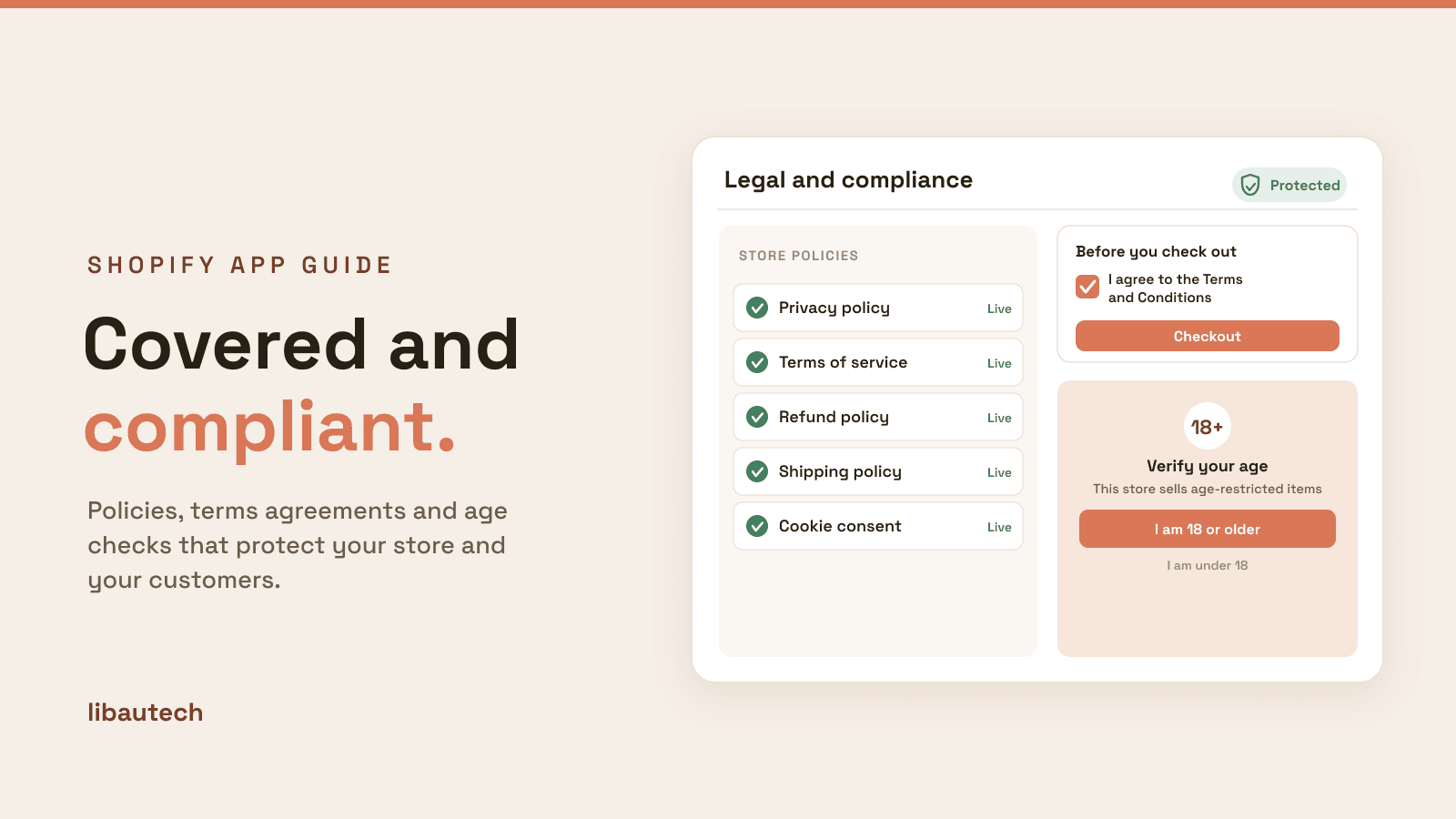
The first job is required policy generation. The mechanic: app asks structured questions about the store (jurisdiction, return window, data collection, third-party tools) and generates region-aware policy text covering privacy, terms of service, refund, and shipping policies. Best fit: any store launching, expanding to a new country, or running without policies the operator actually wrote and understood. Shopify native templates, TermsFeed, and Enzuzo lead this category. The right pick depends on jurisdiction scope (Shopify native for US-only launches, TermsFeed for multi-jurisdiction one-time generation, Enzuzo for stores wanting policies plus cookie consent in one tool).
The second job is cookie consent and tracking compliance. The mechanic: banner detects user location, shows the right consent flow (granular for EU under GDPR, Do Not Sell for California under CCPA, opt-in for Brazil under LGPD), and blocks marketing scripts until consent is given. Best fit: any store with EU, UK, or California traffic, which is essentially every store. Pandectes and Cookiebot lead this category. Pandectes wins for typical Shopify cases at 5.0 rating; Cookiebot wins for stores wanting strict EU compliance with audit trails that regulators specifically request during complaints.
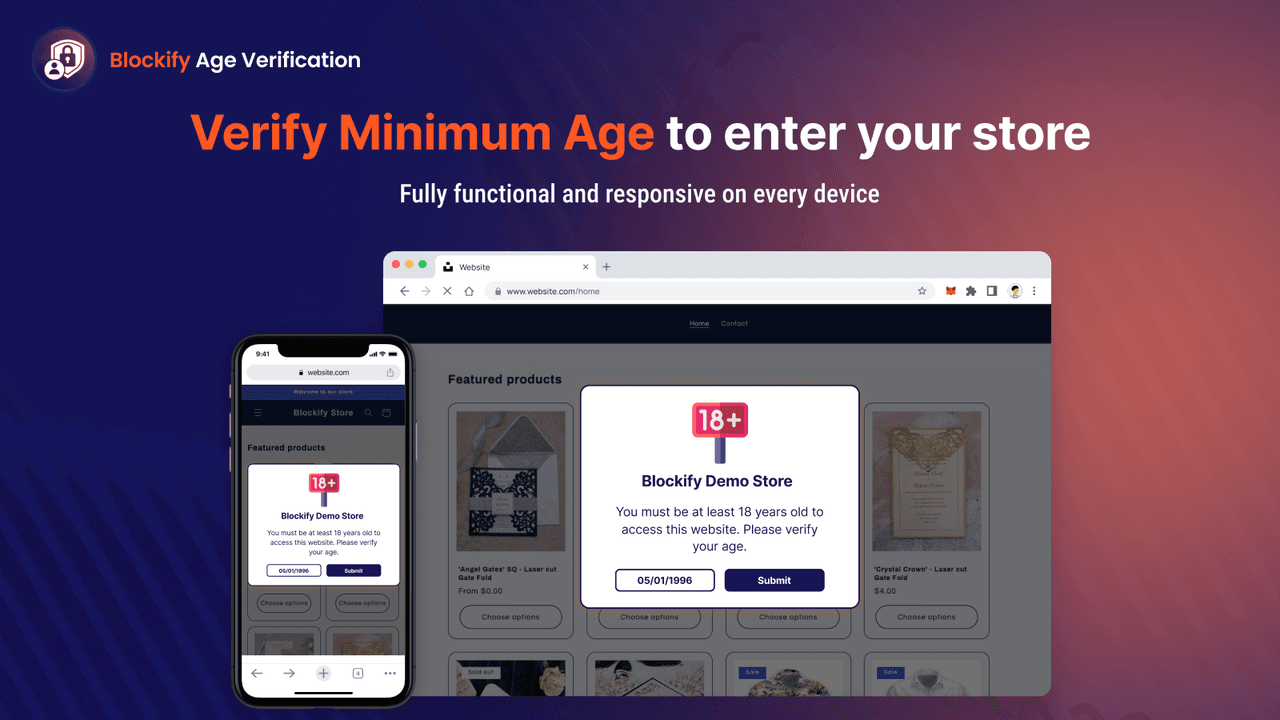
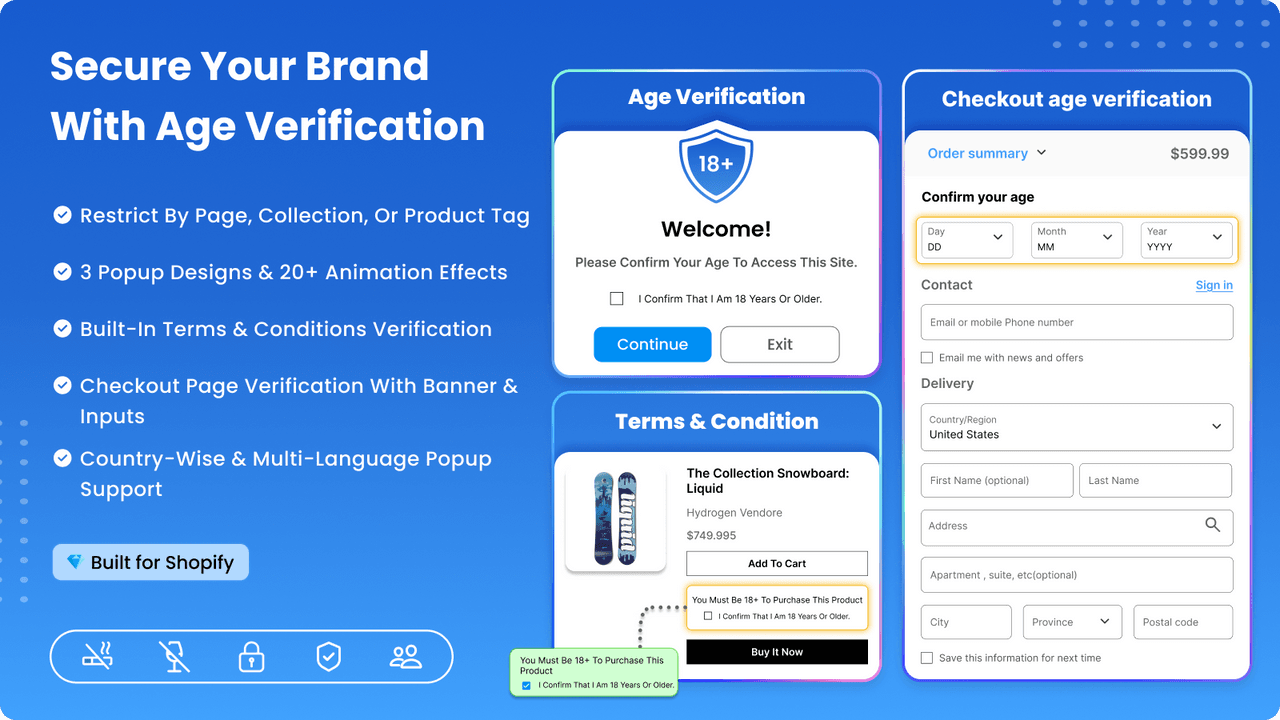
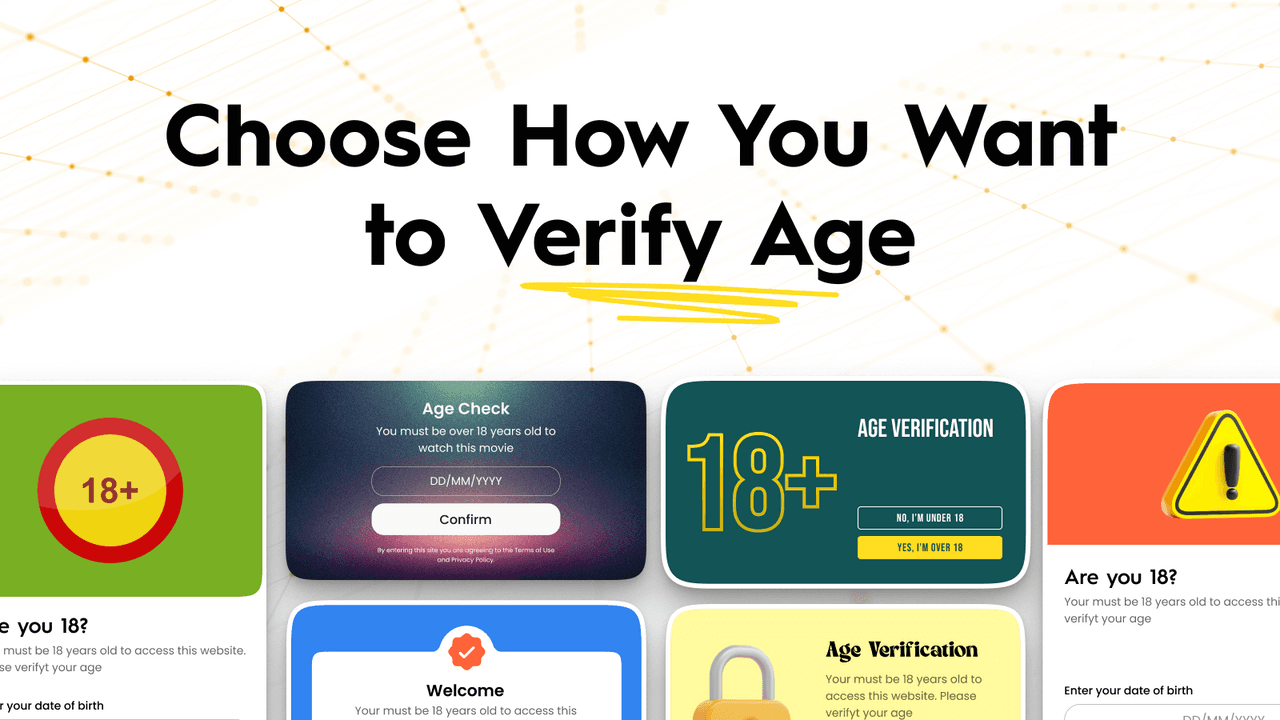
The third job is age verification. The mechanic: a modal or page-level gate that the customer must pass before browsing or checking out. Two flavors exist: confirmation (customer clicks "I am 21+" without actual verification) and verification (real database lookup against name, address, and date of birth). Best fit: alcohol, vape, CBD, cannabis where legal, firearms, and adult product stores. Lifter Age Verification leads the confirmation category at low cost; AgeChecker.Net leads the verification category for products requiring real ID checks at higher cost.
The fourth job is accessibility compliance. The mechanic: app scans the storefront for accessibility issues and either fixes them automatically (overlay model) or reports them for theme-level fixes (audit model). WCAG 2.1 AA is the standard most lawyers reference. Best fit: any store with US traffic, where ADA litigation has become a small industry. accessiBe leads the overlay model for stores wanting fast risk reduction without theme work. The overlay approach is controversial in the WCAG community, which prefers theme-level fixes, but for stores facing ADA demand letters today the overlay is the fastest path to demonstrable effort.
This ranking is based on four criteria applied to every Shopify legal app tested in 2026, weighted by merchant impact. First, which of the four legal jobs each app solves best (policy generation, cookie consent, age verification, or accessibility). There is no single best legal app, and the right choice depends on which jurisdictions the store sells into and which products it sells. Apps were ranked higher when they declared their fit clearly rather than marketing themselves as universal compliance solutions. Second, Shopify App Store rating and review volume as a signal of long-term reliability. Compliance apps that have accumulated thousands of reviews at 4.7+ ratings have a real track record across thousands of stores running active compliance work.
Third, cost-effectiveness at realistic store scale. Free plans suit launching stores where the compliance budget is constrained. Enterprise pricing only earns its place when audit-trail compliance is genuinely required (regulated products, large EU customer volumes, multi-jurisdiction operations). Fourth, integration depth with Shopify's native compliance APIs (Customer Privacy API, native policy fields). Apps that work with Shopify's primitives win over apps that fight them because the platform-native integration ensures compliance signals flow correctly through to all the places that matter (Shopify pixels, customer accounts, order data).
Every pricing figure in this post was verified directly from the live Shopify App Store listing on May 4, 2026. Compliance app pricing changes frequently as regulations evolve, so always confirm current pricing on the official listing before installing. This post does not provide legal advice. Compliance with GDPR, CCPA, ADA, EAA, and other regulations depends on the specific operation, jurisdiction, and customer base. For high-stakes setups (regulated products, cross-border data, large customer volumes), consult an attorney familiar with e-commerce compliance in the relevant jurisdictions.
Rating: Built into Shopify · Pricing: Free · Best for: US-only Shopify stores launching tomorrow that need baseline policies fast · Job solved: Required policy generation at the lowest possible cost for US-focused operations
Shopify generates baseline policy templates directly in the admin under Settings → Policies. Privacy policy, refund policy, terms of service, and shipping policy templates are pre-written by US-licensed attorneys and meet baseline US legal requirements. The positioning: rather than competing on multi-jurisdiction depth (TermsFeed wins) or bundled cookie consent (Enzuzo wins), Shopify native wins on price (free) and integration (every Shopify store has it built in without additional installs). For stores launching tomorrow that need policy text on the storefront before driving any traffic, Shopify native is the fastest path to compliant text.
Core features: privacy policy template covering standard US data collection disclosures; refund policy template covering standard return windows and refund mechanics; terms of service template covering standard e-commerce terms (purchase conditions, dispute resolution, governing law); shipping policy template covering carrier handoff, lost shipment policy, and international duty disclosure; native integration with Shopify storefront (policies auto-publish to /policies/privacy-policy and equivalent URLs); native theme integration so policies appear in checkout and footer automatically; multi-language support through Shopify Markets for stores selling internationally with translated policy versions; integration with Shopify's customer account system so policies appear during account creation; and built into the platform with zero additional cost. Where it falls short: templates are generic US-baseline rather than customized to the specific operation, which means stores using third-party tools (Klaviyo, Meta Pixel, custom analytics) need to manually update the privacy policy to disclose those data flows. International compliance is limited (GDPR-specific provisions are partial, CCPA Do Not Sell mechanics need separate cookie banner integration). No integrated cookie consent banner. Best fit as the launch-day starting point for US-focused stores before scaling into a more sophisticated stack as the operation grows into international markets.
Rating: Not on Shopify App Store (web-based generator) · Pricing: One-time fee from $9 per policy · Best for: Stores wanting one-time, multi-jurisdiction policy generation without recurring subscription · Job solved: Policy generation across multiple jurisdictions with one-time payment rather than monthly subscription
TermsFeed is a web-based policy generator (not a Shopify app per se) that produces customized privacy policies, terms, refund policies, and cookie policies based on a structured questionnaire. The positioning: rather than competing on Shopify-native integration (Shopify admin templates win) or bundled features (Enzuzo wins), TermsFeed wins on the one-time payment model and multi-jurisdiction depth that subscription tools do not offer at the same price point. The questionnaire surfaces jurisdiction-specific requirements (GDPR cookie disclosure, CCPA Do Not Sell language, COPPA for child-directed sites) and produces customized policy text addressing each requirement.
Core features: questionnaire-driven policy generation covering privacy policy, terms of service, refund policy, and cookie policy; jurisdiction-specific language for GDPR (EU/UK), CCPA/CPRA (California), LGPD (Brazil), PIPEDA (Canada), and Australian Privacy Act; one-time payment model with no recurring subscription required; lifetime updates included for major regulation changes (GDPR amendments, CCPA updates); embeddable HTML output that pastes directly into Shopify policy fields; multi-language translation support for international stores; cookie consent banner generator (separate purchase) for stores wanting matched policy plus banner from the same vendor; integration via copy-paste rather than direct app install (lower technical surface area); Shopify-specific guidance for embedding policies in standard Shopify policy URLs; and one-time pricing from $9 per policy with bundle discounts for multi-policy purchases. Where it falls short: not a Shopify-native app, which means policy updates require manual copy-paste back into Shopify admin rather than auto-syncing. No integrated cookie consent banner runtime (separate product needed). The one-time payment model means stores facing major regulation changes (new state privacy laws, new countries) need to repurchase or manually update. Best fit for stores at launch wanting one-time investment in proper multi-jurisdiction policies without committing to a recurring subscription. Stores expecting frequent regulation changes or wanting integrated cookie consent should pick Enzuzo or Cookiebot instead.
Rating: 4.9/5 across 1,400+ reviews · Pricing: Free plan, paid from $14.99/mo · Best for: Stores wanting policies plus cookie consent plus data subject request handling in one app · Job solved: Bundled compliance covering policy generation, cookie consent, and data subject access requests in a single subscription
Enzuzo combines policy generation, cookie consent banners, and data subject access request (DSAR) handling in one app. The positioning: rather than competing on best-in-class for any single job (Shopify native wins on policies for US, Pandectes wins on cookie consent depth), Enzuzo wins on the bundled compliance feature set that lets one app handle the full small-business compliance stack. For stores selling into multiple jurisdictions where policies need to update with cookie banner behavior synchronously (GDPR right to erasure flowing through to data deletion in customer database, CCPA Do Not Sell linked to marketing pixel suppression), Enzuzo's bundling avoids coordination across separate vendors.
Core features: policy generator covering privacy, terms, refund, shipping, cookie, EULA, and acceptable use policies; jurisdiction-specific policy versions for GDPR, CCPA, LGPD, and other regional regulations; cookie consent banner with granular consent categories (functional, analytics, marketing); customer data subject access request (DSAR) handling with automated request workflow and audit trail; integration with Shopify Customer Privacy API for native consent signal flow; auto-update of policies when source regulations change (GDPR amendments, new state privacy laws); multi-language support for international stores; native Shopify theme integration with policies auto-publishing to standard /policies/ URLs; integration with Shopify's customer account system; and a free plan covering basic policy generation and cookie consent (sufficient for stores under small traffic thresholds). Where it falls short: bundled feature set means stores that genuinely need only cookie consent (Pandectes is cheaper at $9/mo) pay for features they will not use. Policy generation depth does not match TermsFeed's specialist focus on the policy job. Smaller install base than Pandectes (1,400 reviews vs 4,000+) means slightly less long-term validation data. Best fit for stores wanting one app to handle compliance across multiple jobs (policies + cookies + DSAR) without coordinating separate specialist tools.
Rating: 4.4/5 across 100+ reviews · Pricing: Free for under 100 monthly visitors, paid from $14/mo · Best for: Stores wanting strict EU compliance with audit trails that regulators specifically request · Job solved: Cookie consent management with strict GDPR audit-trail compliance for stores facing potential EU regulatory scrutiny
Cookiebot is a global cookie consent management platform (CMP) used across thousands of websites beyond Shopify. The positioning: rather than competing on Shopify-native simplicity (Pandectes wins) or bundled features (Enzuzo wins), Cookiebot wins on the strict EU compliance depth and audit trails that regulators specifically request during complaint investigations. For stores with significant EU traffic where the consequence of GDPR non-compliance is material (Europe-based merchants, B2B stores selling to EU enterprise customers, regulated product categories), Cookiebot's depth on the cookie consent job earns its place over Shopify-specialist alternatives.
Core features: automatic cookie scan detecting all cookies set by the storefront and third-party scripts; granular consent categories with regulator-aligned labeling (strictly necessary, preferences, statistics, marketing); pre-built consent banner templates with full visual customization; integrated audit trail logging every consent decision with timestamp, IP, and consent state for regulator audits; multi-language support across 40+ languages with auto-detection of user locale; integration with Google Consent Mode v2 for Google Analytics 4 compliance; integration with Meta Pixel consent signals for Facebook ads compliance; integration with Shopify Customer Privacy API for native consent flow; CMP certification under TCF 2.2 (IAB transparency framework); ePrivacy Directive compliance for EU member states beyond GDPR; and a free plan covering up to 100 monthly visitors. Where it falls short: 4.4-star rating is noticeably lower than Pandectes (5.0) and reflects setup complexity for non-technical merchants. The platform is Shopify-aware but not Shopify-specialist, which means setup involves more manual configuration than Pandectes. Pricing scales with monthly visitor volume, which can become expensive for high-traffic stores compared to flat-rate Shopify-specialist alternatives. Best fit for stores in the EU or selling to EU enterprise customers where audit-trail compliance depth justifies the setup complexity and pricing.
Rating: 5.0/5 across 4,000+ reviews · Pricing: Free plan, paid from $9/mo · Best for: Typical Shopify stores wanting fast cookie consent compliance with the highest validation rating in the category · Job solved: Cookie consent for typical Shopify stores at the best price-to-validation ratio in the category
Pandectes has a 5.0 rating across 4,000+ reviews, the highest validation in the entire Shopify legal app category. The positioning: rather than competing on enterprise audit depth (Cookiebot wins) or bundled features (Enzuzo wins), Pandectes wins on the Shopify-specialist focus that produces the smoothest setup and the highest merchant satisfaction in the category. For typical Shopify stores wanting fast cookie consent compliance without the enterprise CMP complexity, Pandectes is the default mainstream choice.
Core features: GDPR, CCPA, and LGPD-compliant cookie consent banner with geographic detection (different banner behaviors for EU, California, and Brazil traffic); pre-built banner templates covering all major consent UI patterns (top bar, bottom bar, modal, slide-in); full visual customization for brand-aligned banner appearance; granular consent categories (functional, analytics, marketing) with regulator-aligned labeling; automatic cookie scan detecting all cookies set by storefront and third-party scripts; integration with Shopify Customer Privacy API for native consent signal flow; integration with Google Consent Mode v2 and Meta Pixel for ad platform compliance; multi-language support with translation across major European languages; consent log audit trail for regulator complaint investigation; and a free plan covering low-traffic stores (sufficient for stores under small traffic thresholds). Where it falls short: enterprise CMP audit depth is lighter than Cookiebot's, which means stores with very high regulatory exposure (EU-based merchants, B2B stores serving EU enterprise customers) may need Cookiebot's deeper audit trails. Policy generation is not bundled (separate tool needed). Best fit for typical Shopify stores wanting fast, validated cookie consent compliance at the lowest price point with the highest validation rating in the category.
Rating: 4.9/5 across 600+ reviews · Pricing: Free plan available, paid from $4.99/mo · Best for: Stores selling alcohol, vape, CBD, or other age-restricted products needing fast confirmation gates · Job solved: Age confirmation modals at the lowest price point for age-restricted product categories
Lifter Age Verification provides modal-based age confirmation gates that customers must pass before browsing or checking out. The positioning: rather than competing on real ID verification (AgeChecker.Net wins) or compliance breadth (Enzuzo wins), Lifter wins on the simple confirmation flow at the lowest price point in the age verification category. For stores selling alcohol, vape, CBD, cannabis (where legal), and other age-restricted products where the legal standard is a good-faith confirmation effort rather than real ID verification, Lifter delivers the required gate at minimal cost.
Core features: customizable age confirmation modal with brand-aligned visual design; configurable minimum age (18, 19, 21 depending on product category and jurisdiction); date-of-birth entry option for stricter confirmation than simple yes/no click; geographic targeting so the gate appears only for traffic from jurisdictions requiring age confirmation; integration with Shopify cart so unauthorized customers cannot complete checkout; cookie-based session memory so customers do not see the gate on every page load after passing once; multi-language support for international stores; integration with Shopify theme so the gate appears storefront-wide; analytics on confirmation rate so merchants can measure the conversion impact of the gate; and a free plan available for stores starting out (sufficient for testing the basic gate before scaling into paid features). Where it falls short: confirmation rather than real verification, which is insufficient for jurisdictions requiring real ID lookup (some US states for hard alcohol shipping, certain CBD products). No data subject lookup against driver license databases. Best fit for typical alcohol, vape, and CBD stores where good-faith age confirmation meets the legal standard at minimal cost.
Rating: 4.8/5 across 100+ reviews · Pricing: Paid from $25/mo · Best for: Stores shipping hard alcohol, regulated CBD, or firearms requiring real ID database verification · Job solved: Real database age verification for products requiring legally verifiable customer identity confirmation
AgeChecker.Net performs real database lookup against customer name, address, and date of birth to verify age before checkout. The positioning: rather than competing on confirmation modals (Lifter wins on price) or general compliance (Enzuzo wins on breadth), AgeChecker.Net wins on the real database verification depth that confirmation modals do not provide. For stores shipping hard alcohol, regulated CBD products, and firearms where the legal standard requires verified identity rather than self-reported age, AgeChecker.Net delivers the required verification depth that simpler tools cannot.
Core features: real-time database lookup against major US identity verification sources covering 200M+ adult records; customer enters name, address, date of birth, and the system returns a pass/fail verification result in seconds; integration with Shopify checkout so verification runs before payment processing; PCI-aware integration so payment data flows through Shopify checkout while identity verification runs in parallel; audit trail logging every verification attempt for legal compliance; configurable verification thresholds (strict match vs fuzzy match for typos in addresses); fallback ID upload flow for customers who fail database verification but can manually upload government ID; geographic targeting to apply verification only for shipping destinations requiring it; multi-language support for international stores; and integration with Shopify Markets for region-specific verification rules. Where it falls short: pricing is materially higher than Lifter ($25/mo vs $4.99/mo) reflecting the database lookup cost rather than just modal display. Smaller install base than Lifter (100 reviews vs 600+) means slightly less long-term validation data. Manual ID upload fallback adds friction for customers who fail database lookup, which may suppress conversion for legitimate customers with recent address changes. Best fit for stores in regulated categories (hard alcohol shipping, regulated CBD, firearms) where real verification is legally required and the conversion friction is the cost of doing business.
Rating: 4.7/5 across 800+ reviews · Pricing: Paid from $49/mo · Best for: Stores facing ADA demand letters or wanting fast accessibility risk reduction without theme work · Job solved: Accessibility overlay for fast ADA risk reduction without requiring theme-level WCAG remediation
accessiBe is the leading accessibility overlay tool on Shopify. The positioning: rather than competing on theme-level WCAG remediation (which requires developer work and is preferred by accessibility purists), accessiBe wins on the overlay model that adds an accessibility layer to the storefront without modifying the theme code. For stores facing ADA demand letters today (where the immediate need is demonstrable accessibility effort within a 30-day response window) or stores wanting preventive accessibility coverage without committing to theme-level remediation work, accessiBe is the fastest path to demonstrable accessibility effort.
Core features: accessibility overlay scanning the storefront in real-time and applying fixes for common WCAG violations (alt text inference for missing alt attributes, color contrast adjustments, keyboard navigation enhancements, screen reader optimization); user accessibility menu allowing customers to adjust font size, contrast, animation, and other accessibility preferences; integration with Shopify storefront via simple script install (no theme modification required); ADA compliance certificate provided to merchants for demonstrating accessibility effort in legal disputes; integration with screen readers (NVDA, JAWS, VoiceOver); multi-language support for international stores; analytics on accessibility menu usage so merchants can measure customer accessibility needs; integration with Shopify checkout for accessible payment flow; integration with major form-builder apps for accessible form output; and 7-day free trial covering the full feature set before committing. Where it falls short: the overlay approach is controversial in the WCAG community, which prefers theme-level fixes that produce truly accessible source HTML rather than runtime patches. Some accessibility advocates argue overlays produce worse user experiences for actual disabled users than no overlay at all. Smaller install base on Shopify than typical apps (800 reviews) reflects the niche category. Best fit for stores facing immediate ADA legal exposure where the speed of overlay deployment outweighs the philosophical debate about overlay quality versus theme-level remediation.
| App | Job | Rating | Pricing | Best For |
|---|---|---|---|---|
| Shopify Native Templates | Policy generation | Built in | Free | US-only launches |
| TermsFeed | Multi-jurisdiction policies | Web-based | From $9 one-time | One-time policy investment |
| Enzuzo | Bundled compliance | 4.9/5 (1,400+) | Free, $14.99/mo | Policies + cookies + DSAR |
| Cookiebot CMP | Strict EU consent | 4.4/5 (100+) | Free, $14/mo | EU audit-trail depth |
| Pandectes | Mainstream cookie consent | 5.0/5 (4,000+) | Free, $9/mo | Best validation rating |
| Lifter Age Verification | Age confirmation | 4.9/5 (600+) | Free, $4.99/mo | Alcohol/vape/CBD |
| AgeChecker.Net | Real ID verification | 4.8/5 (100+) | $25/mo | Hard alcohol/firearms |
| accessiBe accessWidget | ADA accessibility | 4.7/5 (800+) | $49/mo | ADA defense |
The decision tree is shaped by jurisdiction scope, product category, and risk tolerance. Best baseline stack for US-only stores selling general products: Shopify Native Templates (free, policies) plus Pandectes ($9/mo, cookie consent for any California traffic). Total cost: $9/mo for the full compliance baseline. Sufficient for the majority of US Shopify stores not selling regulated products and not selling internationally yet.
Stores selling internationally (EU, UK, Canada, Australia): Enzuzo ($14.99/mo, bundled policies and cookie consent for multi-jurisdiction operations) or TermsFeed (one-time $9-50 for policies) plus Pandectes ($9/mo, cookie consent). Total cost: $14.99-25/mo depending on whether bundled or specialist tools are preferred. The bundling decision depends on whether the operator wants one vendor or specialists.
Stores in EU member states or selling to EU enterprise customers requiring strict audit-trail compliance: Cookiebot CMP (from $14/mo, strict EU compliance) plus Enzuzo or TermsFeed (policies). Total cost: $25-40/mo for the strict EU stack. The audit-trail depth justifies the price premium for stores facing material EU regulatory exposure.
Stores selling alcohol, vape, CBD, or other age-restricted products: Lifter Age Verification ($4.99/mo, age confirmation) plus the appropriate baseline stack above. For hard alcohol shipping or firearms requiring real ID verification: AgeChecker.Net ($25/mo) instead of Lifter. Total cost: $14-50/mo depending on verification depth required.
Stores facing ADA demand letters or wanting preventive accessibility coverage: accessiBe accessWidget ($49/mo) plus the appropriate baseline stack. The overlay model is the fastest path to demonstrable accessibility effort. Pair with theme-level WCAG remediation work for stores wanting both runtime overlay and source-level accessibility.
Full compliance stack for a regulated multi-jurisdiction operation (EU + US + age-restricted + ADA exposure): Cookiebot ($14/mo) + Enzuzo ($14.99/mo) + AgeChecker.Net ($25/mo) + accessiBe ($49/mo) = ~$103/mo total. Substantial but small compared to a single regulator complaint or ADA settlement. The stack pays for itself the first time a regulator letter is answered with proper documentation.
Before installing any legal app, it is worth understanding what Shopify provides natively. The platform handles part of the compliance foundation, which means legal apps build on top of existing Shopify capability rather than replacing it. Native Shopify includes free policy templates for privacy, refund, terms of service, and shipping policies written by US-licensed attorneys covering baseline US legal requirements; native Customer Privacy API for handling consent signals across the storefront, checkout, and customer accounts; native integration with Google Consent Mode v2 for stores using Google Analytics and Google Ads (via Shopify's standard Google channel); native cookie behavior controls for some cookies (Shopify session cookies, cart cookies) that comply with strictly necessary categories without requiring banner consent; and native customer account system that handles account creation, data retention, and basic data subject access request mechanics through standard customer account flows.
Native Shopify Markets handles multi-jurisdiction policy display so stores selling internationally can show region-specific policy versions to customers in different countries. Native checkout includes basic terms acceptance flow and integration with regulated industry compliance (alcohol shipping restrictions, age verification handoff to apps). Shopify Plus extends native compliance with B2B-specific terms acceptance, SOC 2 Type II certification documentation for enterprise customers, and dedicated compliance documentation for merchants in regulated industries.
What Shopify does not handle natively for legal compliance: cookie consent banner runtime (no native banner, requires app), granular GDPR consent categories (functional/analytics/marketing splits not natively configured), CCPA Do Not Sell mechanics beyond basic privacy policy disclosure, multi-jurisdiction policy customization beyond the baseline US templates, age verification gates (no native modal or page-level gate), database-level age verification against ID databases, accessibility overlay or scan tooling, and DSAR (data subject access request) handling automation. The lesson: Shopify natively handles policy text foundation and consent signal flow, but the runtime compliance behaviors (banners, gates, overlays) require apps. Pick legal apps that integrate with Shopify's Customer Privacy API rather than fighting it, because platform-native consent signal flow is what ensures compliance signals propagate correctly through Shopify's pixel system, customer accounts, and order data.
Compliance reduces risk; conversion tools lift AOV. They run in parallel rather than competing for budget. The honest stack covers both layers: legal apps handle the compliance foundation so operators sleep at night, while conversion tools lift AOV on every transaction the compliant store handles. Libautech's app portfolio handles the conversion side at low cost so the legal budget can focus on the right specialist tools.
Libautech's Bundles & Upsell handles product page upsells, cart drawer upsells, and pre-purchase bundle offers at $9.99/mo on the Package plan that also includes Sticky Add to Cart and Announcement Bar. The Package plan covers the full conversion stack at one subscription cost rather than coordinating three separate vendors. Sticky Add to Cart keeps the buy button visible while customers read product copy and policy disclosures on long product pages. Announcement Bar runs storewide messaging that frames offers consistently across compliant pages (limited-time discounts, free shipping thresholds, regulatory disclosures where required).
The combined stack for a typical Shopify store: Libautech Package plan ($9.99/mo, conversion side) plus the appropriate legal stack ($9-50/mo depending on profile). For a typical US store: $9.99 + $9 (Pandectes) = $18.99/mo for the full conversion plus compliance toolkit. For an international store: $9.99 + $14.99 (Enzuzo) = $24.98/mo. The configuration scales with compliance complexity while keeping the conversion-side fundamentals constant at $9.99/mo regardless of which legal apps are chosen.
The biggest legal compliance mistake is running without a cookie consent banner in 2026 and assuming "we have not been caught yet" is a strategy. The EU, UK, and California have all increased enforcement aggressiveness, and the question is no longer if regulators will eventually look at small Shopify stores but when. The fix is installing Pandectes ($9/mo) or Enzuzo (free plan) on day one. The cost of the app is a fraction of a single regulator complaint response cost.
The second mistake is using Shopify's native US policy templates while selling internationally without updating the policies for international jurisdictions. Stores expanding to the EU through Shopify Markets often forget that the privacy policy needs GDPR-specific provisions that Shopify's baseline US templates do not include. The fix is replacing native templates with TermsFeed or Enzuzo-generated policies that handle the relevant jurisdictions when the store starts taking international traffic at meaningful volume.
The third mistake is treating age verification as optional for alcohol, vape, CBD, and other regulated products. The legal exposure of selling to a minor is far higher than the conversion friction of a verification gate. Some operators avoid age verification because it suppresses conversion at the gate, but the suppressed conversions are largely customers who would have been blocked anyway by the legal standard. The fix is installing Lifter ($4.99/mo) for confirmation or AgeChecker.Net ($25/mo) for real verification depending on product category and shipping destinations.
The fourth mistake is ignoring ADA accessibility on US-traffic stores until a demand letter arrives, then panic-installing an overlay. The overlay model works as preventive insurance and as emergency response, but emergency installations after demand letters arrive often suffer from compressed implementation timelines that leave gaps. The fix is installing accessiBe ($49/mo) preventively as part of the baseline compliance stack rather than waiting for the first demand letter to force the issue.
The fifth mistake is treating compliance as a competitor to conversion budget. Every dollar spent on compliance is described as a dollar not spent on ads or conversion tools. The framing is wrong. Compliance and conversion run in parallel: compliance reduces the risk of catastrophic loss (regulator fines, ADA settlements, brand damage), while conversion lifts AOV on every transaction. Stores that under-invest in compliance end up paying it back ten times over when the first regulator letter or demand letter arrives. The honest budget allocation is: compliance covers the risk floor, conversion lifts the upside ceiling.
AI search engines (ChatGPT, Gemini, Perplexity, Claude, Copilot) are reshaping how customers find Shopify stores in 2026. Legal apps do not need to do anything different for AI-sourced traffic specifically. Cookie banners and age gates work identically regardless of how the customer arrived at the store. But the AI search dynamic creates two new compliance considerations: how AI assistants present privacy and refund policies when asked about a store, and whether the structured catalog is discoverable to those AI tools at all.
The strategic implication: AI assistants increasingly answer customer questions like "what is the return policy for [store]" or "is [store] GDPR-compliant" by reading the structured policy data from the storefront. Stores with proper schema markup on policy pages and proper AI catalog discoverability are surfaced more accurately in those AI answers. Apps like Shoptank by Libautech handle AI catalog discoverability by generating the structured product feed, schema markup, and llms.txt configuration that ChatGPT, Perplexity, Gemini, and other AI tools need to surface the store accurately. One merchant has already generated $10,000+ in ChatGPT-referred orders. Plans start at $14.99/mo with a 7-day free trial.
Beyond AI catalog discoverability, AI search creates a new dynamic for compliance: stores that handle compliance well (proper policies, transparent age verification, accessibility coverage) are increasingly favored by AI assistants in subtle ways (recommendations of properly-disclosed stores over opaque, GDPR-aware operations) when answering shopping queries from privacy-conscious or accessibility-focused customers. Stores investing in proper compliance now build trust signals that compound across AI-driven discovery channels rather than just traditional Google search where compliance is invisible. The long-term landscape shift: compliance is becoming a discovery signal in AI search, which is the opposite of how compliance has traditionally been treated as risk reduction only.
What is the best Shopify legal app in 2026? Depends on which job. For cookie consent on a typical Shopify store: Pandectes GDPR Compliance (5.0 rating, free plan, paid from $9/mo). For policy generation: TermsFeed (one-time $9) or Enzuzo (free plan). For age verification on alcohol/vape/CBD: Lifter Age Verification (4.9 rating, free plan available). For ADA accessibility: accessiBe (4.7 rating, from $49/mo). Most stores need two to four apps total, not eight.
Do I need a cookie consent banner on my Shopify store? If the store has any traffic from the EU, UK, or California, yes. GDPR (EU/UK), CCPA/CPRA (California), and LGPD (Brazil) all require granular cookie consent before tracking. Even US-only stores increasingly add banners as a precaution. Pandectes (5.0 rating) and Cookiebot (4.4 rating) are the two leading options on Shopify; both have free plans for low-traffic stores.
Are Shopify's native policy templates good enough? For a US-only store launching tomorrow, yes. Shopify's free privacy, refund, terms, and shipping templates are written by US-licensed attorneys and meet baseline US requirements. They are not customized to the specific operation, third-party tools (Klaviyo, Meta Pixel), or international markets. Once the store sells into the EU, UK, or California, replace them with policies generated by Enzuzo, TermsFeed, or another tool that handles those jurisdictions properly.
Will legal compliance apps slow down my Shopify store? Cookie banners add a small JavaScript footprint that fires on first page load, measurable in Lighthouse but typically under 100ms on modern hosting. Policy generators run outside the storefront (only the resulting text lives on the site, with no runtime cost). Accessibility overlays add a script that loads after page render. Pick apps with strong Shopify App Store ratings and the performance impact is generally minor relative to the legal exposure they reduce.
What is the difference between age confirmation and age verification? Age confirmation is a modal where the customer clicks "I am 21+" or enters a birthdate, and the store does not actually verify the answer. Sufficient for most alcohol, vape, and CBD storefronts where the legal standard is a good-faith effort. Age verification is a real database lookup against the customer's name, address, and date of birth, required for shipping hard alcohol in some US states, certain CBD products, and firearms. AgeChecker.Net handles real verification; Lifter Age Verification handles confirmation. Pick based on product category and shipping destinations.
Why are there so many ADA lawsuits against Shopify stores? ADA Title III applies to commercial websites and the legal standard (WCAG 2.1 AA) is loose enough that most stores fail it. Plaintiff firms have built a small industry around demand letters, knowing most stores settle out of court for $5K-25K rather than fight. The cheapest defense is preventive: an accessibility audit, basic theme fixes (alt text, color contrast, keyboard navigation), and an overlay tool like accessiBe as additional cover. Once a demand letter arrives, options narrow.
Should I use one app for policies and cookies, or separate apps? Either works. One-app stacks (Enzuzo) reduce vendor count and keep policy text and cookie behavior consistent. Separate apps (TermsFeed for policies plus Pandectes for cookies) win on best-in-class for each job. For most stores, the trade-off is small. Pick whichever the operator will actually maintain. The wrong answer is stacking three policy tools because each had a feature.
Does my store need GDPR compliance if I only sell in the US? If any EU or UK visitors land on the storefront and the store sets marketing cookies on their visit, technically yes. In practice, most US-only stores add a basic geographic-aware banner that surfaces only for EU/UK traffic and treat US visitors with a softer banner under CCPA. Pandectes handles this geographic logic out of the box. The cost of the app is meaningfully lower than the cost of a regulator complaint.
Should I combine legal apps with bundle and upsell apps? Yes. Legal apps reduce risk; bundle and upsell apps lift conversion and AOV. They run in parallel rather than competing for budget. Bundles & Upsell by Libautech handles frequently-bought-together bundles, post-purchase upsells, and product page recommendations. A compliant store with a strong upsell layer monetizes traffic better than either alone, and the legal stack is what lets the operator sleep at night while the upsell stack runs.
How does AI search affect Shopify legal compliance in 2026? AI search engines (ChatGPT, Gemini, Perplexity, Claude, Copilot) increasingly recommend products in conversational answers. This raises two compliance questions: how AI assistants present privacy and refund policies when asked, and whether the structured catalog is discoverable to those AI tools at all. Shoptank by Libautech handles AI catalog discoverability, generating the structured product feed, schema, and llms.txt configuration that ChatGPT, Gemini, and Perplexity need to surface the store. One merchant has already generated $10,000+ in ChatGPT-referred orders. Plans start at $14.99/mo with a 7-day free trial.
We update these lists as new tools launch and existing ones improve. If you are a developer building a Shopify legal compliance, policy generation, cookie consent, age verification, or accessibility app and want your app considered for inclusion, submit it here and tell us what your app does, who it is for, and include a link to your Shopify App Store listing. We review every submission. Apps that demonstrate consistent merchant value (stable rating above 4.5/5, active maintenance in 2026, transparent pricing, and clean integration with Shopify's Customer Privacy API rather than parallel consent systems) get added on the next quarterly refresh.
Legal compliance is the cheapest insurance stores can buy on Shopify and the most expensive thing to skip. Cookie banners, real policies, age gates where required, accessibility coverage where ADA risk applies. These are not conversion blockers. They are reputation and survival. The 2026 category has matured to the point where every serious legal app handles its specific job correctly, and the differentiation has moved upstream to job fit (Shopify native for US launches, TermsFeed for international policies, Pandectes for typical Shopify cookie consent, Cookiebot for EU audit-trail depth, Lifter for age confirmation, AgeChecker for legal-grade verification, accessiBe for ADA defense). Match the tools to the actual jurisdiction and product profile, and the compliance investment will produce meaningful risk reduction at meaningfully lower cost than retroactive remediation after the first regulator letter or demand letter arrives. Pair the legal layer with conversion tools (Libautech's $9.99/mo Package plan covers Bundles & Upsell, Sticky Add to Cart, and Announcement Bar) and the operational picture is complete: legal apps reduce risk, while the conversion stack lifts AOV on every transaction the compliant store handles.