Last updated: May 2026 · Pricing verified May 4, 2026 · Reviewed by the Libautech team, builders of Bundles & Upsell, Announcement Bar, Sticky Add to Cart, and 6 other Shopify apps used by 5,000+ merchants across 50+ countries.
Most donation app roundups list 10 apps that all claim to "add charitable giving to your store" and rank them by star rating. That framing misses the strategic difference between donation app categories. The three jobs are functionally distinct, attract different customer segments, and have different effects on conversion and AOV economics.
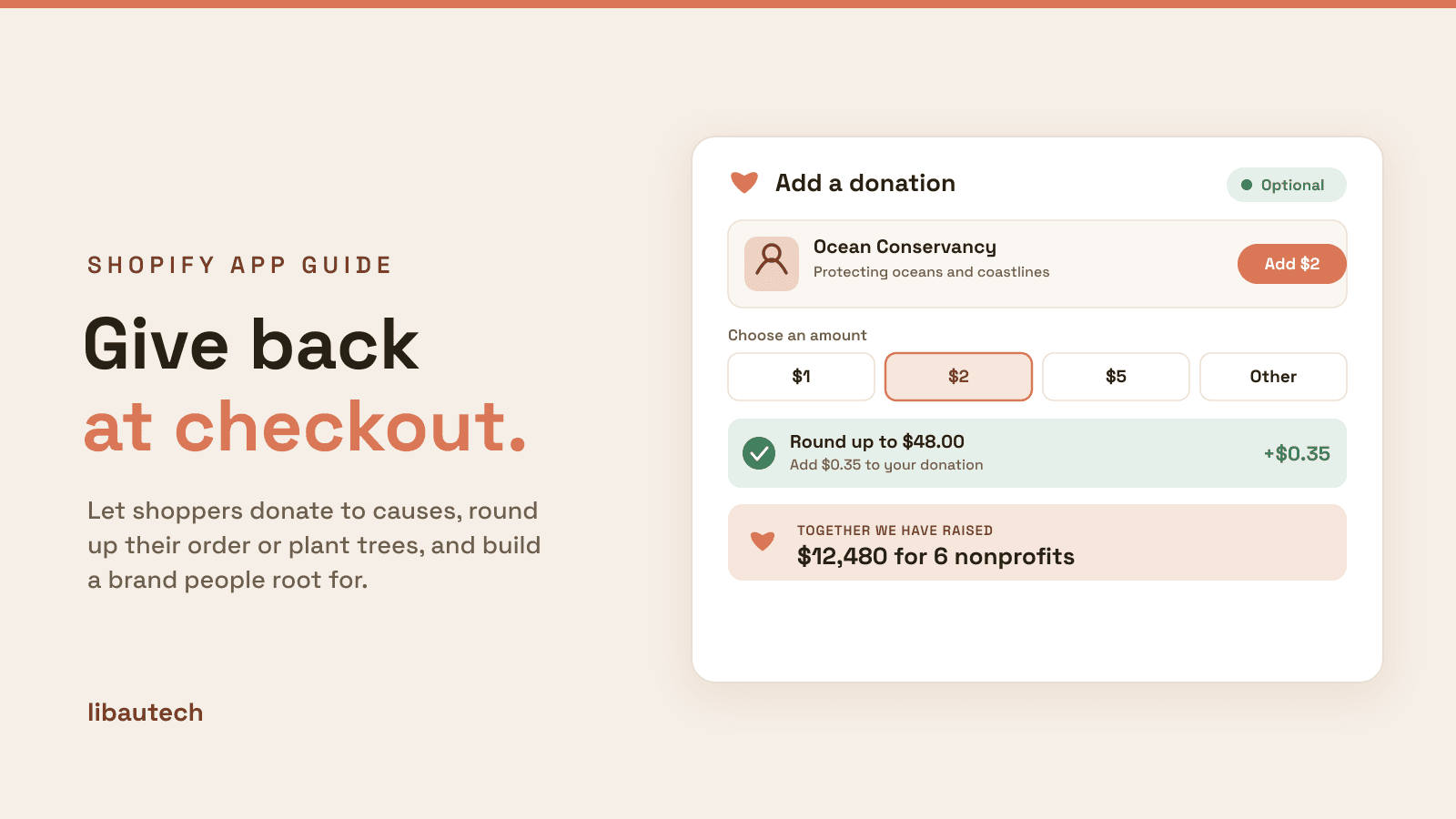
The first job is charity donation widgets — the original category. A widget on the cart page, checkout page, or as a standalone donation page lets customers add a donation amount (preset tiers like $1/$5/$10 or custom amount) to their order. The donation is processed through your store's payment flow and disbursed to the chosen charity. The model works for stores aligned with specific causes (a pet supply store partnering with animal rescue organizations) and for brands wanting to offer customers a frictionless way to contribute. The downside: any pre-checkout widget creates a small but measurable friction layer in the checkout flow, which can offset gains from increased customer engagement.
The second job is cause-marketing donation incentives — the model Givz pioneered for Shopify. Instead of asking customers to add donations during checkout (which interferes with conversion), incentives are configured as post-checkout offers: "Spend $80, and 5% of your purchase goes to charity" or "Buy any pink product and 20% goes to breast cancer research." The customer makes the purchase normally, then receives a post-purchase confirmation email letting them direct the donation to a specific charity from a curated list. The conversion-rate optimization implications are significant: donation incentives lift conversion (the customer feels they are getting something extra) and AOV (threshold-tied incentives nudge shoppers past higher price tiers) without using margin-eroding discount codes that train customers to wait for sales.
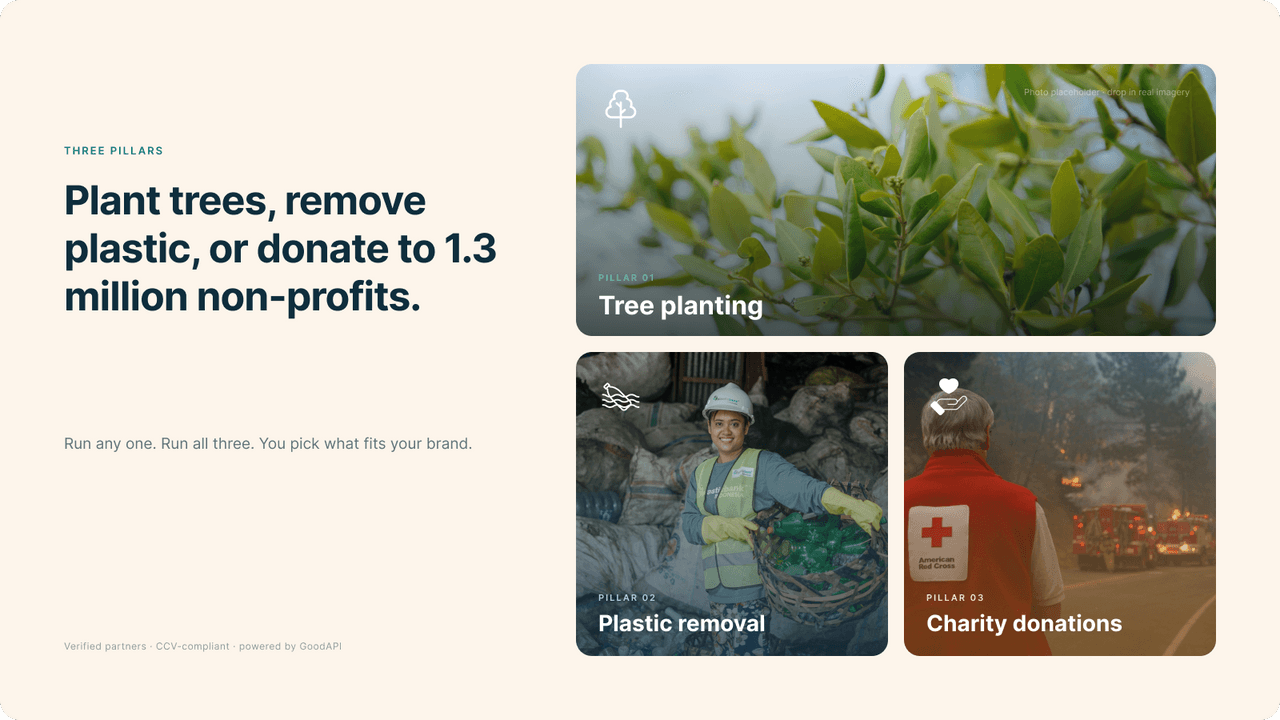
The third job is sustainability-driven impact apps — Greenspark, GoodAPI, and similar tools that automate environmental contributions per sale rather than charitable cash donations. Plant a tree per order. Rescue 1 kg of ocean-bound plastic per subscriber. Offset carbon emissions on a percentage basis. The model fits brands whose customer base values environmental sustainability over discretionary charitable causes (outdoor brands, organic skincare, sustainable apparel). The customer-facing element — branded impact dashboards, certificates, project updates — turns a passive purchase into a brand-storytelling moment, which lifts repeat purchase rates and customer lifetime value.
This post ranks 7 apps across all three jobs with verified May 2026 ratings and pricing.
Donation apps stack with broader brand-storytelling tools. See our guides on best Shopify social proof apps for review and trust-badge mechanics that pair with cause-marketing messaging, and best Shopify popup apps for the on-site campaign layer that announces donation initiatives at the right moments.
| App | Rating | Free Plan | Paid From | Job | Best For |
|---|---|---|---|---|---|
| Givz Donation-Driven Marketing | ⭐ 5.0 (100+) | Yes | $45/mo | Cause-marketing incentives | Replacing discounts with donation incentives, post-checkout |
| ShoppingGives | ⭐ 4.8 (300+) | Yes | $49/mo | Charity widget + impact tracking | Brands donating a percentage of sales to chosen charities |
| Easy Donation | ⭐ 4.9 (200+) | Yes | $9.99/mo | Charity donation widget | General-purpose charity widget, multilingual stores |
| Greenspark | ⭐ 4.9 (200+) | Yes | $39/mo | Sustainability impact | Climate-conscious brands, tree planting + plastic + carbon |
| GoodAPI Plant Trees Clean Seas | ⭐ 4.9 (300+) | Yes | $19/mo | Sustainability impact | Tree planting and plastic rescue, lower price point |
| Virtue Impact | ⭐ 4.9 (40+) | Yes | $29/mo | Charity widget + cause campaigns | Multi-campaign cause marketing with analytics |
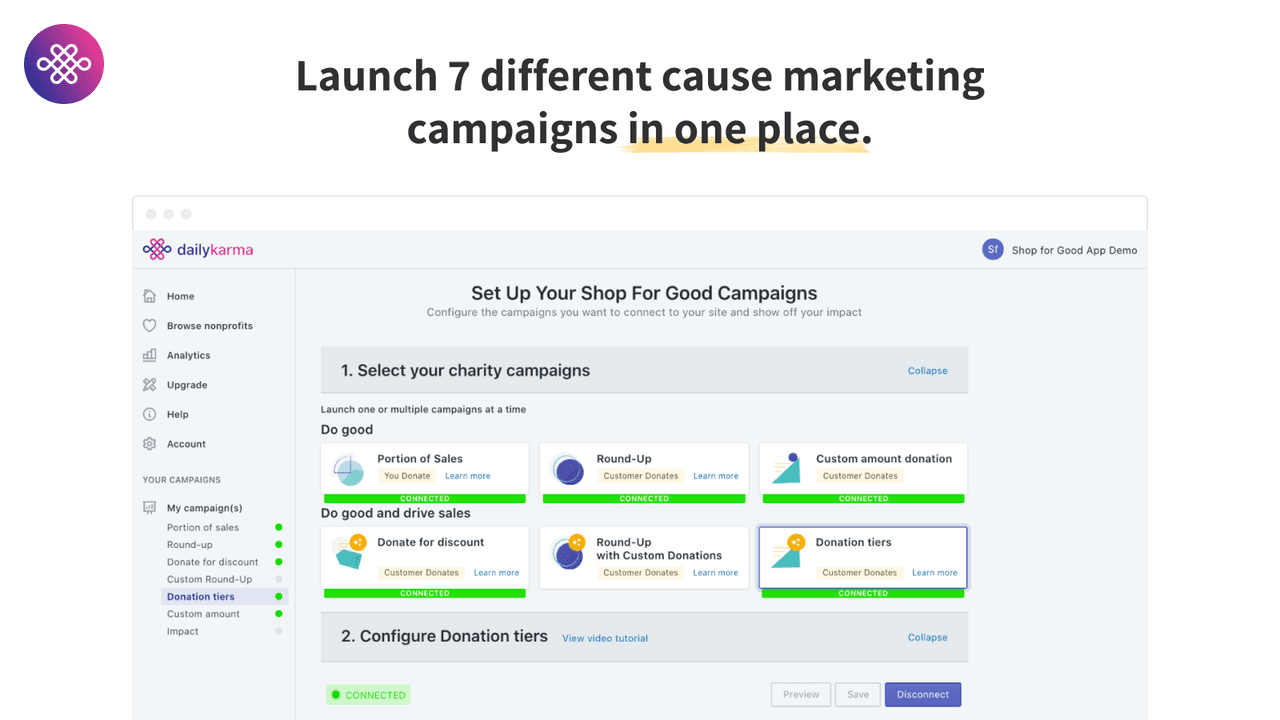
| Shop for Good by DailyKarma | ⭐ 4.9 (90+) | Yes | $25/mo | Charity widget + round-up | Round-up donations and donate-for-discount campaigns |
Best for: Shopify stores that want to replace discount codes with donation incentives — driving conversion and AOV lift without margin-eroding promotions, using post-checkout donation flows that don't disrupt the checkout funnel.
Givz holds 5.0 stars across 100+ reviews and pioneered the post-checkout cause-marketing model on Shopify. The strategic positioning: traditional discount codes train customers to wait for sales, erode margin, and create a perpetual race-to-the-bottom dynamic. Donation incentives offer something different — a meaningful reason to buy now ("$10 of your purchase goes to a charity you pick") that lifts conversion and AOV without compressing margin in the same way percentage discounts do. The customer feels good about the purchase. The brand maintains margin. The charity receives funds. Three-way win.
The mechanic is post-checkout, which is the strategically important detail. Customers complete checkout normally — no donation widget interrupts the funnel, no charity selection forces a decision before purchase, no incremental load impacts page speed. After purchase, qualifying customers receive a confirmation email letting them direct the pre-funded donation to a charity from your curated list (or from Givz's 1000+ vetted charity network). Disbursement happens monthly through PayPal Giving Fund. This model means existing checkout conversion rate optimizations remain intact.
Specific incentive structures: "Give back on all orders" (5-10% of every sale to charity, optimizing for conversion); "Spend threshold incentives" ("Spend $80, get 5% to charity" — optimizing for AOV by nudging shoppers past higher price tiers); "Specific product incentives" ("All pink products get 20% to charity" — moving slow inventory or signaling cause alignment on hero products); and "Coupon code combo" ("Use code XYZ: 10% off + 10% to charity" — A/B testing the donation-vs-discount value proposition for your audience).
Where it falls short: $45/mo entry price is higher than basic charity widgets, justified by the sophistication of post-checkout flow and revenue lift mechanics. Setup requires more thought than a plug-and-play widget — merchants need to design incentive logic that matches their brand and audience. The post-checkout model means customers do not see the donation incentive during checkout itself, which removes the in-cart psychological boost that some customers respond to (the tradeoff for not disrupting conversion). PayPal Giving Fund disbursement adds a small lag between donation funding and actual charity receipt.
Pricing: Free plan available. Paid plans from $45/mo scaling with donation volume and feature tier.
Best for: Shopify Plus and mid-market brands that want to commit a percentage of every sale to chosen charities, with comprehensive impact tracking, donor analytics, and tax-receipt automation built in.
ShoppingGives holds 4.8 stars across 300+ reviews and positions as the enterprise-tier charity widget for brands serious about cause marketing as a strategic pillar. The mechanic: merchants select charities (or causes) and configure donation rules — a percentage of every sale, a fixed amount per order, threshold-based donations, or customer-directed amounts — and ShoppingGives handles the full back-end including charity verification, tax-receipt generation for the brand, donor analytics, and compliance reporting.
Core features: 1.5M+ vetted nonprofit network covering global and US-specific causes; configurable donation rules per product, collection, or storewide; impact tracking dashboards ("$X total donated, Y trees planted equivalent, Z meals provided") that double as customer-facing brand storytelling; round-up donations at checkout (customer can round up their order total to support the cause); donate-for-discount campaigns; tax-deductible receipts automatically issued to the brand; and integration with Shopify Plus checkout customizations.
Where it falls short: $49/mo entry tier with usage fees on top — total monthly cost can reach $100-300/mo for high-volume stores, which makes the math tighter than simpler alternatives. Built more for brands committing serious dollar amounts to causes than for stores running occasional cause-marketing campaigns. Setup time is meaningful — proper charity selection, rule configuration, and customer-facing storytelling take a marketing team several hours to launch well.
Pricing: Free plan available. Paid plans from $49/mo plus usage fees.
Best for: General-purpose stores that want a simple, multilingual charity donation widget at checkout without committing to enterprise-tier cause-marketing infrastructure.
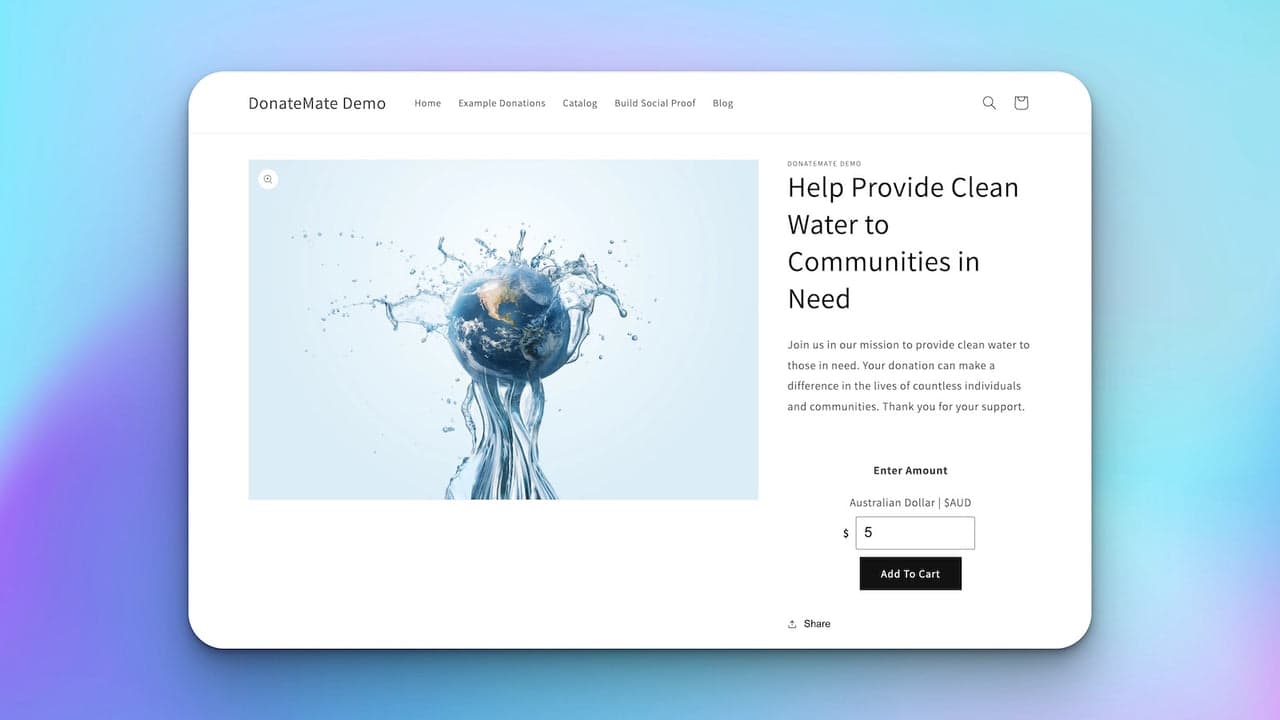
Easy Donation holds 4.9 stars across 200+ reviews and positions as the most accessible charity widget on the Shopify App Store. The mechanic is straightforward: a customizable donation widget appears on cart pages, checkout pages, or as a dedicated donation page, letting customers add a preset amount ($1/$5/$10/$25) or custom amount to their order. The donation is processed through your store's standard checkout and disbursed to the configured charity.
Core features: single and multiple donation widgets configurable by store tier; standalone donation pages for NGOs, religious organizations, and non-profits running their own Shopify-powered fundraising; multilingual support (10+ languages) for international stores; multi-currency for cross-border merchants; customizable donation receipts and admin contribution reports; no geographic restrictions on charities (works with NGOs and charities globally); and clean integration with major Shopify themes without custom theme code.
Where it falls short: lacks the analytics depth of ShoppingGives or the post-checkout conversion-optimization model of Givz. The simpler widget model means it does not actively lift AOV the way threshold-based donation incentives do — donations are pure additions, not strategic conversion levers. Reporting is basic compared to enterprise alternatives. Best for stores treating donations as a values-driven feature rather than a measured cause-marketing campaign with revenue KPIs.
Pricing: Free plan available. Paid plans from $9.99/mo with feature tiering by widget count and store size.
Best for: Climate-conscious brands wanting to automate environmental impact (tree planting, ocean plastic rescue, carbon offsetting) per order with customer-facing impact dashboards and certificate-driven brand storytelling.
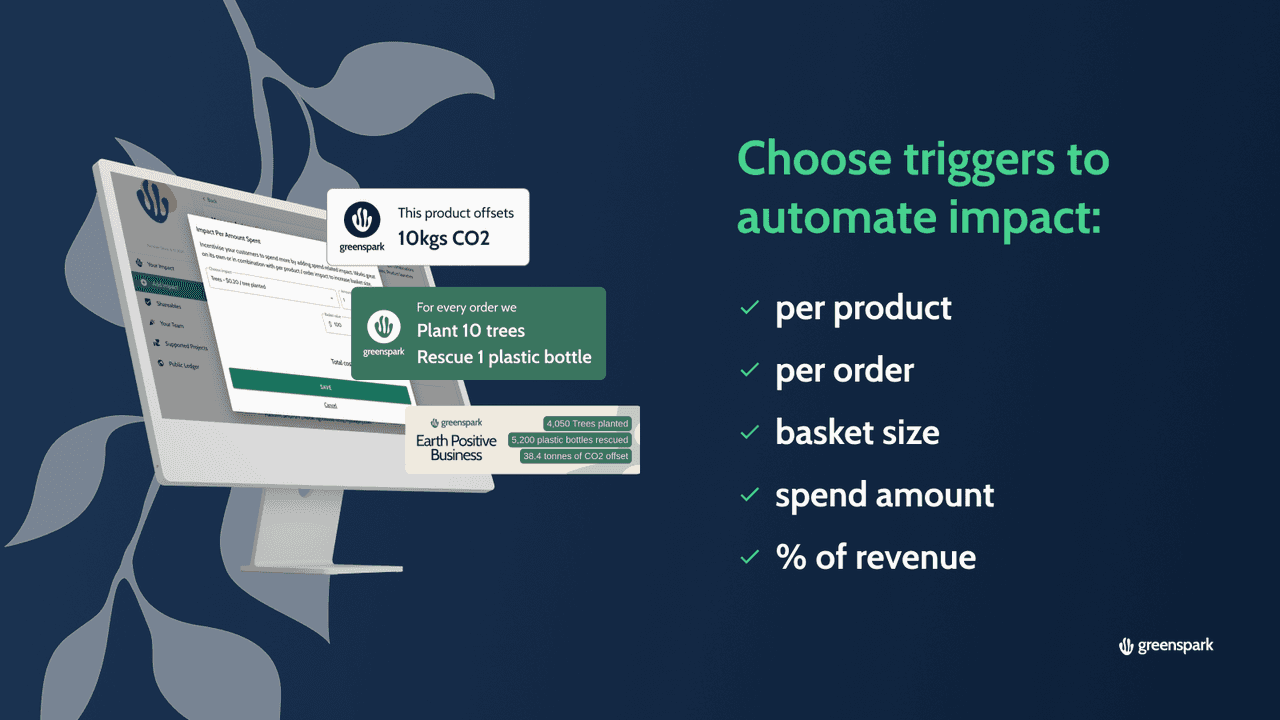
Greenspark holds 4.9 stars across 200+ reviews and is the leading sustainability impact app on the Shopify App Store. The strategic positioning: brands whose customers care about environmental impact (outdoor brands, organic skincare, sustainable apparel, eco-conscious goods) need a way to operationalize that values alignment beyond marketing claims. Greenspark provides the back-end infrastructure to automate per-order environmental contributions and the customer-facing storytelling layer to surface impact in the customer journey.
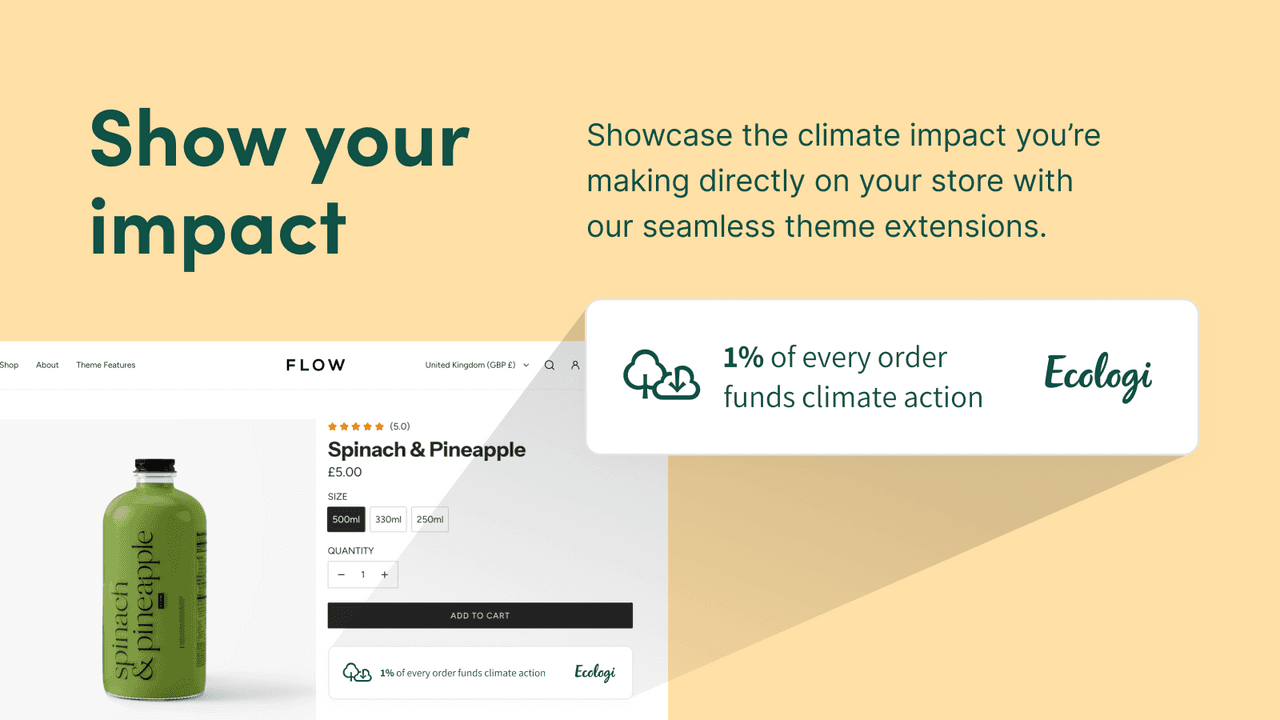
Core features: connection to verified climate and social projects worldwide (tree planting partners across multiple regions, ocean plastic rescue programs, gold-standard carbon offset projects); customizable impact attachments (per product, per order, per dollar spent); customer-facing impact dashboards showing cumulative contributions; tailored impact certificates emailed to customers post-purchase ("Your order planted 3 trees in Madagascar"); sustainability badges that display on product pages and at checkout for at-purchase brand storytelling; project updates that keep customers engaged with the impact over time; and integration with hundreds of complementary apps for full ecommerce stack alignment.
The economic case: Greenspark merchants typically see a measurable lift in conversion (customers buying because of cause alignment) and repeat purchase rates (the impact-storytelling layer creates a memorable post-purchase experience that increases customer lifetime value). For brands where sustainability is a core brand promise rather than a peripheral nice-to-have, the ROI is meaningfully better than traditional discount-driven marketing.
Where it falls short: $39/mo entry price is the higher end for sustainability apps. The customer-facing storytelling depth requires brand investment in messaging — merchants who install Greenspark and don't actively surface the impact in their marketing miss most of the value. Sustainability messaging fatigue is a real risk for over-saturated categories where every brand claims environmental commitments — Greenspark works best for brands with credible foundational sustainability practices, not as cover for greenwashing.
Pricing: Free plan available. Paid plans from $39/mo scaling with impact volume.
Best for: Stores wanting tree planting and ocean plastic rescue automation at a lower price point than Greenspark — including premium content libraries for marketing the sustainability story across product, cart, checkout, and order pages.
GoodAPI (formerly Sprout) holds 4.9 stars across 300+ reviews and offers a focused subset of Greenspark's capabilities at a meaningfully lower price point. The mechanic: automate tree planting, ocean plastic rescue, or both per sale, per Shopify Flow trigger, or per customer action. The customer-facing layer includes sustainability badges that display across the customer journey (home page, product detail pages, cart, checkout, post-purchase order pages) and a premium content library of professionally-shot photos and videos to populate marketing assets.
Core features: automated tree planting and plastic removal triggered by Shopify Flow events; multi-currency and multi-language support for international stores; sustainability badges with no-code installation across all customer-facing surfaces; premium photo and video content library to populate marketing materials with authentic project imagery; project verification through established environmental nonprofits; and integration with Shopify checkout for at-purchase impact display.
Where it falls short: more focused than Greenspark — primarily covers tree planting and plastic rescue rather than the full carbon offsetting plus social project breadth. Reporting and analytics are simpler. Customer-facing impact dashboards are less interactive than Greenspark's. For stores wanting the full sustainability platform, Greenspark is the deeper option; for stores wanting specifically tree planting plus plastic rescue at lower cost, GoodAPI is the cleaner pick.
Pricing: Free plan available. Paid plans from $19/mo scaling with impact volume.
Best for: Brands wanting to run multi-campaign cause-marketing initiatives with detailed analytics — testing different causes, donation structures, and customer segments rather than committing to one charity partnership.
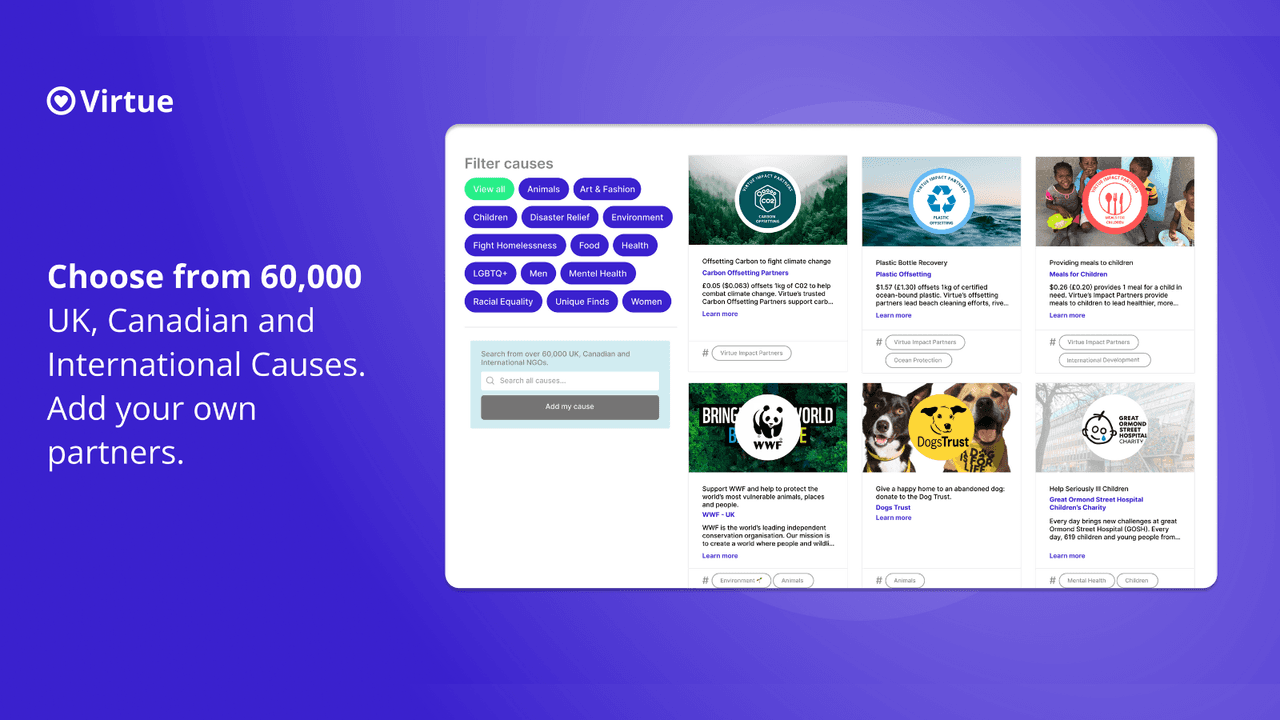
Virtue Impact holds 4.9 stars across 40+ reviews and positions as the cause-marketing campaign-management tool for brands that treat donations as a strategic marketing channel rather than a values-statement feature. The differentiator: rather than being a single widget, Virtue lets brands run multiple simultaneous cause-marketing campaigns (different causes for different product lines, time-limited cause campaigns for awareness months, A/B tests on donation structures) with analytics that surface which campaigns drive conversion, AOV, and customer LTV best.
Core features: multi-campaign management for running concurrent cause initiatives; advanced analytics on campaign-level conversion, AOV, and customer engagement; pre-launch and on-going technical support from the Virtue team; cause partnership facilitation (Virtue can help merchants find appropriate cause partners); customizable widget designs across cart, product, and checkout; and reporting dashboards for measuring social impact alongside revenue impact.
Where it falls short: smaller review base (40+) than alternatives means less long-term stability data; pricing details require contacting the team for some campaigns; campaign-management focus means it is overkill for stores running a single ongoing donation initiative — those stores get better fit from simpler tools.
Pricing: Free plan available. Paid plans from $29/mo scaling with campaign count and feature tier.
Best for: Stores wanting round-up-at-checkout donations and donate-for-discount campaigns from one tool, with easy-to-launch widgets for quick cause-marketing tests.
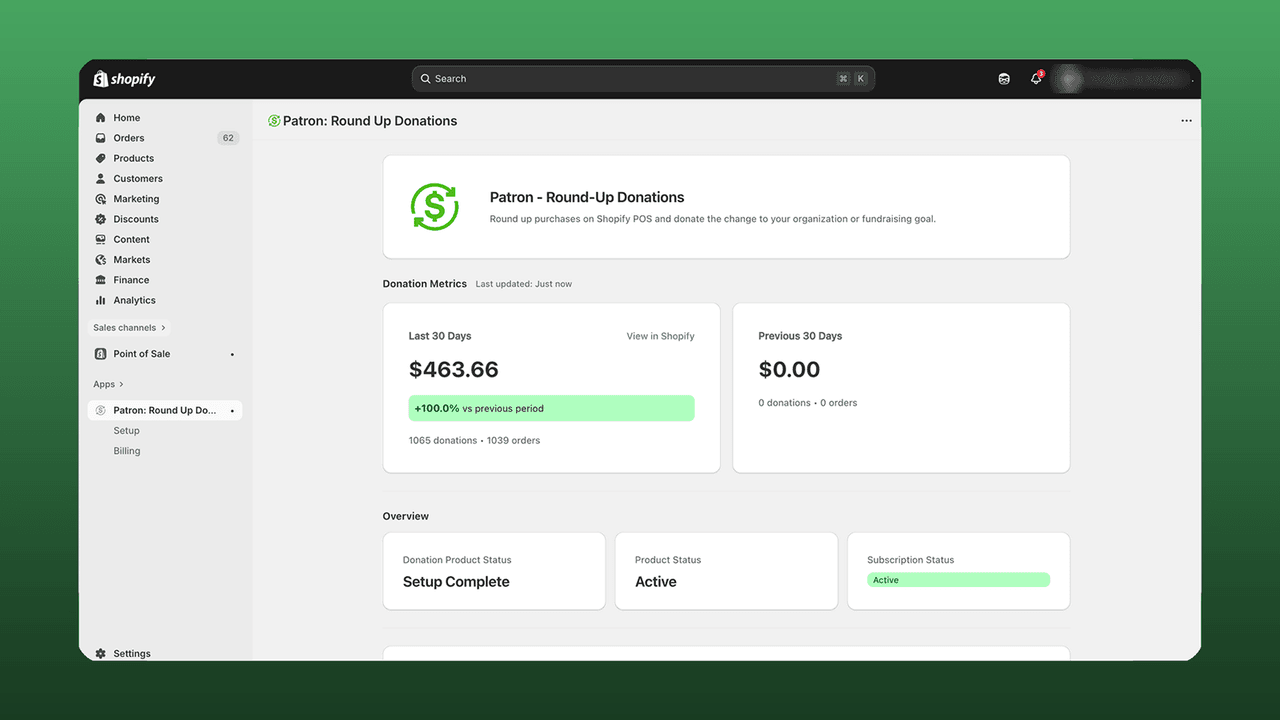
Shop for Good by DailyKarma holds 4.9 stars across 90+ reviews and positions in the middle of the donation app spectrum — more sophisticated than basic charity widgets, less complex than Givz or ShoppingGives. The two specific mechanics that DailyKarma does well: round-up donations (customer rounds up order total to nearest dollar with the difference going to charity, a low-friction donation pattern that drives high participation rates) and donate-for-discount campaigns ("Donate $5 to charity X, get 10% off your next order" — combining donation and customer retention in one mechanic).
Core features: round-up donation widgets with customizable charity selection; donate-for-discount campaigns; cause campaign management with curated charity partners; customizable widget appearance to match brand styling; donor and contribution analytics; and easy-launch templates for stores running their first cause campaigns.
Where it falls short: less depth than ShoppingGives on enterprise-tier charity infrastructure; less conversion-optimization logic than Givz on post-checkout incentives; smaller charity partner network than ShoppingGives. The middle-ground positioning means it works best as a starter cause-marketing tool rather than as the mature platform brands graduate to.
Pricing: Free plan available. Paid plans from $25/mo scaling with feature tier.
For Shopify stores wanting to replace discount codes with donation incentives without disrupting checkout: Givz Donation-Driven Marketing. 5.0/100+, free plan, $45/mo entry, post-checkout incentive model lifts conversion and AOV without margin erosion.
For brands committing a percentage of every sale to chosen charities with full enterprise infrastructure: ShoppingGives. 4.8/300+, free plan, $49/mo entry plus usage fees, 1.5M+ vetted charity network and tax-receipt automation.
For general-purpose multilingual stores wanting a simple at-checkout charity widget: Easy Donation. 4.9/200+, free plan, $9.99/mo entry, multi-currency, no charity geographic restrictions.
For climate-conscious brands automating environmental impact (trees, plastic, carbon) with customer-facing storytelling: Greenspark. 4.9/200+, free plan, $39/mo entry, deepest sustainability platform with verified projects and impact dashboards.
For stores wanting tree planting and plastic rescue at lower cost than Greenspark: GoodAPI Plant Trees Clean Seas. 4.9/300+, free plan, $19/mo entry, includes premium content library for sustainability marketing.
For brands running multi-campaign cause-marketing with detailed analytics: Virtue Impact. 4.9/40+, free plan, $29/mo entry, campaign-management focus.
For stores wanting round-up donations and donate-for-discount mechanics in one tool: Shop for Good by DailyKarma. 4.9/90+, free plan, $25/mo entry, easy-launch starter platform.
For most Shopify stores doing $50K-500K/month wanting to add donation mechanics, the honest recommendation depends on strategic goal. Brands using donations as a conversion-optimization lever (replacing discounts) install Givz. Brands committing serious dollar amounts to specific charities install ShoppingGives. Brands building sustainability into their core identity install Greenspark or GoodAPI. Stores wanting a simple values-driven feature install Easy Donation. Pick based on the strategic frame, not on star ratings — every app on this list has high ratings, but they solve different problems.
This ranking is based on four criteria applied to every Shopify donation app tested in 2026. First, Shopify App Store rating and verified review volume as of May 4, 2026 — the signal of long-term merchant satisfaction at scale. Second, which of the three donation jobs each app solves best (cause-marketing incentives, charity widgets, or sustainability impact) rather than a generic feature checklist — these are functionally different categories that should not be compared on the same axis. Third, conversion and AOV impact for stores running active cause-marketing campaigns — apps that demonstrably lift commerce metrics rank higher than apps that purely add a feature without measurable revenue impact. Fourth, pricing structure and total cost at realistic merchant volumes — flat-fee pricing scales differently than per-transaction or usage-based pricing, and the math diverges meaningfully for high-volume stores.
Every pricing figure in this post was verified directly from the live Shopify App Store listing on May 4, 2026. App pricing structures change as the cause-marketing category matures — always confirm current pricing on the official listing before installing. Ratings and review counts reflect the Shopify App Store at the time of our last update.
Depends on the goal. Givz (5.0/100+, $45/mo) leads cause-marketing incentives that replace discounts. ShoppingGives (4.8/300+, $49/mo) leads enterprise-tier charity widgets with impact tracking. Easy Donation (4.9/200+, $9.99/mo) leads simple at-checkout charity widgets. Greenspark (4.9/200+, $39/mo) leads sustainability impact apps. Each solves a different sub-job within the donation category.
Cause-marketing donation incentives (Givz model) measurably lift conversion 3-8% and AOV 5-15% on properly-configured campaigns. The mechanic works because customers feel they are getting something extra without the brand discounting margin. Plain charity donation widgets (Easy Donation, ShoppingGives) typically have neutral-to-slightly-positive conversion impact — they signal brand values without actively driving commerce metrics. Sustainability impact apps (Greenspark, GoodAPI) lift conversion in customer segments that strongly value environmental commitments, with bigger lift in repeat purchase rates than first-time conversion.
Charity donation widgets let customers add a donation amount during checkout, with the donation processed alongside the order. Cause marketing structures donations as brand commitments tied to purchase behavior — "5% of every sale goes to charity" or "Spend $80 and we donate $10 to your chosen cause." The charity widget model is customer-driven (the customer chooses to donate). The cause marketing model is brand-driven (the brand commits to donate based on the customer's purchase). Cause marketing is the conversion-optimization model; charity widgets are the values-expression model.
At-checkout charity widgets (Easy Donation, ShoppingGives) add a small but measurable friction layer to checkout — typically less than 1% conversion impact when implemented well, larger if widgets are aggressive or poorly placed. Post-checkout cause-marketing apps (Givz) avoid this friction entirely because the donation happens after the order is complete. Sustainability apps (Greenspark, GoodAPI) typically place messaging on product pages and cart rather than directly in the checkout flow, with minimal conversion impact. The single biggest factor is widget placement and design rather than the app itself.
Round-up donation lets customers round their order total up to the nearest dollar (e.g., $47.32 becomes $48.00) with the difference donated to charity. Participation rates are high (often 30-50% of customers opt in) because the friction is low — customers are giving up cents, not dollars, and the psychological commitment matches the small amount. Aggregated across order volume, round-up donations can generate meaningful charity contributions ($500-2,000/month for stores doing 1,000+ orders/month). Shop for Good by DailyKarma and ShoppingGives both support round-up mechanics.
Established sustainability apps (Greenspark, GoodAPI) partner with verified environmental nonprofits and Gold Standard carbon offset projects. The contribution per order is typically a small dollar amount that funds a specific verified action — planting one tree at a partner nursery, removing 1 kg of ocean-bound plastic through a partner program, offsetting carbon at a verified project. Customers can verify the impact through certificates and project updates the apps generate. The risk of greenwashing is real for brands that install these apps as cover for unsustainable underlying practices — the apps themselves are legitimate, but their value depends on the brand having credible foundational sustainability commitments.
Stores running simple charity widgets: $10-30/month subscription plus actual donation dollars. Stores running cause-marketing incentives: $45-100/month subscription plus 3-10% of orders going to charity (which is replacing discount budget rather than adding cost). Stores running sustainability impact apps: $20-50/month subscription plus per-order impact funding (typically $0.10-0.50 per order for tree planting, $0.20-1.00 per order for carbon offsetting). Total cost depends heavily on order volume and contribution rate — model this against expected order volume before committing.
Modern donation apps with Built for Shopify badges (or equivalent quality standards) load asynchronously with no impact on Core Web Vitals or Lighthouse scores. Older apps with heavy widget injection on cart and checkout pages can slow page load measurably — test PageSpeed Insights before and after installing any donation app. Post-checkout apps like Givz have zero storefront performance impact because the donation flow happens after checkout completes.
Technically yes, but practically no. Running multiple donation apps creates competing widgets and confusing customer experience. Pick one based on your strategic goal (cause-marketing, charity widget, or sustainability impact) and run it well rather than stacking three apps that each handle a fraction of the donation job.
We update these lists as new tools launch and existing ones improve. If you are a developer building a Shopify donation app and want your app considered for inclusion, submit it here — tell us what your app does, who it is for, and include a link to your Shopify App Store listing. We review every submission.