


Let me guess what your product page looks like right now.
Hero image. Price. Add-to-cart button. A short description. Then, somewhere down at the bottom, 247 five-star written reviews that all say some version of "love it, fast shipping, would buy again."
And your conversion rate has been flat for eight months.
The problem isn't your product. The problem isn't even your reviews. The problem is that you're using a 2015 playbook to convert 2026 shoppers.
Today's buyers don't read written reviews to decide. They watch. They need to see the product on a real person, in a real setting, with a real voice telling them whether it actually works. And they need that proof at the exact moment their thumb is hovering over the buy button, not buried three screens down after the ingredients list.

The brands crushing it right now figured this out. They built their product pages around two distinct layers:
Layer 1: UGC and video proof right next to the cart button, to convert.
Layer 2: Long-form written reviews lower on the page, to rank.
Different jobs. Different zones. Same page.
Let me show you exactly how the best beauty brands on the internet are doing it.
First, let's be honest about what's actually happening.
Written reviews used to be gold. In 2014, a product with 100 plus five-star reviews was legitimate social proof. In 2026, it's wallpaper.
Here's why:
Shoppers assume text can be faked. And they're not wrong. Fake review farms are a multi-million dollar industry. Amazon quietly removes millions of suspect reviews every quarter. Every shopper under 30 already knows this. They default to skepticism.
Written reviews all sound the same. Scroll any product page. "Love it." "Great quality." "Arrived fast." "Would recommend." These sentences tell buyers nothing they can use to make a decision. They're noise, not signal.
Text makes shoppers imagine. And imagination is the enemy of conversion. Every time a buyer has to picture "how does this actually look on me?" or "how big is this really?", you're giving them an exit ramp from the purchase decision.
This is not a prediction. This is already happening on every product page you visit.
A 15-second phone clip of a real customer using your product does three things a written review will never do:

It kills the imagination gap. The shopper sees the actual color under normal lighting. Actual texture. Actual size. Actual application. Nothing left to wonder about. Nothing left to Google.
It passes the authenticity test instantly. A messy bedroom background. A slightly off-center face. A normal voice that isn't media-trained. These are the unfakeable signals that scream "this is real." Your brain processes this as evidence in under three seconds.
It keeps people on the page. Video holds attention. Attention correlates with conversion. Every session recording tool in existence will show you this if you look at your own data.
And here's the part most stores miss: the type of video matters more than whether you have video at all.
A polished, studio-lit, 4K brand video reads as an ad. Shoppers have been trained since birth to tune ads out.
A wobbly phone clip of someone smearing your lip balm on while sitting on their couch? That reads as truth.
One of these converts. The other one doesn't. It's not close.
Now let's look at the actual product pages from five of the biggest beauty brands on the internet. Each one follows the same two-layer structure, and the specifics are worth copying.
Scroll to the top of the Benetint product page and look at what sits directly beside the Add to Bag button.
Three short customer quotes:
"It stains my lips so well with no transfer" - Bella
"Creates the most natural red, flushed cheeks" - Missy
"I LOVE the natural/no makeup look so this is a daily wear for me" - Kari
These aren't generic testimonials. They're real customer voices placed at the exact moment the shopper is deciding to buy. And right next to them? A bold proof point: "Benetint is sold every 11 seconds."
That's the conversion layer.
Scroll further down and you hit a totally different kind of content: deep FAQ, full ingredient list, ratings, structured written reviews. That's the SEO and objection-handling layer.

Benefit nailed the split. Customer voice at the cart. Everything else below.
Summer Fridays does something smart with their Lip Butter Balm product page. They weave UGC straight into the product image gallery.
Instead of just clean packshots, you scroll through close-up lip shots on real people, texture goops, application angles, and product-in-hand lifestyle images. The gallery itself becomes UGC proof. By the time a shopper finishes swiping, they've already seen the product on four different people.

Right below the cart button, they stack:
Then, and only then, do the written reviews appear, all the way at the bottom of the page after ingredients, FAQ, and related products.
That's two-layer discipline.
Hailey Bieber's Rhode built an entire brand around this layout philosophy.
Go to the Peptide Lip Treatment page and notice what's happening near the Add to Bag button. A silent-autoplay video. Close-up texture. Real application. Zero written review block in sight.
The aesthetic is so clean it almost feels like you're on an Instagram post, not a product page. That's intentional. Rhode knows their target shopper lives on social media and expects product pages to feel like the content they consume there.
The SEO layer, written reviews, ingredient breakdowns, detailed product info, is there, but you have to actively scroll to find it. The buy decision is engineered to happen in the top third of the page, supported entirely by video proof.
Walk into any Milk Makeup product page and you'll see a brand that was literally built for this era.

Their product imagery is UGC-style even when it isn't UGC, off-center, grainy, lived-in. When you scroll to the social proof section above the fold, you find shoppable videos from real users, star ratings pulled tight next to the product name, and short, punchy customer quotes, not 4-paragraph write-ups.
The full written review section? Bottom of the page, optimized for Google. And it does its job. Milk ranks for thousands of long-tail beauty product queries because their review database is deep and crawlable.
The pattern is everywhere once you start looking.
Kylie Cosmetics takes the UGC-at-cart approach to its logical extreme.
On their product pages, the top third of the page is dominated by video and lifestyle imagery. Kylie herself applying the product. Close-up texture shots. Real faces wearing the shade. The buy button is surrounded by this visual evidence on every side, which is exactly how their shoppers decide.
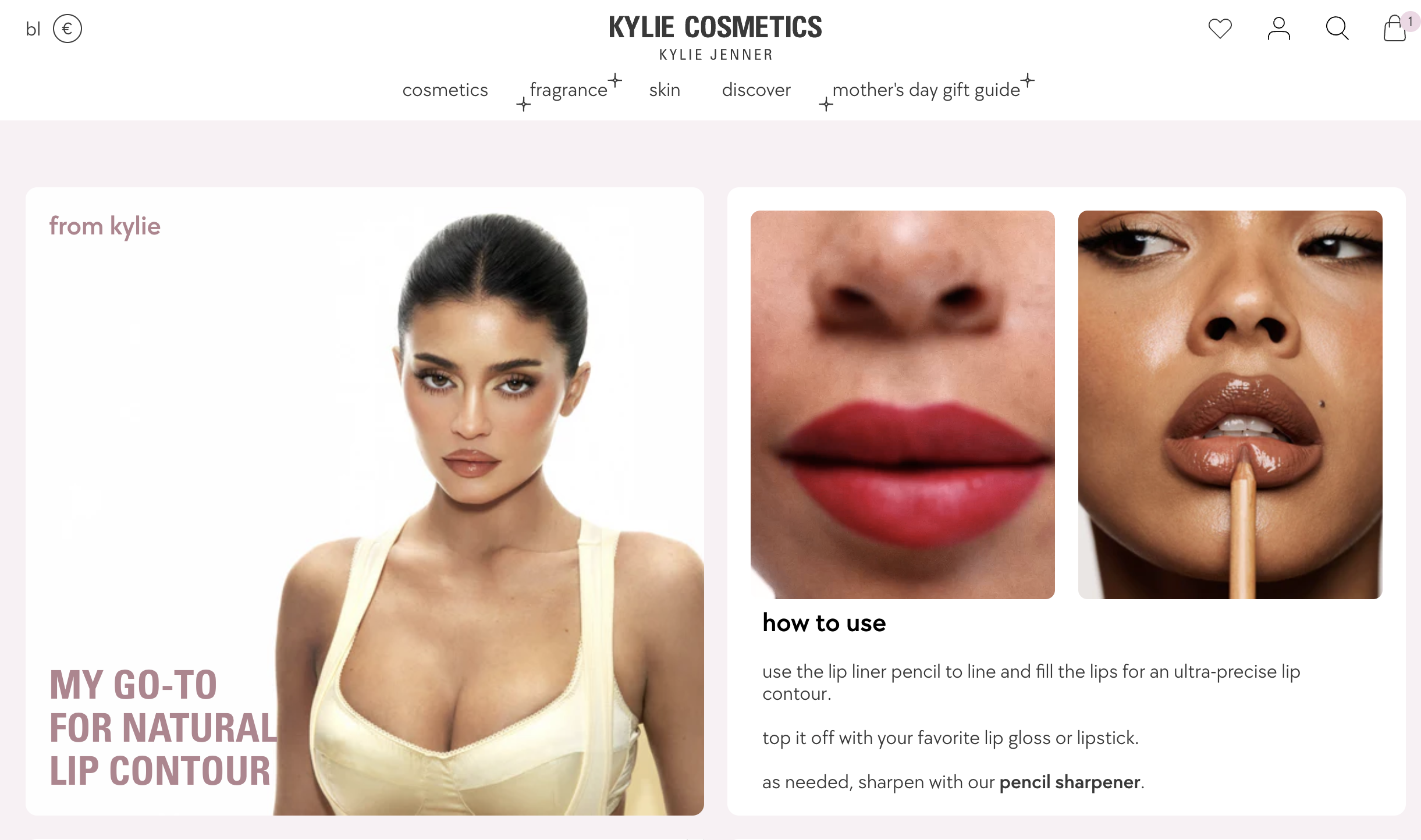
And because Kylie Cosmetics has one of the most photographed customer bases on the internet, their gallery is essentially a never-ending supply of high-quality UGC.
Written reviews exist. They live at the bottom of the page. They handle SEO. They answer objections. They do not fight for cart-button real estate.
Here's what nobody tells you clearly: UGC video and written reviews are not competing. They are doing two completely different jobs.
UGC video's job is to convert. It lives next to the cart button because that's where the buying decision happens. The shopper's hand is already halfway to the checkout. They need one more visual nudge, a real person, real use, real result, to close the loop. Video is the only format that can deliver that nudge in under 20 seconds.
Written reviews' job is to rank. They live lower on the page because that's where they pull their weight. Google indexes the text. Review schema pushes star ratings into search results. Every long-tail keyword a shopper might type, "does [product] work on oily skin?", "[product] vs [competitor]", "best shade of [product] for pale skin", has a shot of landing in your review database.
Stack them wrong and you lose on both sides. Written reviews next to the cart? They don't convert and they push video below the fold where it can't help. Video at the bottom of the page? It converts no one because no one scrolls that far.
Stack them right and they multiply each other. Video pulls shoppers through checkout. Written reviews pull new shoppers in from Google.
Stores that restructure their product pages using this two-layer playbook see consistent patterns:
Conversion rate: up 30 to 80%. The biggest jumps happen in high-consideration categories, beauty, apparel, skincare, supplements, where the imagination gap is widest and UGC closes it hardest.
Add-to-cart rate: up 40 to 60% when at least one UGC video plays above the fold before the shopper makes a decision.
Return rate: down. Shoppers who saw the product on a real person before buying are less likely to be surprised when it arrives. Fewer surprises equals fewer returns equals better unit economics.
AOV: up. Video is better at showing products in context, which opens the door to bundle and cross-sell opportunities that written reviews never unlock.
Organic traffic: up over 3 to 6 months. A deep written review block at the bottom of the page compounds into long-tail search rankings. Keep collecting. Keep publishing. Google rewards it.
Theory is great. But you need two specific tools installed on your store to put this playbook into practice. One for the cart-zone conversion layer. One for the SEO layer at the bottom.
Here's the exact stack I recommend:
For the conversion layer next to your Add to Cart button, use the Libautech UGC app. It's built specifically for this two-layer playbook, not retrofitted from a generic review app.
You can place a hero video or shoppable UGC carousel directly beside the buy button. Customers can tap the video and add the featured shade, size, or variant straight to cart without leaving the player. That's the detail that turns video from "content" into a real buy surface.
It also handles the collection side. Post-purchase flow asks buyers for a short clip, gives them a discount in return, and auto-imports the video into your product page gallery. No editing software. No creator agency. Just a repeatable pipeline of real customer footage feeding straight into your highest-traffic pages.
The app is built for speed on mobile, which matters because 70%+ of Shopify traffic is mobile and video is where most stores break their Core Web Vitals. Libautech UGC is lazy-loaded and muted by default so you don't tank your load time or spook shoppers into bouncing.
For the SEO layer at the bottom of the page, install Judge.me. It's the cleanest, fastest written review app on Shopify and the one I see on nearly every high-performing store's product page.
Why Judge.me specifically:
Install Judge.me. Place the review widget at the bottom of the product page, below ingredients, FAQ, and related products. That's it. Let it collect. Google will do the rest over 3 to 6 months.
This is where most stores still get it wrong. They pick one. Either they install a UGC app and skip written reviews, or they install Judge.me and stop there.
Both of those choices leave money on the table.
Libautech UGC at the cart gets you the conversion lift. Judge.me at the bottom gets you the long-term organic traffic lift. They stack, they don't overlap, and they take less than an hour combined to install and configure.
Here's what to do this week, in order:
1. Audit where your reviews live right now. Open your highest-traffic product page. Is the review section next to the cart button? If yes, that's a problem. If it's buried at the bottom with no video proof above, that's a bigger problem.
2. Install Judge.me and move the review widget to the bottom of the page. Below ingredients, FAQs, and related products. That's where written reviews earn their SEO keep without cluttering the buy decision.
3. Install Libautech UGC and place the video block right next to the Add to Cart button. One hero video (15 to 30 seconds) plus a carousel of 4 to 6 shorter customer clips. Silent autoplay on the hero. Tap-to-play on the rest. Never autoplay with sound, that triggers the bounce reflex on mobile.
4. Turn on shoppable videos. This is the biggest lift most stores leave on the table. A video where the shopper can tap and add the featured shade, size, or product straight to cart is a conversion machine. Don't treat video as content. Treat it as a buy surface.
5. Start collecting UGC systematically. Turn on Libautech UGC's post-purchase request flow, offer a 15% discount for a 15-second clip, and let the pipeline fill itself. Reshare Instagram tags with permission. Build a small creator program for your top 50 customers. Pick one. Start this week.
6. Re-publish and monitor. Give it 14 days. Compare conversion rate, add-to-cart rate, and time-on-page against your baseline. Most stores see measurable lifts inside two weeks, not six months.
Product pages are moving from text-first to video-first. This is already complete on TikTok Shop, Instagram Shopping, and Amazon's Rufus-era product detail pages. Shopify stores that don't catch up will keep losing conversions to platforms where the buying experience already moved on.
Written reviews are not going away. They still carry weight for SEO and for the small slice of shoppers who prefer to skim before buying. But as the primary trust layer at the buy button, written reviews are finished.
The stores winning in 2026 treat UGC video as the conversion lever at the cart, and written reviews as the SEO layer at the bottom. Libautech UGC for the first job. Judge.me for the second. Install both, configure once, and let the stack do the heavy lifting.
If your product page still has 247 written reviews stacked next to the buy button and zero customer video above the fold, you don't have a social proof problem.
You have a layout problem.
And it's one you can fix this week.
