


Every week, 84 million shopping questions are asked on ChatGPT in the US alone. Questions like "what are the best gummy vitamins for women", "best supplement for energy", "where can I buy eco-friendly yoga mats."
Customers are not just Googling anymore. They are asking AI. And AI is recommending specific stores and products in its answers.
The stores showing up in those answers are not there by accident. They are there because ChatGPT found them in sources it trusts. And the stores that are invisible have one thing in common: they have never thought about which sources ChatGPT reads when deciding who to recommend.
This guide shows you exactly how to fix that.
Most merchants assume ChatGPT works like Google. It does not.
Google ranks pages based on links, keywords, and technical signals. ChatGPT forms an understanding of the market by reading sources it trusts — Reddit threads, editorial blog posts, Facebook group discussions, YouTube videos, review sites — and then synthesizes that information into a recommendation.
When someone asks ChatGPT "best collagen supplement for runners", it does not search your product page. It looks at every source it has indexed that discusses collagen supplements for runners and recommends the brands that appear most often in trusted, relevant sources.
If your store is not mentioned in any of those sources, you do not exist to ChatGPT regardless of how good your product is.
The question is not how to optimize your Shopify store for AI. The question is which specific sources does ChatGPT trust for your product category, and how do you get mentioned in them.
Here is where most AI visibility advice fails merchants.
General advice tells you to add an llms.txt file, add schema markup, write better product descriptions. All of that matters. But it does not solve the core problem which is source citation.
ChatGPT cites sources. When it recommends a product it pulls that recommendation from somewhere. A Reddit thread from 2021. A blog post from 2023. A Facebook group answer from eight months ago. A YouTube video from last year.
These sources are not random. For any given product query, ChatGPT consistently pulls from the same small set of sources. And those sources change every few days as new content is indexed.
The merchants who win in AI search are the ones who identify these sources and get their brand mentioned in them before their competitors do.
This is what Shoptank does that no other tool does.
You enter the exact query your customer would type into ChatGPT when searching for your product. For example: "are gummy vitamins as effective as pills" or "best supplement bundle for runners" or "eco friendly yoga mat recommendation."
Shoptank runs that query through ChatGPT, Claude, Gemini and other AI models and reads the answer. It then identifies every source that influenced the recommendation. Every Reddit thread. Every blog post. Every Facebook discussion. Every YouTube video. Every editorial piece.
You see exactly which sources are deciding who gets recommended in your niche right now.
Once you have the source list the action plan is straightforward.
Free opportunities — act on these this week:
Reddit threads. If there is a four-year-old Reddit thread asking about your product category and ChatGPT is citing it, go answer that thread with your brand. A single comment in the right Reddit thread can put you in ChatGPT's answer within two days. Shoptank shows you the exact thread and the exact question.
Facebook group posts. The same logic applies. An eight-month-old Facebook group post asking about your product category is an open door. Comment with your brand, your product, your honest recommendation. ChatGPT reads public Facebook group discussions.
YouTube videos. Recording a short video answering the exact question ChatGPT uses as a query is one of the fastest ways to build citation. YouTube content gets indexed by AI models quickly and a video titled exactly the way customers ask the question becomes a citable source.
Paid opportunities — targeted and high-ROI:
Editorial blog posts. Shoptank shows you which blog posts in your niche are already being cited by ChatGPT. Some of these blogs accept paid placements, sponsored mentions, or product inclusions. Paying to get included in a blog post that ChatGPT already trusts is one of the most efficient marketing spends available because you know in advance that the source is cited.
The difference between paying for a random blog post and paying to get included in a source ChatGPT already cites is the difference between a shot in the dark and a confirmed placement.
Take the query "are gummy vitamins as effective as pills." This is a real question real customers ask ChatGPT before buying supplements. CPC in Google Ads for supplement keywords costs at least ten dollars per click.
Shoptank ran this query and returned the specific sources ChatGPT is using to answer it. Reddit threads. Specific blog posts. Editorial comparison pieces. Every single one is an opportunity to get your supplement brand mentioned.
A supplement store that comments on the relevant Reddit thread this week, answers the right Facebook group question, and requests inclusion in one cited editorial blog post has taken three actions that cost almost nothing and could put them in ChatGPT's answer for that query within days.
That same traffic would cost thousands of dollars in paid ads.
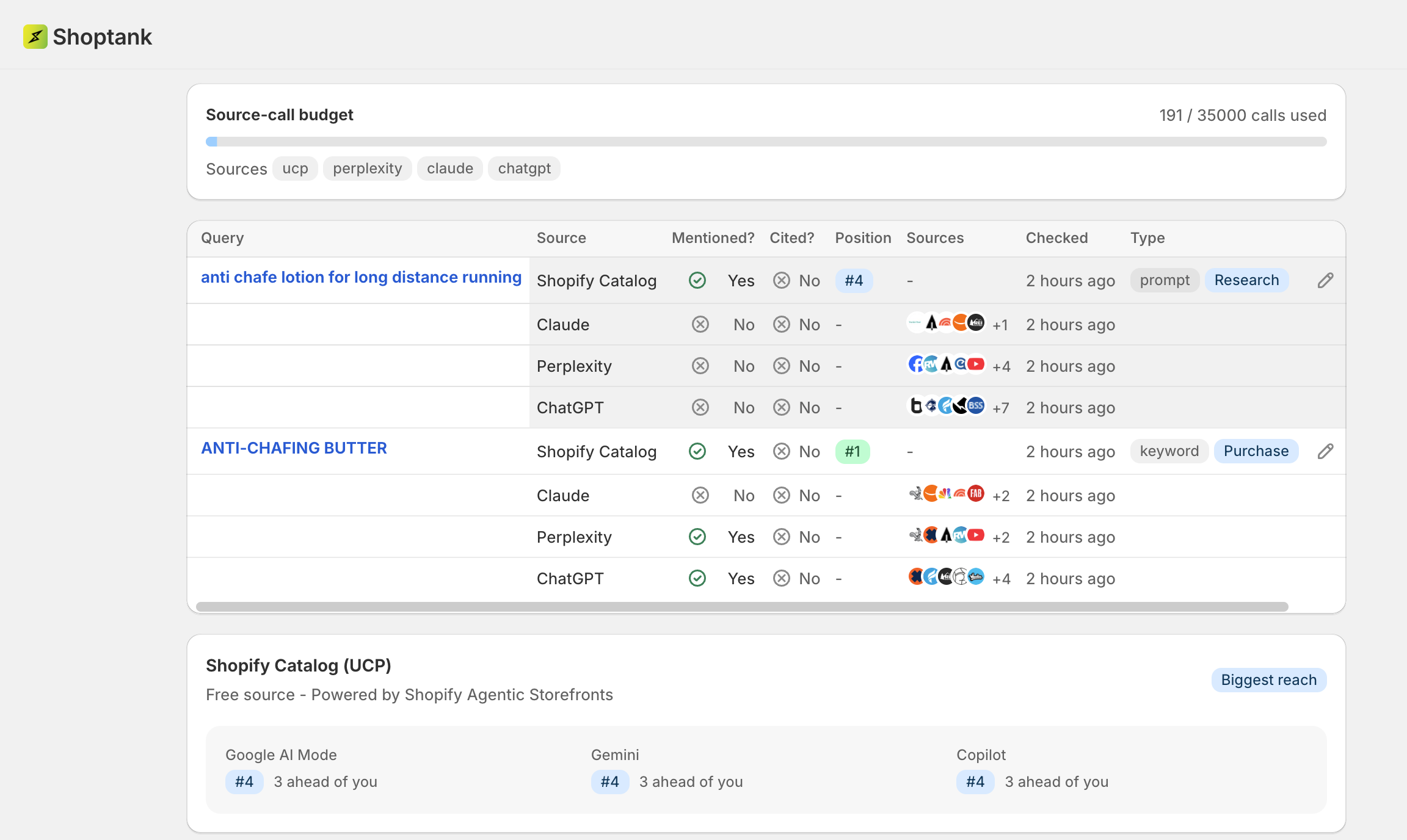
Source citations change every few days as new content is indexed. A source that is driving recommendations today may be replaced by new content next week.
Shoptank tracks your position across queries continuously. You can see when you appear, which position you rank at, whether you were cited by the Shopify catalog, whether Claude mentioned you, whether Gemini included you.
You can also track your competitors. See what sources are driving their recommendations. See their game plan. And see exactly which five sources you need to appear in to outrank them on a specific query.

Most Shopify merchants have never run a single AI search query for their product category. They do not know what ChatGPT says about them. They do not know which sources are driving recommendations in their niche. They have no AI visibility strategy at all.
The merchants who build source citation strategies now are establishing positions in AI search that will be very difficult for competitors to displace once those sources are set.
This is the same opportunity that existed with Google SEO in 2012. Early movers locked in rankings that took competitors years to challenge. The same dynamic is playing out in AI search right now. The difference is the window is still open and the tactics are still simple enough to execute this week without a team or a large budget.
Check what ChatGPT says about your store right now. Search for your product category. See who shows up. If it is not you, you know what to work on.
Shoptank shows you exactly where to start.
Get the app: apps.shopify.com/shoptank
