


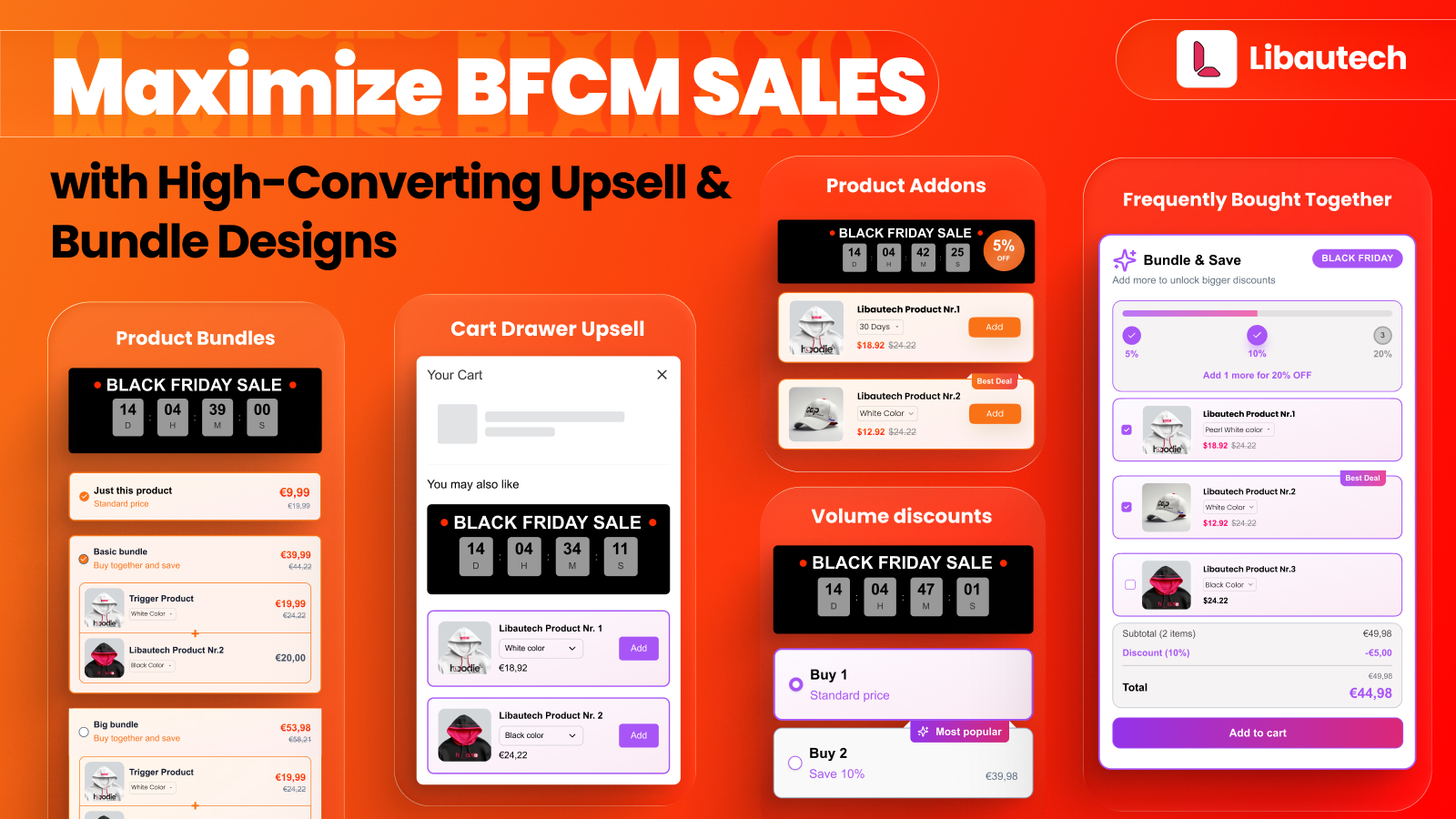
Black Friday is the biggest shopping event of the year. It’s not just about cutting prices. It’s also about getting the most value from every shopper’s cart. One easy way to achieve this is through upselling strategies that increase average order value (AOV).
E-commerce giants show how powerful this can be. Amazon says upsells make up about 35% of its revenue. With strong competition and lots of traffic, a good upsell plan is key for Black Friday sales.
During Black Friday, shoppers are ready to buy. This means it’s the perfect time to gently nudge them toward bigger purchases. Upselling can bolster your Black Friday sales by 10–30% on average. Think of it as giving helpful suggestions. When done well, an upsell feels like good customer service, not a hard sell.
For example, a coffee retailer might upsell a larger bag of coffee for a slight price increase, or offer a pack of filters – a simple combo that boosts the order value. Brick-and-mortar stores have used these tactics for decades (e.g. “Would you like fries with that?”), and online stores can benefit just as much.
With Black Friday bringing a surge of traffic, every extra item or upgrade counts. In the sections below, we will look at the best upsell strategies. These include “Frequently Bought Together” bundles and limited-time add-ons. We will also discuss how to use them in a successful Black Friday marketing plan.
One of the most effective upsell techniques is the classic “Frequently Bought Together” recommendation. This strategy, popularized by Amazon, suggests complementary products that customers often buy together with the item in their cart. You can help shoppers by showing them that other people often buy matching accessories or related items. This uses social proof and makes shopping easier.
The key is relevance. Frequently Bought Together suggestions work when the pairing makes sense. For example, if someone buys a smartphone, showing a case and screen protector together can lead to a bigger purchase.
In one case, a skincare brand offered a popular serum with a matching $12 cleanser. They did not use discounts or ads. Over one weekend, their average order value increased by 22%. When the added item genuinely complements the main product, it feels like a helpful tip rather than an upsell.
Many consumers appreciate the personalized touch. By using “Frequently Bought Together” recommendations, you make it easy for Black Friday customers to add more to their cart. This in turn increases your average order value.
Another upsell strategy is offering product add-ons on the product page. These are often small extras to the product they are purchasing.
A classic offline example is when buying a pair of shoes the store offers a leather care kit. Online, you may see options like gift wrapping, an extended warranty, or an accessory for the main product. When a customer looks at a camera, you can suggest a memory card. You can also recommend a better lens. Offer these items at a discount.
The benefit of product add-ons is that they catch the shopper’s attention before they even hit “Add to Cart”. By presenting the option on the product page (e.g., via a checkbox or a clearly marked section like “Add an extra battery for 20% off”), you’re prompting a larger purchase in a seamless way. It feels like part of the shopping process. Many shoppers prefer the convenience of buying everything at once. This is especially true on Black Friday when they want to get the best deals.
During Black Friday, you can even create exclusive add-on deals – for example, “Get 50% off this accessory today only.” This leverages Black Friday urgency and increases AOV. By integrating product add-ons into your Black Friday strategy, you encourage customers to spend a little extra on each product page they visit.
Shoppers love a good deal, and volume discounts leverage that psychology to boost AOV dramatically. The idea is simple: the more a customer buys, the more they save (often in percentage terms). This can be structured as tiered discounts based on cart value or quantity. For example, you might offer “Buy 2, get 20% off; Buy 3, get 30% off” during your Black Friday sale. These escalating incentives nudge customers to keep adding items to unlock the next deal. It’s one of the best Black Friday marketing ideas to boost average order value because it creates a game-like challenge.
Similarly, you can use “Buy X, Get Y” deals. For instance, “Buy 2, get 1 free”. This not only clears more stock but also raises the order value compared to a single unit sale. The key is that customers perceive they are getting more value by spending more.
Don’t forget threshold rewards as well – offering a bonus for reaching a certain cart value. A great example is Bobbi Brown’s Black Friday campaign, which gave 30% off site-wide plus a free gift for orders over $75. Shoppers were motivated to hit that $75 cart total to receive the gift. Likewise, offering free shipping over a certain amount (say $50 or $75) is a proven tactic to increase order sizes. Many customers will add an item they might have skipped, just to avoid a shipping fee. As an example, retailer River Island gave free delivery on orders above $75, which “encourages them to make an extra purchase” that they might not have made.
To maximize volume-based upsells on Black Friday, clearly advertise these tiered deals: use banners like “💰 Spend more, save more: Add $X for an extra 10% off!” and show a progress indicator in the cart (“You’re $15 away from free shipping!”). By structuring your Black Friday promotions with volume discounts and thresholds, you increase AOV while the customer feels like they’re scoring a better bargain.
Product bundles are a powerful upsell strategy, particularly suited for Black Friday when shoppers are hunting for big bargains and gift ideas. Bundling means pairing or grouping related products and selling them together, often at a slight discount compared to buying each item separately. This can significantly increase the average order value, as customers end up purchasing multiple items instead of one.
There are a couple of ways to approach bundling on Black Friday:
Shoppers feel they are getting more for their money, and you increase the basket size effortlessly. Instead of selling one product at a 20% discount, you might sell three products at, say, a 30% overall discount – the customer spends more total dollars, but is happy with the savings.
The moment a shopper clicks “Add to Cart” is a perfect opportunity for an upsell. At this point, the customer has committed to buying something, so their intent to purchase is high. Pre-checkout upsell pop-ups leverage this by immediately offering an additional product or upgrade before the customer proceeds to checkout. For example, a pop-up might appear saying, “Wait! Add a protective case to your cart now for 20% off!” right after the customer adds a smartphone to their cart. These are timely, relevant offers presented in a modal window, often called upsell funnels or pop-up offers.
Why do these work so well? The shopper is already in buying mode, and you’re showing them something that complements their purchase or improves it. It feels like a last-minute suggestion from a helpful salesperson. Done right, it comes off as “You might also need this” rather than an annoyance. Many Shopify apps (and other e-commerce platforms) support this functionality, letting you configure rules like “If product A is added, show offer for product B.”
During Black Friday, consider making these pop-up offers especially enticing. Perhaps provide a slightly better discount on the upsell item than it normally gets, or frame it as a Black Friday exclusive add-on. For example, “Add this gift item now for 50% off – today only!”. The urgency of Black Friday combined with the relevance of the offer can lead to quick impulse additions.
Beyond product pages and pop-ups, another prime real estate for upselling is the shopping cart itself. Whether you have a dedicated cart page or a slide-out cart drawer, this is where customers review their selections before final checkout and it’s an ideal spot to present one more offer. Many successful online stores embed product recommendations or special offers in the cart. For example, a cart drawer might say “You’re $10 away from a free gift - add one of these to qualify!” alongside a couple of product suggestions.
Cart add-ons work for a few reasons. First, they catch the shopper at a moment of consideration (they’re pausing to review the cart). Second, the customer has intent to buy but hasn’t paid yet, so suggesting an extra item can seem like a helpful reminder. Third, if you tie the cart offer to a threshold (“add one more item to get free shipping or a discount”), it provides a clear incentive to increase the cart value.
During Black Friday, cart add-on sections can also highlight limited-time promotions. For instance, “Add any item to get 15% off, Black Friday only!” This not only upsells an additional item but also increases the appeal of the whole purchase by giving a discount. One strategy is to feature 2 or 3 recommended products in the cart (with images, short titles, and an “Add to Cart” button) so the customer can easily click to include them. The convenience of adding something from the cart view with one click lowers the barrier for the customer to say “sure, why not.”
Finally, let’s touch on Black Friday designs and the user experience aspects of upselling. Implementation matters: how you present upsell offers can determine whether shoppers embrace them or ignore them. Here are some design and UX tips for your upsell strategy:
By paying attention to the design and user experience of your upsell offers, you’ll ensure that these strategies actually convert. An attractive, well-timed upsell can feel like part of the Black Friday excitement, whereas a poorly executed one feels like an intrusive ad.
Black Friday is a prime opportunity to not only multiply your sales volume but also to raise your average order value through smart upsell strategies. By implementing “frequently bought together”, product add-ons, volume discounts, bundles, pop-up offers, and cart drawer add-ons, you encourage customers to buy more without feeling like they overspent.
As you craft your Black Friday marketing strategy, learn from what successful retailers do: offer value at every turn. Whether it’s a free gift for big spenders, an exclusive bundle, or a simple “customers also bought” nudge, each technique makes a meaningful impact on your AOV.
