
Best Shopify ERP Apps 2026
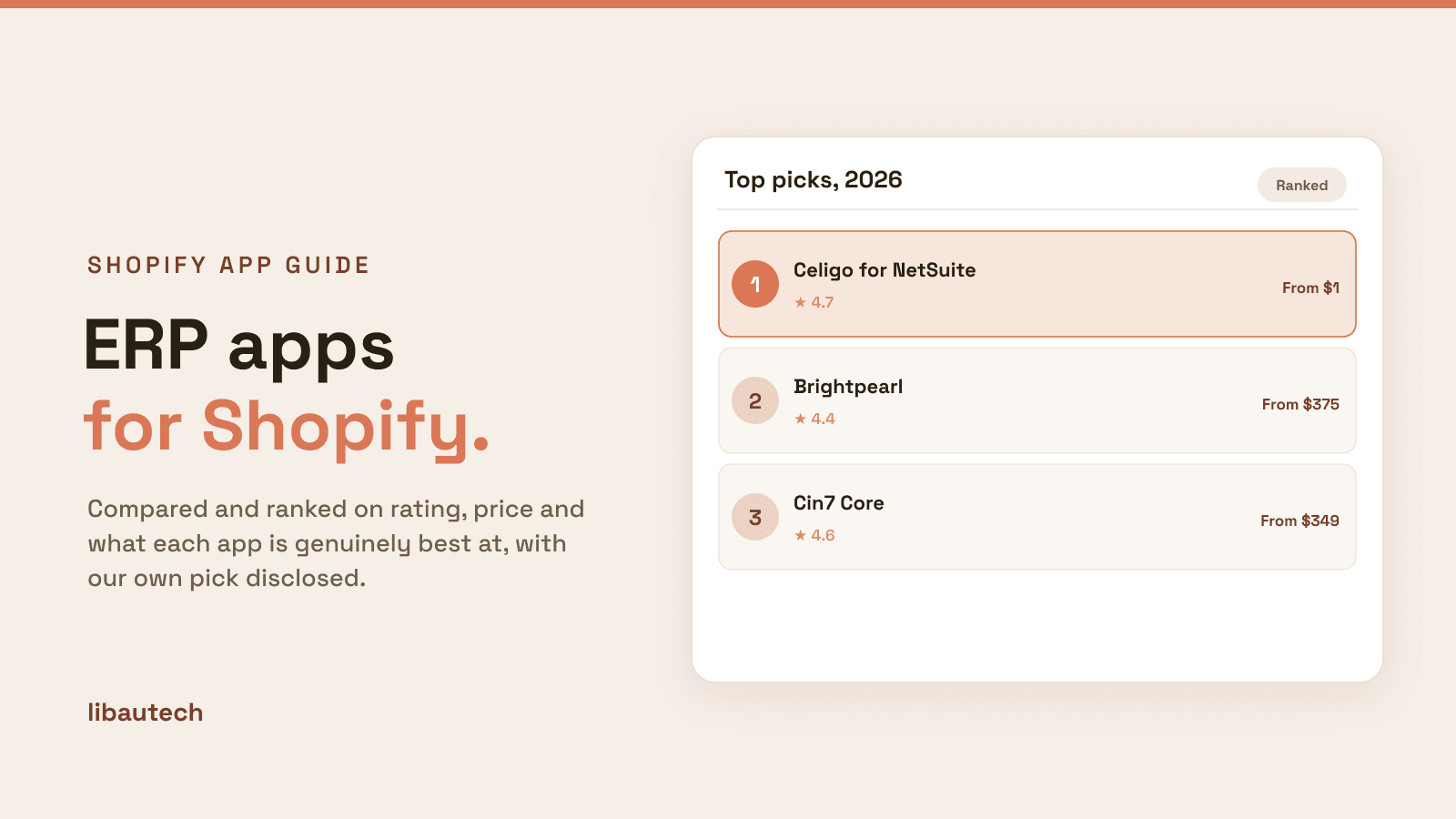
Last updated: May 2026 · Pricing and ratings verified from live Shopify App Store listings on May 4, 2026 · Reviewed by the Libautech team — builders of Bundles & Upsell and 8 other Built for Shopify apps used by 5,000+ merchants across 50+ countries.
Key Takeaways
- ERP integration is essential for Shopify merchants doing $1M+/year, multi-channel selling, or complex inventory across warehouses. Manual sync between Shopify and accounting/operations breaks at scale, leading to inventory errors, accounting mismatches, and the operational chaos that kills margins faster than any single bad campaign ever could.
- The Shopify ERP category splits into three groups — enterprise ERP integrations (Celigo and Boomi for NetSuite, SAP, and Dynamics), mid-market all-in-one commerce ERPs (Brightpearl, Cin7 Core, Linnworks), and lightweight inventory-and-accounting sync (Stocky, QuickBooks Connector, Xero integrations). The right group depends on revenue scale, channel complexity, and inventory operations more than on which platform looks impressive on paper.
- NetSuite is the dominant enterprise ERP for Shopify Plus merchants. Celigo and Boomi are the two most-validated integration platforms, both offering pre-built NetSuite connectors handling orders, inventory, customers, fulfillments, and refunds. Choose Celigo for NetSuite-first stacks, Boomi for multi-system enterprise environments.
- For mid-market stores at $1M to $20M revenue, purpose-built commerce ERPs like Brightpearl and Cin7 Core often beat NetSuite plus Celigo on cost and time-to-value because they are designed for ecommerce out of the box rather than retrofitted from generic ERP foundations. The implementation timeline difference alone (4-8 weeks for Brightpearl vs 8-20 weeks for NetSuite plus Celigo) often determines the right pick.
- Pricing varies dramatically across the category. Stocky free with Shopify Plus, QuickBooks Connector free, Linnworks from $300/mo, Brightpearl from $375/mo, Cin7 Core from $349/mo, Celigo and Boomi enterprise pricing typically $1,000-$5,000-plus/mo for full NetSuite or SAP integration. Match the price tier to the revenue tier rather than buying ahead of operational complexity.
- The biggest ERP mistake is buying ahead of need. Stores at $500K revenue installing Brightpearl burn $4,500 per year on infrastructure they cannot fully use, then quit before reaching the scale where the ERP would have paid back. Start with QuickBooks plus Stocky, scale into Brightpearl or Cin7 Core when revenue and channel count justify it, escalate to NetSuite plus Celigo only at the enterprise tier.
Who Needs an ERP App, and Why?
An ERP integration connects Shopify to a central system for inventory, orders, purchasing and accounting across every channel and warehouse. It becomes the single source of truth once spreadsheets and separate tools can no longer keep a growing operation in sync.
You need one if you sell across multiple channels or locations, carry complex inventory, or have outgrown manual processes and disconnected apps. Smaller single-channel stores do not need the weight of an ERP yet.
The Three Tiers of Shopify ERP Apps
Most ERP roundups treat NetSuite, Brightpearl, and QuickBooks as comparable products. They are not. NetSuite plus Celigo is a $50,000-200,000 per year stack that solves enterprise-scale operations across multi-entity, multi-currency, multi-warehouse, and multi-system environments. Brightpearl is a $1,500-3,000 per month commerce ERP designed specifically for retail and ecommerce. QuickBooks Online plus a Shopify connector is free-plus-subscription accounting sync sufficient for stores under $2M revenue. Different mechanics, different price points, different operational tiers — and different right answers depending on where the store actually sits.
The first tier is enterprise ERP integration. Stores already running NetSuite, SAP Business One, Microsoft Dynamics, or Oracle that need to connect Shopify cleanly without custom development. The mechanics are: an integration platform (Celigo, Boomi, MuleSoft) sits between Shopify and the ERP and handles bidirectional sync of orders, inventory, customers, fulfillments, and refunds with pre-built flows that cover most edge cases. Best fit for stores at $5M-plus revenue where the ERP already exists due to legacy operations or parent company mandate, and the question is connection rather than selection.
The second tier is mid-market all-in-one commerce ERPs. Stores at $1M to $20M revenue running multi-channel retail (Shopify plus Amazon plus wholesale) that need a single platform handling inventory, orders, accounting, CRM, and reporting in one place. The mechanics are: the ERP becomes the operational source of truth, Shopify becomes one of several sales channels feeding into it, and the integration is native to the ERP rather than requiring a third-party platform. Best fit for the mid-market segment where NetSuite is overkill and QuickBooks alone is insufficient — Brightpearl, Cin7 Core, and Linnworks all live in this segment with different specializations.
The third tier is lightweight inventory and accounting sync. Stores under $2M revenue that need to keep accounting in QuickBooks or Xero clean and inventory consistent across one or two channels. The mechanics are: a Shopify-native connector (Intuit's official QuickBooks app, Xero's official integration) handles the accounting sync, and inventory ops happen inside Shopify or via Stocky for Plus merchants. Best fit for stores where the operational complexity has not yet justified a full ERP — and the cheapest correct answer beats the most feature-rich expensive alternative when the use case is small.
How We Ranked These Apps
The ranking weighs four dimensions: depth of features (does the platform handle order sync, inventory sync, accounting integration, multi-warehouse logic, manufacturing and kitting support, and multi-channel coverage), total cost of ownership (platform subscription plus integration platform fees plus implementation cost plus ongoing maintenance), merchant scale fit (where deployments deliver value rather than where vendors say they fit), and Shopify App Store rating verified live on May 4, 2026 with review volume context. Apps that solve a specific operational tier exceptionally well rank higher in their tier than apps with broader feature sets but weaker depth in any single area. ERP integration is rarely a single-app decision — most stores at scale run an ERP, a connector, and one or more accounting or inventory apps that handle specific gaps, and the ranking reflects how cleanly each option fits into a realistic stack rather than treating each as a standalone choice.
1. Celigo for NetSuite
Rating: 4.7/5 · Pricing: From ~$1,000/mo · Best for: Shopify Plus merchants on NetSuite needing bidirectional sync without custom development · Job solved: Enterprise integration between NetSuite ERP and Shopify Plus with pre-built flows for orders, inventory, customers, fulfillments, and refunds
Celigo is the most-validated NetSuite-Shopify integration platform on the market. Pre-built integration flows handle the standard commerce data: orders flow Shopify to NetSuite, fulfillments flow NetSuite to Shopify, inventory updates flow both ways, customer records sync. Configurations cover edge cases (refunds, partial fulfillments, exchanges, drop-ship vendors) without custom scripting, which is the part that makes Celigo justifiable at the enterprise price point — alternative paths that require custom NetSuite scripting cost meaningfully more in implementation hours and ongoing maintenance.
For NetSuite plus Shopify Plus stores, Celigo typically replaces 60-120 hours per month of manual reconciliation work that would otherwise fall to operations or finance staff. The setup is multi-week with NetSuite-side configuration but pays back fast at scale through saved labor and reduced inventory errors. Where it falls short: not for stores below $5M per year (the price floor is too high), NetSuite-only (Boomi is the alternative for SAP, Dynamics, or Oracle), and the implementation requires NetSuite expertise that most Shopify-native operators do not have in-house — plan for a NetSuite consultant alongside the Celigo deployment.
2. Brightpearl
Rating: 4.4/5 · Pricing: From $375/mo · Best for: Multi-channel retail brands at $1M-$20M revenue needing a single platform for inventory, orders, accounting, CRM, and reporting · Job solved: Mid-market commerce ERP purpose-built for retail and ecommerce with native Shopify integration
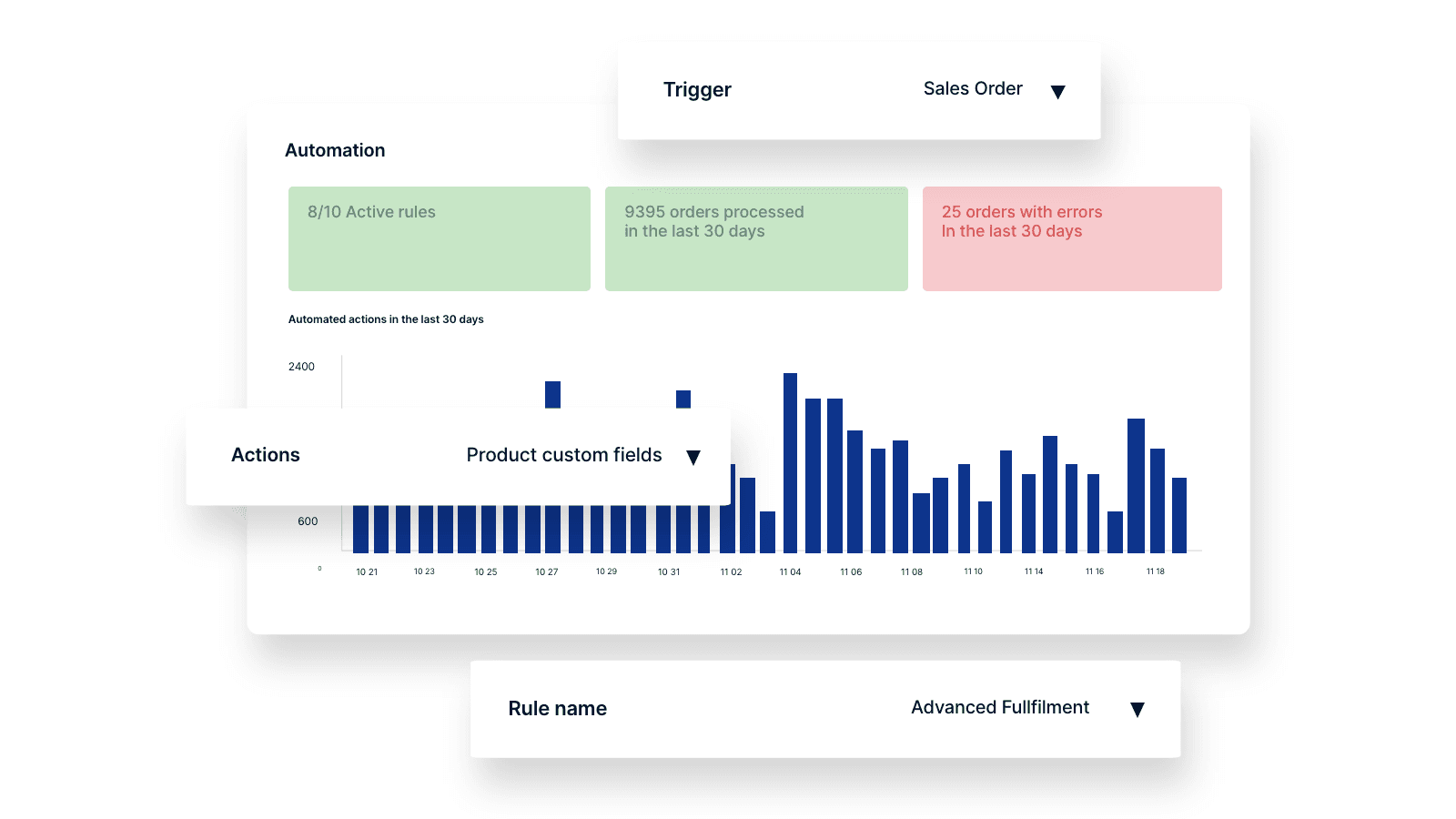
Brightpearl is the dominant mid-market commerce ERP for Shopify. Unlike NetSuite (a generic ERP retrofitted for retail), Brightpearl is built specifically for retail and ecommerce operations. Multi-channel inventory (Shopify, Amazon, eBay, wholesale, retail), order management, real-time accounting, automated reordering, and CRM all live in one platform with retail-aware defaults. The Shopify integration is native and deep — inventory updates in seconds, automated order routing to warehouses, customer history unified across channels.
For stores running multi-channel at the $1M-$20M revenue range, Brightpearl is typically the right pick over NetSuite for total cost of ownership. The implementation runs 4-8 weeks rather than NetSuite's 8-20 weeks, the price point is $1,500-3,000 per month rather than $5,000-15,000, and the retail-specific features (purchase order management, automated reordering, multi-warehouse routing) work out of the box rather than requiring NetSuite customization. Where it falls short: not enterprise-grade for $50M-plus stores where NetSuite's depth in non-commerce operations becomes essential, and stores under $1M find the price hard to justify against simpler alternatives.
3. Cin7 Core
Rating: 4.6/5 · Pricing: From $349/mo · Best for: Inventory-heavy stores with multiple warehouses, manufacturing, or kitting operations · Job solved: Deep inventory ERP with manufacturing BOMs, kitting, batch tracking, expiration dates, and multi-warehouse stock allocation
Cin7 Core (formerly DEAR Systems) is built around inventory complexity. Multi-warehouse stock allocation, manufacturing BOMs (bills of materials), kitting and assemblies, batch tracking, expiration dates, and serial numbers are all first-class features rather than afterthoughts. The Shopify integration syncs orders and inventory bidirectionally with proper reservation logic — when an order comes in on Shopify, the inventory is reserved in Cin7 Core immediately rather than waiting for a sync interval, which prevents the over-selling problem that plagues stores running looser inventory integrations.
For stores manufacturing or assembling products (food and supplements, custom hardware, kitted gift sets, bundled SKUs), Cin7 Core handles complexity that lighter inventory tools cannot. The integrated B2B portal lets wholesale buyers self-serve with custom price lists and credit terms, which is the feature that often justifies the upgrade from a pure DTC inventory tool. Where it falls short: accounting features are lighter than Brightpearl (most Cin7 Core stores still run QuickBooks or Xero alongside for the GL), and the UI feels older than newer competitors that have invested in design polish.
4. Linnworks
Rating: 4.5/5 · Pricing: From $300/mo · Best for: UK and EU multi-marketplace sellers (Shopify plus Amazon plus eBay plus Etsy) needing centralized order and inventory operations · Job solved: Multi-marketplace order processing and inventory sync with strong European fulfillment carrier integrations
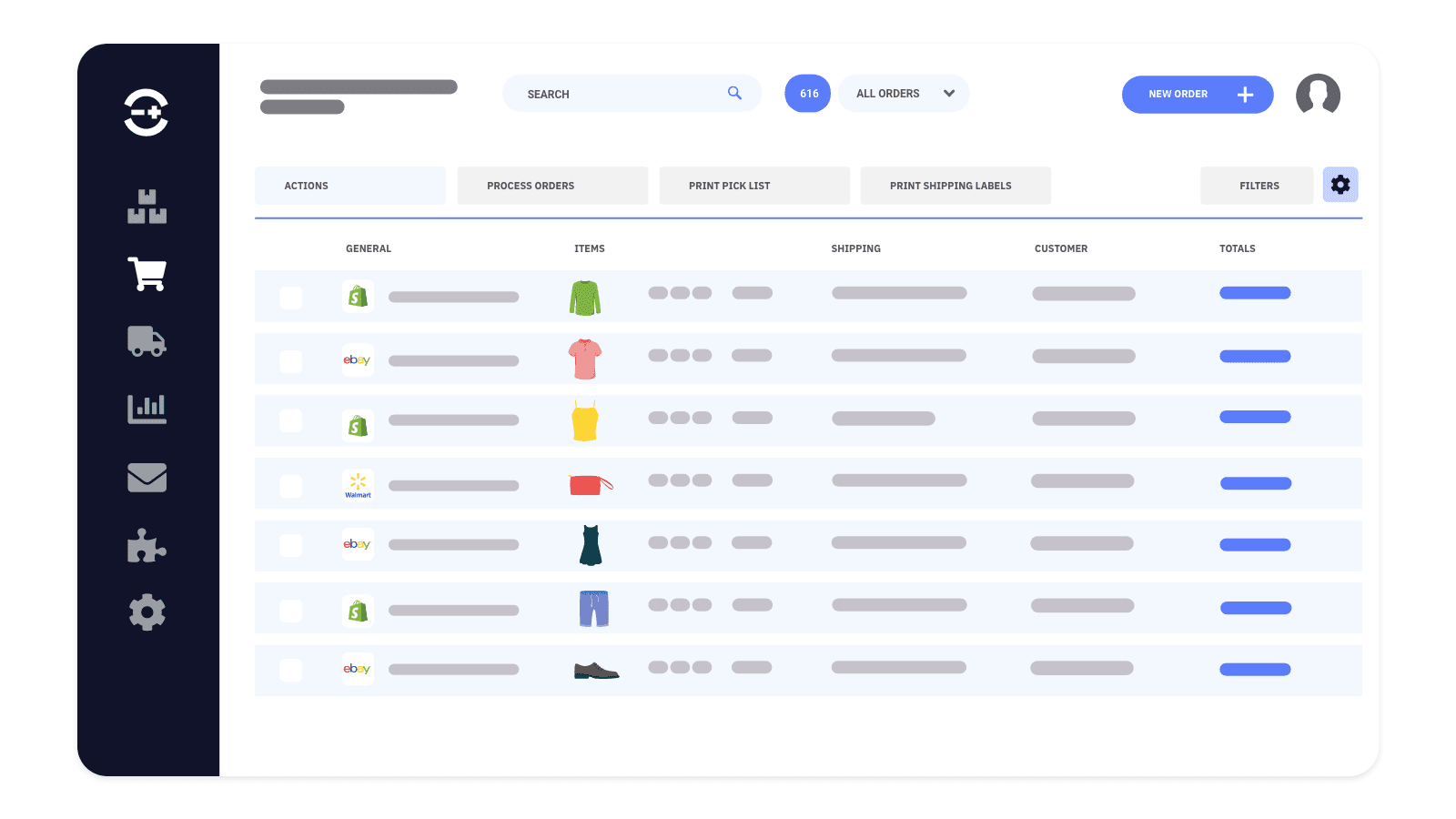
Linnworks dominates the UK and EU multi-marketplace operations market. Centralized order processing across Shopify, Amazon, eBay, Etsy, and OnBuy keeps inventory consistent everywhere. Shipping label generation across Royal Mail, DPD, ParcelForce, Hermes, and US carriers handles the European fulfillment complexity that most US-built tools handle poorly. For UK and EU multi-marketplace sellers, Linnworks is typically the right operational platform regardless of revenue tier because the European logistics integration is the binding constraint that other ERPs cannot match cleanly.
Stores doing $500K-$5M with three-plus sales channels benefit most. The platform shines when there are multiple marketplaces feeding into a single inventory pool with shared fulfillment infrastructure. Where it falls short: less strong in US-only setups where Amazon Seller Central and ShipStation cover similar ground at lower cost, and accounting integrations require third-party tools rather than being native — most Linnworks deployments still need a separate QuickBooks or Xero connector for the GL side. The 4.5/5 rating reflects strong satisfaction in the target European multi-marketplace segment with weaker fit when forced into US-centric or single-channel use cases.
5. Stocky (Shopify Native)
Rating: 4.0/5 · Pricing: Free with Shopify Plus · Best for: Shopify Plus merchants needing purchase order management, demand forecasting, and supplier coordination natively · Job solved: Native inventory operations including POs, demand forecasting, supplier coordination, stocktakes, and reorder point alerts
Stocky is included free with Shopify Plus and handles the inventory operations job: purchase orders, demand forecasting, supplier coordination, stocktakes, and reorder point alerts. It integrates directly with Shopify products and inventory, which means no separate sync layer to break. For Plus merchants whose accounting and ERP needs are met elsewhere (QuickBooks, Xero, custom internal systems), Stocky covers the inventory ops gap without an additional ERP subscription.
The 4.0/5 rating is the lowest in this list and reflects mid-market frustration with Stocky's limitations rather than failures of the core feature set. Stocky does what it claims (PO management, basic forecasting, supplier coordination), but it does not extend into accounting, CRM, or multi-warehouse routing logic — Plus merchants who outgrow Stocky's scope end up needing a real ERP anyway, at which point Stocky becomes the legacy tool to migrate away from rather than the long-term solution. Use Stocky as the bridge between "Shopify alone is enough" and "we need a real ERP" rather than as a permanent answer for serious multi-channel operations.
6. QuickBooks Online by Intuit
Rating: 4.4/5 · Pricing: Free Shopify app + active QBO subscription · Best for: Stores under $2M revenue using QuickBooks Online for accounting needing automated order, refund, and tax sync · Job solved: Accounting sync between Shopify and QuickBooks Online with refunds, taxes, and payouts reconciling automatically
The Intuit-built QuickBooks Online connector handles the accounting sync that smaller stores actually need: orders flow as sales receipts or invoices, refunds reverse cleanly, taxes split correctly, payouts reconcile against bank deposits. For QBO-using stores under $2M revenue, this is the standard accounting integration and the right answer at this scale. The free Intuit-built connector replaced the older third-party tools (A2X, Webgility) that previously dominated this slot — though stores wanting payout-level reconciliation that exactly matches the bank statement still install A2X alongside the official connector.
For stores running multi-channel sales (Shopify plus Amazon plus wholesale), QuickBooks alone is insufficient because there is no inventory layer to keep stock consistent across channels. The path is QuickBooks plus Shopify Connector for accounting plus a separate inventory sync (Stock Sync, Trunk, or eventually Cin7 Core) for the inventory side. Where it falls short: not a full ERP, no CRM, no manufacturing logic, no multi-warehouse routing — stores that need any of these features should plan to migrate to Brightpearl or Cin7 Core within 12-18 months as scale increases.
7. SAP Business One Integration
Rating: 4.5/5 · Pricing: Custom enterprise pricing, typically $1,500-$5,000+/mo · Best for: Established mid-market businesses already running SAP Business One needing clean Shopify integration · Job solved: SAP B1 to Shopify integration without custom ABAP development
For stores already running SAP B1 (typically due to a parent company mandate or legacy operations from before the Shopify migration), the SAP Business One connector delivers the standard commerce sync: orders, inventory, customers, fulfillments. Boomi or MuleSoft sit on top for more complex multi-system integration scenarios where SAP needs to coordinate with separate WMS, CRM, or BI tools. The 4.5/5 rating reflects satisfaction within the narrow target audience — stores that already have SAP and need to connect Shopify cleanly.
Where it falls short: enterprise pricing makes this irrelevant for most Shopify-native operators, and SAP B1 is rarely the right pick for greenfield ERP selection compared to NetSuite or Brightpearl. Use SAP B1 plus this connector when the SAP infrastructure already exists and the question is integration rather than ERP choice. Stores selecting an ERP from scratch should evaluate Brightpearl, Cin7 Core, or NetSuite first because the implementation expertise, partner network, and ongoing support are more accessible in the commerce-native ERP ecosystem.
8. Boomi for SAP, Dynamics, and Oracle
Rating: 4.6/5 · Pricing: Custom enterprise pricing, typically $2,000-$10,000+/mo · Best for: Enterprise stores running SAP, Microsoft Dynamics, or Oracle ERPs needing multi-system integration beyond NetSuite · Job solved: Enterprise integration platform connecting Shopify to non-NetSuite ERPs with multi-system orchestration
Boomi is the alternative integration platform when the ERP is not NetSuite. Where Celigo specializes in NetSuite-Shopify connections, Boomi handles SAP S/4HANA, Microsoft Dynamics 365, Oracle EBS, and other enterprise systems with similar pre-built flow depth. For stores at the $20M-plus enterprise tier running non-NetSuite ERPs, Boomi is typically the right integration platform because the connector library and enterprise support model match the operational reality.
The platform also handles multi-system orchestration that Celigo does not — when Shopify needs to coordinate with SAP plus a separate WMS plus a CRM plus a BI tool, Boomi's iPaaS architecture handles the multi-system flows cleanly. Where it falls short: pricing is enterprise-only (typical deployments run $50,000-200,000 per year all-in), implementation requires Boomi-certified consultants, and the platform is overkill for stores with simpler integration needs. Reserve Boomi for stores genuinely operating across three-plus enterprise systems where multi-system orchestration is the actual problem rather than just point-to-point Shopify-ERP connection.
Shopify ERP Apps Comparison Table
| App | Type | Rating | Pricing | Best For |
|---|---|---|---|---|
| Celigo for NetSuite | Enterprise integration | 4.7/5 | From ~$1,000/mo | NetSuite + Shopify Plus |
| Brightpearl | Mid-market commerce ERP | 4.4/5 | From $375/mo | Multi-channel retail $1M-$20M |
| Cin7 Core | Mid-market commerce ERP | 4.6/5 | From $349/mo | Inventory-heavy multi-warehouse |
| Linnworks | Order & inventory ops | 4.5/5 | From $300/mo | UK/EU multi-marketplace |
| Stocky (Shopify) | Native inventory ops | 4.0/5 | Free with Shopify Plus | Plus merchants needing PO management |
| QuickBooks Online by Intuit | Accounting sync | 4.4/5 | Free + QBO subscription | Sub-$2M QBO stores |
| SAP Business One | Enterprise ERP integration | 4.5/5 | Custom enterprise | Stores already on SAP |
| Boomi | Enterprise iPaaS | 4.6/5 | Custom enterprise | SAP/Dynamics/Oracle multi-system |
Picking the Right Stack by Revenue and Channel Profile
The decision tree for most stores is simple once revenue and channel count are considered. Already on NetSuite plus Shopify Plus: Celigo is the most-validated NetSuite connector and the right pick. Already on SAP, Dynamics, or Oracle at enterprise scale: Boomi handles the integration with deeper multi-system orchestration than Celigo provides outside of NetSuite. $1M-$20M multi-channel retail looking for a single ERP: Brightpearl is the best mid-market commerce ERP and pays back faster than NetSuite at this scale.
Inventory-complex stores running manufacturing, kitting, or multi-warehouse operations: Cin7 Core has the deepest inventory features in the mid-market segment and handles the manufacturing BOMs that lighter tools cannot. UK and EU multi-marketplace sellers: Linnworks is the strongest European fulfillment integration and beats US-built alternatives on local carrier support. Shopify Plus merchant needing PO management without paid ERP: Stocky is free with Plus and covers the gap. Sub-$2M store using QuickBooks for accounting: the Intuit QuickBooks connector is free, well-built, and no full ERP is needed yet at this scale.
Combined with Libautech's Bundles & Upsell, Sticky Add to Cart, and Announcement Bar (all included on the $14.99 per month Package plan), the ERP-plus-conversion stack covers operational backbone and storefront conversion mechanics from one combined toolset. The conversion apps are particularly valuable in the ERP context because clean ERP data feeds richer product information into the storefront, and the storefront conversion tools then capture more of that traffic into orders that flow back into the ERP for fulfillment and accounting.
What Native Shopify Already Handles
Shopify's native operational capabilities have expanded substantially over the last three years. Shopify Locations supports up to 1,000 locations on Plus with multi-location inventory tracking. Shopify Markets handles multi-currency, multi-region pricing, and local checkout. Shopify Flow handles in-Shopify automation including order tagging, fulfillment routing, and inventory alerts. Shopify Reports produces P&L summaries, sales by channel, and finance summaries that cover most of what a small store needs for monthly review.
What native Shopify still does not handle well: deep journal entries posted to external accounting software (the QuickBooks and Xero connectors fill this gap), purchase order management beyond the Stocky scope (Brightpearl, Cin7 Core, or external POs needed), manufacturing BOMs and kitting (Cin7 Core needed), multi-channel inventory across Shopify plus Amazon plus eBay plus wholesale (Linnworks or Brightpearl needed), and any non-commerce ERP functions like fixed asset tracking or project accounting (NetSuite or SAP needed). Before installing a paid ERP, audit whether Shopify's native features plus a clean QuickBooks or Xero connector would suffice for the current scale — most stores under $2M revenue never genuinely need a paid ERP, and the $300-1,500-plus per month subscription is pure waste on top of features the native platform already provides.
How ERP Apps Pair with Conversion Tools
ERP systems are operational backbone, but the storefront still has to convert traffic into orders before any of that operational infrastructure becomes useful. The ERP stack and the conversion stack solve different problems and rarely conflict — ERPs handle orders after they happen, while conversion apps influence whether orders happen in the first place. Both belong in a healthy Shopify operation, and the cost of either stack is small compared to the revenue impact of getting both right.
Libautech's Sticky Add to Cart keeps the buy button visible while customers read product copy, which means more orders flow into the ERP for fulfillment and accounting. Bundles & Upsell increases the average order value of every transaction the ERP then processes — a 15-20% AOV lift compounds across the year into meaningful revenue without any incremental operational cost (the ERP processes the same number of orders at higher per-order value). Announcement Bar runs the storewide messaging that pulls visitors into product pages where the conversion tools can do their work. All three are available on the $14.99 per month Package plan, paying back faster than most ERP infrastructure in saved manual conversion work.
Common ERP Mistakes
The biggest ERP mistake is buying ahead of need. Stores at $500,000 revenue installing Brightpearl burn $4,500 per year on infrastructure they cannot fully use, because the ERP delivers value through multi-channel coordination and the store has only one channel. Then they quit before reaching the scale where Brightpearl would have paid back, and the ERP becomes a stranded cost rather than an operational asset. The fix is to start with QuickBooks plus Stocky, scale into Brightpearl or Cin7 Core when revenue and channel count justify it (typically $1M-plus and three-plus channels), escalate to NetSuite plus Celigo only at the enterprise tier ($20M-plus or genuine non-commerce ERP needs).
The second common mistake is underestimating implementation complexity. Stores select NetSuite expecting a 4-week deployment and discover at week 16 that the data migration alone is consuming the entire ops team's bandwidth. The fix is to plan ERP implementations as multi-quarter projects with dedicated implementation budget — typically 1.5-3x the annual subscription cost in first-year implementation fees for mid-market ERPs, 3-10x for enterprise NetSuite or SAP deployments. Stores that budget only for the subscription and not the implementation hit cash flow problems mid-deployment that often kill the project before completion.
The third is treating ERP as a one-time setup rather than ongoing infrastructure. ERPs require quarterly maintenance, periodic data hygiene reviews, integration flow updates as Shopify and the ERP both release new features, and ongoing user training as the team grows. Stores that install Brightpearl or Cin7 Core and then never touch the configuration again typically discover at the 18-month mark that the system has drifted from operational reality and needs a substantial cleanup project to return to usefulness. Plan for ongoing ERP administration as a real operational role rather than a one-off project.
How ERP Affects Margin and Capacity
The single highest-leverage benefit of clean ERP infrastructure is operational capacity. A mid-market store running on Brightpearl with proper integration can scale from $5M to $20M revenue with the same operations headcount because the ERP automates the work that manual reconciliation would otherwise require. The same store running on QuickBooks plus spreadsheet inventory tracking would need to triple ops headcount to handle the same growth, which means margin compression as scale increases. The capacity unlock is what justifies the ERP cost at mid-market — not the subscription itself, but the prevented hiring as the business scales.
Beyond capacity, the data quality benefit compounds into better decisions. A store with clean ERP data running monthly P&L reviews can spot margin compression by SKU, channel, or customer segment in real time. A store running QuickBooks plus spreadsheets discovers margin issues at year-end after the damage is already done. The compounding effect of "better data, faster decisions" across multiple quarters typically produces 2-5x the value of the ERP subscription cost — but only for stores at the scale where the data volume justifies the analysis effort.
FAQ — Shopify ERP Apps
What is an ERP and do I need one for Shopify? An ERP (Enterprise Resource Planning) system unifies inventory, orders, accounting, fulfillment, and customer data into a single source of truth. Stores under $500,000 per year typically do not need a full ERP — Shopify plus QuickBooks plus Stocky covers the basics. Stores above $1M per year, multi-channel, or with multi-warehouse operations usually benefit from a dedicated ERP.
What is the best ERP for Shopify in 2026? It depends on revenue scale and operational complexity. For Shopify Plus enterprise merchants on NetSuite, Celigo handles the integration. For mid-market multi-channel retail at $1M-$20M, Brightpearl is purpose-built for the use case. For inventory-complex stores (manufacturing, kitting), Cin7 Core wins. For UK and EU multi-marketplace sellers, Linnworks dominates.
How does NetSuite integration with Shopify work? Native NetSuite-Shopify integration is limited; most enterprise stores use Celigo or Boomi as the integration platform. These platforms provide pre-built flows for orders (Shopify to NetSuite), fulfillments (NetSuite to Shopify), inventory (bidirectional), customers, and refunds. Implementation typically takes 4-12 weeks depending on customization needs and NetSuite-side configuration complexity.
What is the difference between an ERP and inventory sync apps? Inventory sync apps (Stocky, Trunk, Stock Sync) keep inventory consistent across channels but do not handle accounting, CRM, or operations. ERPs unify all business data (inventory plus orders plus accounting plus customers plus fulfillment) in a single platform. Inventory apps are sufficient at smaller scale; ERPs become necessary as complexity grows.
How much does ERP integration cost on Shopify? Wide range. Free options exist (Stocky for Plus, QuickBooks connector). Mid-market ERPs run $300-$1,500 per month (Linnworks, Brightpearl, Cin7 Core). Enterprise NetSuite plus Celigo typically runs $1,000-$5,000-plus per month for the integration alone, plus NetSuite licensing of $1,000-$3,000 per month. Total enterprise stack costs $50,000-$200,000 per year all-in.
Can I sync Shopify with QuickBooks Online? Yes — the Intuit-built QuickBooks Online connector handles this natively and is free. Orders, refunds, taxes, and payouts reconcile automatically. For most stores under $2M using QBO, this replaces older third-party connectors and is the standard accounting integration at this scale.
Should I use Brightpearl or NetSuite for my Shopify store? For mid-market commerce stores ($1M-$20M), Brightpearl is typically faster to deploy, lower in total cost, and purpose-built for retail. For enterprise stores ($20M-plus) or businesses needing manufacturing depth, NetSuite is the standard. Brightpearl is the right pick for most multi-channel retail brands; NetSuite is the right pick for businesses where the ERP needs to handle non-commerce operations too.
How long does ERP implementation take? Mid-market ERPs (Brightpearl, Cin7 Core, Linnworks) typically deploy in 4-8 weeks. Enterprise NetSuite plus Celigo deployments run 8-20 weeks depending on customization, data migration complexity, and edge case handling. Plan for 30-60 days of parallel running where the old and new systems both operate before full cutover, and budget the implementation cost separately from the subscription cost.
Final Word
ERP is the operational backbone that determines whether a store can scale from $5M to $50M without breaking its operations. The discipline is to install only what is needed at the current scale, plan the next tier of upgrade ahead of the operational pain that forces it rather than after, and treat the ERP as ongoing infrastructure rather than a one-time setup. Cheap and right beats expensive and wrong every quarter — and the merchants who treat their ERP stack as infrastructure rather than emergency response are the ones who scale calmly through revenue tiers rather than scrambling at year-end when the books do not reconcile. Match the ERP to the business stage, plan the implementation as a real project, and the operational capacity unlock will pay back the subscription cost many times over.