
Best Shopify Analytics Apps (2026)
Last updated: September 2026 · Reviewed by the Libautech team, builders of Bundles & Upsell and Shoptank — Built for Shopify apps used by 5,000+ merchants across 50+ countries.
Key Takeaways
- WeltPixel Conversion Tracking is the data layer beneath the rest: it sends server-side purchase and funnel events to nine platforms (GA4, Meta, TikTok, Google Ads and more), so the conversions your other tools report are complete. $39/mo flat, with a free GA4-only tier.
- Shopify’s native analytics cannot tell you which marketing channel drove a specific first purchase, what a customer is worth over 12 months, or how much profit remains after COGS and ad spend — every app on this list answers one or more of those questions.
- Analyzely is the best free starting point at 4.9 stars across 2,000+ reviews — no-code GA4 setup on Shopify with enhanced e-commerce event tracking built in.
- Triple Whale ($129/mo) uses server-side pixel tracking to fix the iOS 14 attribution gap — essential for stores spending $50K+/mo on Meta and Google ads.
- Lifetimely ($19/mo paid tier) is the highest-ROI analytics pick for growing stores: cohort LTV data that drives better acquisition channel decisions.
- BeProfit shows actual profit per order after COGS, shipping, and ad spend — the gap between revenue and profit numbers that most merchants estimate rather than measure.
- Polar Analytics and Decile sit at the $250–300/mo tier for stores above $1M revenue that need unified multi-channel attribution or predictive customer segmentation.
Who Needs an Analytics App, and Why?
Shopify's built-in reports cover the basics, but a dedicated analytics app pulls your marketing, ad spend, profit and customer data into one dashboard, so you can see true profit per order, blended ROAS across channels, and lifetime value, not just revenue. That is the difference between guessing what works and knowing.
You need one if you spend meaningfully on ads across several channels, want profit and LTV rather than just sales, or are scaling and cannot see the full picture in native reports. A small store with one channel can start with Shopify's own analytics.
What Shopify’s Native Analytics Cannot Tell You
Shopify’s built-in reports cover sales, orders, and traffic at a surface level. They do not tell you which marketing channel drove a specific customer’s first purchase, what a customer is worth over three years, how much profit remains after ad spend and COGS, or which customer segments are churning before you can act on it.
In 2026, that gap matters more than it did in 2020. iOS privacy changes in 2021 broke attribution tracking for stores relying on Meta’s pixel. Rising ad costs made it economically necessary to understand exactly which channels generate profitable customers versus expensive ones. The analytics apps below exist to answer the questions that Shopify’s dashboard cannot.
Analytics pairs with other levers on your store — see our guides to the best page builder apps, top SEO apps, and best email marketing apps to turn insight into revenue.
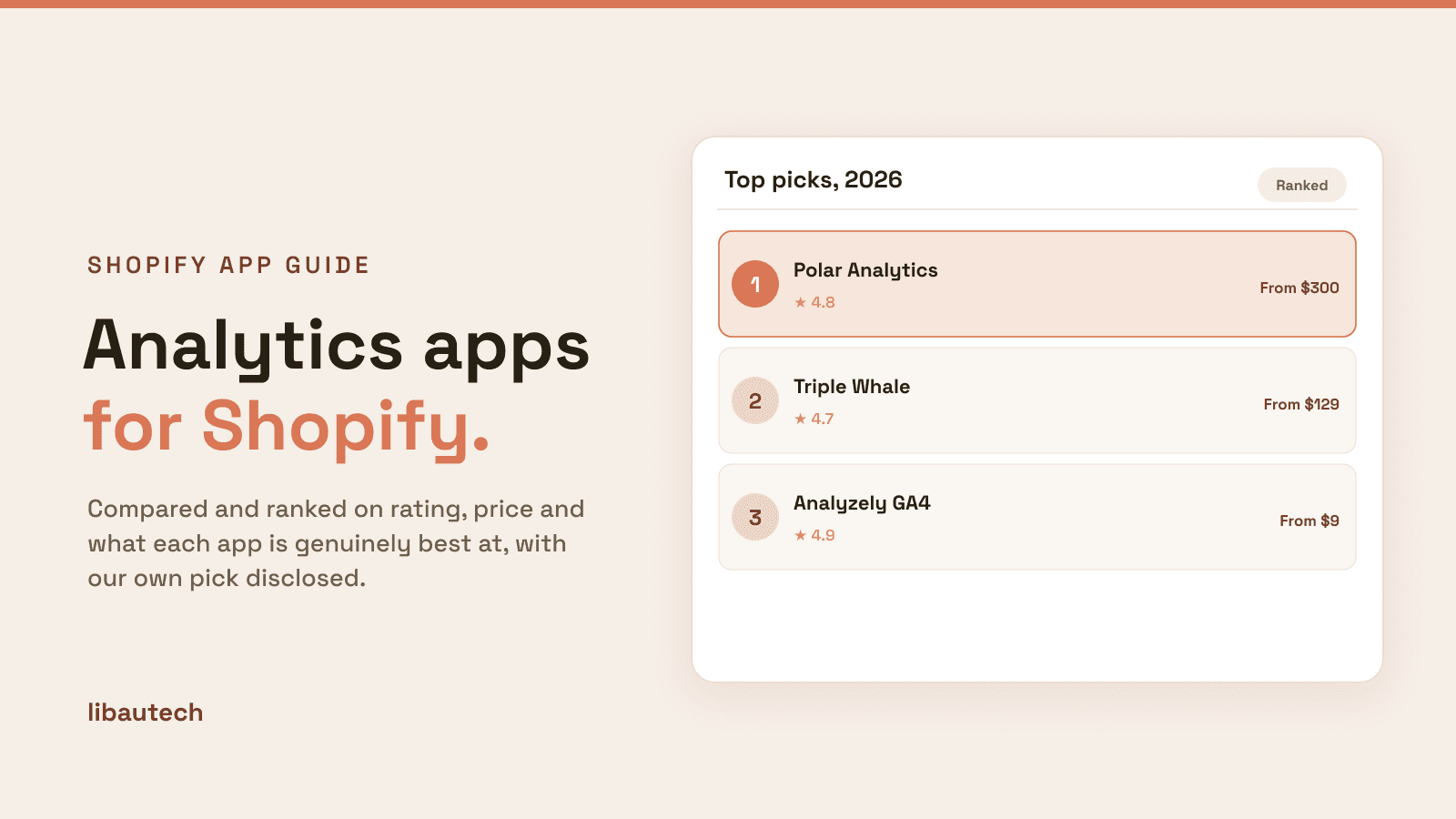
This post ranks 7 Shopify analytics apps in 2026 by data depth, the specific questions they answer, and pricing.
Quick Comparison: Best Shopify Analytics Apps (2026)
| App | Rating | Free Plan | Paid From | Primary Focus | Best For |
|---|---|---|---|---|---|
| WeltPixel Conversion Tracking | ⭐ 5.0 | Yes | $39/mo | Server-side conversion tracking to 9 platforms | Complete conversion data for ad platforms and GA4 |
| Polar Analytics | ⭐ 4.8 | No (14-day trial) | $300/mo | Unified marketing + store data | Multi-channel attribution, one dashboard |
| Triple Whale | ⭐ 4.7 | No (demo) | $129/mo | Paid ad attribution + ROAS | Scaling ad spend with accurate attribution |
| Analyzely — Google Analytics 4 | ⭐ 4.9 | Yes | $9/mo | GA4 integration + event tracking | GA4 setup without developer, free tier |
| Lifetimely by AMP | ⭐ 4.8 | Yes | $19/mo | Customer LTV + cohort analytics | Understanding long-term customer value |
| BeProfit — Profit Analytics | ⭐ 4.8 | Yes | $25/mo | Profit margins after COGS and ad spend | True profit visibility per order |
| Decile — Customer Analytics | ⭐ 4.8 | No (14-day trial) | $250/mo | Customer segmentation + LTV prediction | Enterprise customer data analysis |
| Littledata | ⭐ 4.5 | No (7-day trial) | $99/mo | Server-side tracking + GA4 data accuracy | Fixing broken tracking after iOS changes |
1. WeltPixel Conversion Tracking
Best for: making sure the conversions your analytics apps report are complete, by delivering server-side events to nine ad and analytics platforms.
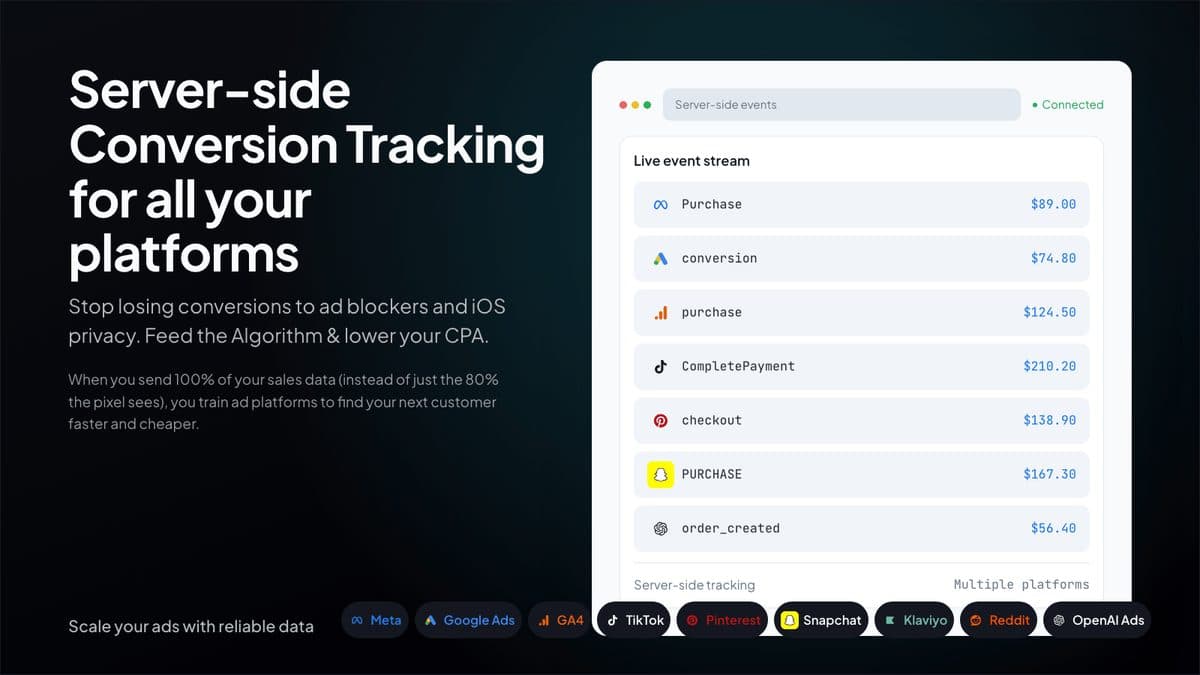
Most analytics apps report on data after it arrives. This one is the layer that gets the data there. It sends purchase and funnel events to nine platforms (GA4, Meta, TikTok, Google Ads, Reddit, OpenAI Ads, Pinterest, Snapchat and Klaviyo) using both browser and server-side delivery, so conversions still register when a browser blocks the pixel or a customer never returns to the thank-you page.
Setup is per-platform rather than all-or-nothing, and server-side events carry order and customer data from Shopify itself rather than from the session, so an ad platform can optimise on all of your conversions rather than only the ones that survive the browser.
Pricing: Free GA4-only plan up to 100 orders a month. The Plus plan is $39/month flat with unlimited orders (or $390/year). 5.0 on the App Store, Built for Shopify.
2. Polar Analytics
Best for: stores managing paid spend across Meta, Google, and TikTok who need all channel data in one dashboard.

Polar Analytics pulls data from Shopify, Meta Ads, Google Ads, TikTok Ads, Klaviyo, and other sources into a single dashboard with unified attribution modeling. Instead of switching between five separate ad platforms to understand overall ROAS, Polar shows one consolidated view with cross-channel attribution that accounts for iOS tracking gaps using first-party data modeling.
The 4.8-star rating reflects consistent quality at the price tier. Merchants at $1M+ revenue who are running multi-channel ad programs are the primary users — at that scale, the $300/mo cost is covered by the efficiency of having correct attribution data versus spending on channels that look profitable in isolation but are not.
Where it falls short: the price is prohibitive for smaller stores. For merchants spending less than $20K/mo on ads, simpler tools like Triple Whale or BeProfit deliver the most important insights at a lower cost.
Pricing: 14-day free trial. Starts at $300/mo.
3. Triple Whale
Best for: DTC brands scaling paid ad spend on Meta and Google who need accurate ROAS after iOS attribution breaks.
Triple Whale was built specifically to solve the iOS 14 attribution problem. When Apple’s App Tracking Transparency update rolled out in 2021, Meta’s pixel lost visibility into roughly 40–60% of conversion events depending on the audience. This made Meta’s in-platform ROAS numbers unreliable. Triple Whale replaces pixel-based attribution with first-party data from your Shopify orders, giving you actual ROAS numbers that match real revenue.
The Pixel feature adds Triple Whale’s own tracking script that captures conversion data server-side, bypassing the browser-level iOS restrictions. For brands spending $50K/mo or more on Meta, the difference between reported ROAS and actual ROAS can mean five-figure budget misallocations per month.
Where it falls short: at $129/mo, it is the mid-range option on this list. Smaller stores spending less than $10K/mo on ads will not see sufficient ROI from the attribution accuracy to justify the cost.
Pricing: Starts at $129/mo. No free plan.
4. Analyzely — Google Analytics 4
Best for: merchants who want GA4 connected to their Shopify store without hiring a developer to configure it.
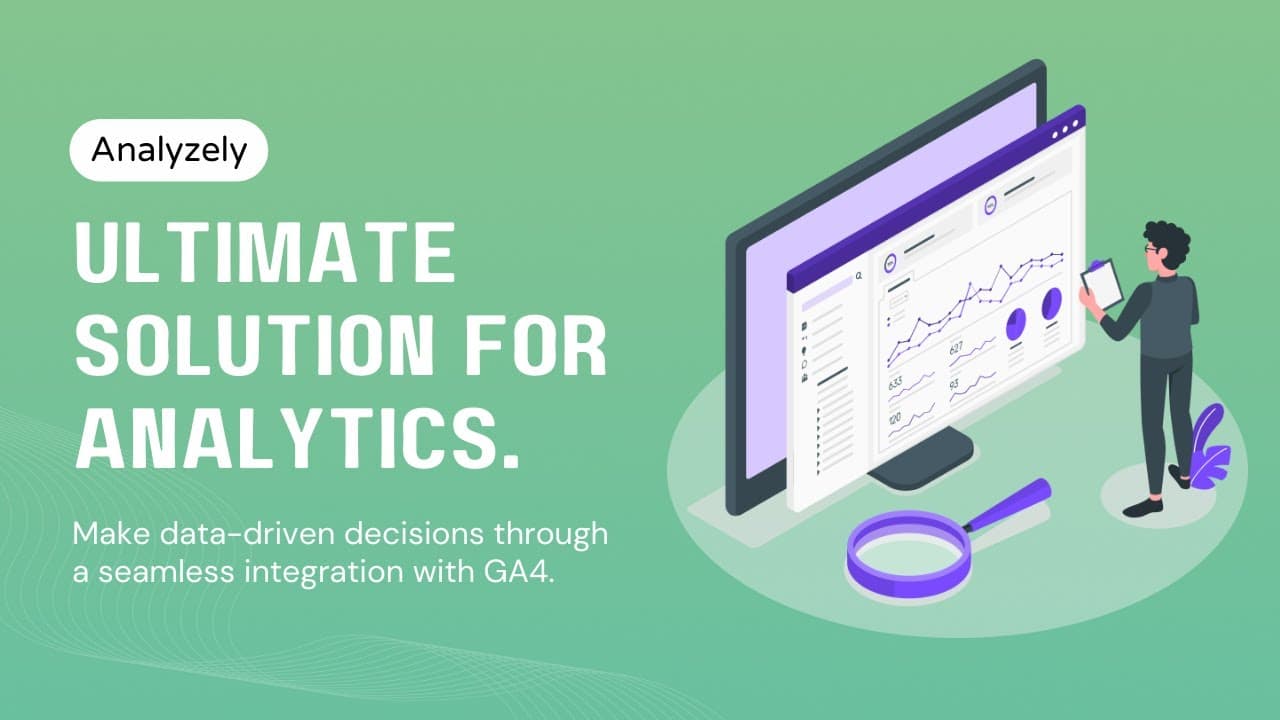
Google Analytics 4 replaced Universal Analytics in July 2023. Stores that had not migrated lost their historical data. Analyzely makes GA4 setup on Shopify accessible without code: it configures enhanced e-commerce tracking, purchase events, add-to-cart events, and product view tracking through a no-code interface.
The 4.9-star rating across 2,000+ reviews makes it one of the most trusted free tools in this category. The free plan covers standard GA4 event tracking. At $9/mo for the paid plan, it is also the most affordable paid analytics tool on this list if you want enhanced reporting beyond the free tier.
Where it falls short: Analyzely connects your store to GA4 but does not solve GA4’s inherent attribution problems post-iOS. For accurate paid ad attribution, you need Littledata’s server-side tracking or Triple Whale on top of GA4.
Pricing: Free plan available. Premium from $9/mo.
5. Lifetimely by AMP
Best for: merchants who need to understand customer lifetime value by acquisition channel, product, and cohort.
Lifetimely calculates customer lifetime value across your entire order history and lets you break it down by the channel that acquired each customer, the first product they bought, the country they ordered from, or the discount code they used. The question it answers is: which acquisition channel produces customers worth the most over 12 months, not just which channel produces the most first orders?
That distinction drives different marketing budget decisions. A channel with a $30 CAC but $120 LTV over 12 months outperforms a channel with a $20 CAC and $60 LTV. Without cohort-level LTV data, merchants systematically underinvest in the right channels.
Where it falls short: Lifetimely is a reporting tool, not an attribution platform. It tells you what happened historically. It does not replace Triple Whale or Polar Analytics for real-time campaign-level ROAS.
Pricing: Free plan available. Basic from $19/mo.
6. BeProfit — Profit Analytics
Best for: merchants who need to see actual profit margins after COGS, shipping, ad spend, and Shopify fees on every order.
BeProfit calculates true profitability per order by pulling in cost of goods, Shopify transaction fees, shipping costs, and ad spend attribution to show what each order actually generated in profit — not just revenue. Most Shopify merchants know their revenue numbers precisely and their actual profit numbers only roughly. BeProfit closes that gap.
The profit dashboard updates in real time and lets you see margin by product, collection, channel, and customer segment. For stores with complex COGS structures or high shipping costs, seeing margin per SKU reveals which products are actually contributing to the business and which are losing money at scale.
Where it falls short: COGS data accuracy depends on what you input. BeProfit does not pull product costs automatically unless they are in Shopify’s cost field — merchants with external supplier pricing need to update costs manually or via CSV.
Pricing: Free plan available. Starter from $25/mo.
7. Decile — Customer Analytics
Best for: enterprise stores that need predictive customer segmentation to identify high-LTV customers before they become high-LTV customers.
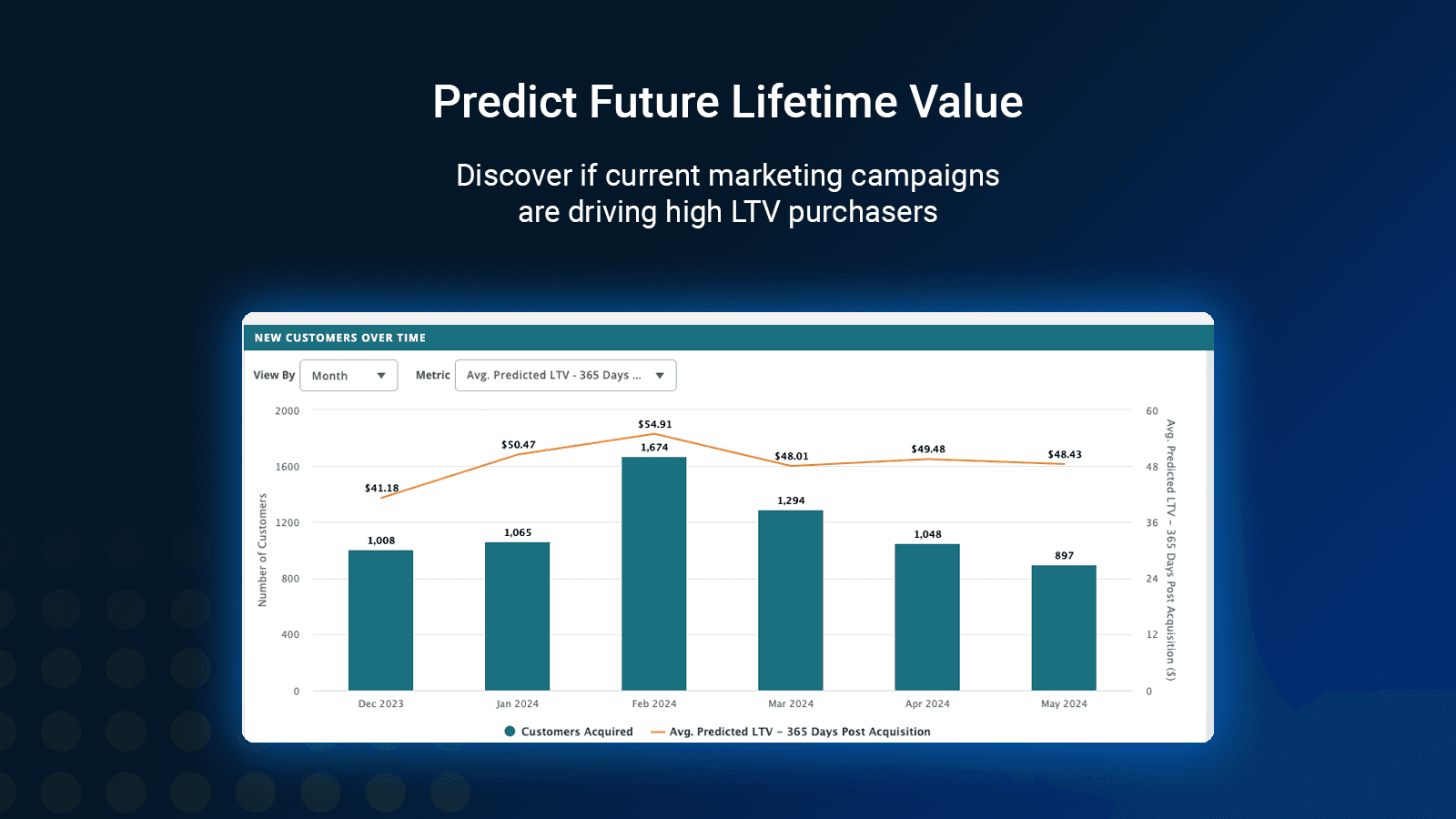
Decile uses machine learning to predict which customers acquired today are likely to become high-LTV customers based on behavioral patterns from your historical data. Rather than waiting 12 months to see which cohorts had the highest repeat purchase rates, Decile surfaces those predictions at acquisition time.
The practical application is ad campaign optimization: if Decile predicts that customers acquired via a specific creative or audience have 40% higher predicted LTV, you can bid more aggressively for those customers. At $250/mo, Decile is priced for stores with enough order volume to generate meaningful predictive signals — typically 500+ monthly orders.
Where it falls short: the price and complexity make it appropriate only for high-volume stores. For merchants under $2M annual revenue, Lifetimely delivers historical LTV data at a fraction of the cost.
Pricing: 14-day free trial. From $250/mo.
8. Littledata
Best for: stores where GA4 data is significantly undercounting conversions due to ad blockers and iOS restrictions.
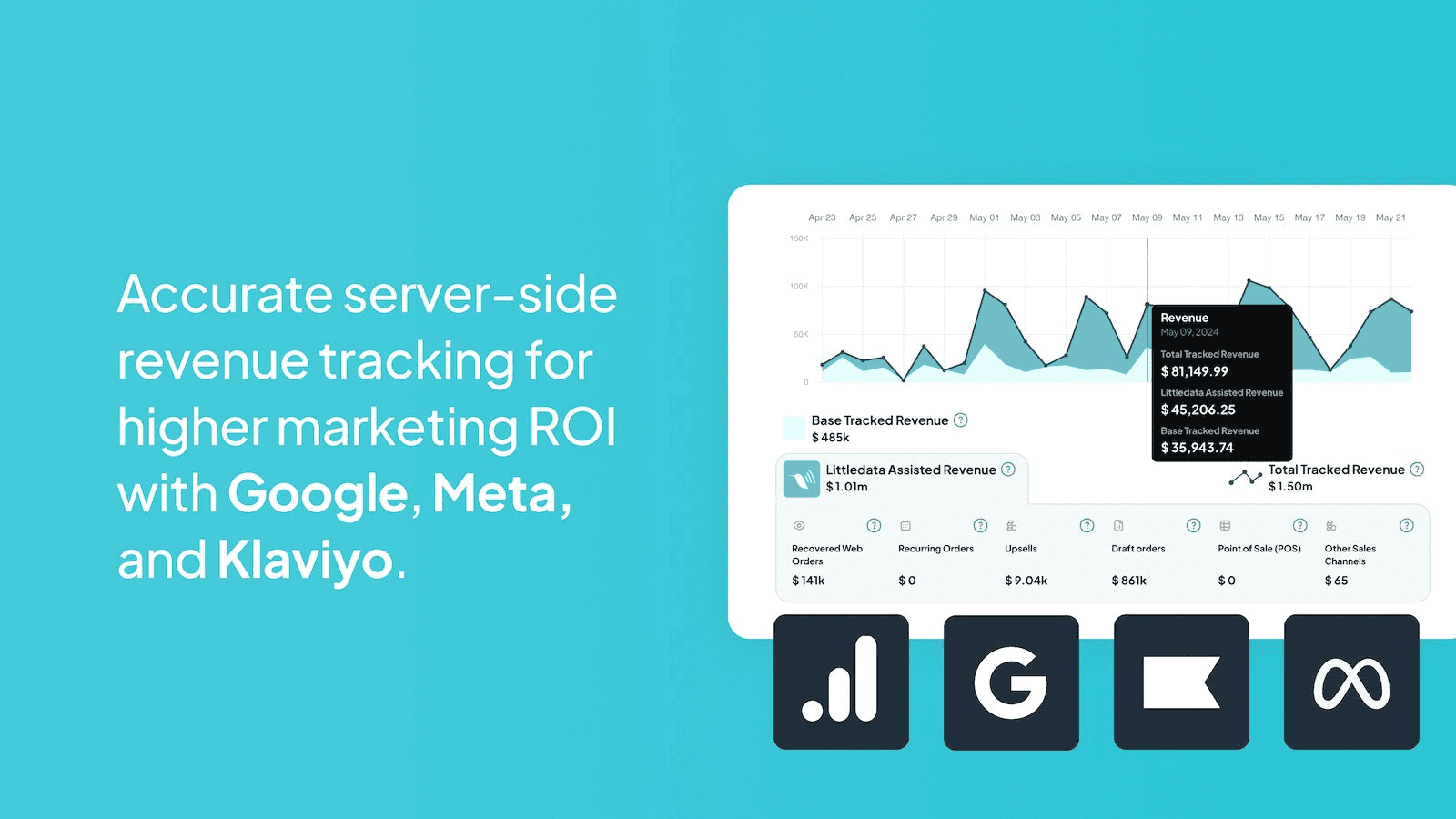
Littledata adds server-side tracking to your Shopify store, sending event data directly from Shopify’s servers to GA4 rather than relying on browser-based JavaScript. Server-side tracking bypasses ad blockers and iOS restrictions entirely, which typically recovers 20–40% of conversions that browser tracking misses.
If your GA4 reports are showing conversion counts that are clearly lower than your Shopify orders dashboard, that gap is browser-tracking data loss. Littledata closes it. At $99/mo, the cost is justified for stores spending on paid ads where inaccurate conversion data leads to incorrect campaign optimization.
Where it falls short: Littledata is a data accuracy tool, not an analytics platform. It fixes the quality of data going into GA4 — you still need GA4 or a separate analytics tool to do anything with that data.
Pricing: 7-day free trial. From $99/mo.
Which App to Choose
Start here and spend nothing: Analyzely. Free GA4 setup, 4.9 stars, covers standard e-commerce event tracking without touching code.
Need to understand which channels produce the most profitable customers over time: Lifetimely. The $19/mo cost is the best ROI analytics investment on this list for growing stores.
Seeing your actual margins per order rather than just revenue: BeProfit. Free plan available, covers COGS-adjusted profit tracking that Shopify’s dashboard does not.
Scaling Meta and Google ad spend and need correct ROAS post-iOS: Triple Whale. The server-side attribution justifies the $129/mo at any meaningful ad budget.
Managing multi-channel campaigns above $20K/mo ad spend: Polar Analytics. The unified cross-channel dashboard pays for itself in misallocation costs avoided.
How We Ranked These Apps
This ranking is based on four criteria applied to every analytics app tested for Shopify in 2026. First, Shopify App Store rating and review volume as of April 2026. Second, the specific data question the app answers that Shopify’s native reports cannot — attribution, lifetime value, profit margins, predictive segmentation, or data accuracy. Third, the minimum monthly order volume or ad spend where the app’s insights become financially meaningful. Fourth, pricing relative to the depth of data returned and the decisions that data supports.
Analytics apps return value only at specific scale thresholds — a $300/mo unified dashboard does nothing for a store doing $5K/mo in revenue, and a free GA4 setup does not solve a $500K/mo paid ads attribution problem. The ranking reflects this. Ratings and review counts are accurate at the time of our last update and can shift as apps release updates.
Frequently Asked Questions
What is the best analytics app for Shopify in 2026?
For most merchants the best starting point is Analyzely at the free tier — 4.9 stars across 2,000+ reviews, no-code GA4 setup, enhanced e-commerce event tracking included. For stores scaling paid ad spend above $50K/mo, Triple Whale at $129/mo is the default for accurate ROAS after iOS attribution changes. For understanding customer lifetime value by channel, Lifetimely at $19/mo is the best ROI pick on this list.
Is Triple Whale worth the cost for Shopify stores?
Triple Whale becomes worth the $129/mo cost once a store spends roughly $10K/mo or more on paid advertising, especially on Meta. The iOS 14 attribution gap can understate Meta-attributed revenue by 40–60% in the pixel alone — at meaningful ad budgets, incorrect attribution leads to budget misallocation that costs more per month than Triple Whale itself. Below that ad spend threshold, simpler tools like Lifetimely or BeProfit cover the critical insights more cost-effectively.
How is Shopify’s native analytics different from third-party apps?
Shopify’s built-in analytics report revenue, orders, sessions, and conversion rates at a store level. Third-party analytics apps add what Shopify cannot: multi-channel attribution, customer lifetime value by cohort, profit margins after COGS and ad spend, predictive segmentation, and server-side tracking for accurate GA4 data. Shopify tells you what happened; analytics apps tell you why and what to do about it.
Do I need GA4 on Shopify if I have other analytics apps?
Yes, in most cases. GA4 is the industry standard for website analytics and integrates with Google Ads for campaign optimization. Other analytics apps answer specific questions — attribution, LTV, profit — that GA4 does not. Running GA4 via Analyzely alongside a specialized tool like Triple Whale or Lifetimely gives you the full picture. Littledata is relevant if your GA4 data is significantly undercounting conversions due to ad blockers.
What is the cheapest Shopify analytics app?
Analyzely is the cheapest with a genuine free plan that covers GA4 integration and enhanced e-commerce event tracking. The $9/mo paid tier unlocks more advanced reporting. BeProfit and Lifetimely also offer free plans, each with partial feature access. For merchants not yet running paid ads, the Analyzely free tier is enough to get Shopify connected to GA4 properly.
How do I fix Shopify GA4 tracking that is missing conversions?
Missing conversions in GA4 typically come from two causes: ad blockers and iOS restrictions blocking browser-based JavaScript, or GA4 not being configured to capture Shopify purchase events properly. Analyzely fixes the configuration side by setting up enhanced e-commerce events correctly. Littledata fixes the browser tracking side with server-side tracking that bypasses blockers. Stores needing both accurate event configuration and server-side tracking run Analyzely plus Littledata together.
What is the difference between Polar Analytics and Triple Whale?
Both solve multi-channel attribution but at different scales. Triple Whale ($129/mo) focuses on paid ad ROAS — Meta, Google, TikTok — with server-side pixel tracking. Polar Analytics ($300/mo) is a broader unified dashboard that pulls in Shopify, ad platforms, email tools like Klaviyo, and custom data sources with cross-channel attribution modeling. Triple Whale is right for ad-focused stores. Polar is right for stores running complex multi-channel programs above $20K/mo ad spend where one unified view prevents channel-by-channel misallocation.
Can I measure actual profit per order on Shopify?
Yes. BeProfit calculates true profit per order by pulling in cost of goods (from Shopify’s cost field), Shopify transaction fees, shipping costs, and ad spend attribution. The result is profit margin per order, per product, per collection, and per customer segment — rather than the revenue-only view in Shopify’s native reports. Accuracy depends on keeping product costs updated in Shopify or via BeProfit’s CSV import.
What is customer lifetime value (LTV) and why does it matter for Shopify stores?
Customer lifetime value is the total revenue a customer generates across all their orders, not just their first one. It matters because acquisition channels are often ranked by cost per first order, which misleads budget decisions — a channel with higher CAC but much higher LTV produces more total profit than a cheaper channel with low repeat rates. Lifetimely breaks down LTV by channel, product, and cohort, which lets merchants allocate acquisition budget to the channels that produce the most profitable long-term customers.
Should I combine an analytics app with conversion-rate apps on Shopify?
Yes — analytics tells you what is happening, conversion-rate apps act on it. For example, analytics data identifying low-AOV customer segments pairs well with our Bundles & Upsell app for driving higher order value, or pop-up apps for capturing visitors identified as high-intent in analytics data. The analytics layer answers “what should we change” and the optimization apps apply the changes.