Best Shopify Wholesale Apps 2026 — B2B Platforms, Tier Pricing, Quote Management & Net Terms Ranked

Last updated: May 2026 · Pricing verified May 4, 2026 · Reviewed by the Libautech team, builders of Bundles & Upsell, Sticky Add to Cart, Announcement Bar, and 7 other Shopify apps used by 5,000+ merchants across 50+ countries.

Key Takeaways

  • Wholesale apps for Shopify cover four distinct jobs: comprehensive B2B platforms (Sparklayer, BSS, Wholesale Gorilla) handling pricing plus quotes plus payment terms, lightweight tier-pricing tools (SC Wholesale Pricing, NetWise) for stores with simple wholesale needs, access-control apps (B2B Login Lock) for password-protected wholesale-only experiences, and native Shopify B2B (included with Plus) for stores at the $2,300+/mo plan tier. Most stores need one app that covers two or three of these jobs rather than four separate tools.
  • Shopify Plus merchants get B2B functionality natively at no extra app cost. Customer-specific catalogs, price lists, payment terms, and a dedicated B2B storefront. Non-Plus merchants on Basic, Grow, or Advanced plans need a third-party app to access these features. The Plus upgrade decision is meaningful when wholesale revenue justifies the $2,300+/mo cost or enterprise buyer integrations are required.
  • B2B orders typically run 5-10x larger than DTC orders. The wholesale app you choose directly affects approval workflows, payment terms (Net 30/60/90), tax exemption handling, and minimum order quantity enforcement, all of which have major margin implications. A single B2B order at $5,000-50,000 can offset months of DTC orders, which is why getting the wholesale app fit right matters meaningfully more than getting the DTC tool fit right.
  • Quote management and Net payment terms are the two highest-value features for B2B Shopify merchants. Quote requests let large buyers negotiate before purchasing rather than forcing them through standard checkout. Net terms (pay later) match how B2B buyers actually pay their suppliers. Apps that handle both well (BSS, Sparklayer, Wholesale Gorilla, native Plus B2B) earn their cost through deal close rate improvements rather than through feature breadth alone.
  • Pricing varies dramatically across the category. SC Wholesale Pricing starts at $19/mo, BSS goes from free to $50/mo, Wholesale Gorilla starts at $39.95/mo, Sparklayer scales with revenue from $69/mo. Match the app to the size of the wholesale operation. Stores doing $50K/year wholesale do not need Sparklayer; stores doing $5M/year wholesale will outgrow SC Wholesale Pricing within months.
  • Wholesale apps pair well with conversion tools rather than replacing them. The honest stack for most stores is one wholesale app plus Libautech's Bundles & Upsell, Sticky Add to Cart, and Announcement Bar on the $9.99/mo Package plan. Wholesale upsells on B2B carts compound dramatically because B2B AOV is 5-10x higher than DTC, which means each successful upsell adds meaningfully more revenue per occurrence than the same upsell on a DTC cart.

The Four Jobs of Shopify Wholesale Apps

"Wholesale app" is a loose category covering four distinct jobs that share the goal of supporting B2B commerce on Shopify but differ completely in implementation, pricing, and operational complexity. Most wholesale app comparisons treat these jobs interchangeably, which produces misleading recommendations because an app that excels at quote management often falls short on tier pricing simplicity, and vice versa. The right choice depends on which job is actually material to the store.

The first job is comprehensive B2B platforms. The threat: stores running serious B2B operations need pricing tiers, quote requests, Net payment terms, tax exemptions, minimum order quantities, buyer approval workflows, and customer hierarchies all coordinated together. Stitching together five separate tools creates data fragmentation and approval-workflow gaps that cost deals. The fix: one app that handles the full B2B workflow as an integrated system. Sparklayer, BSS, and Wholesale Gorilla lead this category. The right pick depends on operation scale (Sparklayer for enterprise, BSS for mid-market, Wholesale Gorilla for streamlined US-focused setup).

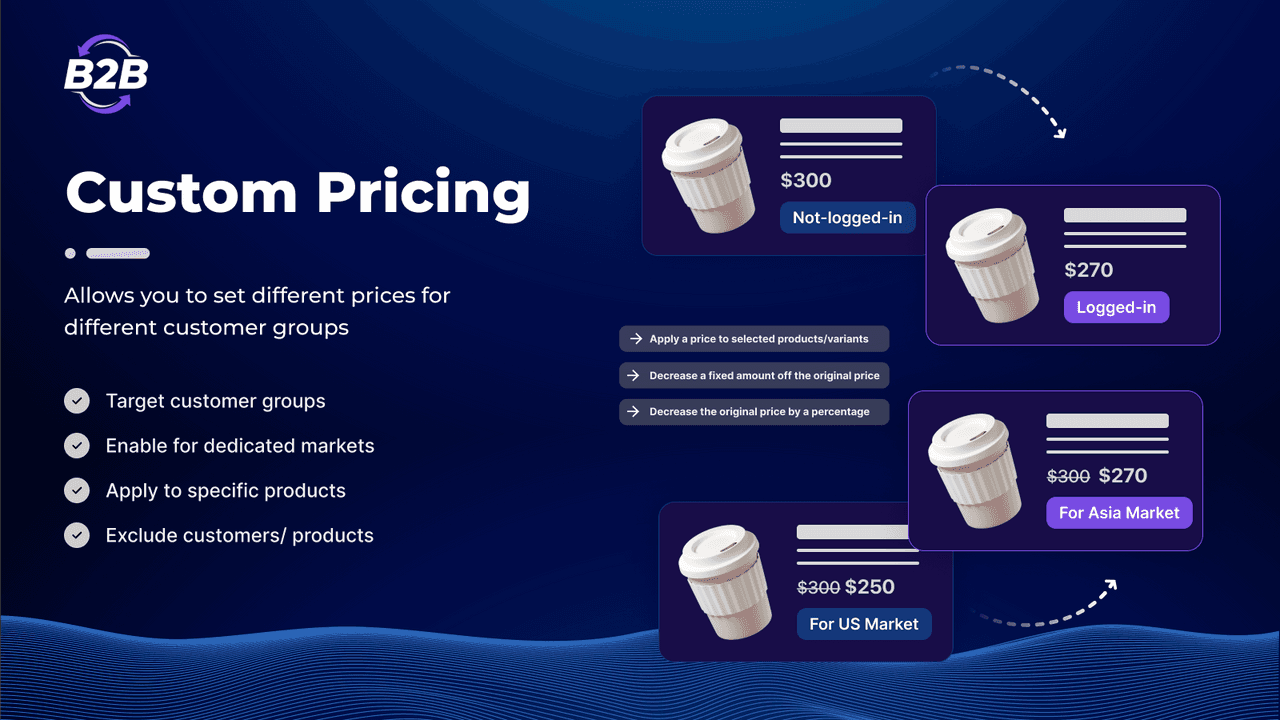
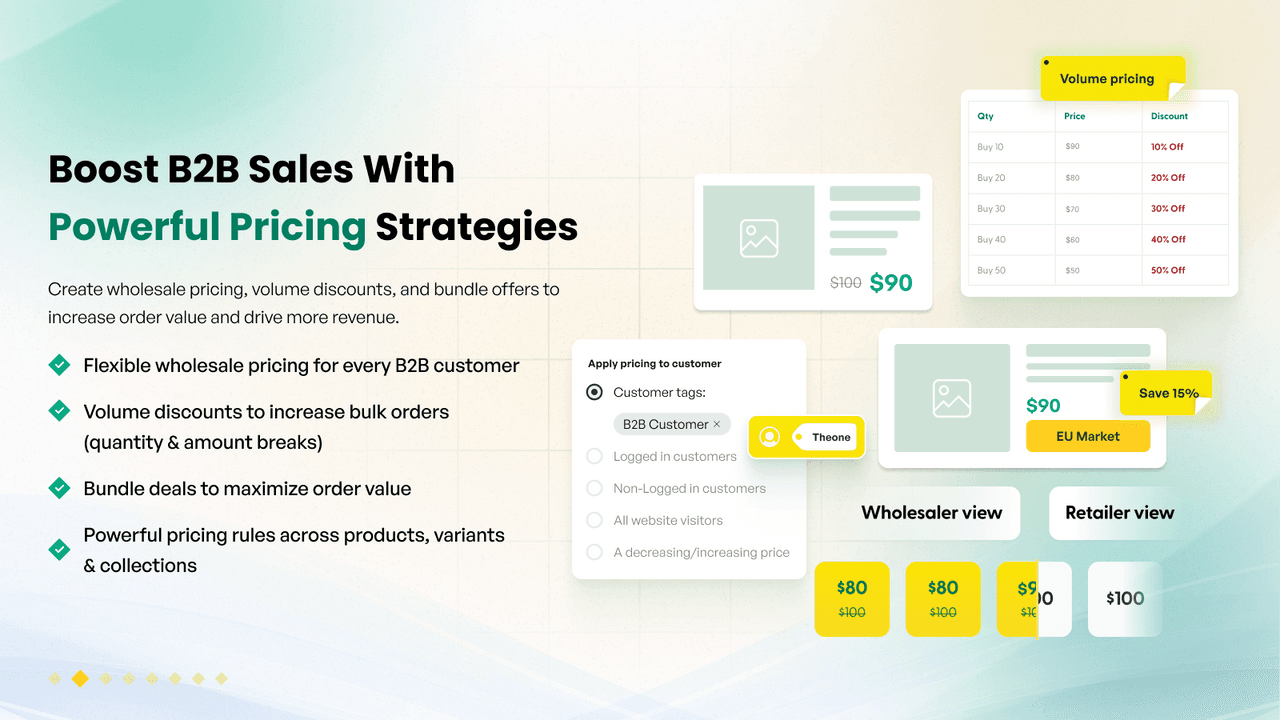
The second job is lightweight tier pricing. The threat: stores adding wholesale as a side channel to existing DTC need customer-tagged pricing without the complexity of full B2B platforms. Installing Sparklayer or BSS for a store doing $50K/year wholesale is operational overhead disproportionate to the channel size. The fix: a focused tier-pricing app that handles tagged customer groups, volume discounts, and quantity breaks at minimal cost and setup time. SC Wholesale Pricing and NetWise lead this category. The lightweight focus is the strength (low cost, fast setup) and the limitation (will be outgrown by serious B2B operations within 6-12 months).

The third job is wholesale access control. The threat: brands with luxury or exclusive wholesale arrangements need the entire wholesale section of the storefront hidden from non-buyers. Customers seeing wholesale prices on the public catalog hurts brand perception and negotiation leverage with retailers. The fix: an access-control app that gates the wholesale storefront behind a login wall. Approved buyers log in and see B2B pricing, products, and content; everyone else sees a login wall. B2B Login Lock leads this category. This is a complement to the wholesale platform, not a replacement, so it pairs with BSS or Wholesale Gorilla rather than running standalone.

The fourth job is native Shopify B2B. The mechanic: Shopify Plus merchants get the full B2B feature set built into the platform at no additional app cost. Customer-specific catalogs, custom price lists, multi-location accounts, Net payment terms (15/30/60/90), and a dedicated B2B storefront flow through the standard Shopify admin. Best fit: every Shopify Plus merchant. The integration depth with Shopify (orders, customers, inventory, taxes) is something no third-party app matches. Plus merchants only consider third-party apps if they need very specific features that the native platform does not handle (industry-specific quote workflows, advanced approval routing, or buyer-side integration with NetSuite/SAP).

How We Ranked These Apps

This ranking is based on four criteria applied to every Shopify wholesale app tested in 2026, weighted by merchant impact. First, Shopify App Store rating and verified review volume as of May 4, 2026. Wholesale apps that have accumulated thousands of reviews at 4.7+ ratings have a real track record across thousands of stores running active B2B operations. Second, depth of B2B feature coverage including customer-specific pricing, quote management, Net payment terms (15/30/60/90), tax exemptions, minimum order quantities, and buyer approval workflows. Third, scale handling across realistic wholesale operation sizes. Smaller pricing tools work for $50K/year wholesale operations; enterprise platforms like Sparklayer earn their cost above $1M/year. Fourth, integration with the broader commerce stack including ERPs (NetSuite, SAP, Microsoft Dynamics), accounting tools (QuickBooks, Xero), and payment processors that handle Net term invoicing.

Wholesale apps are not always mutually exclusive. B2B Login Lock pairs with BSS or Wholesale Gorilla for invitation-only B2B catalogs. Shopify Plus merchants sometimes layer Sparklayer on top of native B2B for enterprise buyer-portal customization that goes beyond what native B2B offers. Apps were ranked higher when they declared their fit clearly rather than marketing themselves as universal solutions, because the wrong wholesale app for the operation size produces meaningfully worse outcomes than the right wholesale app at moderate feature depth.

Every pricing figure in this post was verified directly from the live Shopify App Store listing on May 4, 2026. Wholesale app pricing structures change frequently as the B2B Shopify category evolves, so always confirm current pricing on the official listing before installing. Ratings and review counts reflect the Shopify App Store at the time of our last update.

1. Shopify B2B (Native, Plus Plan)

Rating: Built into Shopify Plus · Pricing: Included with Shopify Plus ($2,300+/mo) · Best for: Shopify Plus merchants wanting B2B functionality at no extra app cost with the deepest platform integration possible · Job solved: Native B2B platform with full feature coverage

Shopify B2B on Plus is included at no extra cost and handles the full B2B workflow natively. Customer-specific catalogs, custom price lists, multi-location accounts (one buyer with multiple delivery addresses), Net payment terms (Net 15, 30, 60, 90), and a dedicated B2B storefront experience. Quote requests and draft orders flow through the standard Shopify admin without requiring separate workflows or third-party tooling. For Plus merchants, this is the default starting point because the integration depth with Shopify (orders, customers, inventory, taxes, marketing) is something no third-party app can match.

Core features: customer-specific catalogs that show different products to different B2B buyers; custom price lists with tier-based pricing rules; multi-location accounts where one company has multiple delivery addresses (parent-child account hierarchy); Net payment terms (15/30/60/90 days) with automatic invoicing; minimum order quantity enforcement at the cart level; tax exemption handling for qualified B2B buyers (resale certificates, VAT exemptions); dedicated B2B storefront with separate URL structure (/wholesale or similar); buyer self-registration with merchant approval workflow; integration with Shopify Flow for custom approval automation; and integration with all native Shopify features (Markets, multi-currency, Shopify Capital, Shopify Email). Where it falls short: Plus only at $2,300+/mo entry price, which makes the B2B feature set the wrong fit for stores below the revenue threshold where Plus pricing is justified by the broader Plus feature set. Buyers see Shopify's standard B2B storefront design with limited customization compared to some third-party apps that offer fully branded buyer portals (Sparklayer wins on this dimension). Quote workflow is functional but lighter than dedicated quote-management apps like BSS for stores with complex quote-driven sales motions.

2. Sparklayer B2B

Rating: 4.9/5 across 200+ reviews · Pricing: Paid from $69/mo, scales with revenue · Best for: Mid-market and enterprise wholesale operations needing a fully branded B2B buyer portal with quote management, customer hierarchies, and ERP integrations · Job solved: Enterprise-grade B2B platform with branded buyer portal and ERP integration

Sparklayer is the most enterprise-grade B2B app on Shopify outside of native Plus B2B. The buyer portal is fully customizable to match brand identity, not just adjusted CSS but a separate frontend experience that matches the brand's visual identity completely. Customer hierarchies (parent-child accounts, regional reps, sub-buyers under one company) are first-class features rather than retrofitted onto a DTC framework. ERP integrations (NetSuite, SAP, Microsoft Dynamics) move data both directions for stores running serious B2B operations with existing enterprise infrastructure.

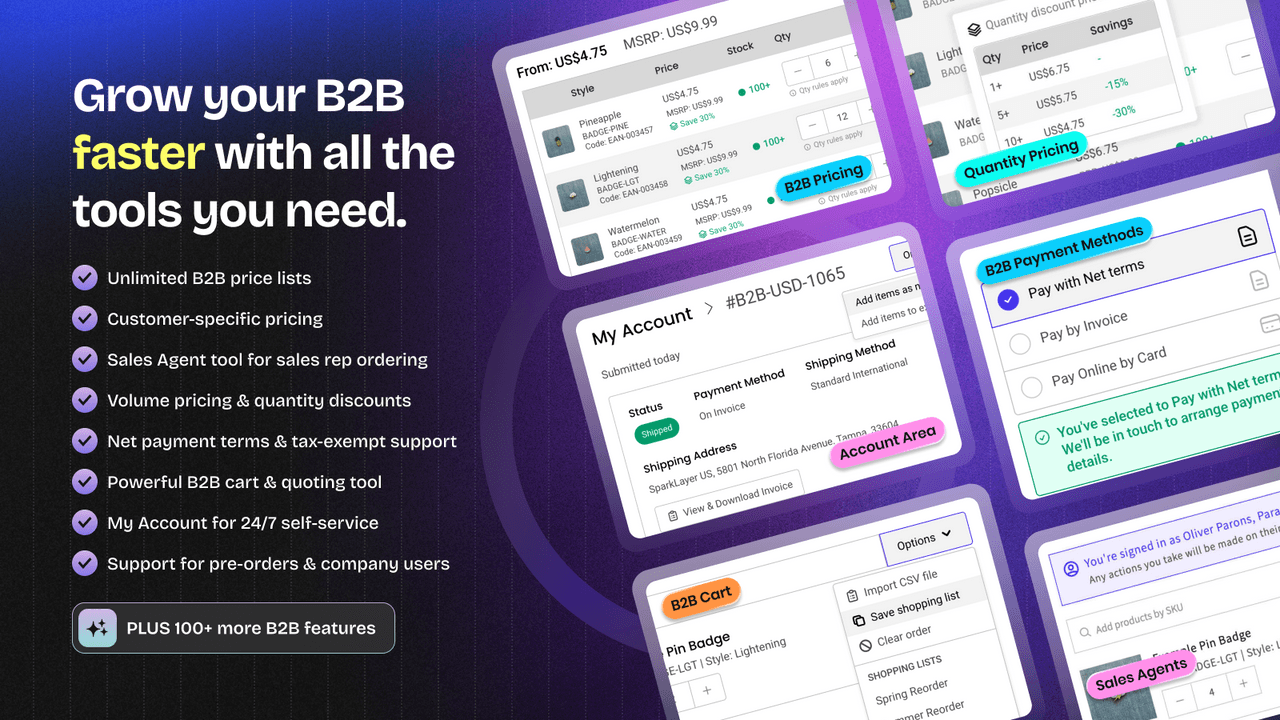
Core features: fully branded buyer portal with separate frontend experience matching brand identity; customer hierarchies supporting parent-child accounts, regional reps, and sub-buyers under one company; deep ERP integrations (NetSuite, SAP, Microsoft Dynamics, Sage) with bidirectional data flow; quote request and management workflow with negotiation history; Net payment terms (15/30/60/90/180) with automatic invoice generation; multi-currency and multi-language support for international wholesale operations; per-customer per-SKU contract pricing with time-limited promotional pricing; integration with major shipping carriers for B2B-specific freight rates; reorder workflow letting buyers reorder past purchases in one click; and dedicated account manager support included on higher tiers. Where it falls short: pricing is on the higher end starting at $69/mo and scaling with revenue, which makes Sparklayer the wrong pick for smaller wholesale operations. Setup time is meaningfully longer than simpler apps because the enterprise feature depth requires proper configuration to use correctly. Smaller install base than BSS (200 vs thousands of reviews) reflects the enterprise focus, not lower quality, but stores wanting maximum review-validated reliability may find this concerning. Best fit for wholesale operations doing $1M+ annually with complex buyer relationships and existing ERP infrastructure.

3. BSS: B2B & Wholesale Solution

Rating: 4.9/5 across 1,000+ reviews · Pricing: Free plan, paid from $25/mo · Best for: Stores wanting comprehensive B2B features (quote requests, Net terms, tax exemptions, custom pricing tiers) at a mid-tier price point with strong free plan to test before committing · Job solved: Mid-tier all-in-one B2B platform with broadest feature breadth per dollar

BSS delivers the broadest feature set for the price in the wholesale category. The all-in-one platform covers custom pricing tiers, quote request workflows where buyers can negotiate before checkout, manual customer approval workflows (verify B2B accounts before granting wholesale access), automatic VAT and tax exemption for qualified buyers, and minimum order quantities. The free plan makes it easy to test before committing to paid pricing. The 4.9-star rating across 1,000+ reviews reflects deep feature coverage and active development that has kept BSS competitive against newer entrants in the category.

Core features: custom pricing tiers with tagged customer groups; quote request workflow where buyers submit quotes for negotiation before checkout; manual buyer approval workflow with merchant review of B2B account applications; automatic VAT and tax exemption for qualified buyers (resale certificates, B2B VAT registration); minimum order quantity enforcement at product or cart level; Net payment terms (15/30/60/90) with invoice generation; volume-based pricing with quantity breaks; integration with Shopify Flow for custom approval automation; multi-language and multi-currency support; bulk order forms for buyers ordering large quantities across multiple SKUs; and a free plan covering basic features (sufficient for testing the approach before committing to the paid tier). Where it falls short: UI can feel busy with so many features, which means the configuration takes longer than simpler tools like SC Wholesale Pricing. Setup time is longer than streamlined alternatives because the feature breadth requires the merchant to make decisions about which features apply to their specific B2B model. The mid-tier price point at $25-50/mo is the wrong fit for very small wholesale operations doing under $50K/year (SC Wholesale Pricing at $19/mo is sufficient) or very large operations doing $5M+ (Sparklayer's enterprise depth is what justifies the higher cost).

4. Wholesale Gorilla

Rating: 4.7/5 across 700+ reviews · Pricing: Paid from $39.95/mo · Best for: US-based merchants wanting streamlined wholesale setup with auto-approval workflows and protected wholesale-only pages · Job solved: Streamlined US-focused B2B platform with fast setup time

Wholesale Gorilla focuses on getting wholesale operational fast. The positioning: rather than competing on feature depth (BSS wins) or enterprise polish (Sparklayer wins), Wholesale Gorilla wins on speed-to-launch. Auto-approval workflows let qualified buyers self-register and immediately access wholesale pricing without merchant manual approval steps. Volume-based pricing creates automatic discounts that encourage larger orders. Wholesale-only product pages and pricing stay hidden from regular DTC customers, which means the B2B catalog does not appear on the public site without manual access-control configuration.

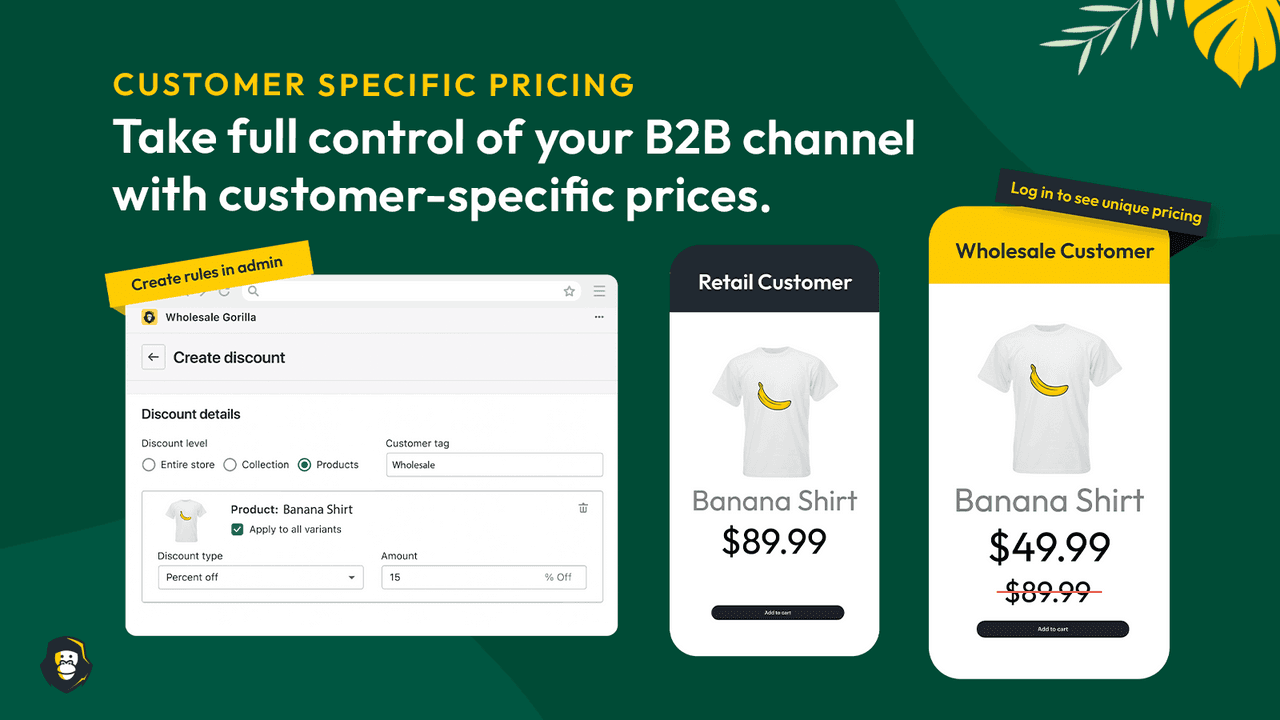
Core features: auto-approval workflow letting qualified buyers self-register and access wholesale pricing immediately; volume-based pricing with automatic quantity-break discounts encouraging larger orders; wholesale-only product visibility that hides B2B catalog from public DTC traffic; quick order forms for buyers ordering large quantities across multiple SKUs; tag-based customer pricing with multi-tier support; minimum order quantity enforcement; integration with Shopify's standard checkout for buyer-familiar UX; tax exemption handling for US resale certificates; and bulk import tools for migrating existing wholesale customer lists from spreadsheets or other platforms. Where it falls short: not as feature-deep as BSS for quote management or international tax handling. Pricing is mid-tier at $39.95/mo, which is more expensive than BSS ($25/mo) for less feature breadth. Smaller install base than BSS (700 vs 1,000+ reviews). Best fit for US merchants prioritizing speed-to-launch over feature depth, where the operational simplicity of Wholesale Gorilla justifies the price premium over BSS. The fast setup time is what justifies the spend for stores wanting to launch wholesale within days rather than weeks of configuration.

5. SC Wholesale Pricing

Rating: 4.7/5 across 1,500+ reviews · Pricing: Paid from $19/mo · Best for: Stores with simple wholesale needs wanting customer-tier pricing without the complexity of quote requests, Net terms, or approval workflows · Job solved: Lightweight tier-pricing tool at the lowest paid price point in the category

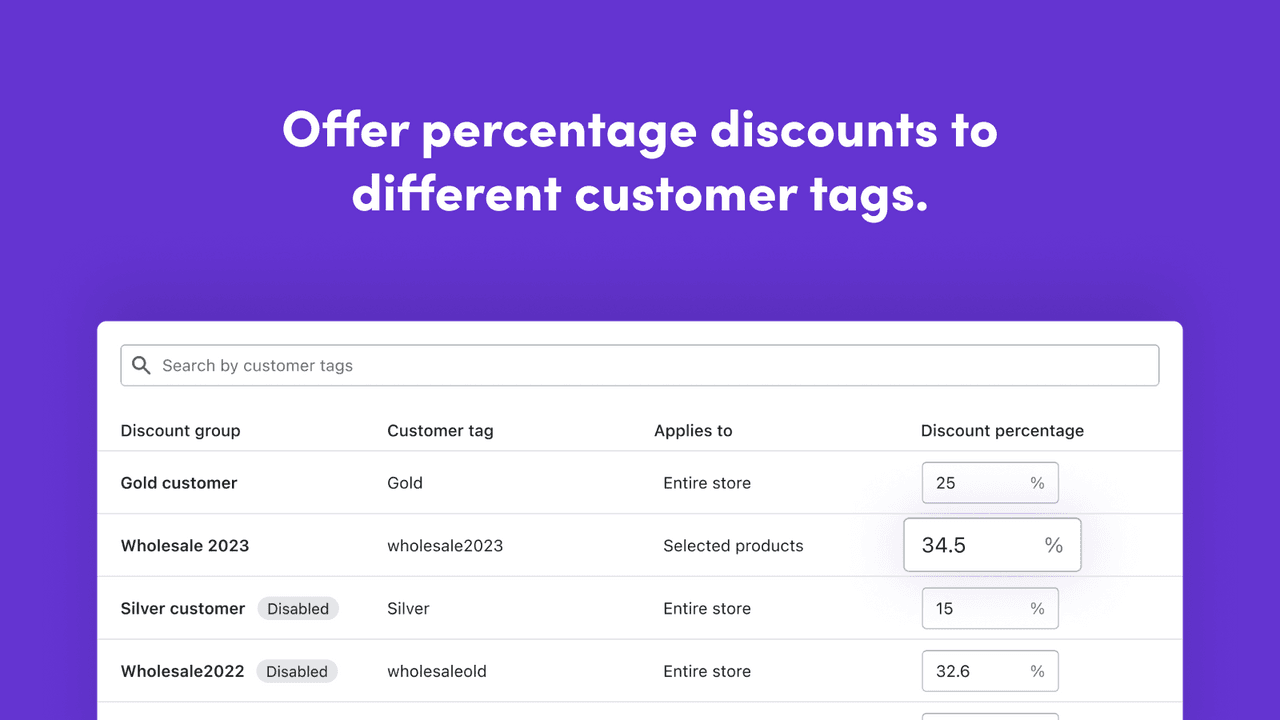
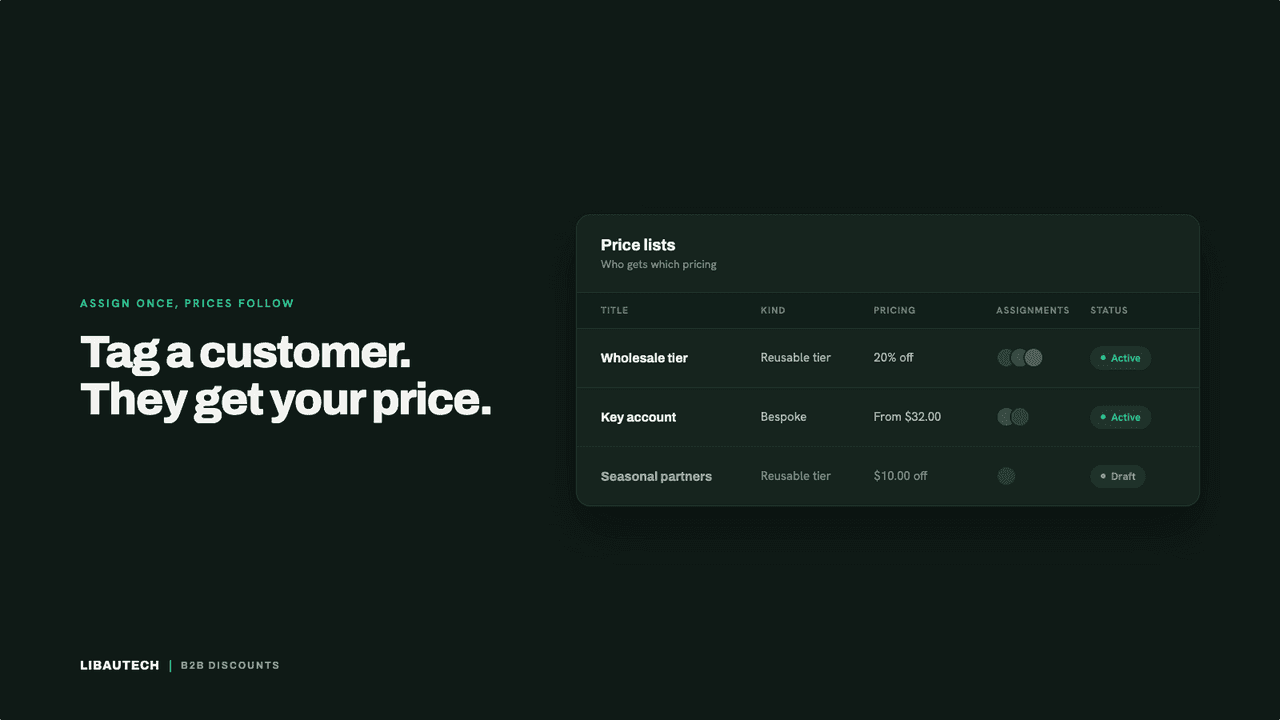
SC Wholesale Pricing focuses on one job and does it well: tiered pricing for tagged customer groups. The positioning: rather than competing as a full B2B platform, SC Wholesale Pricing wins on simplicity and cost. Tag a customer as "wholesale-tier-1," they see 30% off automatically. Volume discount tiers add bulk-purchase incentives. Quantity breaks support mix-and-match within bundles. For stores adding wholesale as a side channel to existing DTC, rather than building a full B2B operation, SC Wholesale Pricing is the simplest and most affordable option in the category.

Core features: tag-based customer pricing with unlimited tier definitions; volume discount tiers with automatic application as cart quantities cross thresholds; quantity breaks supporting mix-and-match within bundles; percentage-based or fixed-amount discounting per tier; integration with Shopify's standard checkout (no separate B2B portal); manual customer tagging through Shopify admin or bulk-import tools; basic minimum order quantity enforcement at cart level; and the lowest paid-tier price in the dedicated wholesale category at $19/mo. Where it falls short: no quote management, no Net payment terms, no buyer-side approval workflow. Stores running serious B2B will outgrow SC Wholesale Pricing within 6-12 months as the operation grows past simple tier pricing into quote-driven sales and Net term billing. The simplicity is the strength (fast setup, low cost) and the limitation (does not scale with operational complexity). Best fit for stores at the early stage of wholesale where the operation is generating $50-200K/year and the customer count is under 50 active wholesale accounts.

6. NetWise B2B Pricing

Rating: 4.8/5 across 300+ reviews · Pricing: Paid from $19/mo · Best for: Stores needing custom pricing plus Net payment terms (Net 30/60) on a budget without paying enterprise-tier app prices · Job solved: Budget-friendly Net term invoicing combined with tier pricing

NetWise covers the two B2B fundamentals (customer-tagged pricing and Net payment terms) at a price point that makes B2B accessible for smaller operations. The positioning: rather than competing on feature breadth (BSS wins) or specialty (Sparklayer wins), NetWise focuses on the two highest-impact B2B features at the lowest paid price point. Tiered pricing structures handle differentiated wholesale customer groups. The Net terms feature lets buyers complete checkout and pay later (15/30/60/90 days), matching how B2B buyers actually pay suppliers in practice rather than forcing them through immediate-pay checkout that does not match B2B procurement workflows.

Core features: tag-based customer pricing with multi-tier support; Net payment terms (15/30/60/90) with automatic invoice generation through Shopify's draft order system; native Shopify checkout integration so buyers do not navigate to a separate B2B portal; integration with major accounting tools (QuickBooks, Xero) for automated invoice reconciliation; minimum order quantity enforcement; volume discount support with quantity breaks; tax exemption handling for qualified B2B buyers; and the lowest paid-tier price among apps offering Net term invoicing at $19/mo. Where it falls short: no quote management, which means stores with quote-driven sales motions need to coordinate quote workflows manually outside the app. Smaller feature set than BSS for the same price tier (BSS includes quote management at $25/mo). Smaller install base (300 vs 1,000+ reviews) means slightly less long-term stability data. Best fit for stores transitioning from manual invoicing workflows to automated wholesale where the Net term invoicing is the primary need, before scaling up to BSS or Sparklayer at higher operational complexity.

7. B2B Login Lock

Rating: 4.9/5 across 200+ reviews · Pricing: Free plan, paid from $9.95/mo · Best for: Stores running invitation-only wholesale where the entire wholesale catalog needs to be password-protected from the public internet · Job solved: Wholesale access control gating B2B catalogs behind login walls

B2B Login Lock solves a narrow but important problem: hiding the wholesale section of a Shopify store entirely from non-buyers. The positioning: rather than competing as a wholesale platform, B2B Login Lock works in combination with another wholesale app (BSS, Wholesale Gorilla, Sparklayer) that handles the actual pricing logic. Approved buyers log in and see B2B pricing, products, and content; everyone else sees a login wall. For brands with luxury or exclusive wholesale arrangements where the catalog itself is confidential (premium DTC brands selling to authorized retailers, exclusive distribution agreements with regional partners), this is the only clean solution on Shopify.

Core features: storewide access control gating the entire B2B catalog behind a login wall; product-specific access control allowing some products to be public while others stay B2B-only; custom login page styling matching brand identity; password-protect entire pages or product collections; integration with major wholesale apps (BSS, Wholesale Gorilla) so access control layers cleanly on top of pricing logic; manual buyer approval workflow with merchant review of access requests; bulk customer import for migrating existing buyer lists; mobile-responsive login experience; and a free plan covering basic password protection (sufficient for testing the approach before committing to the paid tier). Where it falls short: not a wholesale platform on its own, just access control. Pair B2B Login Lock with BSS or Wholesale Gorilla for the full wholesale operation. Smaller install base (200 reviews) reflects the narrow specialist focus rather than category dominance. Best fit for stores where the wholesale catalog itself is confidential information, not just the prices.

8. Wholesale Helper

Rating: 4.8/5 across 500+ reviews · Pricing: Free plan, paid from $24.99/mo · Best for: Mid-market stores wanting deeper wholesale features than SC Wholesale Pricing plus broader integration than NetWise at a lower cost than BSS · Job solved: Mid-tier wholesale platform combining tier pricing with Net terms and quote management at value pricing

Wholesale Helper positions between the lightweight tier-pricing tools (SC Wholesale Pricing, NetWise) and the comprehensive platforms (BSS, Wholesale Gorilla). The pitch: deeper feature coverage than the lightweight tools, broader integration than NetWise's Net-term focus, at a meaningfully lower cost than BSS's $25/mo paid tier when including the free plan transition path. For mid-market stores ($250K-1M/year wholesale revenue) that have outgrown SC Wholesale Pricing's simplicity but find BSS or Sparklayer overkill at their scale, Wholesale Helper provides a middle ground.

Core features: tier-based custom pricing with tagged customer group support; Net payment terms (15/30/60) with invoice generation; quote request workflow for buyer-side negotiation before checkout; minimum order quantity enforcement at product and cart levels; volume discount support with quantity breaks; tax exemption handling for qualified buyers; integration with Shopify Flow for custom approval automation; bulk customer import and tag management; and a free plan covering basic tier pricing (sufficient for testing before committing to the paid subscription). Where it falls short: smaller install base than BSS (500 vs 1,000+ reviews) means slightly less long-term stability data. Quote management depth does not match BSS's specialist focus on quote-driven sales motions. The mid-tier positioning means Wholesale Helper is the wrong pick for stores that genuinely need either pure simplicity (SC Wholesale Pricing is cheaper) or full enterprise depth (Sparklayer is the right fit at scale). Best fit for stores at the specific revenue range where BSS feels expensive but the lightweight tools feel limiting.

Comparison Table: 8 Best Shopify Wholesale Apps (2026)
AppJobRatingPricingBest For
Shopify B2B (Plus)Native B2B platformN/APlus onlyShopify Plus merchants
Sparklayer B2BEnterprise B2B4.9/5 (200+)$69/mo$1M+ wholesale operations
BSSMid-tier all-in-one4.9/5 (1,000+)Free, $25/moBest feature breadth per dollar
Wholesale GorillaStreamlined B2B4.7/5 (700+)$39.95/moFast US-focused setup
SC Wholesale PricingTier pricing only4.7/5 (1,500+)$19/moSimple wholesale needs
NetWise B2BNet terms + pricing4.8/5 (300+)$19/moBudget Net term invoicing
B2B Login LockAccess control4.9/5 (200+)Free, $9.95/moPassword-protected catalogs
Wholesale HelperMid-tier all-in-one4.8/5 (500+)Free, $24.99/moMid-market middle ground

Picking the Right Wholesale Stack by Operation Profile

The decision tree is shaped by wholesale revenue scale and feature complexity. Stores already on Shopify Plus: Shopify B2B Native. The included native solution beats most third-party apps for Plus merchants because the integration depth with Shopify infrastructure cannot be matched by any third-party app. Plus merchants only consider third-party apps for very specific feature gaps (industry-specific quote workflows, advanced approval routing, NetSuite/SAP buyer-side integration).

Mid-market or enterprise wholesale operations doing $1M+ annually with custom buyer portal needs: Sparklayer at $69/mo. The most enterprise-grade B2B app for non-Plus merchants. Best fit when the wholesale operation has complex buyer relationships (parent-child accounts, regional reps), existing ERP infrastructure (NetSuite, SAP, Microsoft Dynamics) that needs bidirectional data flow, and brand identity requirements that exceed what third-party apps with adjustable CSS can produce.

Stores wanting full B2B feature set (quotes, Net terms, tax, approvals) at mid-tier price: BSS at $25-50/mo. Best feature breadth per dollar in the wholesale category. The free plan makes it easy to test before committing to paid pricing. Right pick for stores that need most B2B features but do not need Sparklayer's enterprise polish or price.

US-based merchants prioritizing fast wholesale setup with auto-approval workflows: Wholesale Gorilla at $39.95/mo. The streamlined US-focused tool gets wholesale operational within an afternoon, which justifies the price premium over BSS for stores wanting to launch quickly rather than configuring deep feature trees.

Stores with simple wholesale needs (tier pricing only, no quotes or Net terms): SC Wholesale Pricing at $19/mo. Cheapest path to basic wholesale for stores adding B2B as a side channel to existing DTC operations.

Stores needing custom pricing plus Net payment terms on a budget: NetWise at $19/mo. Cheaper than BSS while covering the two highest-impact B2B features for stores transitioning from manual invoicing to automated wholesale.

Stores running invitation-only wholesale with confidential catalogs: B2B Login Lock at $9.95/mo paired with another wholesale app for pricing logic. Best fit when the wholesale catalog itself is confidential information that should not appear publicly even to buyers without account access.

Stores at the mid-market range wanting features between SC and BSS: Wholesale Helper at $24.99/mo. Right pick for stores at $250K-1M/year wholesale revenue where BSS feels expensive but lightweight tools feel limiting.

What Native Shopify Already Handles for B2B

Before installing any wholesale app, it is worth understanding what Shopify provides natively. The platform handles part of the B2B foundation, which means wholesale apps build on top of existing Shopify capability rather than replacing it. Native Shopify (across Basic, Grow, and Advanced plans) includes basic customer accounts, customer tagging for segmentation, draft orders for manual invoicing, and Shopify Markets for multi-currency and multi-language support.

Native Shopify checkout includes basic discount code support, which can substitute for tier pricing in very small wholesale operations (under 5 wholesale customers, simple discount structures). Native customer accounts include order history and reorder workflows, which handle part of the buyer experience that B2B portals build on top of. Shopify Plus extends the native B2B feature set substantially, including customer-specific catalogs, custom price lists, multi-location accounts, Net payment terms, and a dedicated B2B storefront, which is why most Plus merchants stay on native B2B rather than installing third-party wholesale apps.

What Shopify does not handle natively for non-Plus merchants: customer-specific pricing tiers (no tag-based tier pricing across the catalog), Net payment terms (no automatic invoice generation with deferred payment windows), quote request workflows (no buyer-side negotiation before checkout), wholesale-only catalog visibility (cannot hide products from public DTC traffic without third-party apps), tax exemption handling for qualified B2B buyers (resale certificates require manual verification), minimum order quantity enforcement at the cart level, and customer hierarchies (no native parent-child account relationships).

The lesson: wholesale apps build on top of Shopify's native infrastructure rather than replacing it. The right pick is an app that integrates with Shopify's native customer accounts, draft orders, and Shopify Markets rather than building parallel infrastructure that creates data fragmentation. The most common wholesale app failure mode is apps that build separate B2B systems disconnected from Shopify's native order and customer data, which creates operational complexity at scale when reporting needs to combine DTC and wholesale revenue.

How Wholesale Apps Pair with Conversion Tools

Wholesale operations have larger orders but the same conversion mechanics on individual product pages and carts. The honest stack covers both layers: the wholesale app handles B2B-specific pricing and workflows, while conversion tools lift AOV and conversion rate on the resulting B2B carts. Libautech's app portfolio handles the conversion side at low cost so the wholesale app budget can focus on the right specialist tool.

Libautech's Bundles & Upsell handles product page upsells, cart drawer upsells, and pre-purchase bundle offers at $9.99/mo on the Package plan that also includes Sticky Add to Cart and Announcement Bar. The Package plan covers the full conversion stack at one subscription cost rather than coordinating three separate vendors. B2B upsells compound dramatically because B2B AOV is 5-10x higher than DTC. A 15% AOV lift from upsells on a $5,000 wholesale cart adds $750 per order, which is meaningfully larger than the same percentage lift on a $50 DTC cart. Sticky Add to Cart keeps the buy button visible on long B2B product pages where buyers read through specifications, MOQ requirements, and lead times before adding to cart. Announcement Bar runs storewide messaging that frames offers consistently across DTC and B2B traffic (volume discounts, free shipping thresholds, limited-time wholesale promotions).

The combined stack for a typical mid-market B2B store: Libautech Package plan ($9.99/mo, conversion side) plus BSS ($25/mo, wholesale platform). Total cost: $34.99/mo for the full conversion plus B2B toolkit. Stores running Sparklayer instead of BSS adjust the wholesale line to $69/mo; total around $78.99/mo. The configuration adapts to the actual wholesale operation scale while keeping the conversion-side fundamentals constant at $9.99/mo regardless of which wholesale platform is chosen.

Common Wholesale App Mistakes

The biggest wholesale mistake is choosing the wrong app for the operation scale. Stores doing $50K/year wholesale install Sparklayer at $69/mo (too much app for too small an operation), creating $830/year in wasted spend. Stores doing $5M/year wholesale stick with SC Wholesale Pricing at $19/mo because the cost feels good (too little app for too large an operation), creating operational complexity as the simple tier-pricing approach breaks down with quote-driven enterprise sales. The fix is matching the app to the actual wholesale revenue scale: SC Wholesale Pricing for $50-200K/year, NetWise for $200-500K/year, BSS for $500K-2M/year, Sparklayer for $1M+/year.

The second mistake is running wholesale apps that bypass Shopify's native customer and order data. Some wholesale apps build parallel customer databases and parallel order tracking, which creates data fragmentation. Reporting needs to combine the wholesale app's data with Shopify's data, which is operational complexity at scale. The fix is choosing wholesale apps that integrate with Shopify's native customer accounts and draft orders rather than building separate B2B systems disconnected from the platform.

The third mistake is ignoring quote-driven sales workflows. B2B buyers at the larger end of the wholesale operation often negotiate quotes before purchasing rather than going through standard checkout. Stores running BSS, Sparklayer, or native Plus B2B handle this through built-in quote-management workflows. Stores running SC Wholesale Pricing or NetWise (which lack quote management) handle this through email back-and-forth with buyers, which creates lost-deal risk because the buyer experience does not match B2B procurement expectations. The fix is upgrading to a wholesale app with quote management when the operation grows past the simple tier-pricing stage.

The fourth mistake is treating wholesale as identical to DTC at the conversion-mechanics level. B2B carts have different cart-abandonment patterns (buyers comparing quotes from multiple suppliers, multi-step approval workflows on the buyer side), different upsell opportunities (case quantities, complementary SKUs, freight-cost optimization), and different urgency triggers (Net term deadlines, pricing valid-until dates). The fix is configuring the conversion stack with B2B-specific messaging and offers rather than applying DTC tactics directly to wholesale traffic.

How AI Search Is Changing B2B Buyer Discovery

B2B buyers increasingly use ChatGPT and Perplexity to find suppliers ("best wholesale supplier of X for Y industry"). The mechanic: when a procurement manager asks an AI search system for wholesale supplier recommendations, the AI extracts product data, supplier capabilities, and minimum order quantities from structured data on supplier storefronts. Stores with proper structured data appear in AI citations; stores without structured data get skipped entirely. This dynamic mirrors the DTC AI search landscape but with much larger order values per acquisition because B2B buyers are often making $5,000-100,000+ procurement decisions.

The strategic implication: structured data has shifted from a nice-to-have for rich result eligibility to a requirement for B2B AI search visibility. Stores investing in wholesale operations in 2026 without serious structured data work are leaving meaningful procurement traffic on the table because AI-driven B2B search is growing faster than traditional Google Search for supplier discovery queries. The structured data needs to include product specifications, MOQ requirements, lead times, and B2B pricing tiers, not just the basic e-commerce schema that DTC stores typically implement.

Beyond schema markup, B2B AI search rewards stores with clear documentation of capabilities (product specifications, certifications, manufacturing capacity), case studies of similar buyer use cases, and FAQ content addressing common B2B procurement questions (lead times, MOQ flexibility, custom pricing, shipping logistics). Stores writing wholesale product descriptions in pure marketing language ("Premium quality, exceptional service, best prices") get cited less than stores writing descriptions that answer common B2B procurement questions ("Lead time 14 days, MOQ 500 units, FOB pricing available, custom packaging at +15%"). The descriptive specifics are what AI systems extract and cite. Marketing language gets summarized away.

FAQ

What is the best wholesale app for Shopify in 2026? For Shopify Plus merchants, native Shopify B2B is the default, included at no extra cost with the deepest platform integration. For non-Plus merchants, BSS is the strongest mid-tier option (free plan available, comprehensive features). For larger wholesale operations needing enterprise capability, Sparklayer is the closest non-Plus option to enterprise-grade B2B. For simple tier-pricing needs at the lowest paid price point, SC Wholesale Pricing at $19/mo is the right pick.

Do I need Shopify Plus to sell wholesale? No. Shopify Plus includes B2B natively, but Basic, Grow, and Advanced merchants can run wholesale through third-party apps like BSS, Wholesale Gorilla, Sparklayer, or NetWise. Most B2B features (custom pricing, Net terms, quotes, tax exemptions) are available through apps without upgrading. Stores typically only move to Plus when wholesale revenue justifies the $2,300+/mo cost or when enterprise buyer integrations are required.

How do Net payment terms work on Shopify? Net terms (Net 15, 30, 60, 90) let approved buyers complete checkout without immediate payment, then pay the invoice within the agreed window. Apps like BSS, Wholesale Gorilla, NetWise, and Shopify Plus B2B handle this by issuing draft orders or pending invoices that buyers settle later. Many merchants pair Net terms with credit-check workflows or invoice-financing services (like Resolve or Treyd) to manage cash flow during the deferred-payment window.

What is the difference between wholesale apps and B2B apps? The terms are used interchangeably on Shopify. "Wholesale" historically referred to bulk discount selling to retailers; "B2B" is the broader category covering wholesale plus enterprise sales, distributors, and corporate buyers. Modern apps like BSS and Sparklayer cover both. The distinction is mostly historical. Today, every wholesale app is also a B2B app.

Can I run wholesale and DTC on the same Shopify store? Yes, this is the most common setup. Wholesale apps tag customers (or use customer accounts) to determine which prices, products, and pages they see. DTC visitors see retail pricing; logged-in wholesale customers see wholesale pricing. Apps like B2B Login Lock add an extra access layer to hide wholesale catalogs entirely from DTC visitors when needed.

How much do wholesale apps cost on Shopify? Pricing ranges from free (BSS free plan, B2B Login Lock free plan) to enterprise pricing for Sparklayer (from $69/mo, scaling with revenue). Most mid-tier paid plans run $19-50/mo. Match the app to wholesale revenue: stores doing $50K/year do not need Sparklayer; stores doing $5M/year do not fit on SC Wholesale Pricing.

Do wholesale apps integrate with QuickBooks and accounting software? The enterprise-tier apps (Sparklayer, BSS Pro, Shopify Plus B2B) integrate directly with QuickBooks, Xero, NetSuite, and SAP via their accounting integrations. Mid-tier apps (Wholesale Gorilla, NetWise) typically rely on Shopify's standard accounting integrations. Most stores running serious B2B add a dedicated accounting integration like A2X or Webgility on top to handle invoice reconciliation properly.

Can I offer different prices to different wholesale customers? Yes, customer-specific pricing is the core feature of every wholesale app in this list. Tag customers (or use customer groups) to assign tier-1, tier-2, or volume-based price lists. Apps like Sparklayer handle even more granular pricing: different prices per SKU per customer, contract pricing for specific accounts, time-limited promotional pricing.

Should I combine wholesale apps with upsell or bundle apps? Yes, wholesale upselling is one of the most underutilized B2B AOV levers. Bundles & Upsell works on B2B carts the same way it works on DTC carts, offering an additional case quantity or complementary SKU when a buyer adds the main product. B2B average order values are 5-10x higher than DTC, so each successful upsell compounds dramatically.

Think Your App Belongs on This List?

We update these lists as new tools launch and existing ones improve. If you are a developer building a Shopify wholesale, B2B, quote management, or Net term invoicing app and want your app considered for inclusion, submit it here and tell us what your app does, who it is for, and include a link to your Shopify App Store listing. We review every submission. Apps that demonstrate consistent merchant value (stable rating above 4.5/5, active maintenance in 2026, transparent pricing, and clean integration with Shopify's native customer accounts and draft order infrastructure rather than parallel B2B systems) get added on the next quarterly refresh.

Final Word

Wholesale is the highest-leverage B2B channel on Shopify because individual B2B orders run 5-10x larger than DTC orders. The 2026 category has matured to the point where every serious wholesale app handles the four core jobs (tier pricing, quote management, Net terms, access control) at varying depths, and the differentiation has moved upstream to operation scale fit (Sparklayer for enterprise, BSS for mid-market, SC Wholesale Pricing for simple tier pricing), feature depth (BSS wins on breadth per dollar), and platform integration (native Plus B2B wins for Plus merchants). Match the tool to the actual wholesale operation scale and the channel will produce 5-10x larger orders without overspending on enterprise apps for capabilities the operation does not need yet. Pair the wholesale layer with conversion tools (Libautech's $9.99/mo Package plan covers Bundles & Upsell, Sticky Add to Cart, and Announcement Bar) and the operational picture is complete: the wholesale app handles B2B-specific pricing and workflows, while the conversion stack lifts AOV on the resulting B2B carts where the per-order revenue impact compounds dramatically.

Drive More Sales with Product Page Upsell Offers & Add-Ons

Try Out Now