
Best Shopify Tax & Invoice Apps (2026)
Last updated: May 2026 · Pricing and ratings verified from live Shopify App Store listings on May 4, 2026 · Reviewed by the Libautech team — builders of Bundles & Upsell and 8 other Built for Shopify apps used by 5,000+ merchants across 50+ countries.
Key Takeaways
- Tax and invoice apps solve four distinct jobs — accurate tax calculation at checkout, compliant invoice generation across markets, automated returns filing, and customer-facing invoice delivery. The right stack depends on geography (US versus EU), revenue tier, and whether B2B sales are part of the mix.
- For US D2C stores under $500K revenue, Shopify Tax (built in) plus Order Printer (free) handles 90% of needs without a third-party app. The category gets expensive fast above that threshold and across borders, so install only what the next 12 months of growth actually require.
- EU stores selling B2B or operating cross-border need invoice apps that handle VAT IDs, reverse charge logic, sequential numbering compliance, and country-specific format requirements. Sufio (4.9/5, from $19/mo) is the category leader for EU and B2B compliance — invoice apps without VAT ID validation void deduction rights for B2B customers.
- Multi-state US sellers above economic nexus thresholds need a tax automation layer (TaxJar from $19/mo, Avalara from $50/mo) that calculates by destination and either files automatically or generates audit-ready data. Manual filing across 5+ states costs more in accountant hours than the app subscription within the first quarter.
- The most underrated insight: stacking multiple invoice apps causes more problems than it solves. Two apps competing to generate the source-of-truth invoice produces duplicate emails, conflicting numbering sequences, and impossible reconciliation. Pick one tax tool and one invoice tool, and resist the urge to add a third "specialty" tool unless the compliance gap is concrete.
- Order Printer Pro (5.0/5) is the strongest invoice generator for non-EU stores wanting professional PDFs without enterprise pricing — drag-and-drop template builder, multi-currency, multi-language, and automatic email delivery. The 5.0 rating reflects how cleanly it solves the invoice problem for the median Shopify merchant.
Who Needs a Tax & Invoice App, and Why?
A tax and invoice app automates two chores that get risky as you grow: calculating the right sales tax or VAT across regions, and producing compliant, branded invoices and receipts. It keeps you accurate at filing time and gives customers the documents they need.
You need one if you sell across states or countries with different tax rules, have crossed tax thresholds, or need proper invoices for B2B and international orders. A small single-region store may manage with Shopify's built-in tax.
The Four Jobs of Shopify Tax and Invoice Apps
Most tax and invoice app lists rank 15 tools by review count and recommend Avalara for everyone. That framing misses how this category actually works. A US Shopify store collecting sales tax across 12 states with automated AutoFile, an EU B2B store needing VAT-compliant invoices with reverse charge notation, an Italian merchant required to send electronic invoices through the SDI system, and a B2C dropshipping operator wanting customers to receive a branded PDF in confirmation emails all solve completely different jobs — and the right app depends on which compliance gap is the binding constraint. Tax and invoice apps cover four distinct jobs, and the strongest stacks rarely involve picking one "best app" without first identifying the dominant compliance requirement.
The first job is tax calculation at checkout. The right rate has to be applied based on shipping address, product taxability category, and customer status (B2B with verified VAT ID versus B2C consumer). The mechanics are straightforward — at checkout, the tax engine determines jurisdiction, classifies the product, applies the destination rate, and records the breakdown on the order for later reporting. Best fit for any store selling across tax jurisdictions: multi-state US, cross-border EU, mixed B2B and B2C operations, or jurisdictions with category-specific rates (clothing exemptions, food versus prepared food, digital products).
The second job is compliant invoice generation. Different markets require different invoice formats — VAT number on header, sequential numbering without gaps, reverse charge note for B2B intra-EU transactions, currency display rules, and language requirements. The mechanics are when an order is placed, the app generates a PDF (or XML for e-invoicing markets like Italy and Mexico) using the right template for the buyer's country and tax status. Best fit for EU stores, B2B merchants, sellers in markets with strict invoice rules (Italy SDI, Brazil NF-e, Mexico CFDI), and any operator where the invoice itself is part of the deliverable.
The third job is automated returns filing. Some apps not only calculate the tax but file the actual return with the tax authority on a recurring schedule. The mechanics involve aggregating sales by jurisdiction, preparing the filing data with correct line breakdowns, and either submitting directly or handing the accountant a ready-to-file format. Best fit for US multi-state sellers above economic nexus thresholds in five or more states, where the manual filing time alone exceeds the app subscription cost within the first month.
The fourth job is customer-facing invoice delivery. Customers — especially B2B buyers and corporate accounts — expect a proper invoice attached to the confirmation email or available in their account page for download. The mechanics involve PDF generation triggered automatically by the order event, attached to the confirmation email, and surfaced in the customer account area. Best fit for B2B-heavy stores, EU merchants where customers need invoices for VAT deduction, and any market where the invoice is the trigger for accounts payable processing rather than a nice-to-have receipt.
How We Ranked These Apps
The ranking weighs five dimensions: compliance depth (does the app handle the strict requirements of EU, B2B, and e-invoicing markets), automation quality (do calculations and filings run without manual intervention), template flexibility (can invoices be branded and localized cleanly), pricing fit (does the cost scale reasonably with revenue), and merchant reviews on the live Shopify App Store as of May 2026. Apps that solve a niche compliance gap exceptionally well rank higher in their job category than apps with broader feature sets but weaker depth where it matters. The native Shopify tools rank first in their categories where they are sufficient, because the cheapest correct answer beats the most feature-rich paid alternative for stores below the relevant threshold.
1. Shopify Tax (Native)
Rating: Built into Shopify · Pricing: Free up to $100K, then 0.35% of orders capped at $0.99 per order · Best for: Most US stores under $500K revenue · Job solved: Tax calculation at checkout
Shopify Tax is Shopify's native US sales tax engine, with rate accuracy by ZIP+4 and product taxability categories built in. Rooftop-accurate rates, automatic updates when jurisdictions change, category-based taxability for clothing, food, and other special cases, and nexus tracking dashboards that flag when a store crosses economic thresholds in new states. For US merchants under $500K revenue with nexus in fewer than five states, this is the right answer for tax calculation — third-party tools only become necessary when AutoFile or complex exemption certificate management is required on top of calculation.
The hidden value is the nexus tracking dashboard. Shopify Tax monitors sales by state and surfaces alerts when a store approaches economic thresholds (typically $100K or 200 transactions per state), so merchants register before the threshold breach rather than discovering it during an audit. The 0.35% fee above $100K stings on first read, but it caps at $0.99 per order and applies only to orders in jurisdictions where Shopify Tax actively calculates — meaning international orders, B2B exempt orders, and digital-only orders in non-tax jurisdictions are not charged.
2. TaxJar by Stripe
Rating: 4.6/5 · Pricing: From $19/mo · Best for: Mid-market US sellers wanting AutoFile across 5+ states · Job solved: Tax calculation plus automated returns filing
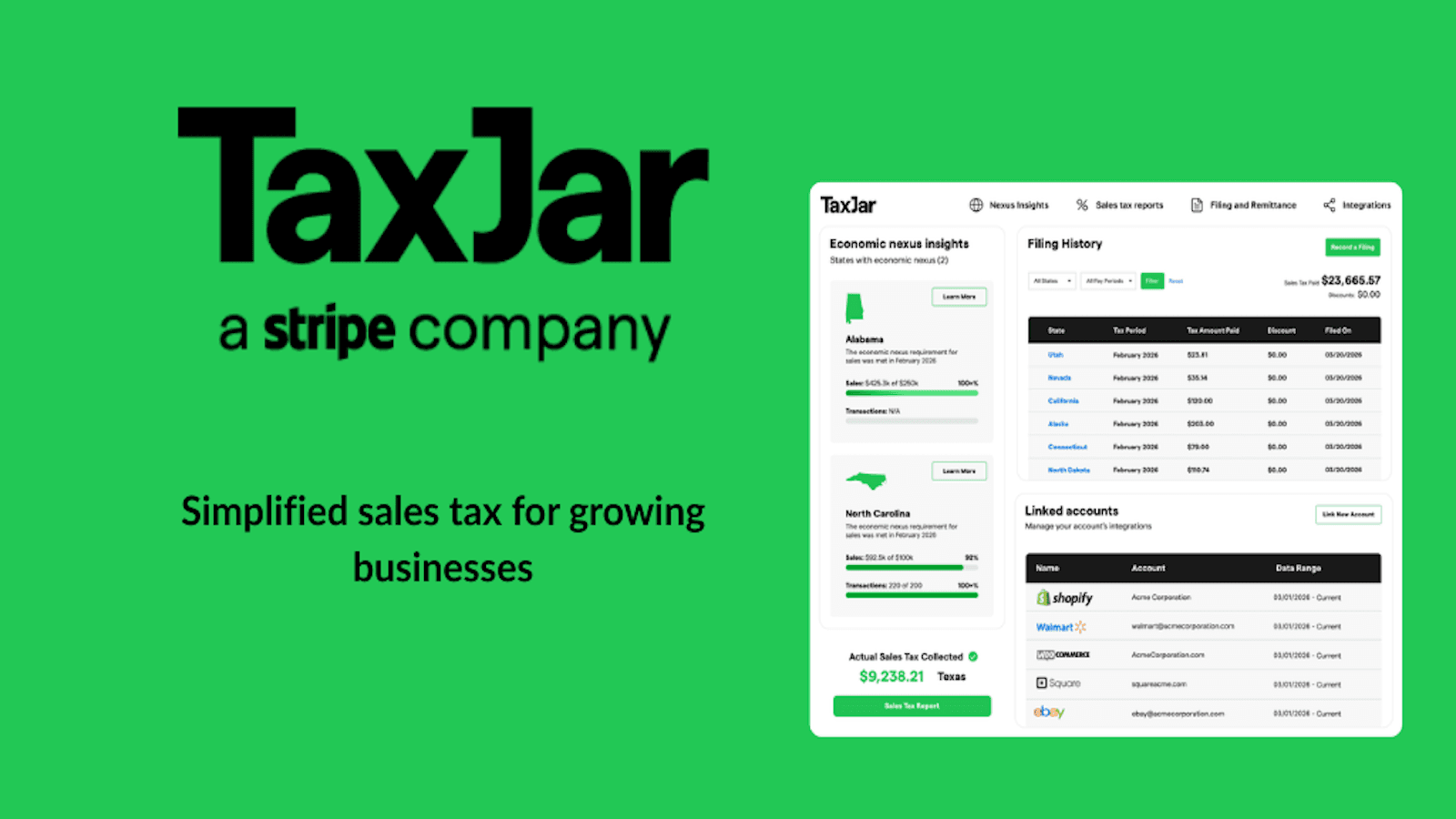
TaxJar (now part of Stripe) adds automated filing on top of calculation. The merchant value is real — hours of manual return preparation per state per month disappear once AutoFile is configured. The price is reasonable for stores doing $500K to $5M with multi-state nexus, and the AutoFile guarantee covers any penalties caused by TaxJar errors, which removes a meaningful tail risk for operators registering in unfamiliar jurisdictions.
The integration with Shopify is clean — orders sync automatically, exemption certificates can be uploaded for B2B customers, and the SmartCalcs API runs at checkout for stores wanting an alternative to Shopify Tax. Reports break down sales by state, county, and city for jurisdictions where local taxes apply on top of state rates. The weakness is that TaxJar focuses on US sales tax — for EU VAT or international filings, a separate tool is needed.
3. Avalara AvaTax
Rating: 3.5/5 · Pricing: From $50/mo, custom pricing for full suite · Best for: Enterprise sellers with complex taxability rules and exemption management · Job solved: Tax calculation plus exemption certificate management
Avalara is the enterprise default for US sales tax, with international VAT extensions available as add-ons. The pricing and install complexity push it out of reach for stores under $5M revenue, but for those above that threshold — particularly merchants with complex taxability (mixed product categories, drop-shipping multi-jurisdiction, marketplace facilitator status — Avalara pays for itself in audit defense and exemption certificate management. The 3.5 rating reflects user frustration with the implementation experience and account management more than the underlying tax engine, which is genuinely strong.
CertCapture (Avalara's exemption certificate module) is the standout feature for B2B sellers — it collects, validates, and stores resale certificates from wholesale customers, automatically applying tax exemptions at checkout for verified accounts. For wholesale-heavy stores where 30%+ of orders are tax-exempt, the manual certificate management alone justifies the cost. Plan on a 4-8 week implementation with the Avalara onboarding team, and budget for an annual review with the assigned account manager.
4. Order Printer by Shopify
Rating: 4.4/5 · Pricing: Free · Best for: Basic invoice and packing slip needs without branded PDF requirements · Job solved: Customer-facing invoice and packing slip generation
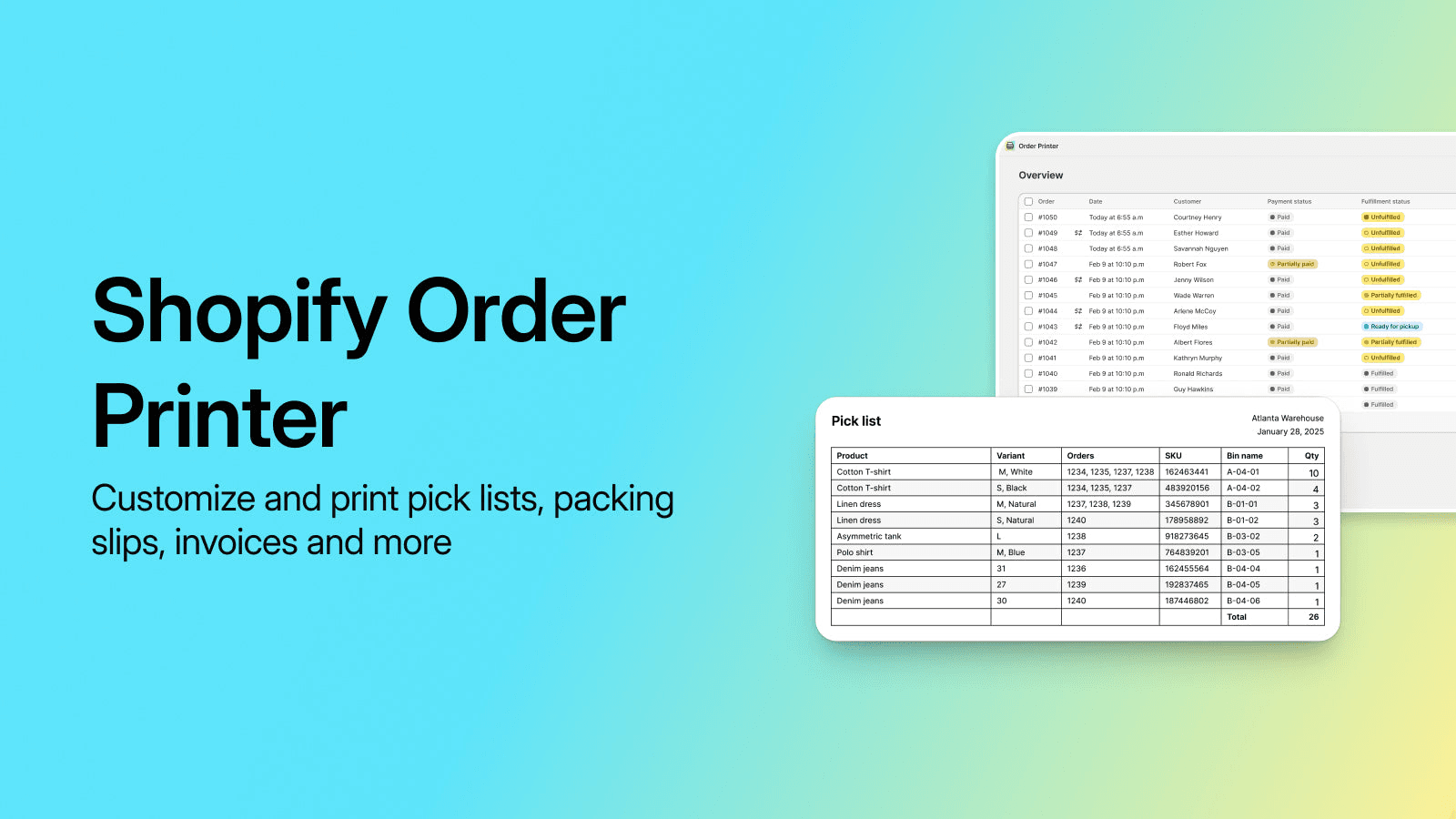
Order Printer is Shopify's free invoice tool. Customizable Liquid templates, bulk printing for fulfillment workflows, packing slips, return forms, and basic invoice generation — all native and free. For stores with simple needs (US D2C, single currency, no VAT requirements, no B2B accounts), this is enough. Customize the template once with the store's logo and tax breakdown, then leave it alone.
The limitation is that Order Printer is print-first rather than email-first. PDFs can be downloaded manually but are not sent automatically with order confirmation emails — for that workflow, Order Printer Pro is the upgrade path. Liquid template editing is required for any non-trivial customization, which puts deeper formatting changes out of reach for non-technical merchants. For shops that print-and-stuff invoices into shipped packages and do not need email delivery, the free tier covers the job cleanly.
5. Order Printer Pro by FORSBERG+two
Rating: 5.0/5 · Pricing: Free plan, paid from $9.99/mo · Best for: Most stores wanting professional branded invoices with automatic email delivery · Job solved: Customer-facing invoice generation plus PDF email automation
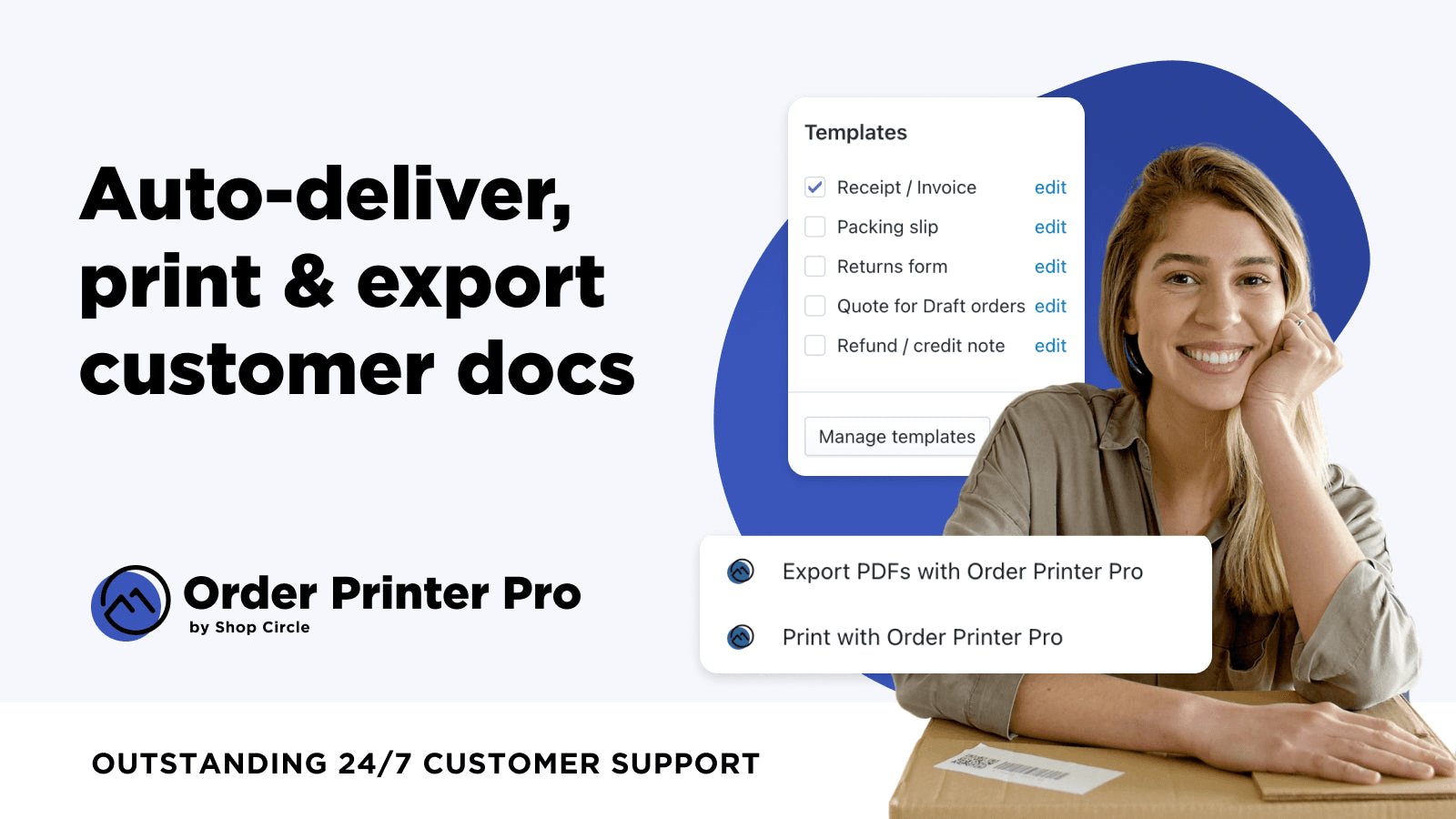
Order Printer Pro extends Shopify's basic Order Printer with automatic PDF generation, professionally branded templates, multi-currency display, multi-language support, and email delivery triggered on order confirmation. The 5.0 rating reflects how cleanly the app solves the invoice problem for the median Shopify merchant — drag-and-drop template builder with no Liquid editing required, branded headers with logo placement controls, and the ability to attach the PDF automatically to confirmation, fulfillment, or refund emails.
The free plan covers up to 50 orders per month, which makes the app accessible for small stores while paid tiers ($9.99/mo for 1,000 orders, scaling up) cover most merchant volumes. Multi-language templates handle the non-EU international case well — English plus a localized template for Spanish, French, or German B2C markets — without the strict compliance requirements that EU B2B sellers need from Sufio. For most non-EU stores wanting professional invoices on customer emails, this is the default recommendation.
6. Sufio: Professional Invoices
Rating: 4.9/5 · Pricing: From $19/mo · Best for: EU stores and B2B sellers needing strict VAT-compliant invoices with reverse charge logic · Job solved: Compliant invoice generation for EU and B2B
Sufio is the EU and B2B specialist. VAT ID validation through the VIES system, reverse charge logic for intra-EU B2B transactions, sequential numbering compliant with EU directive 2006/112/EC, country-specific templates with the correct legal text per jurisdiction, and B2B customer field handling that captures and validates VAT IDs at checkout. If a store sells B2B in the EU, the alternatives leave compliance gaps that Sufio closes by default — and those gaps cost real money when audited or when B2B buyers cannot deduct VAT due to incomplete invoices.
The depth on EU compliance is what justifies the price difference versus generic invoice apps. Italian SDI e-invoicing, German GoBD-compliant numbering, Spanish Suministro Inmediato de Información requirements, and OSS-compatible breakdowns for cross-border B2C all work out of the box rather than requiring custom configuration. For EU B2B operators specifically, this is one of the few categories where the right answer is unambiguous — Sufio is the tool the rest of the market is benchmarked against.
7. Invoice Hero PDF
Rating: 4.9/5 · Pricing: Free plan, paid from $10/mo · Best for: Multi-language B2C stores wanting auto-emailed invoices without B2B complexity · Job solved: Customer-facing invoice generation for B2C international stores
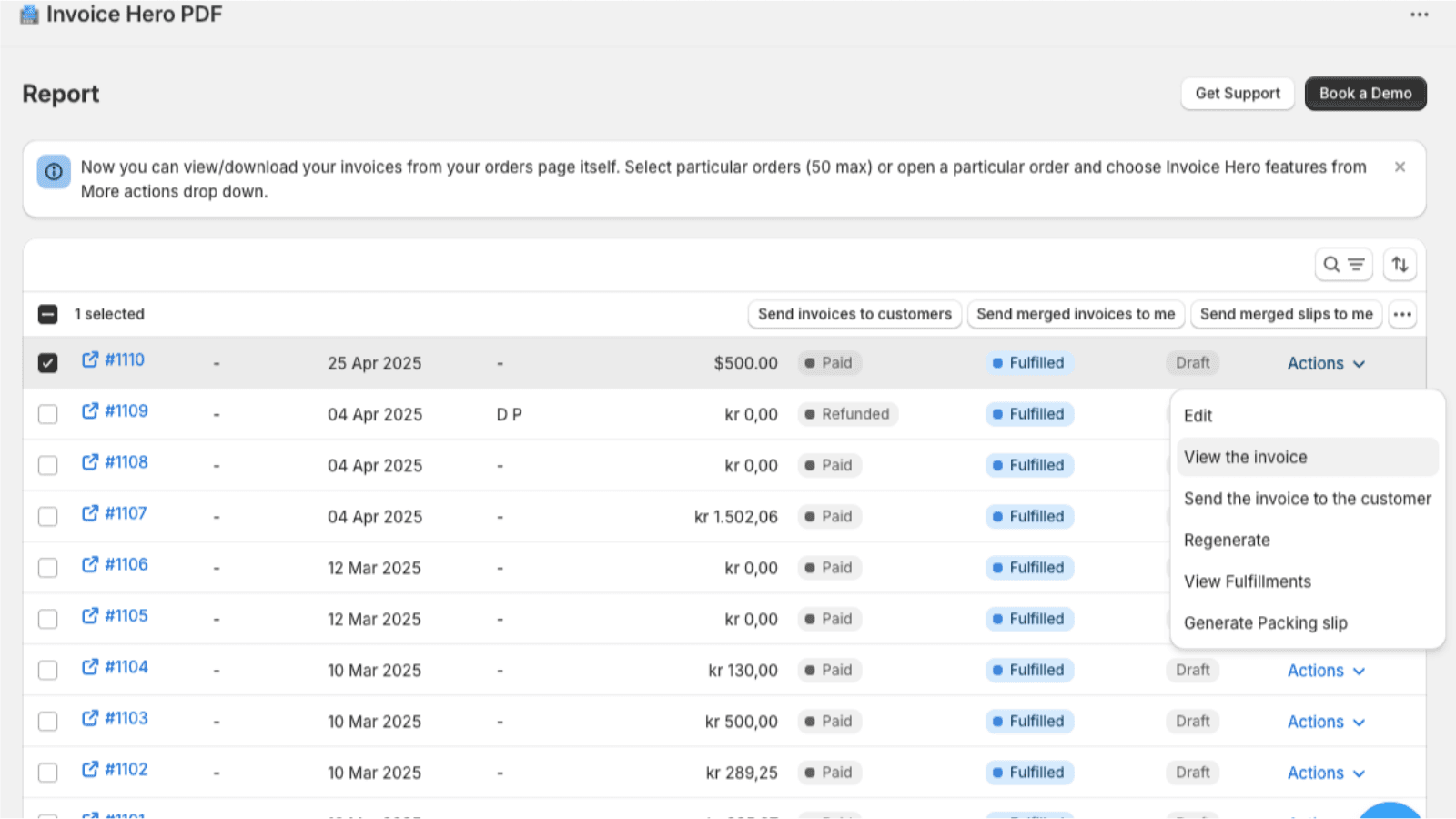
Invoice Hero handles the multi-language B2C case well. Templates available in 25+ languages, automatic PDF email delivery after order confirmation, branded template designs that do not require Liquid knowledge, and basic VAT support for stores collecting VAT but not needing the strict B2B compliance depth that Sufio provides. Cheaper than Sufio and easier to configure, which makes it the right pick for B2C-heavy EU stores rather than B2B operators.
The free plan covers up to 50 invoices per month and supports the core feature set, which is unusually generous for the category. The paid tier from $10/mo unlocks higher volume plus additional template customization and bulk operations. Where Invoice Hero falls short is the deep B2B compliance — VAT ID validation is supported but reverse charge logic and country-specific legal text are less robust than Sufio. For stores selling B2C across the EU with simple compliance needs, this is the cost-effective answer.
8. Avalara VAT Reporting
Rating: 3.0/5 · Pricing: Custom (typically $300+/mo) · Best for: Cross-border EU sellers needing OSS, IOSS, or country-specific filings · Job solved: Automated VAT returns filing for EU jurisdictions
Avalara's VAT reporting tool handles the EU multi-country VAT filing case — One-Stop-Shop (OSS) for cross-border B2C, Import One-Stop-Shop (IOSS) for sub-€150 imports, and country-specific returns where local registration is required (typically when warehousing inventory in another EU member state). The 3.0 rating reflects an enterprise-grade user experience that punishes infrequent users, but for stores hitting OSS thresholds or operating fulfillment hubs across multiple member states, the alternative is hiring a tax consultant per country at significantly higher cost.
The implementation requires accountant involvement and typically takes 6-12 weeks to fully deploy across all relevant jurisdictions. For stores under €500K cross-border EU revenue, the cost is rarely justified — a regional accountant filing manually is cheaper. Above that threshold, particularly when warehousing or marketplace facilitator obligations enter the picture, Avalara VAT Reporting becomes the practical default despite the implementation pain.
Tax and Invoice Apps Comparison Table
| App | Job | Rating | Pricing | Best For |
|---|---|---|---|---|
| Shopify Tax | Tax calculation | Native | Free up to $100K then 0.35% | US stores under $500K |
| TaxJar | Calculation + AutoFile | 4.6/5 | From $19/mo | US mid-market multi-state |
| Avalara AvaTax | Calculation + exemptions | 3.5/5 | From $50/mo | Enterprise US with B2B |
| Order Printer | Basic invoices | 4.4/5 | Free | Print-first US D2C |
| Order Printer Pro | Branded PDF invoices | 5.0/5 | Free, paid from $9.99/mo | Most non-EU stores |
| Sufio | EU and B2B compliance | 4.9/5 | From $19/mo | EU B2B sellers |
| Invoice Hero PDF | Multi-language B2C invoices | 4.9/5 | Free, paid from $10/mo | EU B2C multi-language |
| Avalara VAT Reporting | EU VAT filing | 3.0/5 | Custom | Cross-border EU above OSS thresholds |
Picking the Right Stack by Store Profile
The right combination depends on geography, revenue, and customer type. For a US D2C store under $500K revenue with nexus in 1-3 states, Shopify Tax plus Order Printer (both free or near-free) is the complete answer. For US D2C between $500K and $5M with nexus in 5+ states, Shopify Tax or TaxJar plus Order Printer Pro covers calculation, filing, and branded customer invoices for around $30 per month total. For US enterprise above $5M with significant B2B exposure, Avalara AvaTax with CertCapture plus Order Printer Pro handles both the tax engine and the exemption certificate workflow that becomes a full-time job at scale.
For EU B2C stores selling to consumers across member states, Shopify Tax plus Invoice Hero PDF gets the basics right at low cost. For EU B2B operators or stores needing strict compliance — Italian merchants required to use SDI, German operators subject to GoBD, or any reverse-charge B2B flow — Sufio is non-negotiable. For cross-border EU stores above OSS thresholds with warehousing in multiple member states, the stack expands to include Avalara VAT Reporting alongside the calculation and invoice tools.
The combinations to avoid: stacking three invoice apps because each one has "one nice feature," running TaxJar and Avalara simultaneously, or using both Order Printer Pro and Sufio in parallel. Two apps competing to generate the source-of-truth invoice produces duplicate emails and conflicting numbering sequences that break reconciliation. Pick one tool per job and resist the temptation to add a "specialist" app for an edge case that occurs less than once a quarter.
What Native Shopify Already Handles
Shopify's native capabilities have expanded meaningfully over the last two years. Shopify Tax now handles US sales tax calculation for free under $100K with rooftop-accurate rates. Order Printer (free) covers basic invoice and packing slip generation with Liquid template customization. Shopify Markets handles cross-border tax-inclusive versus tax-exclusive pricing display logic for international stores. B2B on Shopify (available on Plus) handles wholesale customer accounts with custom catalogs and net-payment terms.
What native Shopify still does not handle well: automatic returns filing across US states (TaxJar or Avalara needed), strict EU B2B invoice compliance with reverse charge and VAT ID validation (Sufio needed), e-invoicing in markets like Italy and Mexico (specialist tools or local connectors needed), and exemption certificate management for B2B-heavy operations (Avalara CertCapture or equivalent). Before installing a third-party tool, audit whether the native capability would suffice — the cheapest correct answer beats the most feature-rich paid alternative every time.
How Tax and Invoice Apps Pair with Conversion Tools
Tax and invoice work cleanly hand off to the conversion layer in front. Invoice apps run on the back end of the order — the customer has already converted, paid, and the merchant is satisfying compliance and delivery requirements. The conversion layer sits in front of the order: getting visitors to add to cart, increasing average order value before checkout, and pre-framing pricing for international visitors who see different tax presentations.
Libautech's Sticky Add to Cart keeps the buy button visible on long product pages, which matters more on EU stores where descriptions tend to run longer for compliance reasons (specifications, ingredients, regulatory text). Bundles & Upsell adds AOV-lifting upsells before checkout — bundle discounts, frequently bought together, post-purchase upsells — which compounds with tax-efficient pricing thresholds. Announcement Bar runs free shipping or VAT-included messaging that pre-frames pricing for international visitors who otherwise drop off when tax appears at checkout. All three are available on the $14.99 per month Package plan, which gives a clean conversion-side stack without adding monthly cost on top of the tax tooling.
Common Tax and Invoice Compliance Mistakes
The cheapest mistake in this category is non-compliant invoices in EU markets. Missing VAT IDs, wrong number sequences, missing reverse charge notation for intra-EU B2B transactions, or incorrect language can void deduction rights for B2B customers — meaning the customer cannot recover the VAT they paid, which usually triggers an immediate complaint and sometimes a request for a corrected invoice across multiple historical orders. Once that pattern is detected (typically by an accountant during quarterly review), retrospective corrections become a multi-week cleanup project.
The second common mistake is ignoring economic nexus thresholds in US states. Crossing the threshold (typically $100K or 200 transactions) without registering creates a back-tax liability that compounds monthly until detected, and most state audits look back at least three years. Shopify Tax surfaces nexus alerts in the dashboard but acting on them is the merchant's responsibility — register with the state, configure the tax engine, and update the product taxability categories before processing the next order in that jurisdiction.
The third is over-engineering the stack. Stores with two states of nexus and 20 orders per day do not need Avalara — Shopify Tax handles the calculation, and a quarterly export to the accountant handles the filing. Match the tool depth to the actual compliance complexity, not the projected complexity 24 months out.
How Tax Calculation Affects Conversion
Tax presentation has a measurable impact on conversion, particularly for international and EU stores. Stores displaying tax-inclusive pricing (the European default) convert 8-15% better than stores showing tax-exclusive prices that add tax at checkout — because every surprise increase between product page and checkout is a drop-off trigger. Shopify Markets handles this presentation logic automatically when configured correctly, displaying tax-inclusive prices to EU visitors while keeping tax-exclusive prices for US visitors.
For B2B stores, the inverse applies — B2B buyers expect tax-exclusive prices because they handle the VAT calculation themselves through their accounting systems, and seeing tax-inclusive prices on a B2B catalog suggests the store is not B2B-ready. Configure the tax presentation by customer segment (Markets handles geographic segmentation, B2B on Shopify handles customer-status segmentation) rather than picking one global default. The conversion lift from getting this right typically exceeds the lift from any single conversion app installed on top.
FAQ — Shopify Tax and Invoice Apps
Do I need a tax app if I sell only in one US state? No. Shopify Tax handles single-state US sales tax natively for free under $100K revenue, and Order Printer (also free) covers basic invoices. A third-party tax app becomes necessary when nexus expands to 5+ states (for AutoFile efficiency) or revenue exceeds $5M (for exemption certificate management at B2B scale).
What is the difference between Shopify Tax and TaxJar? Shopify Tax calculates US sales tax at checkout. TaxJar calculates and also files the returns automatically with state revenue departments through AutoFile. For stores with nexus in 5+ states, TaxJar saves meaningful accountant time. For stores with nexus in 1-2 states, Shopify Tax plus a quarterly accountant export is cheaper.
Why do EU B2B sales need a special invoice app? EU B2B invoices have strict compliance requirements — VAT ID on the buyer record, reverse charge notation when applicable, sequential numbering without gaps, country-specific legal text, and currency display rules. Generic invoice apps miss one or more of these by default, which voids the buyer's right to deduct VAT and triggers compliance issues for the seller. Sufio (4.9/5) handles these requirements out of the box.
Is Order Printer Pro worth $9.99 per month over the free Order Printer? For most stores, yes. The free Order Printer is print-first and requires Liquid template editing for branding changes. Order Printer Pro adds drag-and-drop template design, automatic email attachment of PDF invoices on order confirmation, multi-currency, and multi-language — all of which become important once stores ship to international customers or want professional branded receipts on confirmation emails.
What happens if I cross a US economic nexus threshold without registering? The state can assess back taxes for the period after the threshold was crossed, typically with penalties and interest. Most states allow voluntary disclosure agreements that reduce penalties when the seller registers proactively, but ignoring the threshold and continuing to sell without registering increases liability monthly. Shopify Tax surfaces nexus alerts — register and configure the tax engine before the next order in that jurisdiction.
Can I run Sufio and Order Printer Pro at the same time? Technically yes, practically no. Both apps generate invoices, which means customers receive duplicate PDFs, numbering sequences conflict, and reconciliation breaks. Pick one per job — Sufio for EU B2B compliance, Order Printer Pro for non-EU branded invoices — and disable the other.
Do I need Avalara if I am under $5M revenue? Almost never. Avalara's strength is exemption certificate management and multi-jurisdiction tax engines for stores with complex taxability rules and significant B2B exposure. Stores under $5M with B2C focus or simple B2B exemption flows are better served by Shopify Tax or TaxJar at a fraction of the cost and implementation time.
Final Word
Tax and invoicing is the most boring category to set up correctly and the most expensive category to set up wrong. Build the stack once with the accountant in the loop, validate the first 20 invoices manually against the legal requirements for each market, then trust the automation. The hidden tax in this category is the time spent re-doing it later when an EU B2B customer's invoice is found to be missing their VAT ID for nine months, or when a US state issues a nexus assessment three years after the threshold was crossed. The right answer for most stores is the simplest one — Shopify Tax plus Order Printer Pro for non-EU, Shopify Tax plus Sufio for EU B2B — and the wrong answer is stacking three apps because each one had one feature that looked compelling in isolation. Match the tooling to the actual compliance burden, not the projected one.