Last updated: May 2026 · Pricing and ratings verified from live Shopify App Store listings on May 4, 2026 · Reviewed by the Libautech team — builders of Bundles & Upsell and 8 other Built for Shopify apps used by 5,000+ merchants across 50+ countries.
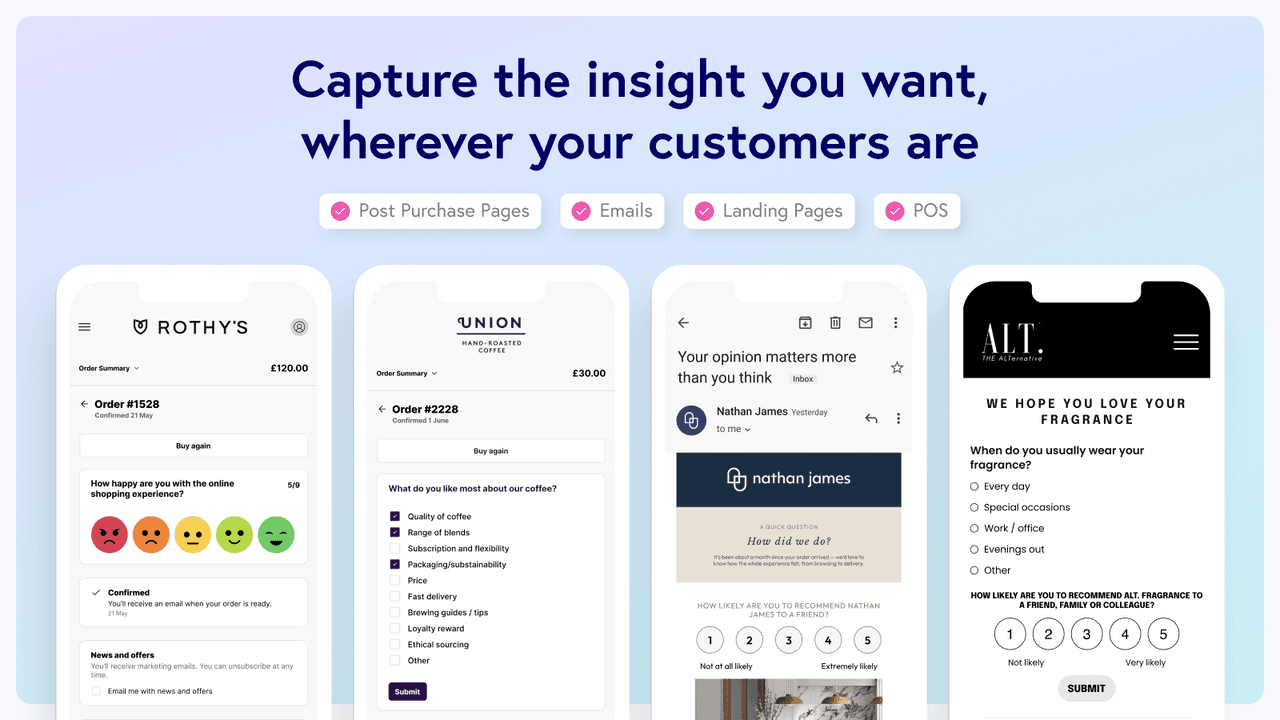
Most roundups of Shopify survey apps treat post-purchase, NPS, on-site, and product feedback as one category. They are not. A post-purchase attribution survey appears on the order confirmation page asking "How did you hear about us?" and feeds traffic source data back to acquisition tracking. An on-site poll triggers during a session asking "What were you looking for today?" and produces immediate intent data. An NPS survey emails customers 7-30 days after purchase asking "How likely are you to recommend us?" A product feedback survey collects reviews and post-delivery experience data after fulfillment. Different mechanics, different timings, different data outputs — and different apps.
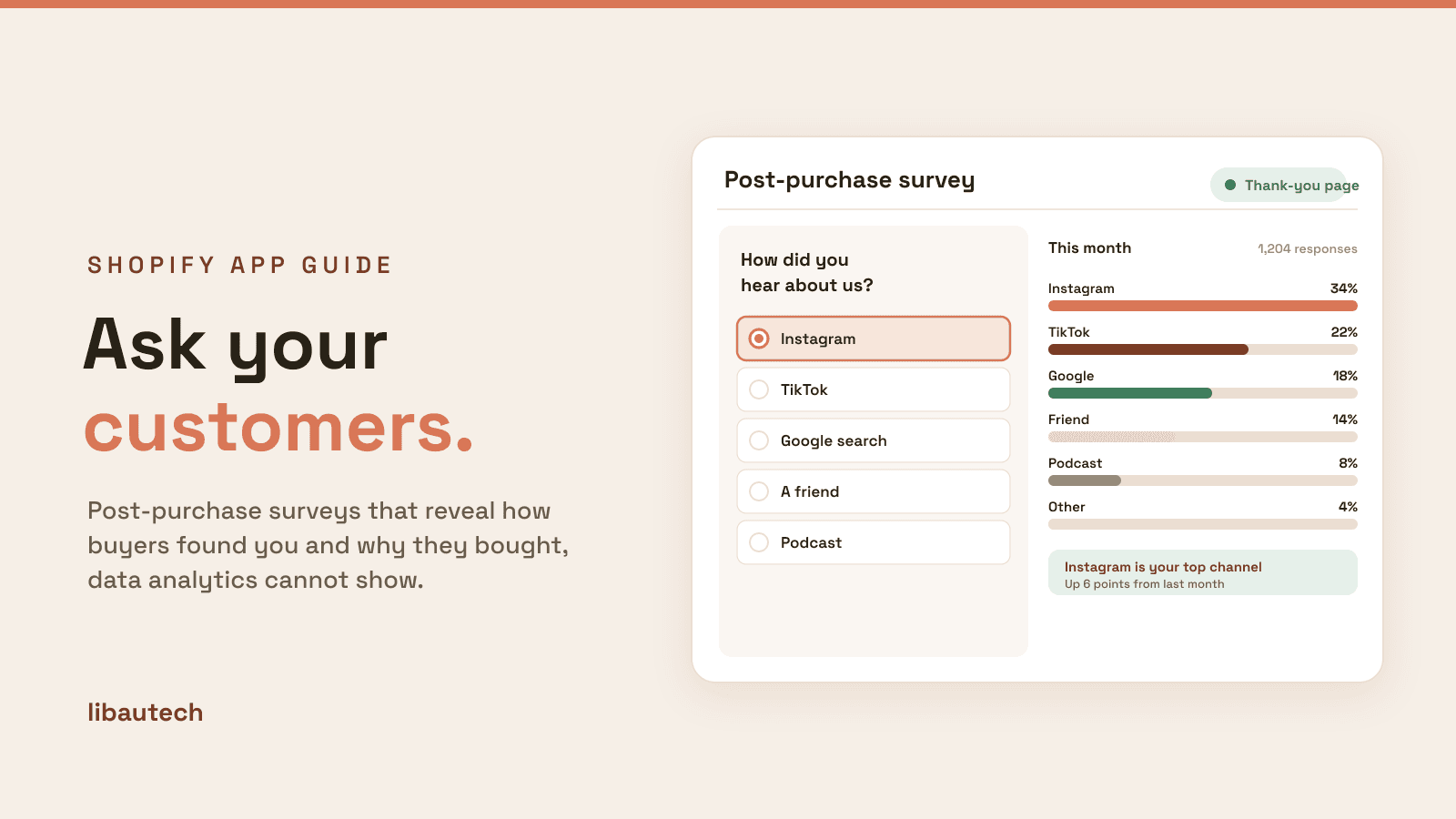
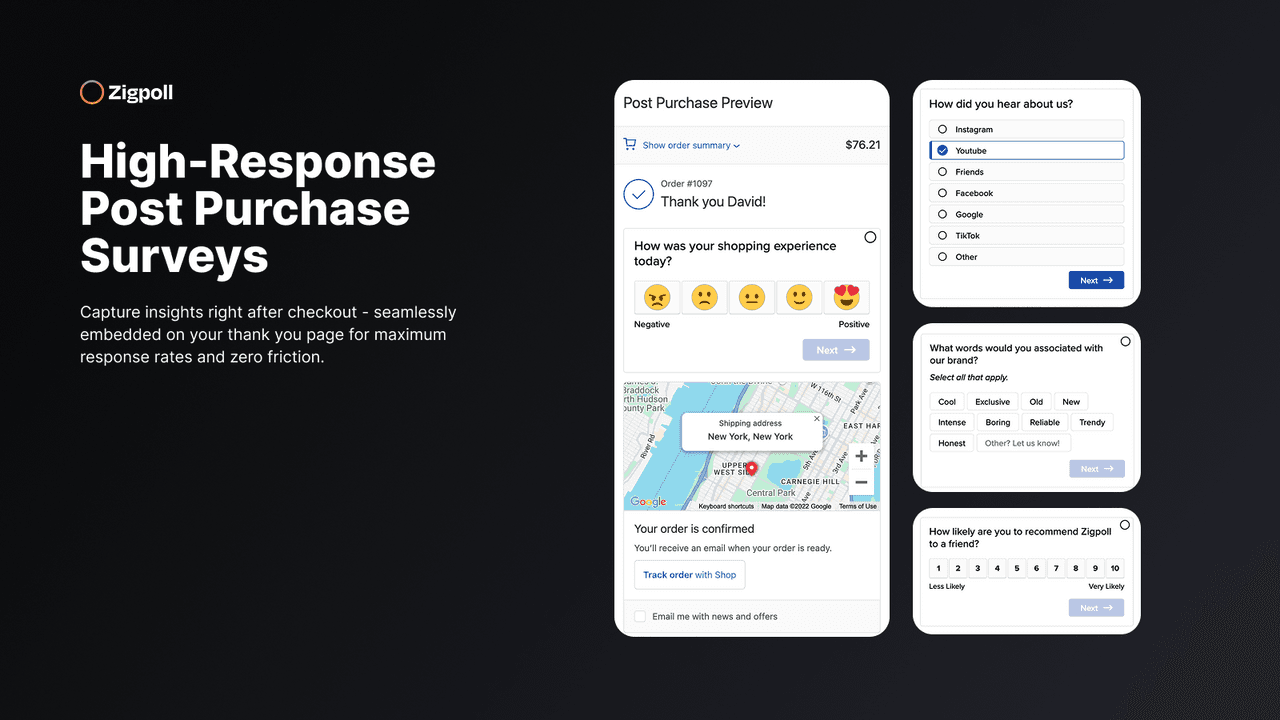
The first job is post-purchase attribution surveys. Close the iOS 14 attribution gap by asking customers directly. The mechanics are: a survey appears on the order confirmation page (the highest-engagement moment in the entire customer journey), the customer answers one question about how they discovered the store, and the response feeds into an attribution tool like Triple Whale or Northbeam alongside the platform-reported data. Best fit for stores spending $5,000-plus per month on paid ads where channel ROI clarity moves the budget needle. Below that ad spend threshold, the survey infrastructure is overkill relative to the budget being optimized.
The second job is on-site polls and exit-intent surveys. Capture intent and abandonment reasons mid-session. The mechanics are: trigger a poll based on visitor behavior (exit intent, scroll depth, time on page, specific page visited), ask one to three questions, and feed responses back to a CRO program for hypothesis development. Best fit for active CRO programs running tests on cart abandonment, product page optimization, or trust factor research. Stores without an active CRO process will collect data they never act on.
The third job is NPS and satisfaction tracking. Measure long-term customer sentiment via post-delivery email. The mechanics are: send an email 7-30 days after purchase asking "How likely are you to recommend us on a scale of 0 to 10?", capture the response, and trigger follow-up questions based on the score (detractors get "What went wrong?" and promoters get "What did you love?"). Best fit for established stores at $500,000-plus annual revenue where repeat purchase economics make customer satisfaction tracking valuable. Below that scale, the survey volume is too low to produce statistically meaningful trend data.
The fourth job is product feedback and review collection. Capture post-delivery product experience for both internal product improvement and on-site display. The mechanics are: send a review request email 7-14 days after delivery, collect star ratings and written reviews (optionally with photos), display reviews on product pages with rich snippets for Google Shopping syndication. Best fit for any store building product-page conversion infrastructure where social proof is a primary trust lever. The price entry point at $9.99 per month makes this the cheapest survey category to install.
The ranking weighs five dimensions: completion rate (do customers actually finish the survey at the moment it appears), data quality (is the response data structured for downstream use in attribution or CRO tools), pricing fit (does the cost scale with response volume rather than punishing growth), integration depth (does the app connect cleanly to Klaviyo, Triple Whale, Postscript, and major CRMs), and Shopify App Store rating verified live on May 4, 2026. Apps that solve a niche survey job exceptionally well rank higher in their job category than apps with broader feature sets but weaker depth in any single area. Native Shopify post-purchase pages are too limited to compete in this category, so unlike most app categories, every recommendation here is a third-party app rather than a native Shopify feature.
Rating: 5.0/5 across 180+ reviews · Pricing: From $49/mo · Best for: Stores spending $5K+/mo on paid ads needing channel attribution data · Job solved: Post-purchase attribution surveys with industry-leading completion rates and integration into the major attribution platforms
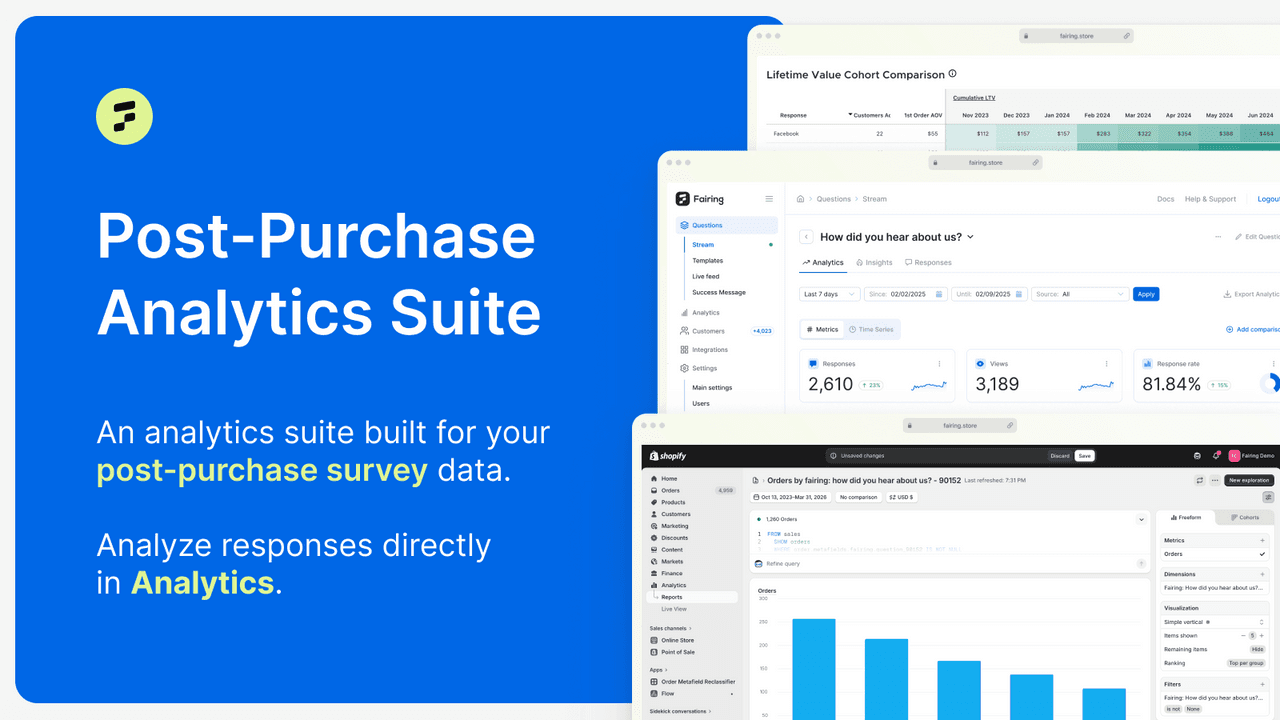
Fairing is the dominant post-purchase attribution survey app, used by Allbirds, Olipop, Magic Spoon, and hundreds of mid-market DTC brands. Completion rates run 40-60% (compared to 1-5% for email surveys) because the moment of completing a purchase is the highest-engagement moment in the entire customer journey — the customer just spent money, they are happy, they are willing to answer one quick question. Responses sync with Triple Whale, Northbeam, and Rockerbox, where the survey data is layered alongside platform-reported attribution to produce a more accurate picture of which channels actually drive purchases.
Pricing reality: Fairing starts at $49 per month for up to 1,000 responses and scales by response volume. The cost-benefit threshold lands roughly at $5,000-10,000 per month paid ad spend — below that, the budget being optimized does not justify the survey overhead. Above that, Fairing pays back through better channel allocation within the first quarter. The 5.0/5 rating across 180-plus reviews reflects the focused product strategy: Fairing does post-purchase attribution exceptionally well rather than spreading thinly across multiple survey categories, and the merchants who use it are typically running serious paid acquisition programs where the data quality matters.
Rating: 4.8/5 across 30+ reviews · Pricing: Free plan available, paid from $25/mo · Best for: Mid-market stores needing post-purchase surveys with multi-question logic at lower entry pricing · Job solved: Post-purchase surveys with branching logic and conditional questions
KnoCommerce competes with Fairing on post-purchase surveys but with stronger multi-question survey logic and lower starting pricing. The app supports branching logic (if attribution answer is "Instagram", show follow-up "Was it a paid ad or organic post?"), conditional questions, and integrations with Klaviyo, Postscript, and major attribution platforms. The free plan covers small stores running their first attribution survey, and the $25 per month paid tier handles most stores under 5,000 monthly orders.
The 4.8/5 rating across 30-plus reviews reflects the genuine product depth at the mid-market price point. KnoCommerce is the right choice for stores wanting more than single-question attribution but unwilling to commit to Fairing's $49 starting tier or the response volume implied by Fairing's customer base. The branching logic also supports use cases beyond pure attribution — stores can layer in post-purchase NPS, product feedback, and demographic questions on the same form, which extends the value of the install beyond just the channel attribution job.
Rating: 4.9/5 across 1,400+ reviews · Pricing: Free plan available, paid from $9.99/mo · Best for: Multi-purpose form builder for surveys, contact forms, and customer feedback at the lowest entry price in the category · Job solved: General-purpose form and survey builder with conditional logic and Shopify customer field integration
Hulk Form Builder is the highest-rated form builder on Shopify with 4.9/5 across 1,400-plus reviews. While not survey-specific, its conditional logic, file upload support, and Shopify customer field integration make it suitable for multi-question survey deployment without paying for a dedicated survey product. For stores that need a form builder anyway (contact forms, custom checkout fields, wholesale application forms) and also want occasional survey capability, Hulk Form Builder covers both jobs at $9.99 per month — significantly cheaper than running a separate survey app alongside a separate form builder.
The trade-off is that Hulk Form Builder is not optimized for post-purchase attribution like Fairing or KnoCommerce. The completion rates on Hulk-based surveys typically lag dedicated survey products because the form interface is designed for general-purpose data collection rather than the specific psychology of post-purchase or exit-intent moments. For stores running serious attribution programs, Hulk is a fine first step but eventually gets replaced by Fairing or KnoCommerce. For stores running occasional one-off surveys (annual customer survey, new product feedback collection), Hulk is sufficient and cost-efficient.
Rating: 4.5/5 across 1,300+ reviews · Pricing: From $39/mo · Best for: CRO teams needing on-site polls combined with heatmap and session recording analysis · Job solved: On-site polls integrated with heatmaps, session recordings, and conversion funnels in one platform
Lucky Orange combines on-site polls with heatmaps, session recordings, and conversion funnels in one platform. For CRO teams running active optimization programs, the combined poll-plus-recording context tells you both what visitors are saying and what they are doing — and the gap between those two signals is where most CRO insights actually live. A visitor who answers "I was looking for size 9" in a poll and the session recording shows them clicking around in confusion before exiting reveals a product page navigation problem that neither signal alone would surface clearly.
The 4.5/5 rating reflects the typical CRO platform trade-off between feature breadth and ease of use. Lucky Orange has more capabilities than any single-purpose survey app, which means more setup time and a steeper learning curve. Stores at the active-CRO maturity level (running multiple A/B tests per quarter) typically have someone dedicated to the optimization work, which makes Lucky Orange's complexity manageable. Stores not running active CRO will install Lucky Orange, look at heatmaps once, and never check the survey results — at which point the $39 per month is wasted on data nobody acts on.
Rating: 4.9/5 across 30+ reviews · Pricing: Free plan available, paid from $224/mo · Best for: Mid-market and enterprise stores running structured NPS programs · Job solved: Enterprise-grade NPS measurement with deep follow-up question logic and integrations
Delighted is the gold-standard NPS platform, owned by Qualtrics, used by hundreds of mid-market and enterprise brands. The free plan covers 25 responses per month — enough to validate the workflow before upgrading. Paid pricing starts at $224 per month, which prices it out of small stores but lands fairly for stores with $1M-plus annual revenue running structured NPS programs. The integrations with Salesforce, HubSpot, Klaviyo, and Slack make NPS data actionable across teams (CX gets the detractor alerts, marketing gets the promoter quotes for testimonials, product gets the qualitative feedback themes).
The 4.9/5 rating across 30-plus reviews reflects the depth of the NPS-specific feature set rather than just the survey delivery. Delighted handles the follow-up question logic that turns NPS from a vanity metric into actionable feedback — a detractor scoring 4 gets "What went wrong?", a passive scoring 8 gets "What would have made this a 10?", a promoter scoring 9 gets "What did you love?". Stores that install a generic NPS tool and never set up follow-up questions are getting maybe 20% of the value of the framework; Delighted's defaults push merchants toward the better practice automatically.
Rating: 4.7/5 across 100+ reviews · Pricing: Free plan available, paid from $25/mo · Best for: Smaller stores needing affordable NPS without enterprise features · Job solved: Basic NPS measurement with post-purchase email delivery at SMB pricing
Hulk NPS Post Purchase Survey from HulkApps offers NPS functionality at SMB pricing. For stores starting NPS tracking from zero, the $25 per month entry point makes the framework accessible without committing to Delighted's $224 starting tier. The app handles the basic NPS workflow (post-purchase email, 0-10 scoring, response capture) but lacks the depth of follow-up logic, integration breadth, and dashboard analysis that Delighted provides at the higher price point.
Use Hulk NPS for stores at the $200,000 to $1,000,000 annual revenue range where NPS tracking is worth starting but the budget does not justify Delighted yet. The 4.7/5 rating reflects mid-market satisfaction — the app does what it claims, but stores typically outgrow it and migrate to Delighted once revenue and CX program maturity justify the upgrade. The migration path is clean: NPS data exports as CSV, and the methodology is identical, so the only loss is historical dashboard continuity rather than the data itself.
Rating: 4.8/5 across 9,500+ reviews · Pricing: Free plan available, paid from $19/mo · Best for: Stores building product-page conversion through reviews and user-generated content · Job solved: Product review collection, on-site display, and syndication to Google Shopping with rich snippets
Yotpo is the dominant review platform on Shopify, used by 200,000-plus stores including Steve Madden, Princess Polly, and Glossier. The app sends post-delivery review request emails, captures star ratings and written reviews, syndicates reviews to Google Shopping and search results with rich snippets, and supports photo and video review collection. The free plan covers small stores running their first review collection workflow; the $19 per month paid tier unlocks the features (on-site widgets, advanced templates, Klaviyo integration) that produce real conversion lift.
The 4.8/5 rating across 9,500-plus reviews reflects how broadly Yotpo is deployed across the Shopify ecosystem. Most mid-market and enterprise stores either use Yotpo or have used it at some point, which means the integration support across email platforms, attribution tools, and customer service software is the deepest in the category. The trade-off is that Yotpo's pricing scales aggressively at higher tiers (enterprise plans run $300-1,000-plus per month), which is why stores under $500,000 revenue often start with Loox at the cheaper entry point and only migrate to Yotpo when scale justifies the upgrade.
Rating: 4.9/5 across 26,000+ reviews · Pricing: From $9.99/mo · Best for: Photo-first product reviews with strong visual presentation at the lowest entry price · Job solved: Photo and video review collection with widget designs optimized for visual social proof
Loox emphasizes photo and video reviews, with widget designs optimized for visual social proof. Pricing starts at $9.99 per month — the lowest entry point in the category — making Loox the practical pick for stores prioritizing visual social proof on a budget. The app sends post-delivery review request emails with explicit photo upload incentives (small discount codes for customers who include a photo), which produces a meaningfully higher photo review rate than Yotpo's default workflow.
The 4.9/5 rating across 26,000-plus reviews makes Loox one of the most consistently-praised apps in the entire Shopify App Store ecosystem. The focus on visual social proof matches well with the dominant social commerce trend (Instagram, TikTok, Reels-driven discovery) where customer photos in reviews compound the brand's visual presence beyond what the merchant could create themselves. For DTC brands selling visually-distinctive products (apparel, home goods, accessories), Loox is genuinely the right answer at any revenue scale; only when review volume exceeds 10,000-plus per month do the analytics and integration features of Yotpo justify the upgrade cost.
| App | Job | Rating | Pricing | Best For |
|---|---|---|---|---|
| Fairing | Post-purchase attribution | 5.0/5 | From $49/mo | $5K+/mo paid ad spenders |
| KnoCommerce | Post-purchase multi-question | 4.8/5 | Free, paid from $25/mo | Branching logic surveys |
| Hulk Form Builder | General forms + surveys | 4.9/5 | Free, paid from $9.99/mo | Multi-purpose form needs |
| Lucky Orange | On-site polls + heatmaps | 4.5/5 | From $39/mo | Active CRO programs |
| Delighted | NPS enterprise | 4.9/5 | Free, paid from $224/mo | $1M+ revenue NPS programs |
| Hulk NPS | NPS SMB | 4.7/5 | Free, paid from $25/mo | Affordable NPS entry |
| Yotpo Reviews | Product feedback | 4.8/5 | Free, paid from $19/mo | Reviews + UGC scaled |
| Loox | Photo-first reviews | 4.9/5 | From $9.99/mo | Visual social proof |
The decision tree for most stores: start with Yotpo or Loox ($9.99-19 per month) for product reviews, add Fairing ($49 per month) once paid ad spend exceeds $5,000 per month, layer in Hulk Form Builder for general-purpose survey deployment, and reserve Delighted ($224 per month) for stores with mature CX programs at $1M-plus revenue. Lucky Orange ($39 per month) joins the stack only for stores running active CRO programs with someone dedicated to test design and analysis.
A small store under $200,000 revenue should run Loox for product reviews and skip everything else — the data volume is too low to produce statistically meaningful insights from NPS, attribution, or on-site polls, and the budget is better spent on conversion apps that touch every order. A mid-market store at $500,000 to $5M revenue running active paid acquisition should run Loox or Yotpo plus Fairing or KnoCommerce, which covers product reviews and channel attribution at $30-70 per month combined. Above $5M revenue with a structured CX program, add Delighted for NPS and Lucky Orange for on-site CRO.
Combined with Libautech's Bundles & Upsell, Sticky Add to Cart, and Announcement Bar (all included on the $9.99 per month Package plan), the survey-plus-conversion stack covers data capture, product page social proof, and AOV mechanics under $100 per month for most SMB stores. The Announcement Bar in particular handles "Tell us what you think" callouts on order confirmation or tracking pages that drive customers into the survey workflow.
Shopify's native customer-feedback capabilities are limited compared to most app categories. Order confirmation pages support custom HTML blocks where a merchant can manually embed a Google Form or Typeform survey — useful for one-off research projects but not equivalent to a real attribution survey app. The native checkout post-purchase page (on Shopify Plus) supports custom apps via the Post-Purchase API, which is what Fairing and KnoCommerce use to inject their surveys. Native customer accounts support basic order history and review display, but no native review collection workflow exists.
What native Shopify still does not handle: post-purchase attribution surveys with response capture and integration into attribution tools, on-site polls with behavior-triggered display logic, NPS email workflows with follow-up question logic, product review collection with photo support and Google Shopping syndication. Before installing a paid survey app, audit whether a one-off Google Form linked from the order confirmation page would suffice for the specific research question — for stores running their first customer survey ever, the free Google Form is genuinely sufficient and the paid survey infrastructure is overkill.
Survey apps capture data, but the data only matters if it leads to conversion improvements. The survey stack and the conversion stack solve different problems and rarely conflict — surveys produce hypotheses about why customers do or do not buy, while conversion apps influence what online transactions look like at the moment of purchase. Both belong in a healthy Shopify operation, and the cost of either stack is small compared to the revenue impact of getting both right.
Libautech's Sticky Add to Cart keeps the buy button visible while customers read product copy, which means the trust-building social proof from Yotpo or Loox reviews actually leads to purchases rather than getting lost when customers scroll past the buy button. Bundles & Upsell increases the average order value of every transaction the surveys then ask about — a 15-20% AOV lift compounds across all the orders that subsequently feed back into post-purchase attribution data. Announcement Bar runs the post-purchase messaging that drives customers into NPS and product review workflows. All three are available on the $9.99 per month Package plan, making the survey-plus-conversion stack genuinely affordable for stores under $1M revenue.
The biggest survey mistake is asking too many questions. Survey completion rates drop 15-20% per additional question after the first, and stores that ship 8-question post-purchase surveys end up with the same response volume as stores that ship 1-question surveys but spent 5x the development effort. The fix is to default to single-question post-purchase surveys with optional branching follow-up — Fairing and KnoCommerce both make this the default for a reason, and the merchants who follow that discipline get 5-10x the response volume of stores running long surveys.
The second common mistake is collecting survey data nobody acts on. Stores install Lucky Orange, look at heatmaps once during setup, and never check the data again — at which point the $39 per month is wasted on data nobody uses. The fix is to set a recurring weekly or monthly review of survey data tied to a specific decision (which channel to allocate budget to, which page to A/B test next, which product to discontinue based on review themes). Surveys without action loops are vanity metrics; surveys with explicit action loops are the highest-ROI marketing investment a store can make.
The third is asking for feedback at the wrong moment. Sending NPS emails 1 day after order placement (before the customer has received the product) produces nonsense data because the customer cannot rate the experience yet. Sending review request emails 2 days after delivery (before the customer has actually used the product) produces low-quality reviews. The fix is to time surveys to the genuine experience moment: post-purchase attribution at order confirmation, NPS at 14-30 days post-delivery, product reviews at 7-14 days post-delivery, exit-intent surveys at the actual exit moment.
For stores running paid acquisition, post-purchase attribution surveys are the single highest-ROI survey investment because they directly influence ad budget allocation. A store spending $50,000 per month on paid ads with 30% mis-attributed channels (the typical state after iOS 14.5) is making allocation decisions on bad data — and the cost of that bad data dwarfs the cost of the survey infrastructure that would correct it. Fairing or KnoCommerce running for one quarter typically reveals 10-30% budget reallocation opportunities that pay back the survey cost 100x over.
For retention, NPS and product review data feed directly into customer lifetime value optimization. Detractors scoring 0-6 are churn signals — their feedback should trigger immediate CX outreach to recover the relationship before they leave. Promoters scoring 9-10 are referral candidates — their feedback should trigger ambassador program invitations or referral incentives. Stores that run NPS without segmenting follow-up actions are getting maybe 20% of the framework's value; stores that segment by score and trigger automated workflows compound the data into measurable retention lift over 6-12 months.
What is the best post-purchase survey app for Shopify? For stores spending $5,000-plus per month on paid ads, Fairing ($49/mo) is the gold standard with 40-60% completion rates and integration with Triple Whale, Northbeam, and Rockerbox. Smaller stores or those needing branching logic should evaluate KnoCommerce ($25/mo or free tier).
How are post-purchase surveys different from email surveys? Post-purchase surveys appear on the order confirmation page (the highest-engagement moment in the customer journey) and produce 40-60% completion rates. Email surveys produce 1-5% completion rates because they compete with hundreds of other emails for customer attention. The difference in data volume is roughly 10x in favor of post-purchase delivery.
Do I need a survey app if I am already using Yotpo or Loox? Yotpo and Loox handle product reviews and feedback specifically. They do not capture attribution data, on-site intent, or NPS. Stores running paid acquisition or CRO programs need additional survey apps for those specific jobs — review tools and attribution tools solve different problems despite both being labeled "survey".
What is NPS and is it worth tracking? NPS (Net Promoter Score) asks customers "How likely are you to recommend us?" on a 0-10 scale. It is worth tracking for stores with $500,000-plus annual revenue where repeat purchase economics matter and the response volume is high enough to produce meaningful trend data. Below that threshold, prioritize product reviews and post-purchase attribution.
How many questions should my survey have? One question for post-purchase attribution surveys (40-60% completion rate). Two to three questions for on-site polls (5-10% completion rate). Five or fewer questions for NPS surveys with optional open text follow-up. Survey completion drops 15-20% per additional question after the first, so the bias should always be toward fewer questions rather than more.
Can I trigger surveys based on customer behavior? Yes. Lucky Orange and Hulk Form Builder support behavior-triggered surveys: exit intent, scroll depth, time on page, page visited, or specific click actions. Behavior-triggered surveys produce more relevant responses than always-on popups, and the targeting reduces survey fatigue across the customer base.
What integrations matter most for survey data? For post-purchase attribution: Triple Whale, Northbeam, Rockerbox. For NPS and product feedback: Klaviyo, Mailchimp, Postscript. For CRM: HubSpot, Salesforce. Verify integration availability before subscribing — manual data export breaks survey workflow value, and survey data that does not flow into the action systems is data nobody acts on.
What happens to my data if I cancel a survey app? Most apps export historical data on cancellation but lose ongoing collection. Best practice: export survey data quarterly to a CRM or data warehouse so historical insights are not lost when switching tools. Fairing, KnoCommerce, and Delighted all support CSV export, and the migration path between any two of these apps is straightforward as long as the export discipline is in place.
Most Shopify stores under $1M annual revenue do not need every survey category covered simultaneously. Start with product reviews (Yotpo or Loox) and post-purchase attribution (Fairing or KnoCommerce) — these two cover 80% of survey-driven decisions across the lifetime of the store. Add NPS tracking and on-site polls only as CX maturity and CRO program structure justify the additional data load. Survey fatigue is real — too many questions train customers to ignore the next survey before reading it, and the operational discipline of asking less and acting more is what separates stores that get value from survey infrastructure from stores that pay for data nobody uses. Pick one survey, ship it, act on the results before adding the next one.